

How to Celebrate Effort Without Making Everything About Winning
Your child runs into the house after a school race, excited to tell you what happened. They tried their hardest, but another child crossed the finish line first.
Or perhaps they've spent an afternoon drawing, building a tower, learning to ride a bicycle, or practising a new skill. The result isn't quite what they imagined, and they look to you to see how you'll respond.
As parents, we naturally want to celebrate our children's achievements. We cheer when they win, feel proud when they master something difficult, and look for ways to encourage them when things don't go as planned.
But what happens when winning becomes the main way children learn to measure success?
They may begin to focus more on the result than on what they discovered along the way. They might hesitate to try unfamiliar activities, feel disappointed when someone performs better, or assume that an unsuccessful attempt means they haven't done well enough.
Celebrating effort offers another way to approach achievement. It helps children notice the choices they make, the skills they practise, the problems they work through, and the progress that may not be visible in a final result.
This doesn't mean that winning is unimportant or that every attempt deserves the same celebration. It means helping children understand that success can take different forms—and that their worth is never determined by whether they come first.
1. Celebrate What Your Child Did, Not Just the Result
When a child wins a race, completes a puzzle, or earns a good grade, it is natural to congratulate them. The result matters, and children should be allowed to enjoy their achievements.
But there is often more to the experience than the outcome.
Perhaps your child practised a difficult skill several times. Maybe they changed their approach when something wasn't working, asked a thoughtful question, or helped a teammate along the way.
These are meaningful parts of the experience, too.
Instead of saying only, “You won! That's amazing,” you might add:
-
“You practised that turn so many times.”
-
“You kept adjusting the pieces until you found one that fit.”
-
“I noticed how carefully you listened to your teammate.”
-
“You came up with a different way to solve that problem.”
Specific observations help children understand what they actually did, rather than simply hearing a general judgment about how well they performed.
They also make room to celebrate meaningful effort when the outcome isn't a win.
Imagine your child enters an art competition and doesn't receive a prize. You can acknowledge their disappointment while still discussing what they enjoyed creating, what they learned, or which part of the project they feel proud of.
Try this: When your child tells you about an achievement, ask what they worked on, what they found challenging, or what they enjoyed most. Celebrate the result when appropriate, but don't let it become the only part of the story.
2. Recognize Effort Without Expecting Endless Persistence
Celebrating effort doesn't mean praising children simply for working harder or longer.
A child who spends an hour struggling with a task may need a different strategy, clearer instructions, or some help. Another child might recognize that they need a break before they can continue.
Both situations can involve thoughtful effort.
The aim is to help children notice how they approached a challenge, not to teach them that they must keep going regardless of how they feel.
For example, if your child is struggling to build a stable tower, you might say:
“You tried a few different arrangements before deciding to make the base wider.”
This recognizes a useful strategy. It doesn't suggest that success is guaranteed if they just keep trying.
You can also recognize good decisions such as asking for help, taking a break, or choosing a more manageable step.
Children benefit from understanding that effort and strategy work together. Sometimes a different approach is more useful than simply doing more of the same thing.
Try this: Notice when your child experiments, adjusts a plan, asks a question, or recognizes that they need support. Celebrate thoughtful choices alongside persistence.
3. Praise Progress Instead of Comparing Children
Children often encounter comparisons naturally: who finished first, who scored the most goals, who read the longest book, or whose drawing looks most like the example.
Competition can be enjoyable, and comparison isn't always harmful. But when adults repeatedly use other children as the standard, children may begin to judge their progress primarily by where they stand in relation to others.
A more helpful approach is to notice individual growth.
Perhaps your child was reluctant to try swimming last month but is now willing to enter the pool with support. Maybe they used to abandon a difficult puzzle immediately but now ask for a hint before deciding what to do next.
These changes may not earn a medal, but they can still be worth recognizing.
Try saying:
-
“You seem more comfortable trying this than you were before.”
-
“Last time, you wanted help with every step. Today, you tried the first few yourself.”
-
“You found a way to explain your idea that worked for you.”
Be careful not to turn progress into another rigid standard. Children develop at different rates, and a child who needs more help today has not necessarily moved backwards.
The purpose is to notice the child's own experience, not to establish a new ranking system.
Try this: When possible, compare a child's current attempt with their previous experience rather than with a sibling, friend, or classmate.
4. Make Room for the Experience, Not Just the Achievement
Children sometimes hear the same questions after an activity: “Did you win?” “What score did you get?” “Did you finish?”
These questions are understandable, but they can unintentionally narrow the conversation.
A child might have lost the game but enjoyed working with their teammates. They might not have completed the project but discovered an idea they want to explore. They might have performed poorly on a test yet learned which topics need more practice.
Ask questions that help them reflect on the whole experience.
“What was your favourite part?”
“What did you find difficult?”
“Was there anything that surprised you?”
“What would you like to try next time?”
These questions don't dismiss results. They simply make space for other meaningful details.
It's also important to follow your child's lead. If they are upset about losing, you don't need to immediately redirect them toward the positives. Listen first. Acknowledge the disappointment, and let the conversation develop naturally.
A child who feels heard may be more willing to reflect on the experience when they're ready.
Try this: After a game, performance, or activity, ask one open-ended question before offering your own assessment. Listen to the answer without turning it into a lecture.
5. Let Children Enjoy Winning Without Making It Their Identity
There is nothing wrong with being proud of a win.
Children can enjoy competition, work toward goals, and feel delighted when their efforts lead to a result they wanted. They don't need to pretend that winning doesn't matter.
The important distinction is between celebrating an achievement and suggesting that it defines the child.
“You worked hard for that, and I'm happy you're proud of yourself” leaves room for the child to enjoy the result.
“You're the best at everything!” can unintentionally make future setbacks feel more threatening.
Similarly, when a child loses, avoid implying that the result tells you something definitive about their ability or character.
Instead of “You weren't good enough today,” try, “That didn't go the way you hoped. Would you like to talk about it?”
Children can learn to enjoy success while remaining open to learning from other people, accepting disappointment, and trying new things without knowing how they will perform.
Try this: Celebrate wins warmly and specifically. Avoid turning them into labels such as “the smartest,” “the best,” or “the most talented.”
6. Show Children What Healthy Effort Looks Like
Children don't learn about achievement only from what adults say. They also notice how adults respond when their own plans succeed or fail.
If a parent becomes harshly self-critical after making a mistake, a child may begin to believe that getting something wrong deserves embarrassment. If an adult refuses to ask for help because they think they should know everything already, a child may learn to hide their own uncertainty.
You can model a more balanced response in everyday life.
When a recipe doesn't work, you might say, “That didn't turn out as expected. I'll try changing something next time.”
When a task is difficult, you could explain, “I'm not sure how to do this yet. Let's look for instructions.”
When you achieve something important, share what helped you get there without suggesting that success came entirely from talent.
These small moments show children that capable people still learn, make mistakes, ask questions, and adjust their plans.
Try this: Let your child see you appreciate the process behind your own accomplishments. Talk about what you learned, the help you received, and what you might do differently next time.
7. Use Everyday Play to Celebrate Curiosity
Children have opportunities to explore effort outside formal lessons, sports, and competitions. Play can provide space to experiment with ideas, practise skills, and create something that has meaning to them.
A child might spend an afternoon building a cardboard castle, arranging a pretend shop, drawing a map to an imaginary island, or inventing a game with rules of their own.
There may be no winner and no finished product to display. The experience can still involve concentration, decision-making, creativity, and problem-solving.
Parents can encourage this kind of exploration by asking about the child's ideas rather than judging the final result.
“What made you decide to build it that way?”
“What part did you enjoy figuring out?”
“What would you like to add to your story?”
These questions show interest without turning play into another performance.
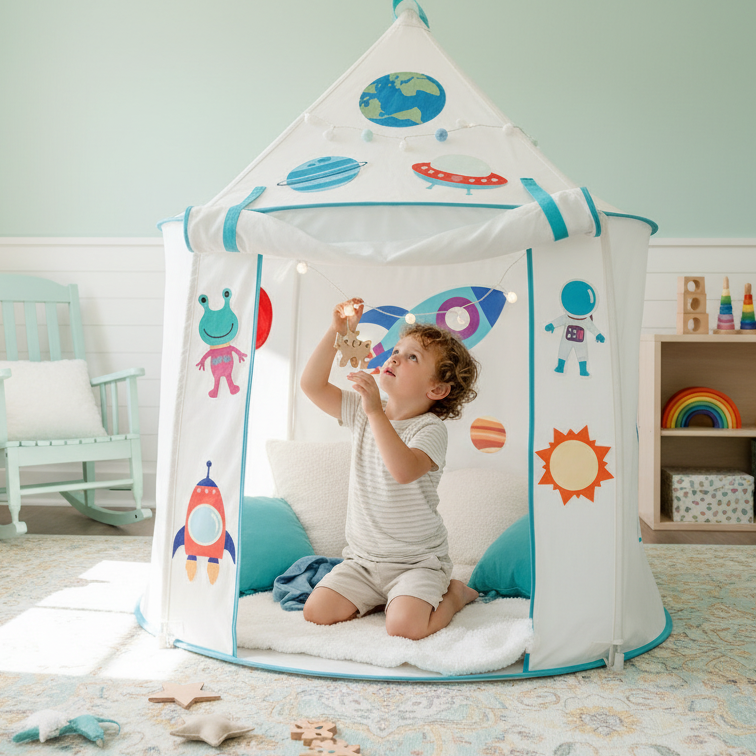
An adaptable play environment can give children a familiar setting in which their ideas change and develop. ZeeZee Adventures uses a customizable play tent and changeable StickeeZ themes to let children transform a familiar space for different imaginative adventures.
The broader lesson is not about any particular product. It is about giving children room to make choices, explore their interests, and experience the satisfaction of creating something of their own.
Some children will enjoy showing adults everything they make. Others may prefer to play privately or share only part of the experience. Respecting those differences helps keep play enjoyable rather than turning every activity into a performance for approval.
Try this: Show genuine curiosity about your child's process. Let them decide whether they want to explain their creation, invite you into the game, or simply continue playing.

8. Help Children Find Their Own Reasons to Feel Proud
External recognition can be enjoyable. Stickers, certificates, trophies, praise, and applause can all make an achievement feel special.
But children can also learn to notice how an experience felt to them personally.
After completing a challenging activity, you might ask:
“Which part are you happiest with?”
“What are you proud of?”
“Is there something you understand better now?”
These questions help children reflect on their own experience rather than relying entirely on someone else's judgment.
Not every child will answer immediately. Some may find it easier to talk about what happened than to explain how they feel about it. Others may not want to discuss the experience at all.
There is no need to turn reflection into another task they must complete correctly.
You can also avoid insisting that children should always feel proud of their efforts. Sometimes they will feel disappointed, dissatisfied, or ready to move on. Those feelings deserve space, too.
The aim is to make room for children to recognize their own learning and preferences without needing every experience to be validated by an award or an adult's approval.
Try this: Occasionally ask what your child enjoyed, learned, or would like to explore further. Accept their answer, even if it differs from what you expected them to value.
Celebrating Effort Means Broadening the Meaning of Success
Children will win some races, lose some games, complete some projects, and abandon others halfway through. They will have days when they feel proud and days when they wish they had done things differently.
We don't need to remove competition from childhood or celebrate every attempt as though it were a major achievement. Children can learn to handle disappointment while still enjoying the excitement of winning.
What matters is the broader message they receive from us.
Success can include learning a new skill, changing a strategy, asking for help, cooperating with others, making something original, or recognizing when a break is needed.
When we notice these parts of children's experiences, we give them more ways to understand their own progress.
The next time your child tells you about a game, a test, a drawing, or a difficult task, you can celebrate the outcome if it matters to them. Then make room for the rest of the story.
Ask what they enjoyed. Notice what they tried. Listen to what they found difficult.
Because childhood is not one long competition, and growing up is not about winning every time.
It's about discovering what interests you, learning what you can do, finding ways through challenges, and understanding that your value is never determined by coming first.






Comment (0)