
Easy Toddler Activities Using Everyday Household Items
You don't need another trip to the toy shop. Look around your home, and you may already have everything you need for meaningful, screen-free toddler play.
Introduction
Toddlers don't need elaborate toys to learn.
Give them a cardboard box, and it can become a house. Give them a few cups, and they can spend ages stacking, filling, and emptying them. A kitchen towel can become a cape, a blanket can become a den, and a laundry basket can become a boat.
For toddlers, the value of an object often comes from what they can do with it, not what it was originally designed for.
This is one of the simplest ways to make everyday life more playful.
Instead of constantly buying new activities or searching for complicated craft ideas, look around your home. Ordinary household objects can offer opportunities to practise coordination, language, problem-solving, creativity, sensory exploration and early independence.
And because these objects are familiar, they can be especially useful when you're looking for something to do right now.
Quick Answer
Some of the easiest toddler activities use everyday items such as cardboard boxes, plastic cups, paper, towels, laundry baskets, wooden spoons, and containers. These objects can be used for stacking, sorting, transferring, pretend play, drawing, building, sensory exploration, and simple problem-solving. Always choose age-appropriate objects, avoid choking hazards, and supervise activities whenever necessary.

Why Everyday Objects Can Be Great for Toddler Play
A toy usually has an obvious purpose.
A saucepan is for cooking.
A cardboard box is for packaging.
A laundry basket is for clothes.
A wooden spoon is for stirring.
But toddlers don't necessarily see objects in the same way adults do.
A box can become a car.
A spoon can become a microphone.
A basket can become a boat.
A towel can become a superhero cape.
That freedom is useful because it encourages children to decide what an object could become.
This is at the heart of open-ended play.
The object provides the starting point.
The child supplies the idea.
Before You Begin: A Quick Safety Note
Everyday household items are not automatically toddler-safe.
Choose objects based on your child's age, abilities, and developmental stage.
Avoid small objects that could present a choking risk, sharp or breakable materials, hot items, electrical equipment, chemicals, medicines, and anything with loose parts that could be swallowed.
Activities involving water should be supervised, and toddlers should never be left alone around water, even in small quantities.
When in doubt, choose a larger, simpler, and safer alternative.
The goal is playful exploration, not creating unnecessary risk.
1. Build a Cardboard Box House
You don't need to decorate it.
Place a large cardboard box in a safe area and let your toddler explore.
They might climb around it, put toys inside, or pretend it is a house.
Learning through play: spatial awareness, imagination, movement, and pretend play.
2. Cup Stacking
Give your toddler several sturdy, age-appropriate plastic cups.
Let them stack them.
Then knock them down.
And start again.
Learning through play: coordination, balance, concentration, and cause and effect.
3. Container Transfer Game
Place a few large, safe household objects in one container.
Give your toddler another container and let them move the objects between them.
Learning through play: hand-eye coordination, concentration, and early problem-solving.
4. Kitchen Towel Cape
Give your child a clean, lightweight towel or piece of fabric and let their imagination take over.
Today it might be a superhero cape.
Tomorrow it could become part of a pretend picnic.
Learning through play: imaginative play, movement, and storytelling.
Always supervise and avoid anything that could create a strangulation or tripping hazard.
5. Paper Scrunching
Give your toddler sheets of scrap paper and let them tear, scrunch, and flatten them.
Learning through play: hand strength, fine motor control, and sensory exploration.
Use appropriate paper and supervise younger toddlers closely.
6. Make a Paper Collage
Give your toddler larger pieces of paper and a sheet to stick them onto using an age-appropriate adhesive.
Let them choose where each piece goes.
Learning through play: creativity, decision-making, and fine motor skills.
7. Wooden Spoon Orchestra
Give your toddler suitable wooden kitchen utensils and let them explore different sounds using safe surfaces.
Tap.
Tap.
Tap.
Then create a rhythm together.
Learning through play: rhythm, listening, coordination, and cause and effect.
Keep breakable and sharp kitchen items away.
8. The Laundry Basket Boat
Turn an empty laundry basket into an imaginary boat.
Ask your toddler where they're going.
The beach?
The jungle?
The moon?
Learning through play: imagination, language, and storytelling.
Keep the basket on a stable surface and supervise.
9. Sock Matching
After doing laundry, give your toddler a small selection of clean socks.
Invite them to find matching pairs.
Learning through play: visual discrimination, matching, and early categorisation.
10. Make a Sock Puppet
Use a clean sock to create a simple pretend character.
Your toddler can give it a name and decide what it likes to do.
Learning through play: language, imagination and social-emotional expression.
Avoid buttons, beads or other small decorations that could become choking hazards.
Everyday Kitchen Play
The kitchen can provide countless learning opportunities, provided children are kept away from hot surfaces, sharp objects, cleaning products and other hazards.
You can give toddlers safe, simple tasks that allow them to participate without turning the activity into a formal lesson.
11. Wash Fruit
Give your toddler a suitable piece of fruit and let them help rinse it under supervision.
Talk about its colour, shape, and texture.
Learning through play: sensory exploration, vocabulary and practical life skills.
12. Stir a Pretend Soup
Use a large bowl and safe, dry household ingredients for pretend play.
Your toddler can "cook" their own soup.
Learning through play: imagination, language, and sequencing.
13. Sort Kitchen Items
Give your toddler a few large, safe objects such as plastic cups and containers.
Invite them to group similar objects together.
Learning through play: categorisation, visual discrimination and problem-solving.
14. Pouring Practice
Using a small amount of water and suitable containers, allow your toddler to pour from one container into another.
Learning through play: coordination, concentration and cause and effect.
Supervise closely around water.
15. Find the Matching Container
Place a few suitable containers together.
Give your toddler several large objects and let them discover which ones fit inside.
Learning through play: spatial reasoning, experimentation, and problem-solving.
Paper, Cardboard and Creativity
Paper and cardboard are wonderfully flexible materials.
They can become art.
Games.
Maps.
Houses.
Signs.
Books.
Or almost anything else your toddler imagines.
16. Cardboard Tube Telescope
Give your child a clean cardboard tube and let them pretend it is a telescope.
What can they see?
A bird?
A dinosaur?
A rocket?
Learning through play: imagination, observation, and language.
17. Make a Cardboard Road
Use strips of cardboard or paper to create roads for toy vehicles.
Your toddler can decide where the roads go.
Learning through play: spatial awareness, creativity and pretend play.
18. Draw a Treasure Map
Draw a very simple map together.
Add a few familiar objects or symbols.
Then let your toddler follow it.
Learning through play: language, memory, spatial awareness, and imagination.
19. Make a Mini Book
Fold several sheets of paper together and create a simple homemade book.
Your toddler can draw pictures.
You can write down their words.
Learning through play: storytelling, early literacy, and creativity.
20. Cardboard Box Decorating
Give your toddler crayons or other age-appropriate art materials and a large cardboard box.
Let them decorate it.
The box can later become part of their pretend play.
Learning through play: creativity, coordination, and imaginative thinking.
Simple Sensory Activities
Sensory play doesn't need expensive materials.
Everyday objects can provide interesting textures, sounds, and movements.
The key is choosing materials that are safe for your child.
21. Texture Hunt
Walk around your home together and find safe objects that feel different.
Soft.
Smooth.
Hard.
Bumpy.
Talk about the differences.
Learning through play: sensory awareness, observation and vocabulary.
22. Fabric Basket
Place several safe pieces of fabric with different textures into a basket.
Let your toddler touch and compare them.
Learning through play: tactile exploration and descriptive language.
23. Ice Exploration
On a warm day, allow your toddler to explore ice in a suitable container under close supervision.
Talk about what happens as it melts.
Learning through play: sensory exploration, observation, and cause and effect.
24. Water and Sponge Play
Give your toddler a sponge and a shallow container of water.
Let them squeeze the sponge and watch the water move.
Learning through play: hand strength, coordination, and cause and effect.
25. Sound Hunt
Listen carefully around the home.
What can you hear?
A clock?
Birds?
Water?
A door?
Ask your toddler to identify different sounds.
Learning through play: listening, attention, and environmental awareness.
Movement Activities Using Household Items
You don't need specialist equipment to get toddlers moving.
Your home can provide plenty of opportunities for safe movement.
26. Cushion Path
Arrange cushions on the floor to create a simple path.
Your toddler can walk around or over them.
Learning through play: balance, coordination, and body awareness.
27. Laundry Basket Push
If your basket is safe and stable, your toddler can push it across an appropriate surface.
Learning through play: gross motor development, coordination and movement.
Stay close and make sure the basket cannot tip or trap your child.
28. Pillow Mountain
Create a soft pile of cushions or pillows and let your toddler climb over them with close supervision.
Learning through play: balance, movement and spatial awareness.
29. Sock Toss
Roll clean socks into soft balls.
Place a suitable container nearby.
Can your toddler throw the socks inside?
Learning through play: hand-eye coordination, aiming and movement.
30. Follow the Tape
Use removable tape to create a simple line on a suitable floor.
Ask your toddler to walk along it.
Learning through play: balance, coordination and concentration.
Remove the tape afterwards to prevent slips or damage.
Pretend Play With Everyday Objects
Pretend play doesn't require a complete toy kitchen or elaborate costume box.
Children can transform ordinary objects into almost anything.
31. Make a Pretend Restaurant
Use safe household objects as plates, cups, and pretend food.
Let your toddler decide what is on the menu.
Learning through play: language, imagination and social skills.
32. Create a Laundry Shop
A basket of clean clothes can become a pretend shop.
Your toddler can sort, "sell" or organise them.
Learning through play: language, categorisation and imaginative play.
33. Cardboard Box Car
Sit inside or behind a large cardboard box and pretend it is a car.
Where are you going?
Learning through play: imagination, language and storytelling.
34. Make a Cosy Den
Use blankets and cushions to create a small den.
Add some books or favourite soft toys.
Learning through play: imagination, emotional comfort and independent exploration.
35. Household Object Storytelling
Place several safe household objects together.
Then invent a story that connects them.
A spoon could become a microphone.
A box could become a house.
A towel could become a superhero cape.
Learning through play: language, creativity and symbolic thinking.
Early Independence Through Everyday Tasks
Some of the most meaningful toddler activities involve helping with real life.
These experiences allow children to practise useful skills while feeling involved in family routines.
36. Put Clothes in the Basket
Give your toddler a simple job during laundry.
Ask them to place suitable clothing into the basket.
Learning through play: coordination, responsibility and sequencing.
37. Wipe the Table
Give your toddler a clean, damp cloth and let them help wipe a safe surface.
Learning through play: practical life skills, coordination and independence.
38. Carry Napkins to the Table
Give your toddler a small stack of napkins to place on the table.
Learning through play: responsibility, coordination and participation.
39. Tidy the Toy Basket
Make toy storage accessible.
Ask your toddler to return a few toys to their basket.
Learning through play: organisation, categorisation and independence.
40. Choose and Create
This may be the simplest activity of all.
Place a small selection of safe household objects in an accessible space.
Don't tell your toddler what to make.
Let them choose.
A box.
A towel.
Some paper.
A few cups.
Then wait.
You may be surprised by what happens.
Learning through play: decision-making, creativity, imagination, and independent exploration.
You Don't Need to Make Every Activity Educational
This is worth remembering.
Parents can easily feel pressure to explain the learning behind every activity.
You don't have to.
If your toddler spends ten minutes putting cups inside one another, let them.
If they repeatedly open and close a box, observe.
If a cardboard tube becomes a telescope, join their world.
Play does not need a learning objective to be valuable.
Children learn because they are curious.
Our role is often to give that curiosity somewhere safe to go.
How to Encourage More Independent Exploration
Everyday household objects can be particularly useful for independent play because they are familiar.
Start with activities your toddler already understands.
Keep the materials accessible.
Stay nearby.
Then give them time.
Try not to demonstrate everything.
Instead of saying:
"This is how you use the cups."
You could simply place them nearby and say:
"I wonder what you could do with these."
Then let your child experiment.
Create an "Everyday Play Basket"
You can make this even easier by creating a small basket of safe, age-appropriate household materials.
It might contain:
-
Large cardboard tubes.
-
Fabric pieces.
-
Paper.
-
Large plastic cups.
-
Clean containers.
-
Wooden kitchen utensils.
-
Cardboard pieces.
-
Safe household objects that can be sorted or stacked.
Rotate the contents occasionally.
The basket doesn't need to contain toys.
It simply provides materials for imagination.
Always check objects regularly for damage and remove anything that becomes unsafe.
The ZeeZee Adventures Connection
Sometimes children need more than materials.
They need a place where those materials can become part of their own world.
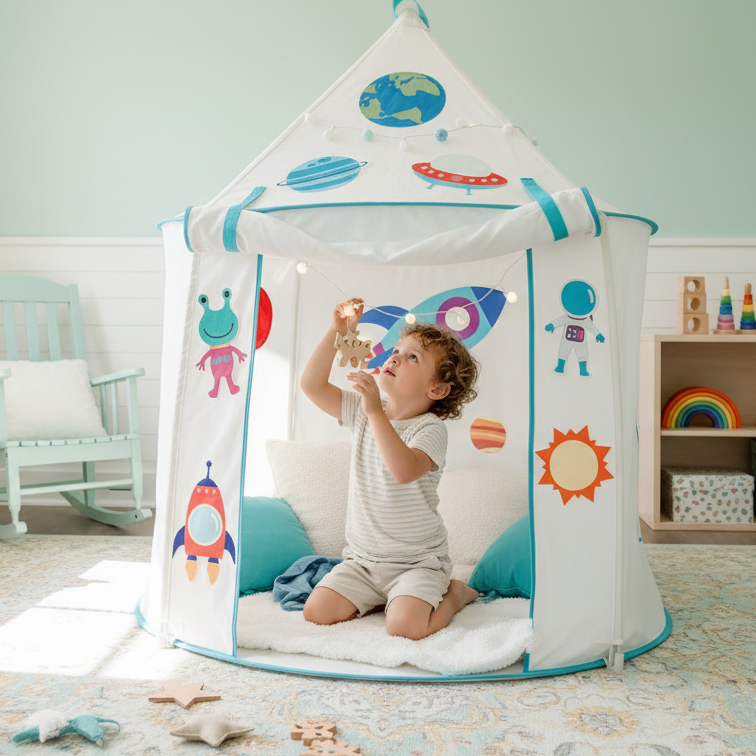
The ZeeZee Adventure Tent provides a dedicated, sensory-friendly space for children to read, imagine, and explore away from screens.
A child can bring books inside.
Soft toys.
Building materials.
Household objects.
Pretend-play props.
The tent itself can then become part of the story.
With interchangeable StickeeZ themes, the same familiar environment can take on different imaginative identities.
One day, it might be a jungle.
Another day, a castle.
Another day, a quiet reading retreat.
The environment stays familiar.
The story changes.
And the child remains in charge of the adventure.

A Final Reminder
You don't need to buy something new every time your toddler says:
"I'm bored."
Look around.
There may already be an activity hiding in your home.
A cardboard box can become a spaceship.
A basket can become a boat.
A towel can become a cape.
A few cups can become a tower.
A pile of socks can become a matching game.
A piece of paper can become an entire story.
The most valuable part isn't the household object itself.
It's what your child does with it.
When children are given safe materials, time, and freedom to explore, ordinary moments can become extraordinary opportunities for learning.
And sometimes, the simplest activities are the ones children remember.
More Simple Ways to Turn Everyday Objects Into Learning Through Play
You don't need a cupboard full of craft supplies to create meaningful play for a toddler.
In fact, some of the most engaging activities can begin with things you already use every day.
A bowl can become a sorting tray.
A towel can become a costume.
A cardboard tube can become a telescope.
A few containers can become a problem-solving challenge.
The beauty of using everyday household objects is that they are familiar, flexible, and easy to adapt. They also give children plenty of opportunities to make choices and take an activity in their own direction.
The activities below continue our list with more ideas for sensory exploration, language, creativity, movement, problem-solving and independence.
As always, choose materials appropriate for your child's age and abilities. Avoid small objects that could be choking hazards, sharp items, breakable materials, hot objects, chemicals, and anything else that could pose a risk. Supervise activities whenever necessary, especially activities involving water.
Sensory Activities Using Everyday Objects
Toddlers are constantly gathering information through their senses.
They feel textures.
Notice sounds.
Watch objects move.
Explore weight and shape.
Everyday household materials can give them plenty of opportunities to do this naturally.
16. Mystery Texture Bag
Place several large, safe household objects with different textures into a fabric bag.
Let your toddler reach inside and explore one object at a time.
Ask simple questions such as:
"Does it feel soft or hard?"
"Is it smooth?"
"What do you think it is?"
Learning through play: tactile awareness, vocabulary, observation, and curiosity.
Keep the objects large enough to avoid choking risks.
17. Kitchen Sponge Squeeze
Give your toddler a clean sponge and a shallow container of water.
Let them dip the sponge in the water and squeeze it.
Watch what happens.
The sponge fills.
Then the water comes out.
Learning through play: hand strength, coordination, sensory exploration, and cause and effect.
Always supervise closely around water.
18. Cold and Warm Exploration
Offer two safe containers containing water at noticeably different but comfortable temperatures.
Let your child explore them with their hands while you talk about the difference.
Learning through play: sensory awareness and descriptive language.
The water should always be comfortably safe to touch. Never use hot water.
19. Fabric Discovery
Collect several safe fabric pieces from around the house.
A cotton cloth.
A soft towel.
A piece of fleece.
A smooth scarf.
Let your toddler touch and compare them.
Learning through play: tactile exploration, comparison, and vocabulary.
20. Listen and Find
Choose a safe household object that makes a recognisable sound.
Shake a container containing larger safe materials.
Tap a wooden spoon gently on a suitable surface.
Then ask your toddler to identify where the sound came from.
Learning through play: listening, attention, memory and cause and effect.
Fine Motor Activities
Toddlers develop hand control through repeated everyday movements.
Picking something up.
Putting something down.
Turning.
Pulling.
Pushing.
Squeezing.
These activities can help make those movements playful.
21. Paper Ball Toss
Give your toddler pieces of paper that can safely be scrunched into soft balls.
Place a large container nearby.
Can they throw the paper balls inside?
Learning through play: hand-eye coordination, aiming, and movement.
22. Tear and Create
Give your toddler suitable pieces of paper.
Let them tear them into smaller pieces.
You can then use the pieces to create a simple collage together.
Learning through play: finger strength, coordination and creativity.
23. Open and Close
Provide a few safe household containers with simple lids that your toddler can manage.
Let them practise opening and closing them.
Learning through play: fine motor control, problem-solving and coordination.
Avoid containers with small removable components.
24. Big Spoon Transfer
Place large, safe objects in a bowl.
Give your toddler a suitable large spoon and another container.
Invite them to transfer the objects.
Learning through play: hand control, concentration, and coordination.
25. Peg Practice
If your child is developmentally ready, offer large, child-safe pegs and a suitable container or piece of fabric.
Let them experiment with attaching and removing them.
Learning through play: finger strength, coordination, and concentration.
Language and Communication Activities
Everyday play can become a natural conversation.
You don't need to ask your toddler questions constantly.
Simply describe what you see.
Add new words.
Pause and listen.
Follow their ideas.
26. Household Object Naming Game
Place several familiar objects together.
Ask your toddler to identify them.
Then add descriptive words.
"This is a big spoon."
"This cup is blue."
Learning through play: vocabulary, listening, and language development.
27. What Am I Holding?
Hide a familiar household object behind your back.
Give your toddler clues.
"It's something we use at dinner."
See if they can guess.
Learning through play: vocabulary, memory, and reasoning.
28. Make Up a Story
Choose three everyday objects.
Perhaps a spoon, a box and a towel.
Create a simple story that connects them.
Then ask your toddler what happens next.
Learning through play: imagination, sequencing, and language.
29. Action Words
Use everyday actions to introduce verbs.
Pour.
Push.
Pull.
Open.
Close.
Wash.
Carry.
Let your toddler copy you.
Learning through play: vocabulary, comprehension, and movement.
30. "Where Is It?"
Hide a familiar object somewhere safe.
Use simple positional words to help your toddler find it.
"It's under the chair."
"It's beside the basket."
Learning through play: language, memory, and spatial awareness.
Creative Play With Household Materials
Creativity is not about producing a perfect craft.
For toddlers, the process is more important than the final result.
Let them choose.
Let them experiment.
Let them make something completely different from what you expected.
31. Cardboard Stamp Art
Cutting cardboard can involve sharp tools, so prepare the materials yourself.
Give your toddler suitable cardboard shapes and washable paint.
Let them create prints.
Learning through play: creativity, pattern recognition, and coordination.
32. Homemade Shaker
Use a securely sealed container filled with appropriate large materials that cannot be accessed by your child.
Let your toddler shake it and listen to the sound.
Learning through play: rhythm, sound exploration, and cause and effect.
Make sure the container is securely closed and inspect it regularly.
33. Paper Plate Face
Use a paper plate as the base for a simple face.
Your toddler can add age-appropriate drawing materials.
"Where should the eyes go?"
Learning through play: creativity, body awareness, and language.
34. Cardboard Character
Give your toddler a cardboard shape and let them turn it into a person, animal or imaginary creature.
Learning through play: imagination, drawing and storytelling.
35. Create a Homemade Book
Fold several sheets of paper together.
Your toddler can draw on each page while you write down their words.
The result becomes a story created together.
Learning through play: early literacy, language, sequencing and creativity.
Movement Activities Around the Home
Toddlers learn through movement as much as through quiet exploration.
Simple household objects can turn a living room into an opportunity to practise balance, coordination and body awareness.
36. Pillow Path
Place cushions on the floor to create a safe route.
Your toddler can step from one to another.
Learning through play: balance, coordination and body awareness.
Use stable cushions and supervise closely.
37. Sock Basketball
Roll clean socks into soft balls.
Place a laundry basket a short distance away.
Let your toddler throw the socks inside.
Learning through play: aiming, hand-eye coordination, and gross motor skills.
38. Follow the Line
Use removable tape to create a simple line on an appropriate floor.
Ask your toddler to walk along it.
Try walking forwards, backwards, or slowly.
Learning through play: balance, coordination and concentration.
Remove the tape afterwards to prevent slips or floor damage.
39. Laundry Basket Push
If your laundry basket is stable and suitable, let your toddler push it across a clear, safe surface.
You can place a soft toy inside and pretend you are taking it somewhere.
Learning through play: movement, coordination, imaginative play, and spatial awareness.
Stay close and ensure the basket cannot tip over.
40. Animal Movement Game
Choose different animals and copy the way they move.
Stomp like an elephant.
Waddle like a penguin.
Crawl like a bear.
Hop like a rabbit.
Learning through play: gross motor development, imitation, language, and imagination.
Problem-Solving With Everyday Objects
One of the easiest ways to support problem-solving is to resist solving everything for your child.
Give them a manageable challenge.
Then wait.
They might try one solution.
Then another.
That process is the learning.
41. Which Container Fits?
Give your toddler several suitable containers and larger household objects.
Let them experiment with what fits where.
Learning through play: spatial reasoning, comparison, and problem-solving.
42. Build a Bridge
Use cardboard pieces or suitable blocks to create a bridge for toy animals or vehicles.
Ask:
"How can we get the car across?"
Learning through play: planning, balance, construction and problem-solving.
43. The Missing Object
Place three or four familiar objects together.
Let your toddler study them.
Then remove one.
Ask what has disappeared.
Learning through play: memory, attention and observation.
44. Make It Fit
Give your toddler a large cardboard box and several safe objects.
Can they work out what can go inside?
What needs to be turned?
What doesn't fit?
Learning through play: spatial awareness, experimentation, and reasoning.
45. Build a Tower Challenge
Give your toddler different-sized blocks or suitable household containers.
Ask them to make the tallest tower they can.
Learning through play: balance, sequencing, spatial reasoning and persistence.
Pretend Play With Everyday Items
Toddlers love transforming ordinary objects.
And pretend play can support much more than imagination.
It can provide opportunities for language, social understanding, sequencing, and emotional expression.
46. Pretend Picnic
Use a clean towel as a picnic blanket.
Add safe pretend food or suitable household objects.
Let your toddler organise the picnic.
Learning through play: language, sequencing and imaginative play.
47. Make a Pretend Phone
A safe, unused object can become a pretend phone.
Who are you calling?
Grandma?
A friend?
A superhero?
Learning through play: communication, imagination, and social understanding.
48. Cardboard Box Train
Arrange boxes or create a simple pretend train using safe materials.
Your toddler can decide where the train is going.
Learning through play: imagination, language and storytelling.
49. Teddy's Bedtime
Use a towel or small blanket to create a bed for a soft toy.
Let your toddler put Teddy to sleep.
Learning through play: empathy, sequencing and imaginative play.
50. Household Treasure Hunt
Choose a few familiar objects and hide them in safe locations.
Give your toddler simple clues.
Learning through play: memory, language, movement and problem-solving.
Everyday Activities That Encourage Independence
Some of the most meaningful learning happens when toddlers participate in genuine household routines.
It may take longer.
It may not be perfect.
But that's okay.
They are practising.
51. Fold Small Towels
Give your toddler a few small towels and demonstrate how to fold them.
Let them have a go.
Learning through play: coordination, sequencing and independence.
52. Put Clothes in Drawers
Give your toddler a simple job during laundry.
They can place suitable clothes into a drawer or basket.
Learning through play: categorisation, responsibility and practical life skills.
53. Help Prepare a Snack
With appropriate supervision, let your toddler participate in a simple food-preparation task that is safe for their age.
Learning through play: practical skills, sequencing and independence.
54. Wipe a Safe Surface
Give your toddler a clean, damp cloth and allow them to wipe a suitable surface.
Learning through play: coordination, responsibility and practical life skills.
55. Put Books Away
Create an accessible place for books.
After reading, invite your toddler to return the book.
Learning through play: organisation, responsibility and independence.
How to Adapt Activities for Different Toddler Stages
Not every toddler will approach an activity in the same way.
A younger toddler may simply explore an object.
An older toddler may begin creating a game around it.
For younger toddlers, focus on:
-
Simple cause-and-effect activities.
-
Large objects.
-
Repetition.
-
Basic movement.
-
Sensory exploration.
-
Short activities.
For older toddlers, you can gradually introduce:
-
More complex sorting.
-
Simple problem-solving.
-
Longer pretend-play scenarios.
-
Multi-step activities.
-
More opportunities for independent choices.
The same household object can therefore support different levels of play.
A cardboard box can be explored by a younger toddler and transformed into a pretend house by an older one.
How to Encourage Independent Exploration
You don't need to disappear from the room.
Start by choosing an activity your toddler already understands.
Set out the materials.
Stay nearby.
Then wait.
Instead of immediately showing them what to do, allow them to experiment.
If they become stuck, offer a small hint.
If they are enjoying themselves, give them space.
Over time, these small experiences can help children become more comfortable initiating their own activities.
Don't Turn Every Activity Into a Lesson
There is a temptation to constantly ask questions.
"What colour is that?"
"How many are there?"
"What shape is this?"
"What comes next?"
Questions can be useful.
But children also need space to simply play.
Try mixing questions with observations.
Instead of asking:
"What colour is this?"
you could say:
"You've picked the yellow cup."
Instead of:
"How many blocks are there?"
try:
"Your tower is getting taller."
This keeps learning conversational rather than turning play into a test.
What to Grab When Your Toddler Says "I'm Bored"
You can create a simple mental list.
Grab a box.
Build something.
Grab some paper.
Draw something.
Grab a few cups.
Stack or pour.
Grab a towel.
Build a den.
Grab some socks.
Match or toss.
Grab a basket.
Create a pretend boat.
Grab some books.
Read or invent a story.
You don't need a new toy every time.
You may already have enough materials to create an entirely new adventure.
How ZeeZee Adventures Fits Into Everyday Play
Everyday objects become even more interesting when children have a dedicated environment in which to use their imagination.
The ZeeZee Adventure Tent is designed as a calm, sensory-friendly space where children can read, play, create, and explore away from screens.
A child can bring a few books inside.
Take building blocks into the tent.
Bring soft toys.
Create a pretend picnic.
Build a story around everyday objects.
The tent can become part of the play itself.
Its interchangeable StickeeZ themes also allow the familiar space to evolve with a child's imagination.
Today, it might be a jungle.
Tomorrow, a castle.
Another day, a cosy reading retreat.
The environment provides the setting.
The child creates the adventure.
A Simple "Everyday Play Basket"
If you want to make these activities easier to access, create a small basket of safe, age-appropriate household materials.
You could include:
-
Cardboard pieces.
-
Fabric scraps.
-
Large plastic cups.
-
Paper.
-
Clean containers.
-
Large cardboard tubes.
-
Wooden kitchen utensils.
-
Soft socks.
-
Safe household objects for sorting.
Keep the basket somewhere accessible.
When your toddler is looking for something to do, bring it out and let them explore.
You can introduce one idea if needed.
Then step back.
The goal is not to tell them exactly what to do.
It is to give them materials that can become something.
Final Thought
Children don't need a constant stream of new activities.
They need opportunities.
Opportunities to touch.
Move.
Build.
Pretend.
Ask questions.
Make mistakes.
Try again.
And sometimes, do absolutely nothing until an idea appears.
Look around your home.
You may find that the materials for meaningful play were already there.
The cardboard box.
The old towel.
The paper.
The cups.
The basket.
The socks.
None of them were designed specifically for toddler learning.
But in the hands of a curious child, almost anything can become the beginning of a story.
And perhaps that's the most beautiful part of learning through play.
The child doesn't need to know they're learning. They just need the freedom to explore.
Easy Toddler Activities Using Everyday Household Items
Part 3: Making Everyday Play More Meaningful
By now, you may have noticed something important.
You don't need a cupboard full of specialist toys to create meaningful experiences for your toddler.
A cardboard box can become a house.
A few cups can become a stacking challenge.
A towel can become a picnic blanket.
A laundry basket can become a boat.
And a simple piece of paper can become the beginning of an entire story.
The real value is not in the household object itself. It is in the opportunities the object creates for your child to explore, choose, experiment, and imagine.
In this final part, we'll look at how to get even more value from everyday play without making it complicated.
Let Your Toddler Take the Lead
One of the easiest ways to make an activity more meaningful is to stop trying to control the outcome.
You might give your toddler a cardboard box expecting them to build a house.
Instead, they put their favourite toy inside and announce that it is a hospital.
That's not a failed activity.
That's imagination.
Follow the idea.
Ask:
"Who is in the hospital?"
"What does the teddy need?"
"How can we help?"
Suddenly, a cardboard box has become a language activity, a pretend-play experience and a small problem-solving challenge.
The child created the direction.
You simply followed.
Don't Rush to Help
Toddlers are still developing confidence.
When something doesn't work, our instinct can be to fix it.
The tower falls.
We rebuild it.
The container doesn't fit.
We show them which one does.
The puzzle piece won't go in.
We turn it around.
Sometimes, however, it is worth waiting.
Give your child a few moments to experiment.
They may try a different approach.
They may discover the solution themselves.
And that moment of:
"I did it!"
can be more valuable than getting the answer immediately.
Use Everyday Play to Build Independence
Household activities are particularly useful because they can involve genuine responsibilities.
A toddler can help carry napkins.
Put clothes into a basket.
Wash fruit.
Wipe a safe surface.
Return books to a shelf.
Put toys away.
These may seem like ordinary chores to us.
To a toddler, they can be opportunities to practise being capable.
The task doesn't have to be perfect.
In fact, it probably won't be.
That's okay.
You're not looking for perfect laundry folding from a two-year-old.
You're giving them a chance to participate.
Turn Repetition Into a Learning Opportunity
Toddlers love repetition.
They may pour the same cup of water twenty times.
Stack the same blocks repeatedly.
Open and close the same container.
Read the same book every night.
It can be tempting to introduce something new.
But repetition has value.
Each attempt gives children another opportunity to practise a movement, notice a pattern or understand what happens next.
So if your toddler wants to do the same activity again and again, let them.
They may be learning more than it appears.
Make Activities Easier to Start
One reason children may struggle with independent play is that getting started feels difficult.
They have to find the materials.
Open the box.
Decide what to do.
Set everything up.
An accessible play environment removes some of those barriers.
Try keeping a small collection of safe materials together.
A basket of books.
A building basket.
A creative basket.
A pretend-play basket.
A household-object basket.
Your toddler can see the options and choose.
The less adult assistance needed to begin, the easier it becomes for children to take ownership of their play.
Create a "Boredom Basket"
This can be particularly useful on days when you hear:
"I'm bored."
Put together a basket containing simple, safe materials.
For example:
-
Large cardboard tubes
-
Paper
-
Fabric pieces
-
Large plastic cups
-
Cardboard
-
Clean containers
-
Soft socks
-
Wooden utensils suitable for play
You don't need to provide instructions.
Let your child explore.
You might occasionally suggest an idea, but allow them to decide what the objects become.
One day, the basket could become a pretend shop.
Another day, a construction site.
Another day, a spaceship.
Everyday Objects Can Support Different Types of Learning
One household object can support several areas of development at once.
Consider a cardboard box.
Your toddler can:
Climb around it
→ movement and coordination
Put objects inside
→ spatial awareness
Decorate it
→ creativity and fine motor skills
Pretend it is a house
→ imagination
Tell a story about it
→ language development
Decide what belongs inside
→ decision-making
This is why learning through play doesn't need to be separated into subjects.
Children naturally combine skills.
Don't Forget Outdoor Exploration
Your home isn't the only place filled with learning opportunities.
Step outside and ordinary surroundings become materials for discovery.
Leaves.
Stones.
Puddles.
Twigs.
Birds.
Clouds.
Flowers.
You can walk together and simply notice what is around you.
Try saying:
"I wonder where that leaf came from."
Or:
"That stone feels smooth."
Or:
"Can you hear that bird?"
You don't need to know every answer.
Being curious together is enough.
How to Make Everyday Play Screen-Free
If you're trying to create more screen-free moments, household activities can be an easy starting point.
Instead of reaching for a device when your toddler is restless, try offering something simple.
A box.
A book.
Some cups.
Paper and crayons.
A pretend-play basket.
A sensory activity.
A few cushions for building a den.
The activity doesn't have to compete with a screen by being louder or more stimulating.
It simply needs to offer your child something meaningful to do.
What If an Activity Doesn't Work?
It happens.
You prepare the activity.
Your toddler looks at it.
Walks away.
And starts playing with the box the materials came in.
Don't worry.
Children have their own interests and moods.
An activity that works brilliantly on Monday may be completely ignored on Tuesday.
That is normal.
Instead of asking:
"Why didn't they like this?"
try asking:
"What did they choose instead?"
Their choice may tell you what they are currently interested in.
Follow that.
How ZeeZee Adventures Can Extend Everyday Play
A dedicated play environment can give children a consistent place to use all these simple materials.
The ZeeZee Adventure Tent is designed as a calm, sensory-friendly space for reading, imaginative play, and independent exploration.
You can bring everyday objects inside and allow your child to transform the space.
A few cushions can become a mountain.
A cardboard box can become a spaceship.
Books can turn the tent into a reading retreat.
Soft toys can become characters in an adventure.
With interchangeable StickeeZ themes, the same familiar environment can also take on different imaginative settings.
The tent provides the space.
The household objects provide possibilities.
Your child's imagination connects everything together.
A Simple Daily Rhythm for Play
You don't need to schedule six activities every day.
A simple rhythm might look like this:
Morning
A practical activity.
Help wash fruit or put away clothes.
Afternoon
An open-ended activity.
Build with blocks, create with cardboard, or explore a sensory material.
Outdoor time
Take a walk and notice the environment.
Quiet time
Read a book or allow your child to explore a cosy play space.
That's enough.
Some days will look completely different.
That's okay too.
Five Questions to Ask When Your Toddler Is Bored
Before reaching for a screen or buying another toy, ask:
1. What do we already have?
Look around.
2. What is my child interested in today?
Follow their curiosity.
3. Can I turn an everyday object into a game?
A box, basket, towel, or cup may be enough.
4. Can I give them a small responsibility?
Children often enjoy meaningful participation.
5. Can I step back and let them decide?
Sometimes they need less direction, not more.
The Most Valuable Material Is Imagination
You can buy beautiful toys.
You can create elaborate sensory trays.
You can follow activity guides.
But none of those things are more important than giving your toddler the freedom to explore.
The cardboard box isn't magical.
The cup isn't magical.
The towel isn't magical.
Your child's imagination is.
Those everyday objects simply give that imagination something to work with.
Frequently Asked Questions
What household items are safe for toddler activities?
Large, sturdy, and age-appropriate objects such as cardboard boxes, paper, fabric, large plastic cups, clean containers, and suitable wooden utensils can often be useful. Avoid small objects, sharp items, breakable materials, hot objects, chemicals and anything that could create a choking or other safety hazard.
How can I entertain my toddler without buying toys?
Use objects you already have. Cardboard boxes, paper, towels, cups, containers, socks and baskets can become building materials, art supplies, pretend-play props or simple problem-solving activities.
Can household activities help toddler development?
Yes. Everyday play can provide opportunities to practise coordination, language, sensory awareness, problem-solving, creativity and early independence.
How can I encourage my toddler to play independently?
Start with familiar activities and accessible materials. Stay nearby, give your child time to explore and gradually reduce your involvement. Avoid expecting long periods of independent play immediately.
What should I do if my toddler loses interest?
Follow their lead. Toddlers naturally move between interests. You can put the activity away and try again another day.
Do I need educational toys for my toddler?
No. Children can learn through everyday experiences, household activities, outdoor exploration, books and open-ended play. The quality of the interaction matters more than whether an object is marketed as educational.
How can I create a screen-free play environment?
Keep a small selection of accessible books, building materials, creative supplies and imaginative-play resources available. A dedicated cosy space can also help children associate a particular area with quiet, screen-free exploration.




Comment (0)