
What Happens When Children Are Given Time to Experiment and Discover?
A child builds a tower with blocks. It falls. They try again, changing the position of two blocks. The tower stands a little longer before toppling over once more.
An adult watching might be tempted to show them the correct way to build it. After all, a wider base would probably help.
But what happens if we wait a moment instead?
The child might notice that the bottom blocks keep moving. They might try a different arrangement, ask for help, or abandon the tower and build a bridge instead. Each possibility creates a new direction for exploration.
Children learn through instruction, observation, conversation, and practice. They also learn by trying things, noticing what happens, and adjusting their ideas. When adults give them time to experiment, children have opportunities to become active participants in their own learning.
That doesn't mean leaving children to solve every problem alone. It means knowing when to step back, when to offer a helpful question, and when to provide the support they need to continue.
Why Experimentation Matters in Childhood
Experimentation is the process of trying an idea to see what happens. For a young child, it may be as simple as rolling a ball down a ramp, mixing two paint colors, or testing which blocks can support a toy.
Children are not necessarily following a formal scientific method. They may not make a prediction in words or explain their findings afterward. They are exploring relationships between actions and outcomes.
The National Association for the Education of Young Children describes how young children investigate their world by observing, asking questions, testing ideas, comparing results, and trying different approaches.
These experiences can provide opportunities to practice problem-solving, develop vocabulary, notice patterns, and connect new information with what a child already knows.
The process matters even when an experiment doesn't work as expected. An unsuccessful attempt can give a child something new to notice and another possibility to consider.
1. Children Learn to Connect Actions With Outcomes
When children experiment, they get to see what happens after they make a choice.
A child might roll a ball down two different ramps and notice that it travels farther on one. They might pour water between containers and discover that a narrow opening makes the task harder. They may build a tall structure and notice that it becomes less stable as it grows.
These observations help children explore cause-and-effect relationships.
Adults can support this process by asking simple questions:
-
“What happened when you tried that?”
-
“What do you notice?”
-
“What could we change?”
-
“Would you like to try it another way?”
There is no need to demand a detailed explanation. Sometimes, watching the child repeat an action or change their approach tells you that they are already investigating the result.
2. They Practice Problem-Solving
Experimentation gives children opportunities to encounter small challenges and explore possible solutions.
Imagine a child trying to build a bridge between two stacks of blocks. The middle keeps collapsing. They could add more blocks, change the distance between the stacks, or use a different piece as the bridge.
Each attempt gives them information about what might work.
Problem-solving develops through opportunities to think, act, notice, and adjust. Children may need adult guidance along the way, particularly when a task is unfamiliar or frustrating.
Instead of immediately solving the problem, try asking, “What have you tried so far?” or “Would you like a hint?”
This approach gives children room to contribute their own ideas while making support available when they need it.
3. Mistakes Become Useful Information
Children sometimes expect their first attempt to work. When it doesn't, they may feel disappointed, frustrated, or ready to give up.
Adults can help by changing how they talk about the experience.
Instead of saying, “You did it wrong,” try, “That didn't work the way we expected. What could we change?”
The aim isn't to pretend that every mistake feels good. It is to help children understand that an unsuccessful attempt can still provide useful information.
A paper airplane that falls quickly may need a different fold. A painting that turns muddy may reveal what happens when certain colors are mixed. A puzzle piece that doesn't fit may encourage a child to look more closely at its shape.
Children don't need to celebrate every mistake. They need room to experience frustration, receive support, and decide whether they want to try again.
4. Curiosity Becomes Something Children Can Act On
Curiosity often starts with a question: What happens if I put this here? Why does that move? Can these two things fit together?
Experimentation gives children a way to investigate those questions.
If a child wonders whether a toy car will travel farther on a smooth surface or a carpet, you can test the idea together. If they want to know what happens when colors mix, offer suitable paints and let them explore.
You don't need to provide a scientific explanation before every activity. Begin with what the child notices, then add information when it becomes useful.
If you don't know the answer, you can say so. Looking it up together or repeating an observation can become part of the discovery.
The important thing is that curiosity has somewhere to go beyond the question itself.
5. Children Discover That There Can Be More Than One Solution
Some problems have a clear answer. Others can be approached in many different ways.
A blanket fort might be built between two chairs or over a table. A cardboard box could become a car, a shop, or a house for stuffed animals. A drawing might change direction halfway through because the child has imagined something new.
When adults allow children to explore different possibilities, they make room for flexible thinking and creative problem-solving.
Try asking, “What else could we do with this?” or “Is there another way to make it work?”
Avoid insisting that a child return to the original plan simply because it was the first idea. Changing direction may be part of their exploration.
6. They Practice Persistence Without Being Forced to Continue
Experimentation often involves repeating an action, changing a detail, and trying again. These experiences can give children opportunities to practice persistence.
But persistence does not mean continuing indefinitely.
A child may need a break, a new idea, some adult assistance, or permission to stop. Repeated frustration without enough support can make an activity less productive rather than more educational.
Pay attention to how your child is responding. If they remain interested, offer time and encouragement. If they are becoming overwhelmed, simplify the challenge or pause.
You might say, “Would you like to take a break, try a different idea, or work on it together?”
The goal is to support a child's willingness to engage with challenges, not to turn every activity into a test of determination.
7. Experimentation Can Strengthen Communication
Children often need to describe what they are doing, explain an idea, or ask for a particular material during an experiment.
A child building a pretend machine might ask for another box, explain that a piece needs to move, or describe what the machine is supposed to do.
Adults can support this communication by naming actions, reflecting observations, and inviting children to explain their plans when they are ready.
For example: “You moved the bigger block to the bottom. Now the tower is standing. What would you like to add next?”
Children can communicate through words, gestures, demonstrations, drawings, and play. They don't need to give a formal explanation for an experiment to be meaningful.
8. Children Begin to Trust Their Own Ideas
When adults consistently take over, children may have fewer opportunities to test their own approaches. When adults offer time, attention, and appropriate support, children can experience themselves as contributors to the process.
This does not guarantee confidence or independence. Those develop through many experiences and relationships. But experimenting gives children opportunities to make decisions, observe outcomes, and discover what they can do with support.
An adult's response matters here.
“You found another way to make it stand” recognizes the child's process. “You must be the smartest builder” places more emphasis on an evaluation of the child.
Specific observations can help children notice their own strategies without suggesting that every activity needs praise or a perfect result.
9. Play Gives Discovery Room to Grow
Play is a natural setting for experimentation because children can change the materials, the rules, and the direction of an activity.
Blocks become a bridge-building challenge. Water play turns into an exploration of filling and pouring. Drawing becomes an experiment with lines, textures, and colors. Pretend play invites children to test ideas about characters, places, and imaginary problems.
The National Association for the Education of Young Children emphasizes the value of play that combines children's choices and exploration with thoughtful adult support. Adults can prepare an inviting environment, introduce useful materials, and offer questions without directing every move.
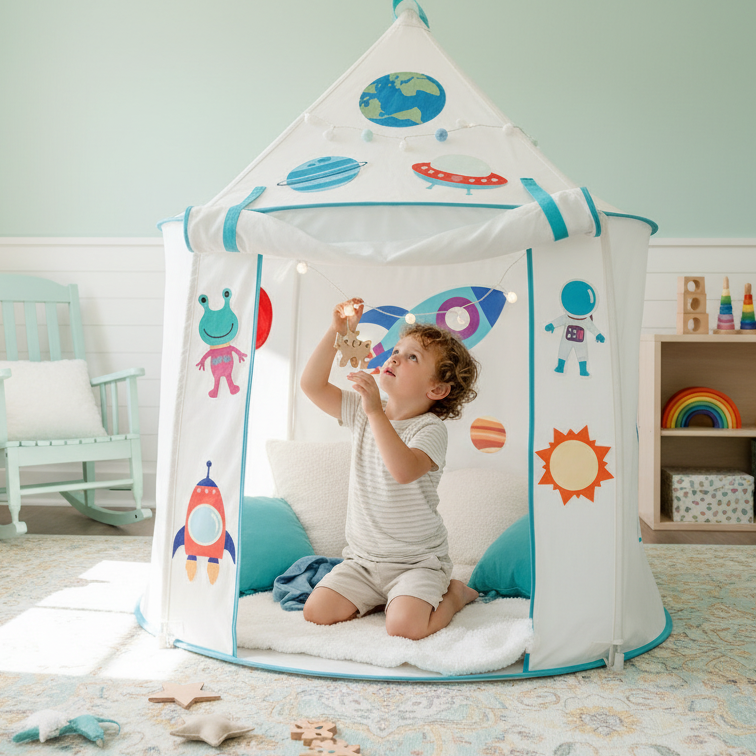
Families using ZeeZee Adventures can adapt a familiar play tent with different themes, creating new settings for stories, imaginative challenges, and child-led exploration. The same space can inspire different ideas as children's interests change.
The aim isn't to make every play session educational. It is to leave room for children to discover what their ideas can become.
10. Adults Learn When to Step In—and When to Wait
Giving children time to experiment doesn't mean adults should remain silent or avoid helping.
Sometimes a child needs a demonstration, a simpler starting point, or a clear explanation. Sometimes a task involves a safety concern that requires immediate adult intervention.
The challenge is recognizing when help will extend the child's exploration and when it will replace it.
Before stepping in, consider:
-
Is my child still interested in trying?
-
Can I offer a question or small hint instead of the solution?
-
Is the activity safe and appropriate?
-
Is frustration becoming too much for them to continue?
-
Would a short break help?
You might say, “I have an idea if you'd like a hint,” and let your child decide whether to accept it.
This kind of support respects a child's role in the process while recognizing that learning is not something children must do entirely alone.
Simple Ways to Encourage Experimentation at Home
You don't need a science kit or a dedicated playroom. Start with safe, everyday activities.
-
Build with blocks: Experiment with height, balance, bridges, and different bases.
-
Explore art materials: Mix colors, compare textures, and try different ways to make marks.
-
Test paper airplanes: Change one fold and observe how the flight changes.
-
Investigate water: With close supervision, explore filling, pouring, floating, and sinking using age-appropriate objects.
-
Create with cardboard: Build a vehicle, a house, or a structure that solves a pretend problem.
-
Cook together: Notice how ingredients change when stirred, chilled, or combined, with an adult managing heat and sharp tools.
-
Make a prediction: Ask what your child thinks will happen, try it safely, and compare the result.
-
Keep a discovery journal: Draw an experiment, describe what happened, or record an idea to try next time.
Follow your child's interests rather than completing every activity on a list. A few minutes of focused exploration can be enough to begin.
Frequently Asked Questions
Does experimentation help children learn?
Experimentation can give children opportunities to explore cause and effect, practice problem-solving, make observations, and test ideas. What they learn depends on the activity, their developmental stage, the support available, and their engagement.
Should parents let children make mistakes?
Yes, when it is safe and appropriate to do so. Mistakes can provide useful information, but children also need emotional support and guidance when they become frustrated.
What if my child gets upset when an experiment fails?
Acknowledge the frustration and offer choices. They may want help, a break, a simpler challenge, or an entirely different activity. Don't force them to continue.
Do children need special materials to experiment?
No. Blocks, paper, cardboard, safe household objects, art materials, and observations outdoors can all provide opportunities for exploration. Adult supervision is important when activities involve small objects, water, tools, heat, or other hazards.
How much should adults guide discovery?
Provide enough support to keep the activity safe, engaging, and manageable, while leaving room for the child to make decisions. Sometimes a question is enough; other times, a demonstration or direct instruction is more helpful.
Give the Process Time
A child experimenting with blocks may not build the tallest tower. A painting may not turn out as expected. A cardboard invention may never work the way its creator imagined.
Those outcomes don't automatically make the experience unsuccessful.
During experimentation, children have opportunities to observe, make decisions, encounter problems, revise ideas, and discover new possibilities. They also learn that they can ask for help, change direction, and take a break when they need one.
You don't have to plan a perfect discovery activity. Offer safe materials, allow enough time, pay attention to what interests your child, and resist the urge to solve every problem immediately.
Sometimes the most useful thing an adult can do is stay nearby, remain curious, and give a child a little longer to find out what happens next.




Comment (0)