
Designing a Home That Encourages Independent Play (Room-by-Room Guide)
What Does a Home That Encourages Independent Play Look Like?
Quick Answer
Homes that support independent play are designed around children, not just for them. They make it easy for children to access materials, move freely, make choices, and use their imagination without waiting for adult permission or instructions.
Research Snapshot
Child development experts consistently recognize that children's environments influence how they learn and play. When children have access to predictable, organized, and flexible spaces, they're more likely to explore independently, remain engaged, and develop confidence in their own abilities.
The goal isn't to create a picture-perfect playroom.
It's to create a home that quietly invites exploration throughout the day.
Expert Tip
Walk through your home from your child's perspective.
Ask yourself:
-
Can they reach their favorite books?
-
Can they choose activities independently?
-
Are materials easy to put away?
-
Does the space invite imagination?
Small adjustments often make a bigger difference than expensive renovations.
Parent Script
Instead of saying:
"Wait until I get everything ready."
Try:
"You can choose where your adventure begins."
Giving children ownership over their environment encourages confidence from the very beginning.
Bottom Line
Independent play begins when children feel capable of making their own choices.
Why Environment Matters More Than Entertainment
Quick Answer
Children don't need constant entertainment to stay engaged. More often, they need environments that encourage curiosity, creativity, and self-directed exploration.
Research Snapshot
It's easy to assume that keeping children entertained requires buying new toys or planning more activities.
However, research in child development suggests something different.
Children learn best when they:
-
explore freely
-
solve their own problems
-
make meaningful choices
-
revisit ideas repeatedly
-
experience uninterrupted play
These opportunities depend as much on the environment as they do on the materials available.
Expert Tip
Before buying something new, ask yourself:
"Does my child need another toy—or a better opportunity to use their imagination?"
Often, changing the environment unlocks new ways to play with things your child already owns.
Example
Imagine two different play spaces.
Space A
-
Bright flashing toys
-
Dozens of activities available at once
-
Constant background television
-
Frequent interruptions
Space B
-
A comfortable reading corner
-
Building materials within easy reach
-
Dress-up clothes
-
Art supplies
-
Space to invent stories
Most children naturally stay engaged longer in environments that encourage creativity rather than constant stimulation.
Bottom Line
Children don't simply play with toys.
They play within environments.
Five Characteristics of an Independent Play Environment
Quick Answer
Independent play environments share several common characteristics regardless of the size of the home or the family's budget.
1. Accessible
Children should be able to reach materials independently.
Books on low shelves.
Art supplies in labeled containers.
Dress-up clothes within reach.
When children can access materials without asking for help, they're more likely to begin playing on their own.
2. Flexible
The same space should support many different kinds of play.
Today's reading nook.
Tomorrow's spaceship.
Next week's veterinary clinic.
Flexible spaces encourage imagination because they don't dictate how children should play.
3. Calm
Highly stimulating environments can make it difficult for children to concentrate.
Simple doesn't mean boring.
It means reducing unnecessary distractions so children's own ideas become the focus.
4. Safe
Children should feel confident exploring without constant reminders about what they shouldn't touch.
When appropriate boundaries are built into the environment, parents can spend less time saying "no" and more time observing creativity unfold.
5. Child-Led
Perhaps most importantly, independent play environments belong to the child.
Adults prepare the space.
Children decide how to use it.
That ownership strengthens confidence, curiosity, and intrinsic motivation.
Bottom Line
The best play environments don't control children's ideas.
They support them.
Why Some Homes Make Independent Play Difficult
Quick Answer
Most homes aren't intentionally designed to discourage play—but everyday habits and layouts can unintentionally make independent play harder.
Research Snapshot
Children are naturally curious.
When independent play doesn't happen, it's often because the environment creates unnecessary barriers rather than because children lack imagination.
Fortunately, many of these barriers can be changed with small, thoughtful adjustments.
Common Challenges
Too Much Visual Clutter
When everything is available all at once, children may struggle to decide where to begin.
Instead of engaging deeply with one activity, they often move quickly from toy to toy.
Materials Stored Out of Reach
If children must ask an adult every time they want to draw, build, or read, opportunities for spontaneous play become less frequent.
Easy access encourages independence.
Every Space Belongs to Adults
Sometimes children only have one designated area where they're "allowed" to play.
When imagination is welcomed throughout the home, creative opportunities naturally expand.
Constant Interruptions
Independent play takes time to develop.
Frequent interruptions—even well-intentioned ones—can disrupt storytelling, problem-solving, and concentration.
Children often benefit from uninterrupted periods where they're free to follow their own ideas.
Myth vs. Fact
|
Myth |
Fact |
|
Children need a large playroom to play independently. |
Small, thoughtfully designed spaces can be just as effective. |
|
More toys create more independent play. |
Open-ended environments often encourage longer engagement than overflowing toy collections. |
|
Independent play means children should always play alone. |
Independent play is about children directing the experience, even if an adult is nearby. |
|
A perfectly organized home is necessary. |
Consistency, accessibility, and flexibility matter far more than perfection. |
Expert Tip
Instead of redesigning your entire home, begin with one small area.
A single shelf.
A cozy corner.
A basket of open-ended materials.
Small changes often create lasting habits.
Parent Script
Instead of:
"Don't make a mess."
Try:
"I'm excited to see what you create."
This subtle shift communicates that exploration is welcome.
Bottom Line
Supporting independent play doesn't require a bigger home.
It starts with creating spaces where children feel trusted, capable, and inspired to explore.
Why Independent Play Is About More Than Keeping Children Busy
Quick Answer
Independent play isn't simply a way to occupy children while parents finish household tasks.
It's an opportunity for children to develop life skills they'll use for years to come.
Research Snapshot
When children direct their own play, they practice:
-
decision-making
-
planning
-
persistence
-
flexible thinking
-
emotional regulation
-
creativity
-
confidence
These experiences prepare children not only for school but also for everyday problem-solving and lifelong learning.
Expert Tip
Success isn't measured by how quietly your child plays.
It's measured by how confidently they explore, imagine, and solve problems independently.
Bottom Line
Independent play isn't about doing less for children.
It's about giving them more opportunities to discover what they're capable of.
The ZeeZee HOME Framework™: Designing Spaces That Inspire Independent Play
Creating a home that supports independent play doesn't require expensive renovations or an entire room dedicated to toys.
Instead, it begins with a simple mindset:
Design your home around curiosity instead of entertainment.
The ZeeZee HOME Framework™ helps parents create environments where children naturally explore, imagine, and build confidence through everyday play.

H — Honor Your Child's Interests
Quick Answer
The best play environments begin with observing your child rather than deciding what they should enjoy.
Research Snapshot
Children are naturally motivated to spend more time on activities that reflect their interests. When play environments are built around what fascinates them—whether that's animals, space, vehicles, nature, or storytelling—they're more likely to remain engaged and return to play independently.
Child-led play doesn't mean children direct every aspect of the home. It means adults pay attention to what repeatedly captures their curiosity.
Expert Tip
Spend one week simply observing.
Ask yourself:
-
What stories does my child tell most often?
-
Which toys do they return to repeatedly?
-
What books do they request?
-
What questions do they ask?
These observations provide valuable clues for designing a play environment they'll actually use.
Parent Script
Instead of saying:
"Today we're going to play with this."
Try:
"What are you interested in exploring today?"
Bottom Line
Children engage more deeply when the environment reflects their interests rather than adult expectations.
O — Offer Open-Ended Possibilities
Quick Answer
The most creative environments don't tell children what to do—they invite them to decide.
Research Snapshot
Open-ended materials support flexible thinking because they have no single purpose.
A basket containing:
-
blocks
-
fabric
-
recycled boxes
-
wooden figures
-
art materials
can become hundreds of different adventures depending on the child's imagination.
Unlike toys that perform for children, open-ended materials encourage children to become creators.
Expert Tip
Before buying something new, ask:
"Can this become ten different things?"
If the answer is yes, it will likely support creativity for much longer.
Bottom Line
The fewer rules an object has, the more possibilities it creates.
M — Make Spaces Flexible
Quick Answer
Flexible spaces grow with children's changing interests instead of requiring constant replacement.
Research Snapshot
Children rarely play the same way every day.
One week, they may love dinosaurs.
Next, they're fascinated by outer space.
A month later, they might spend hours pretending to run a bakery.
Flexible environments allow these interests to evolve naturally without needing an entirely new setup each time.
Expert Tip
Think beyond permanent themes.
Instead of decorating a room around one idea, create spaces that can easily transform alongside your child's imagination.
Example
The same corner can become:
-
a reading nook
-
a castle
-
a veterinary clinic
-
a rainforest
-
a pirate ship
-
a campsite
The environment stays.
The story changes.
Bottom Line
Flexible environments encourage long-term creativity because they evolve with the child.
E — Encourage Exploration
Quick Answer
Children become more independent when they feel safe exploring without constant correction.
Research Snapshot
Independent play develops through exploration, experimentation, and small problem-solving opportunities.
Children don't need adults to provide every answer.
They need adults who trust them enough to discover answers themselves.
Expert Tip
Allow children to rearrange materials, invent new rules, and change stories.
Creative confidence grows through ownership.
Parent Script
Instead of:
"That's not where it goes."
Try:
"Tell me about what you're creating."
Bottom Line
Children become explorers when adults become curious observers.
A Room-by-Room Guide to Encouraging Independent Play
Independent play doesn't belong in one room.
It can happen throughout the home when each space offers opportunities for exploration.
The Bedroom
Purpose
Rest, reading, imaginative play, and quiet creativity.
Ideas
-
Low bookshelf with rotating books
-
Dress-up basket
-
Sketchbook and crayons
-
Soft cushions
-
Stuffed animals for storytelling
The bedroom should feel like a peaceful place where children can quietly imagine, create, and recharge.
The Living Room
Purpose
Family connection and collaborative creativity.
Ideas
-
Basket of blocks
-
Puzzles
-
Board games
-
Art supplies
-
Building materials
Instead of hiding every toy, thoughtfully integrate a few open-ended materials into family spaces.
Children naturally enjoy playing where family life happens.
The Kitchen
Many parents overlook the kitchen.
Yet it's one of the richest places for symbolic play.
Children can pretend to:
-
cook meals
-
run a café
-
host dinner parties
-
explore measuring
-
organize ingredients
Simple household items often inspire remarkable creativity.
Outdoor Spaces
Nature encourages play that no toy can replicate.
Children can:
-
build forts
-
collect leaves
-
invent treasure hunts
-
create obstacle courses
-
Imagine magical forests
Natural environments constantly change, providing endless opportunities for exploration.
The Calm Corner
Every child benefits from a space where they can slow down.
A calm corner isn't a punishment area.
It's a place children can choose when they want to:
-
read
-
draw
-
build quietly
-
listen to stories
-
think
-
imagine
Simple lighting, comfortable seating, and accessible books or creative materials often work beautifully.
Why Symbolic Play Can Happen Anywhere
Quick Answer
Children don't need elaborate sets to engage in symbolic play.
They need permission to imagine.
Research Snapshot
Symbolic play happens when children transform ordinary objects into something entirely different.
Examples include:
A blanket becomes:
-
a superhero cape
-
a river
-
a magic carpet
A cardboard box becomes:
-
a castle
-
a train
-
a spaceship
A dining table becomes:
-
a cave
-
a bakery
-
a secret headquarters
The object isn't what's important.
The meaning children give it is.
Expert Tip
Rather than asking,
"What is that?"
Ask,
"Tell me about your world."
Children often reveal incredible creativity when adults show genuine curiosity.
Bottom Line
The entire home can become part of a child's imagination.
Why Adaptable Play Environments Inspire Longer Play
Quick Answer
Children's interests change constantly. Environments that can change with them often stay engaging much longer than spaces designed around a single theme or activity.
Research Snapshot
Many traditional toys are built around one storyline or one way of playing.
Once children understand how they work, the novelty may fade.
Adaptable play environments work differently.
Instead of telling children what to imagine, they provide a flexible setting that can support many different adventures over time.
This approach encourages children to revisit familiar spaces while continuously inventing new stories.
Expert Tip
Think of the environment as the stage—not the performance.
Children write the script.
Example
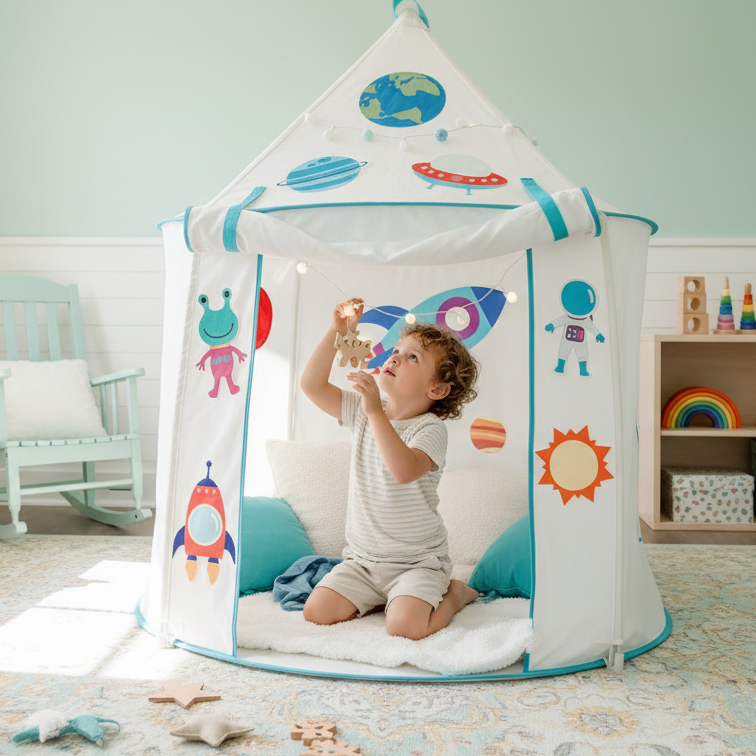
This philosophy is reflected in adaptable play environments such as those created by ZeeZee Adventures. Rather than centering play around a fixed design, the Adventure Tent is intended to evolve with children's interests through interchangeable StickeeZ themes. One day it might become a rainforest, the next a castle, a space station, or an underwater world. The goal isn't to provide every story—it's to create a flexible setting where children can imagine, role-play, build, read, and explore in ways that reflect their own ideas.
For many families, the same adaptable environment also becomes a cozy place for reading, storytelling, quiet reflection, or calming transitions throughout the day.
Common Mistakes When Designing Play Spaces
Mistake 1: Buying More Instead of Simplifying
More toys don't automatically create richer play.
Often, fewer carefully chosen materials inspire longer engagement.
Mistake 2: Designing for Adults Instead of Children
Beautiful spaces are wonderful—but if children can't reach books, art supplies, or building materials independently, creativity becomes dependent on adult assistance.
Mistake 3: Interrupting Deep Play
Children often become deeply immersed in imaginative worlds.
Whenever possible, allow these moments to continue without interruption.
Deep play supports concentration, storytelling, and creative thinking.
Mistake 4: Expecting Every Room to Stay Perfect
Homes that encourage independent play will sometimes look lived in.
A blanket fort in the living room or a cardboard spaceship in the hallway can be signs of meaningful engagement—not disorder.
Bottom Line
The most supportive homes aren't the ones with the most toys or the most carefully styled playrooms.
They're the homes where children feel trusted to explore, free to imagine, and confident enough to turn everyday spaces into extraordinary adventures.
When parents focus on creating adaptable environments instead of constantly adding new entertainment, independent play becomes something children choose—not something they're asked to do.
Frequently Asked Questions
1. What is independent play?
Independent play is child-led play where children choose their own activities, solve problems, and explore ideas without needing constant adult instruction. It doesn't mean children must play alone—it means they direct the experience while adults provide a safe, supportive environment.
Bottom Line: Independent play helps children become confident thinkers, problem-solvers, and creators.
2. At what age can children start independent play?
Independent play begins much earlier than many parents realize.
Even infants explore objects independently for short periods. As children grow, these moments naturally become longer and more complex.
General guide:
|
Age |
Typical Independent Play |
|
6–12 months |
A few minutes exploring objects |
|
1–2 years |
5–15 minutes |
|
2–4 years |
15–30 minutes |
|
4–6 years |
30–60 minutes |
|
6+ years |
Often 60 minutes or more, depending on interest |
Every child develops at their own pace.
3. Does my child need a dedicated playroom?
No.
One of the biggest misconceptions is that independent play requires a separate playroom.
Children benefit more from accessible, inviting spaces throughout the home than from one room filled with toys.
A reading corner, a basket of building materials, or a cozy imaginative space can be just as effective.
4. What if my child always says, "I'm bored"?
Boredom is often the bridge between passive entertainment and active imagination.
Instead of immediately providing an activity, allow your child time to think, experiment, and invent.
Many creative adventures begin after the first few minutes of boredom.
5. How can I encourage independent play without buying more toys?
Instead of purchasing new toys, try:
-
Rotating existing materials
-
Creating open-ended play invitations
-
Organizing books within easy reach
-
Using cardboard boxes and household items
-
Creating themed imaginative spaces
-
Encouraging storytelling
-
Providing uninterrupted play time
Creativity grows from possibilities—not possessions.
6. Why do some children struggle to play independently?
Several factors may make independent play more challenging, including:
-
Overscheduled routines
-
Constant entertainment
-
Highly stimulating environments
-
Too many toy choices
-
Frequent interruptions
-
Limited opportunities to make independent decisions
Fortunately, small environmental changes often make a significant difference over time.
7. What are signs my home supports independent play?
You may notice your child:
-
Starting play without being prompted
-
Returning to unfinished projects
-
Creating elaborate pretend worlds
-
Using everyday objects imaginatively
-
Staying engaged for longer periods
-
Solving small problems independently
-
Asking fewer questions about what to do next
These are strong indicators that your environment is encouraging child-led exploration.
8. What is an adaptable play environment?
An adaptable play environment is a space that evolves with a child's changing interests instead of being limited to one fixed activity or theme.
Rather than directing play, adaptable environments encourage children to imagine new stories, roles, and adventures over time.
This flexibility supports creativity, symbolic play, and long-term engagement.
9. Why is symbolic play important?
Symbolic play allows children to use one object or situation to represent another.
Examples include:
-
A chair becomes a race car.
-
A blanket becomes a river.
-
A cardboard box becomes a castle.
This type of play supports:
-
Language development
-
Creative thinking
-
Flexible problem-solving
-
Storytelling
-
Emotional expression
-
Social understanding
10. Do parents need to play with children all the time?
No.
Children benefit from meaningful interactions with adults, but they also need opportunities to explore independently.
Parents play an important role by preparing the environment, showing interest, and being emotionally available without directing every activity.
Sometimes the best support is simply observing while children lead the adventure.
Related Articles (Internal Linking Suggestions)
Strengthen your child's independent play journey with these articles from the ZeeZee Adventures Knowledge Hub:
-
How to Encourage More Creative Play at Home (Without Buying More Toys)
-
What Is Symbolic Play? A Parent's Complete Guide
-
Why Open-Ended Play Matters More Than Ever
-
Why Boredom Is Good for Children
-
How Independent Play Builds Executive Function
-
Designing Calm Spaces That Encourage Emotional Regulation
-
Screen-Free Activities That Inspire Creativity
-
Why Pretend Play Supports Emotional Expression
-
Creating Child-Led Play Environments at Home
-
How to Reduce Screen Time Without Power Struggles
These interconnected resources help build a comprehensive understanding of child-led play while strengthening topical authority across the ZeeZee Knowledge Hub.
About the Author
ZeeZee Adventures Editorial Team
The ZeeZee Adventures Knowledge Hub is developed by child development specialists, pediatric occupational therapy consultants, parenting educators, early childhood researchers, and content strategists committed to helping families create homes where imagination, independence, and meaningful play can flourish.
Our goal is to provide practical, evidence-informed guidance that empowers parents to nurture confident, creative, and curious children through everyday play experiences.
Continue the Adventure
Explore More Expert Parenting Resources
Discover practical, research-informed articles on independent play, symbolic play, imaginative learning, sensory-friendly environments, and child-led exploration in the ZeeZee Adventures Knowledge Hub.
Build Environments That Grow With Your Child
Children don't simply outgrow toys—they outgrow experiences that no longer challenge their imagination.
Adaptable play environments offer a different approach. By creating flexible spaces that can evolve alongside a child's changing interests, families can encourage longer-lasting imaginative play, storytelling, and independent exploration. ZeeZee Adventures embraces this philosophy through adaptable environments that can transform with interchangeable StickeeZ themes, giving children new opportunities to create their own worlds while returning to a familiar space.
Join the ZeeZee Community
Join parents, educators, and caregivers who are discovering practical ways to encourage independent play, creativity, and joyful childhood experiences through thoughtfully designed play environments.





Comment (0)