
How to Encourage More Creative Play at Home (Without Buying More Toys)
Quick Answer
Creative play doesn't require expensive toys or constant entertainment. Children develop richer imaginations when they have time, freedom, and an environment that encourages exploration. By reducing distractions, embracing boredom, supporting symbolic play, and creating opportunities for child-led discovery, parents can help creativity become a natural part of everyday life.
Key Takeaways
-
Creative play is a skill that grows with practice and opportunity.
-
Children often need less entertainment and more freedom to imagine.
-
Symbolic play helps children express emotions, solve problems, and build language.
-
A thoughtfully prepared play environment matters more than owning more toys.
-
Parents encourage creativity best by guiding less and observing more.
Definition Box
What Is Creative Play?
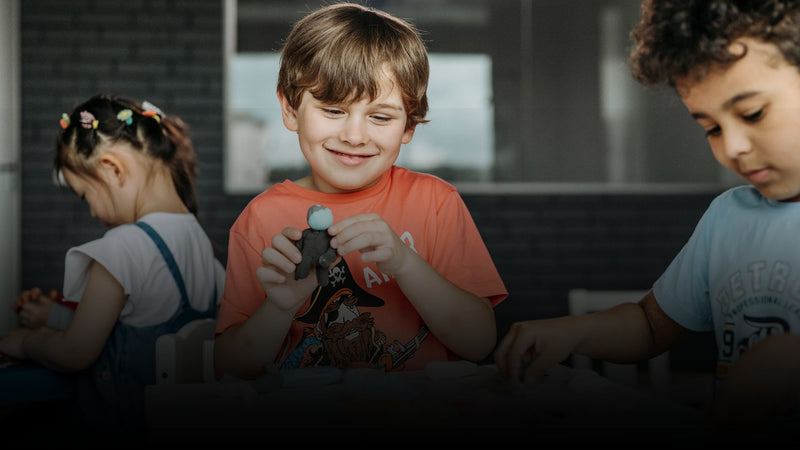
Creative play is child-led play where there is no single "right" way to play. Children use their imagination to invent stories, explore ideas, solve problems, and express emotions.
Creative play can include:
-
Pretending to be a firefighter
-
Turning a blanket into a spaceship
-
Building imaginary cities with blocks
-
Creating stories with stuffed animals
-
Drawing fantasy creatures
-
Inventing games with household objects
Unlike activities with fixed rules or expected outcomes, creative play allows children to become the author, designer, storyteller, and problem-solver all at once.
Why Is Creative Play So Important?
Quick Answer
Creative play helps children develop far more than imagination. It supports cognitive, social, emotional, and language development while encouraging independence, confidence, and flexible thinking.
Research Snapshot
Early childhood experts widely recognize play as one of the primary ways children learn. During imaginative play, children practice skills they will use throughout life, including planning, communication, self-regulation, collaboration, and creative problem-solving.
Creative play also gives children opportunities to explore ideas without fear of making mistakes because there is rarely one correct answer.
Expert Tip
Think of creative play as "brain exercise."
Every imaginary adventure asks children to:
-
make decisions
-
solve challenges
-
tell stories
-
understand different perspectives
-
adapt when ideas change
These experiences strengthen thinking skills in ways passive entertainment cannot.
Parent Script
Instead of saying:
"Let's build it this way."
Try:
"How do you think it should work?"
This simple question encourages ownership, confidence, and creative thinking.
Bottom Line
Creative play isn't simply about having fun—it's one of childhood's most powerful learning experiences.
What Is the Difference Between Creative Play, Imaginative Play, and Symbolic Play?
Quick Answer
These terms are closely connected but describe different aspects of how children play.
Creative play is the broad umbrella. Imaginative play and symbolic play are two important ways creativity comes to life.
At-a-Glance Comparison
|
Type of Play |
What It Looks Like |
Skills It Supports |
|
Creative Play |
Inventing, building, designing, making |
Creativity, problem-solving, flexible thinking |
|
Imaginative Play |
Pretending, storytelling, fantasy adventures |
Language, confidence, social skills |
|
Symbolic Play |
Using one object to represent another |
Abstract thinking, emotional expression, communication |
Research Snapshot
Symbolic play usually begins during the toddler years and becomes increasingly sophisticated throughout early childhood.
Examples include:
-
A cardboard box becomes a pirate ship.
-
A wooden spoon becomes a magic wand.
-
A blanket becomes a superhero cape.
-
A chair becomes a race car.
Children aren't simply pretending.
They're learning that one object can represent another—a foundational skill that supports language, reading, creativity, and abstract thinking later in life.
Expert Tip
Avoid correcting imaginative ideas.
If your child says:
"This pillow is a dragon."
You don't need to remind them it's actually a pillow.
Instead, join their world.
Ask:
"Where is the dragon flying today?"
Following their lead encourages richer storytelling and deeper engagement.
Parent Script
Child:
"I'm a veterinarian today."
Instead of:
"That's not how veterinarians do it."
Try:
"Who is your first animal patient?"
Children build confidence when adults participate without taking over.
Bottom Line
Creative, imaginative, and symbolic play all work together to help children explore ideas, relationships, emotions, and possibilities.
Why Do Some Children Struggle With Creative Play?
Quick Answer
Children aren't born "uncreative." Creativity often declines when children have fewer opportunities to direct their own play, solve their own problems, or experience unstructured time.
Research Snapshot
Modern childhood looks very different from previous generations.
Many children spend more time:
-
following instructions
-
attending scheduled activities
-
consuming digital entertainment
-
completing structured tasks
While these experiences can have value, they leave less room for child-led exploration—the type of play where creativity naturally develops.
Common Reasons Creative Play Becomes Difficult
1. Constant Entertainment
Children who are always entertained rarely need to generate their own ideas.
When every moment is filled with videos, games, or planned activities, imagination has fewer opportunities to emerge.
2. Too Many Toys
This may sound surprising.
Having dozens of toys doesn't necessarily create richer play.
When everything is available at once, children often move quickly from one activity to another without becoming deeply engaged.
A smaller selection of flexible, open-ended materials often encourages longer, more meaningful play.
3. Overscheduled Days
When children move from school to extracurricular activities to homework to bedtime, there is little uninterrupted time for creative exploration.
Creativity needs space.
It can't always be scheduled.
4. Fear of Being Wrong
Some children become hesitant to invent ideas because they worry about making mistakes.
Creative play has no answer key.
Parents can support confidence by celebrating curiosity rather than perfection.
Myth vs. Fact
|
Myth |
Fact |
|
Creative children are naturally gifted. |
Creativity develops through opportunities and practice. |
|
More toys create more creativity. |
Open-ended experiences often inspire deeper imagination. |
|
Boredom is unhealthy. |
Boredom frequently becomes the starting point for creative thinking. |
|
Adults should lead imaginative play. |
Children usually benefit most when they direct the experience themselves. |
Expert Tip
If your child says,
"I don't know what to do."
Pause.
Resist solving the problem immediately.
That quiet moment is often where imagination begins.
Children need time to move through boredom before creativity takes over.
Parent Script
Child:
"There's nothing to play."
Instead of:
"Let's buy a new toy."
Try:
"What could this room become if you could turn it into anything?"
Questions like this encourage possibility instead of consumption.
Bottom Line
Creativity doesn't disappear.
It simply needs the right conditions to grow.
Why Boredom Is the Beginning of Creativity
Quick Answer
Boredom isn't a sign that children have nothing to do—it's often a sign that their brains are searching for something meaningful to create.
Research Snapshot
When children aren't immediately entertained, they begin generating ideas internally.
This process encourages:
-
imagination
-
curiosity
-
planning
-
experimentation
-
problem-solving
While boredom may feel uncomfortable at first, many children naturally transition from "I don't know what to do" to inventing games, building worlds, or creating stories.
Expert Tip
Instead of rushing to solve boredom, treat it as an invitation.
Allow children enough uninterrupted time to discover what captures their interest.
Not every moment needs adult direction.
Bottom Line
Many of childhood's most memorable adventures begin with a simple sentence:
"I'm bored."
When parents resist the urge to immediately fill that space, children often discover something even more valuable—their own imagination.
The ZeeZee CREATE Method™: A Practical Framework for Encouraging Creative Play
Parents often ask,
"What should I actually do to encourage more creative play?"
The answer isn't buying more toys or planning more activities.
It's creating the conditions where creativity naturally develops.
The ZeeZee CREATE Method™ is a simple framework built around child development principles that helps families nurture imagination, independence, and meaningful play at home.
C — Create an Inviting Play Environment
Quick Answer
Children are more likely to play creatively when their environment feels welcoming, flexible, and designed for exploration rather than entertainment.
Research Snapshot
Child development specialists have long recognized that children's surroundings influence how they play. Calm, organized, child-friendly spaces reduce unnecessary distractions and encourage children to focus, imagine, and remain engaged for longer periods.
The environment doesn't have to be large or elaborate. What matters most is that children feel ownership of the space and freedom to direct their own play.
Expert Tip
Instead of asking,
"What toy should I buy next?"
Ask,
"Does my child have a space that invites imagination?"
Sometimes changing the environment has a greater impact than adding another toy.
Example
A small reading corner can become:
-
a pirate ship
-
a doctor's office
-
a secret cave
-
a bakery
-
a dinosaur museum
The space stays the same.
The child's imagination transforms it.
Bottom Line
Creative play begins with environments that invite possibilities rather than dictate outcomes.
R — Reduce Distractions
Quick Answer
Children often play more deeply when there is less visual clutter, less noise, and fewer competing distractions.
Research Snapshot
When children have too many choices or constant stimulation, they may move quickly between activities without becoming deeply engaged in any one of them.
Simple environments help children sustain attention and develop richer play experiences.
Expert Tip
Try rotating toys instead of displaying everything at once.
You don't need fewer opportunities.
You need clearer ones.
Parent Script
Instead of:
"You have so many toys—go play with something."
Try:
"Which adventure feels most exciting today?"
This encourages intentional choices instead of overwhelming options.
Bottom Line
Sometimes creativity grows when there is less to look at and more room to imagine.
E — Encourage Open-Ended Materials
Quick Answer
Open-ended materials can become almost anything, allowing children to invent new stories every time they play.
Research Snapshot
Unlike single-purpose toys, open-ended materials encourage experimentation because they have no predetermined outcome.
Examples include:
-
blocks
-
cardboard boxes
-
fabric
-
cushions
-
wooden figures
-
art supplies
-
loose natural materials
-
recycled household objects
These materials invite children to become designers, storytellers, architects, scientists, and explorers.
Expert Tip
Don't worry if something looks "too simple."
A blanket often inspires more imagination than a toy with dozens of buttons and lights.
Bottom Line
The fewer rules an object has, the more creative possibilities it offers.
A — Allow Boredom
Quick Answer
Boredom gives children the opportunity to create their own entertainment instead of relying on someone else to provide it.
Research Snapshot
Many parents understandably feel pressure to keep children constantly occupied.
However, uninterrupted free time encourages children to:
-
invent games
-
tell stories
-
build imaginary worlds
-
solve problems
-
explore personal interests
Creativity often appears after the initial discomfort of boredom passes.
Expert Tip
When your child says,
"I'm bored."
Pause before offering suggestions.
Many children discover their best ideas after a few quiet minutes.
Parent Script
Instead of:
"Let's find something to do."
Try:
"I wonder what your imagination will think of next."
Bottom Line
Boredom isn't the enemy of creativity.
It's often the beginning.
T — Trust Your Child's Ideas
Quick Answer
Children become more confident creators when adults follow their lead instead of directing every moment of play.
Research Snapshot
Child-led play encourages:
-
independent thinking
-
confidence
-
decision-making
-
flexible problem-solving
Adults don't need to control every story or correct every imaginary detail.
Children learn by experimenting with their own ideas.
Expert Tip
Join the adventure without taking over.
Become a character—not the director.
Parent Script
Instead of:
"Let's build it this way."
Try:
"Show me how your world works."
Bottom Line
Children's ideas become stronger when they're trusted.
E — Expand Through Curious Questions
Quick Answer
Questions encourage deeper thinking without interrupting creativity.
Research Snapshot
Open-ended questions help children:
-
explain ideas
-
build language
-
extend stories
-
solve problems
-
develop flexible thinking
Unlike instructions, questions invite imagination to continue growing.
Questions That Spark Creativity
-
Who lives here?
-
What happens next?
-
How did they become friends?
-
What problem are they solving?
-
Where does this adventure begin?
-
What would happen if...?
Why the Play Environment Matters More Than the Toy
Quick Answer
Children don't simply play with toys—they play within environments.
The environment influences how long they stay engaged, how deeply they imagine, and how freely they explore.
Research Snapshot
Many traditional toys have one intended purpose.
Once children understand how they work, the novelty often fades.
Flexible environments are different.
They evolve with children's interests.
The same space might become:
-
a castle on Monday
-
a rainforest on Tuesday
-
a veterinary clinic on Wednesday
-
a spaceship on Thursday
The environment becomes part of the story rather than limiting it.
Expert Tip
When choosing play experiences, think beyond individual toys.
Ask:
"Will this continue inspiring new ideas six months from now?"
Long-term creativity comes from flexibility, not constant novelty.
Symbolic Play: Where Creativity Meets Emotional Expression
Quick Answer
Symbolic play gives children a safe way to explore emotions, relationships, and everyday experiences through imagination.
Research Snapshot
When children pretend, they're often exploring ideas that matter to them.
A child playing "school" may be processing their classroom experiences.
A child pretending to care for stuffed animals may be exploring empathy and nurturing.
A superhero adventure may reflect bravery, confidence, or overcoming challenges.
Rather than asking children to explain their feelings directly, symbolic play allows emotions to emerge naturally through stories, characters, and imaginative scenarios.
Expert Tip
You don't always need to interpret your child's play.
Sometimes the greatest gift is simply providing the time, space, and emotional safety for the story to unfold.
Parent Script
Instead of:
"Why is your teddy sad?"
Try:
"Tell me about what's happening."
Children often reveal far more when they lead the conversation.
Creating an Adaptable Play Environment at Home
By now, one idea has become clear:
Children don't necessarily need more toys.
They need environments that grow with them.
An adaptable play environment doesn't tell children what to imagine—it gives them the freedom to decide for themselves.
That philosophy is increasingly reflected in homes, classrooms, and child-centered learning spaces that prioritize flexibility, child-led exploration, and open-ended experiences over fixed, single-purpose toys.
This is also the thinking behind ZeeZee Adventures.
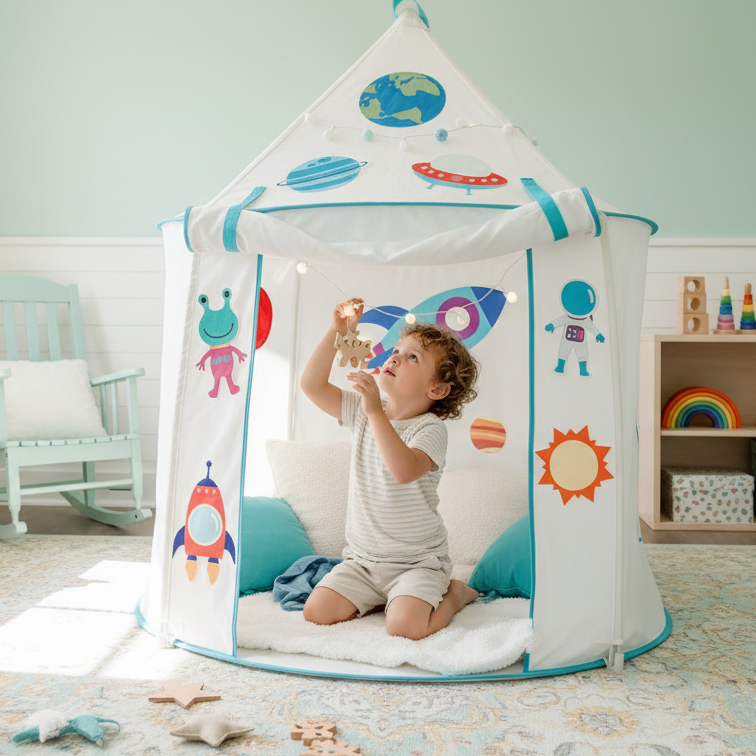
Rather than creating another toy with one specific purpose, ZeeZee was designed as an adaptable play environment that changes alongside a child's imagination. A single Adventure Tent can transform into a castle, a rainforest, a space station, or an underwater world through interchangeable StickeeZ themes, allowing children to revisit the same environment while creating entirely new stories. Instead of encouraging constant consumption, the focus is on extending imaginative possibilities through child-led exploration and long-term play.
For many families, the environment also becomes a cozy place to read, draw, build, imagine, or simply enjoy quiet moments. Pairing imaginative play with calming storytelling or guided audio experiences can create gentle transitions between active adventures and peaceful reflection.
The goal isn't to direct children's imagination.
It's to give it a place where it can continue growing.

Age-by-Age Guide to Encouraging Creative Play
|
Age |
Focus |
Parent's Role |
|
0–2 years |
Sensory exploration, simple pretend play, object discovery |
Narrate, observe, and respond to curiosity. |
|
2–4 years |
Symbolic play, role play, storytelling |
Follow your child's lead and expand ideas with questions. |
|
4–6 years |
Imaginative adventures, building worlds, collaborative play |
Provide open-ended materials and uninterrupted play time. |
|
6–9 years |
Creative problem-solving, longer stories, themed projects |
Encourage independence and avoid over-directing. |
|
9+ years |
Complex storytelling, design projects, hobbies, world-building |
Support long-term creative interests and self-directed exploration. |
Common Mistakes That Limit Creative Play
❌ Solving every problem immediately
❌ Interrupting deep imaginative play
❌ Buying more instead of simplifying
❌ Over-scheduling every afternoon
❌ Correcting imaginary ideas
❌ Expecting every activity to produce a visible result
Creativity isn't measured by what children make.
It's measured by how deeply they think, imagine, and explore.
Frequently Asked Questions
1. What is creative play?
Creative play is child-led play that encourages children to imagine, invent, explore, and solve problems without a predetermined outcome. It includes activities like pretend play, storytelling, building, drawing, role-playing, and creating imaginary worlds using everyday objects.
Bottom Line: Creative play helps children become active creators rather than passive consumers.
2. Why is creative play important for child development?
Creative play supports many areas of development, including:
-
Executive functioning
-
Language development
-
Emotional expression
-
Problem-solving
-
Social skills
-
Flexible thinking
-
Self-confidence
-
Independent decision-making
These skills help children both inside and outside the classroom.
3. What is symbolic play?
Symbolic play is when children use one object, action, or idea to represent something else.
Examples include:
-
A cardboard box becomes a rocket ship.
-
A spoon becomes a microphone.
-
A blanket becomes a superhero cape.
Symbolic play lays important foundations for imagination, language, storytelling, and abstract thinking.
4. Does my child need expensive toys to be creative?
No.
Many of the most creative play experiences happen with simple, open-ended materials like:
-
Cardboard boxes
-
Blankets
-
Blocks
-
Art supplies
-
Natural objects
-
Dress-up clothes
-
Cushions
Creativity grows from possibilities—not price tags.
5. Why does my child say they're bored?
Boredom is often the brain's transition into creativity.
Instead of immediately providing entertainment, giving children time to explore their own ideas can lead to richer, more independent play.
6. How can I encourage more independent creative play?
Parents can encourage independent play by:
-
Creating a dedicated play environment
-
Reducing unnecessary distractions
-
Offering open-ended materials
-
Avoiding over-directing play
-
Allowing uninterrupted play time
-
Asking curious questions instead of giving instructions
Consistency matters more than perfection.
7. How much time should children spend in creative play each day?
There isn't a universal recommendation.
Rather than aiming for a specific number of minutes, focus on ensuring children have regular opportunities for uninterrupted, child-led play every day.
Quality matters far more than quantity.
8. How can I encourage creativity without planning lots of activities?
Children don't need parents to entertain them constantly.
Often, creativity grows when adults:
-
provide time
-
create a welcoming environment
-
trust children's ideas
-
resist solving every problem
-
embrace moments of boredom
Sometimes doing less creates space for children to do more.
9. What are signs my child's creativity is growing?
You may notice your child:
-
Inventing stories independently
-
Playing longer without adult help
-
Using everyday objects imaginatively
-
Asking "what if" questions
-
Returning to unfinished play over several days
-
Creating more detailed pretend worlds
-
Expressing emotions through storytelling
These are positive signs that imagination is becoming more self-directed.
10. How can I create a home that inspires imaginative play?
Start with the environment.
Children thrive in spaces that feel:
-
calm
-
flexible
-
inviting
-
child-led
-
free from constant interruptions
The goal isn't to create the perfect playroom—it's to create a space where imagination feels welcome.
About the Author
ZeeZee Adventures Editorial Team
The ZeeZee Adventures Knowledge Hub is created by a multidisciplinary team of child development specialists, pediatric occupational therapy consultants, parenting educators, early childhood researchers, and content strategists dedicated to helping families raise creative, confident, and independent children.
Our articles combine evidence-informed guidance with practical strategies that parents can use every day to nurture imagination, emotional well-being, and meaningful play.




Comment (0)