
How Pretend Play Builds Communication and Social Skills
Introduction
"You're the doctor."
"No, I'm the doctor."
"Okay, you're the doctor and I'm the patient."
"But Teddy is the patient."
A small disagreement over a teddy bear might sound insignificant to an adult.
For children, it can be an opportunity to practise something much bigger.
They are deciding how to communicate an idea.
They are listening to another person's perspective.
They are negotiating.
They are changing their plan.
And, eventually, they are finding a way to continue playing together.
This is one of the fascinating things about pretend play.
The imaginary world gives children a reason to communicate.
A restaurant needs customers.
A hospital needs doctors and patients.
A spaceship needs astronauts.
A shop needs buyers and sellers.
Once another person enters the imaginary world, the story becomes collaborative.
Research supports a relationship between pretend play and social competence in early childhood. A 2024 meta-analysis covering 34 studies found an overall positive association, with the quality of pretend play showing stronger relationships with social competence than simply the amount of pretend play. However, the researchers emphasised that the evidence does not establish that pretend play itself causes better social competence.
More recent research makes that distinction even more important. A controlled 2026 study involving 333 preschoolers found that an eight-week social pretend-play intervention did not produce significant effects on measured social cognitive skills or social-emotional behaviour.
So what should parents take from this?
Not that pretend play is unimportant.
Rather, pretend play creates opportunities to practise communication and social interaction, particularly when children are genuinely engaged with other people. It should be considered one part of a much broader developmental environment.
And that makes pretend play especially interesting.
Children are learning to communicate without feeling as though they are being taught.
Quick Answer
Pretend play can create natural opportunities for children to practise communication and social interaction. When children share an imaginary scenario, they may need to explain ideas, listen to others, negotiate roles, take turns, follow shared rules and adapt their stories. The strongest evidence currently supports an association between pretend play and social competence, rather than proving that pretend play alone causes improvements in social skills.
Key Takeaways
-
Pretend play gives children meaningful reasons to communicate.
-
Shared imaginary worlds require children to listen, respond and negotiate.
-
Role play can provide opportunities to explore different perspectives.
-
Social pretend play involves back-and-forth interaction and shared rules.
-
Children can practise communication in both adult-child and peer play.
-
The quality and richness of play may matter more than simply counting how long children play.
-
Pretend play should complement, not replace, other opportunities for social interaction and communication.
What Is Social Pretend Play?
Pretend play happens when children create an "as if" situation.
A box becomes a car.
A child becomes a doctor.
A soft toy becomes a patient.
A living room becomes a restaurant.
When another person joins the scenario, something changes.
Now the children have to establish a shared understanding of what is happening.
Researchers commonly describe pretend play through elements such as substituting objects, assigning imaginary properties, taking on roles, interacting within the imaginary scenario and communicating about the pretend situation itself.
That last part is particularly interesting.
Children don't just communicate during pretend play.
They also communicate about how the pretend play works.
"You're the customer."
"No, that's my shop."
"Okay, I'll be the delivery person."
This is a tiny conversation.
But it contains negotiation, clarification and collaboration.
Pretend Play Gives Children Something to Talk About
Children communicate most effectively when communication has a purpose.
Pretend play naturally creates that purpose.
Imagine two children playing airport.
One is the pilot.
One is the passenger.
The passenger needs a ticket.
The pilot needs to know where the plane is going.
Someone needs to announce boarding.
Someone else has lost their luggage.
Suddenly there are dozens of reasons to speak.
The children aren't practising conversation from a worksheet.
They are communicating because the imaginary situation requires it.
Research examining pretend play and language competence in preschoolers has found associations between certain measures of pretend play and aspects of language, including linguistic complexity.
Again, association is not the same as proof of causation.
But the connection makes intuitive sense.
Imaginary worlds create reasons for children to use language in meaningful contexts.
1. Pretend Play Encourages Children to Explain Their Ideas
Imagine your child says:
"We're going to the moon."
You ask:
"How are we getting there?"
"Rocket."
"What do we need?"
"Food."
"What else?"
"Moon boots."
Your child is explaining a world they have created.
They have to put an idea into words so someone else can understand it.
This is an important part of communication.
The child isn't simply naming objects.
They are sharing an idea.
2. It Encourages Listening
Communication isn't just talking.
Children also need to understand what someone else is saying.
Shared pretend play gives them reasons to listen.
If one child says, "The shop is closed," the other child needs to respond to that information.
If someone says, "You're the firefighter," the child has to understand the role they've been given.
If a friend changes the story, the child needs to notice.
These moments can create natural opportunities for attentive listening.
3. It Creates Opportunities for Turn-Taking
Conversation involves taking turns.
So does collaborative pretend play.
One child speaks.
Another responds.
One child acts.
Another reacts.
One person introduces an idea.
Someone else adds to it.
These exchanges can happen naturally when children are deeply engaged in a shared imaginary world.
The play itself creates the rhythm.
4. Children Learn to Negotiate
This might be one of the most valuable parts of social pretend play.
Two children rarely want exactly the same thing.
One wants to be the doctor.
The other wants to be the doctor.
One says the sofa is the hospital.
The other says it's the spaceship.
Now there is a problem.
They have options.
They can argue.
They can walk away.
Or they can negotiate.
"You're the doctor first, then I'll be the doctor."
"The sofa can be the hospital and the chair can be the spaceship."
These small compromises are part of learning how to create a shared experience.
5. Pretend Play Can Encourage Perspective-Taking
When children take on roles, they temporarily imagine being someone else.
A child becomes a teacher.
Another becomes a parent.
Someone else becomes a shopkeeper.
The role comes with different needs and expectations.
The customer needs something from the shopkeeper.
The patient needs help from the doctor.
The passenger needs information from the pilot.
Pretend play therefore creates situations in which children have to consider what another character might want, know or do.
This is one reason researchers have theorised that pretend play may provide a context for social perspective-taking.
However, it is important not to turn that theory into a guaranteed developmental claim. Current intervention evidence remains mixed.
6. Imaginary Rules Require Cooperation
Every pretend game has rules.
Sometimes they're obvious.
Sometimes they're completely invented.
"The doctor needs a waiting room."
"The spaceship can't leave until everyone is inside."
"The shop closes when it's dark."
Children have to remember these rules if they want the game to continue.
When playing with others, they also need to agree on them.
That creates opportunities for cooperation.
7. Pretend Play Can Help Children Practise Social Problem-Solving
Something inevitably goes wrong during children's imaginary games.
The castle falls down.
Someone wants the same character.
The spaceship runs out of fuel.
The teddy refuses to go to hospital.
These problems can become part of the story.
Instead of immediately solving them for children, adults can give them space to find their own solutions.
Try asking:
"What could we do?"
rather than:
"Here's what we should do."
That keeps the child involved in the problem-solving process.
8. Pretend Play Can Create Space for Emotional Communication
Children don't always talk directly about their feelings.
But feelings often appear in their stories.
A doll might be scared.
A teddy might be lonely.
A superhero might be angry.
A child might create a story about someone who doesn't want to go somewhere.
Pretend play can provide a symbolic way for children to explore emotional experiences.
Parents do not need to interpret every story.
Simply listening can be enough.
9. Siblings Can Learn to Build a Shared Story
Sibling pretend play can be wonderfully creative.
It can also be chaotic.
One child wants a castle.
Another wants a restaurant.
One wants to be the hero.
Another wants to be the villain.
Rather than solving every disagreement, parents can sometimes help children find a shared storyline.
"What could make both ideas work?"
Maybe the restaurant is inside the castle.
Maybe the hero owns the restaurant.
Maybe the villain is the customer.
Children discover that different ideas do not always have to compete.
Sometimes they can combine them.
10. Pretend Play Gives Quiet Children Another Way to Participate
Not every child is the loudest person in a group.
Some children need more time before joining a social activity.
Pretend play can provide a shared structure.
A role gives them something concrete to do.
A child who is hesitant to start a conversation might find it easier to say:
"Welcome to my shop."
because the imaginary situation provides a reason to speak.
This does not mean pretend play will automatically solve social difficulties.
But a familiar imaginary scenario can sometimes make interaction feel more manageable.
Expert Insight
The goal isn't to make children "better at socialising" through pretend play.
The goal is to give them meaningful opportunities to interact.
Current research is deliberately cautious about causal claims. A 2024 meta-analysis found a positive relationship between pretend play and social competence, while a 2026 controlled intervention study found no significant effect of an eight-week social pretend-play intervention on measured social competence outcomes.
For parents, this suggests a balanced approach.
Encourage rich social play.
Don't turn it into a training programme.
And remember that children develop communication and social skills through many experiences, including everyday conversation, relationships, group activities and shared play.
How Parents Can Support Communication During Pretend Play
The most useful thing an adult can do is often surprisingly simple.
Listen.
If your child says, "We're going to the jungle," ask where the jungle is.
If they give you a role, play it.
If they change the story, adapt.
If they disagree with you, let them explain their idea.
Try open-ended prompts such as:
"What happens next?"
"What does your character need?"
"How can we help?"
"What should we do now?"
These questions encourage children to contribute rather than simply answer questions with one correct response.
Give Children Something to Talk About
This is where the play environment matters.
A completely empty room may offer fewer starting points.
A space containing a few books, soft toys, blocks, blankets, costumes and open-ended props can provide inspiration without dictating the story.
The goal isn't to create a perfectly themed environment.
It's to give children enough material to build a shared imaginary world.
How ZeeZee Adventures Can Support Shared Pretend Play
A dedicated play space can provide children with a familiar setting for their stories.
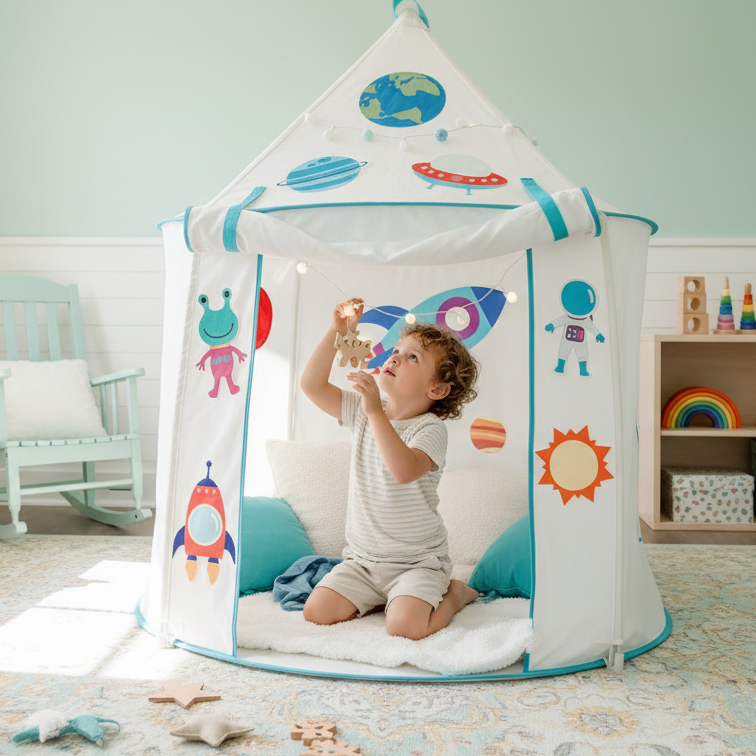
The ZeeZee Adventure Tent is designed to become an adaptable environment for imaginative, screen-free play. Its interchangeable StickeeZ themes allow the same familiar space to take on different settings, giving children new prompts for storytelling and role play.
One day, two children might turn it into a jungle research station.
Another day, it might become a castle where they have to solve an imaginary problem together.
The physical setting provides the starting point.
The children create the conversation.
That distinction is important.
The purpose of the environment is not to tell children what to say or how to play.
It is to give them somewhere to begin.
From Imagination to Real-World Connection
Pretend play becomes especially interesting when another child joins in.
A child playing alone can create characters and stories at their own pace. When a sibling or friend enters the game, the imaginary world becomes something that needs to be shared.
Suddenly, children have to explain what they are doing, listen to someone else's ideas and work out how two different imaginations can exist in the same game.
This is where pretend play can create particularly rich opportunities for communication.
The aim is not to turn every game into a social-skills lesson. Children need freedom to play, disagree, change their minds and even abandon a game when it stops being enjoyable. The adult's role is often simply to provide a supportive environment and step in when children genuinely need help.
Pretend Play With Siblings
Siblings can create some wonderfully complex imaginary worlds because they already have an established relationship.
They know one another's personalities, preferences and favourite games. This familiarity can make it easier to return to an imaginary world repeatedly and add new characters or storylines.
At the same time, sibling play can involve plenty of disagreements.
Who gets to be the princess?
Who gets the red cup?
Is the sofa a spaceship or a hospital?
These disagreements are not necessarily a sign that play has failed.
They are part of the social experience.
Children are learning that other people have ideas too.
When the situation is safe, give them an opportunity to negotiate before immediately deciding for them.
You might say:
"You both want to use the sofa. How could the game work for both of you?"
The solution belongs to them.
Perhaps the sofa becomes a spaceship hospital.
Perhaps they take turns.
Perhaps they build a second spaceship.
The important part is that they discover that disagreements can sometimes be solved through communication.
Pretend Play With Friends
Peer pretend play introduces another layer of complexity.
Friends may not share the same experiences, vocabulary or ideas about how a game should work.
One child might say, "Let's play school."
The other might want to play superheroes.
Instead of abandoning one idea, they may eventually discover a way to combine them.
The superhero becomes the teacher.
The classroom becomes a secret headquarters.
The school needs rescuing.
This ability to combine ideas is one of the reasons collaborative pretend play can be so engaging.
Children are not simply sharing toys.
They are attempting to create a shared imaginary world.
Communication Happens Throughout the Game
Children communicate in pretend play in more ways than simply talking.
They use facial expressions.
Gestures.
Movement.
Objects.
Sounds.
Stories.
They may point to an imaginary destination or use a toy as a symbol for something else.
A child might hold a block to their ear and announce:
"The space station is calling."
Another child has to decide how to respond.
Perhaps they pick up another block.
"Hello, space station."
Now they have created a shared conversation around an imaginary object.
These tiny exchanges are what make pretend play so rich.
Turn-Taking Does Not Always Need to Be Taught
Adults often think of turn-taking as something children need to practise deliberately.
But conversation itself naturally involves taking turns.
Pretend play creates countless opportunities for this.
One child introduces an idea.
Another responds.
Someone changes the story.
Another reacts.
A character speaks.
Another character answers.
The interaction continues because both children contribute.
The game becomes a kind of conversational rhythm.
This is particularly valuable because the communication has a purpose.
Children aren't simply waiting for their turn because an adult told them to.
They want the story to continue.
Pretend Play Can Encourage Children to Listen
Listening can be challenging when children are excited.
Pretend play gives them a reason to pay attention.
If your child is playing shopkeeper and you say, "I'd like two apples, please," they need to understand what you have asked for.
If another child says, "The spaceship can't land here," they need to consider what that means for the story.
Listening becomes part of maintaining the imaginary world.
And if the listener misses something, the story may change.
Sometimes that is fine.
Sometimes it creates a completely new adventure.
Negotiating Roles
Role negotiation is one of the most recognisable parts of collaborative pretend play.
Children may decide:
"You be the doctor."
"I want to be the doctor."
"Okay, I'll be the nurse."
"But there are two doctors."
"Fine. You're the animal doctor."
A few sentences can contain several social skills.
The children are expressing preferences.
They are listening.
They are adapting.
They are finding a compromise.
Parents do not need to solve every disagreement.
Sometimes children need an opportunity to work it out themselves.
What If Children Can't Agree?
Some disagreements will become too difficult for children to resolve independently.
That is when an adult can provide support without taking over.
Instead of announcing the solution, describe the problem.
"You both want to be the pilot."
Then give them time.
If they are still stuck, offer possibilities.
"Could there be two pilots?"
"Could you take turns?"
"Could one of you be the pilot and one be the navigator?"
This approach keeps children involved in the solution.
Pretend Play Can Help Children Practise Perspective-Taking
Imagine a child playing the role of a shopkeeper.
The shopkeeper needs to think about what the customer wants.
Now imagine the child becomes the customer.
The role changes.
So does the perspective.
This does not mean that every role-play activity automatically develops advanced social understanding.
Rather, imaginary roles create situations where children can practise considering what another character might need or expect.
This is one reason pretend play has attracted attention from developmental researchers studying social competence and social cognition.
However, current evidence remains mixed, so it is better to describe these activities as opportunities for practice rather than guaranteed developmental interventions.
Pretend Play for Children Who Are Hesitant to Join In
Some children are naturally comfortable entering group play.
Others prefer to observe before participating.
Neither approach needs to be rushed.
A child who is watching other children play may already be learning about the game.
They may be working out the roles.
They may be deciding whether they want to join.
Instead of saying:
"Go and play with them."
you might offer a smaller invitation.
"Would you like to take the teddy to the shop?"
This gives the child a possible entry point without putting them under pressure.
A familiar role can sometimes make joining an imaginary game feel easier.
Parent-Child Pretend Play
Pretend play between adults and children can be wonderful for communication because the adult can follow the child's interests while modelling responsive conversation.
The key is to avoid becoming the director.
If your child says:
"You're the customer."
You are the customer.
If they say:
"The shop is closed."
You accept that the shop is closed.
If they suddenly decide you're a dinosaur, you may need to adjust quickly.
That flexibility is part of following the child's lead.
Try "Yes, And" Instead of "No, But"
There is a simple conversational approach that can make pretend play more collaborative.
Your child says:
"We're flying to the moon."
Instead of:
"No, we need to get in the car first."
try:
"Yes, and we need to pack our space food."
You're accepting their idea and adding another possibility.
Your child can then build on yours.
"And we need moon boots."
You:
"And a telescope."
The story grows through collaboration.
You are not controlling it.
You are contributing to it.
Ten Pretend Play Prompts That Encourage Communication
When children need a little inspiration, use prompts that require them to explain, decide or imagine rather than simply answer yes or no.
1. "Where are we going?"
Let your child choose the destination.
2. "Who is coming with us?"
Invite them to create characters.
3. "What do we need to take?"
Encourage them to think about the imaginary situation.
4. "What happened?"
Give them an opportunity to create a story.
5. "What should we do?"
Introduce an imaginary problem.
6. "Who needs our help?"
Encourage them to create a character or situation.
7. "What happens next?"
Give them control of the storyline.
8. "How can we fix it?"
Invite problem-solving.
9. "What does your character think?"
Encourage perspective-taking.
10. "Can you show me?"
This allows children to communicate through action as well as words.
Don't Turn Every Game Into a Question-and-Answer Session
Open-ended questions can be useful, but too many questions can interrupt children's concentration.
Imagine a child building a spaceship.
"What is that?"
"Where are you going?"
"Who is the pilot?"
"Why are you doing that?"
"What's that?"
Even well-intentioned questions can make play feel like an interview.
Instead, mix questions with simple observations.
"The spaceship is ready."
"I can see you've packed lots of food."
"The astronaut looks worried."
These comments give children opportunities to respond without demanding that they do so.
The Environment Can Support Social Pretend Play
The physical environment can make it easier for children to create shared imaginary worlds.
A space with a few open-ended materials can become a restaurant, hospital, classroom or spaceship without needing to be redesigned each time.
A cosy play environment can also give children somewhere to retreat when they need quieter play.
This is particularly useful when siblings or friends have different energy levels.
One child might be acting out an energetic adventure while another is reading quietly inside the same space.
The goal is flexibility.
How ZeeZee Adventures Fits Into Collaborative Pretend Play
The ZeeZee Adventure Tent can provide a familiar setting where children create shared stories together.
Its interchangeable StickeeZ themes allow the same play space to take on different imaginative settings, giving children a fresh starting point for role play without changing the entire environment.
Two children might turn the tent into a jungle research station and decide who is the explorer, who is the scientist and who is responsible for rescuing the animals.
Another day, the same space might become a castle where they need to work together to solve an imaginary problem.
The product does not determine the storyline.
The children do.
That is what makes an adaptable environment useful for pretend play. It provides a setting without taking ownership of the imagination.

A Note for Parents
If your child doesn't naturally engage in elaborate pretend play, don't worry.
Children have different interests and different ways of communicating.
Some love role play.
Others prefer construction, drawing, sensory exploration or physical activity.
The goal isn't to make every child play pretend.
It is to give children opportunities to communicate and connect through whichever forms of play genuinely interest them.
Pretend play is one tool in a much larger developmental toolbox.
And the most valuable ingredient is often not the toy or the activity.
It is the relationship around the play.
When children feel listened to, respected and free to contribute their ideas, communication becomes part of the experience rather than a lesson imposed on them.
Practical Strategies, Parent Checklist, FAQs and Conclusion
Pretend play can look wonderfully chaotic.
One minute, your child is a shopkeeper.
The next, they're a firefighter.
Then the shop becomes a spaceship and everyone needs to evacuate.
For adults, the storyline may seem impossible to follow.
For children, this flexibility is part of the fun.
And when children play with other people, that imaginary world becomes a space for communication. They have to share ideas, listen to one another, negotiate roles and work together to keep the story going.
The goal isn't to make pretend play into a lesson.
It is to give children opportunities to experience communication and social interaction naturally.
10 More Ways to Encourage Communication Through Pretend Play
1. Create a Family Restaurant
Let your child become the restaurant owner.
They can create the menu, take orders and decide what happens when something goes wrong.
You might say:
"I'd like to order something, but I don't know what to choose."
Your child now has a reason to explain the options.
2. Run a Pretend Airport
One child can be the pilot.
Another can be the passenger.
Someone else can work at the check-in desk.
Children have to communicate about tickets, luggage, destinations and imaginary problems.
The roles naturally create reasons to talk.
3. Create a Rescue Mission
Choose a soft toy that needs help.
Perhaps it is stuck on a mountain.
Maybe it is lost in the jungle.
Or perhaps it needs to get home before dark.
Let the children decide how the rescue works.
Instead of solving the problem for them, ask:
"What could we do?"
4. Build a Pretend Hospital
Children can take turns being doctors, nurses, patients and receptionists.
They need to explain symptoms, ask questions and decide what happens next.
The roles can change throughout the game.
5. Create a News Station
Give children paper and a safe household object to use as a pretend microphone.
They can report imaginary events.
Perhaps there is a dinosaur in the garden.
Maybe a spaceship has landed nearby.
The more imaginative the news becomes, the more opportunities they have to create narratives.
6. Become Explorers
Create a map together.
Choose a destination.
Then imagine what you discover along the way.
Encourage children to describe what they see and decide where the expedition goes next.
7. Create a Puppet Theatre
Soft toys, dolls or homemade paper characters can become actors.
Children can create conversations between characters and decide how the story ends.
If siblings participate, they can negotiate who plays each character.
8. Open a Pretend Hotel
Your child can become the hotel manager.
You can arrive as a guest.
Ask about the available rooms.
Perhaps the hotel has a swimming pool, a jungle room or a rocket-powered lift.
The child gets to invent the details.
9. Play "Lost and Found"
Choose a toy and pretend it has gone missing.
Your child becomes the person responsible for finding it.
They can ask questions, create clues and interview imaginary witnesses.
10. Create Your Own Story
Start with a single sentence:
"Once upon a time, there was a little explorer who discovered a mysterious door..."
Then let your child continue.
You can take turns adding one part of the story.
There is no correct ending.
What Parents Should Do During Social Pretend Play
The most useful role isn't always the most active one.
Sometimes you should participate.
Sometimes you should observe.
Sometimes you should help children resolve a disagreement.
And sometimes you should step away entirely.
Watch for moments when children need support rather than assuming they need direction.
If they are communicating successfully, let them continue.
If they disagree but are still working towards a solution, give them space.
If the disagreement becomes upsetting or unsafe, step in calmly.
The aim is to support the relationship without taking ownership of the game.
Try Narrating Instead of Directing
There is a subtle difference between these two approaches.
Directing:
"Put the teddy here. Now you're the doctor. Give him medicine."
Narrating:
"The teddy looks like he isn't feeling very well."
The first tells the child what to do.
The second leaves an opening.
Your child might respond:
"I need to take him to hospital."
Now the story belongs to them.
Give Children Opportunities to Make Decisions
Communication becomes more meaningful when children have something to decide.
Instead of:
"We're going to the shop."
Try:
"Where should we go first?"
Instead of:
"The dinosaur is lost."
Try:
"How could we find it?"
Instead of:
"You are the doctor."
Try:
"Who would you like to be?"
Small changes can give children much more ownership.
What About Conflict?
Conflict is inevitable when children play together.
They may disagree about characters.
They may want the same object.
They may have completely different ideas about the story.
That does not automatically mean an adult needs to intervene.
When appropriate, give children the opportunity to communicate their preferences.
You might hear:
"I was using that."
"I want to be the pilot."
"That's not how the game works."
These statements are part of social interaction.
Children are learning that communication can help them express what they want and understand what other people want.
When Adults Should Step In
There are times when adult involvement is necessary.
If a child is becoming distressed, someone is being hurt, or a disagreement cannot be resolved, step in.
Keep your intervention simple.
Describe what is happening.
"You both want the same costume."
Then help them consider possible solutions.
"What could you do?"
You don't need to produce a perfect compromise immediately.
The aim is to help children experience the process of solving social problems safely.
Pretend Play Doesn't Need to Look the Same for Every Child
Some children love elaborate role play.
Others prefer building worlds with blocks.
Some enjoy playing with one close friend.
Others are happiest playing independently.
Some children communicate constantly during play.
Others express their ideas through movement, drawing or actions.
There is no single correct way to pretend.
Parents should avoid comparing one child's play style with another's.
Instead, pay attention to what captures your child's interest and provide opportunities for them to communicate through that interest.
A Simple Parent Checklist
Use this checklist to create more opportunities for communication and social interaction through pretend play.
Before play
☐ Provide a few open-ended props.
☐ Choose a familiar scenario your child understands.
☐ Give children enough time to become absorbed.
☐ Keep the environment comfortable and relatively distraction-free.
During play
☐ Follow your child's ideas.
☐ Listen carefully.
☐ Give children opportunities to make decisions.
☐ Use occasional open-ended prompts.
☐ Allow children to negotiate when it is safe to do so.
☐ Avoid correcting imaginary details.
When children disagree
☐ Give them a moment to try resolving it.
☐ Describe the problem without assigning blame.
☐ Ask what solutions they can think of.
☐ Step in more directly if someone becomes distressed or unsafe.
After play
☐ Ask what your child enjoyed.
☐ Let favourite stories continue another day.
☐ Keep a few successful props accessible.
☐ Notice which scenarios naturally encourage conversation.
Frequently Asked Questions
How does pretend play help communication?
Pretend play creates meaningful reasons for children to use language. They may need to explain ideas, establish roles, describe imaginary situations, respond to other people and develop stories together.
Does pretend play improve social skills?
Research has found a positive association between pretend play and social competence, but this does not prove that pretend play alone causes improvements. It is better understood as one context in which children can practise communication, cooperation, negotiation and perspective-taking.
How can pretend play help children learn to share?
When children create a shared imaginary world, they often need to negotiate access to roles, props and spaces. This creates opportunities to practise cooperation and compromise.
Should parents correct children during pretend play?
Usually, there is no need to correct imaginary details. If the play involves an unsafe situation or a genuinely important factual issue, adults can step in. Otherwise, allowing children to control their imaginary world gives them greater ownership.
What if my child prefers playing alone?
Independent pretend play is perfectly valid. Children do not need to play socially all the time. Provide opportunities for interaction while respecting your child's preferred way of playing.
Can pretend play help shy children communicate?
Pretend play can provide a structured context in which a child has a role and a reason to communicate. However, it should not be treated as a guaranteed intervention for shyness or social difficulties.
What are good pretend play activities for siblings?
Restaurants, shops, hospitals, airports, theatres, rescue missions and exploration games can all provide opportunities for children to share roles and create stories together.
Does pretend play need special toys?
No. Cardboard boxes, blankets, cushions, paper, soft toys and everyday household objects can become useful pretend-play props.
How ZeeZee Adventures Supports Social Pretend Play
A shared imaginary world needs somewhere to begin.
The ZeeZee Adventure Tent can provide that starting point.
Its interchangeable StickeeZ themes allow children to transform the same familiar play space into different settings. A jungle theme might inspire an exploration story. A castle could become the setting for a royal adventure. A space theme could turn the tent into a mission control centre.
For siblings and friends, these settings can provide common ground for creating a story together.
Who will be the explorer?
Who will look after the animals?
Who is flying the spaceship?
What happens when the mission goes wrong?
The tent provides the setting.
The children create the conversation.
That is where its role in pretend play becomes meaningful.
It is not about telling children what to do.
It is about giving their imagination somewhere to go.
Conclusion
Communication is not something children learn only when an adult sits down and teaches them.
It happens throughout everyday life.
During meals.
On walks.
While reading.
While solving disagreements.
And while playing.
Pretend play is particularly interesting because it gives children something meaningful to communicate about.
They aren't talking simply because an adult asks them to.
They are talking because the restaurant needs a customer.
The spaceship needs a pilot.
The lost animal needs rescuing.
The story needs another character.
And when children play together, they discover something important.
Their ideas matter.
But so do someone else's.
Sometimes they have to explain.
Sometimes they have to listen.
Sometimes they have to compromise.
Sometimes they have to change the story.
These are ordinary moments.
But they are also opportunities to practise being part of a shared world.
So the next time your child invites you into an imaginary game, resist the urge to make it perfect.
Let them choose the role.
Let them create the rules.
Let them change the story.
And when another child joins, give them room to figure out how two imaginations can become one adventure.
Because perhaps that's one of the most beautiful things about pretend play.
Children aren't only imagining different worlds. They're learning how to share a world with other people.





Comment (0)