
30 Pretend Play Ideas to Spark Your Child's Imagination
Introduction
A cardboard box can become a rocket.
A blanket can become a secret cave.
A few cushions can turn into a mountain.
And suddenly, your child is no longer playing in the sitting room. They are travelling through space, exploring a jungle or running an imaginary hospital.
This is the wonderful thing about pretend play.
Children do not need elaborate instructions to create an imaginary world. They need opportunities to decide what things could become.
Pretend play allows children to experiment with roles, objects, stories and ideas. It can create opportunities for language, social interaction, problem-solving and emotional exploration. Research has found a positive relationship between pretend play and social competence in early childhood, although the evidence does not establish that pretend play alone causes these developmental outcomes.
For parents, that distinction is important.
Pretend play does not need to become another educational task.
Children should be allowed to play simply because it is enjoyable.
The developmental value comes naturally from the experiences that happen while children are imagining, communicating, negotiating and creating.
And you do not need to spend a fortune to encourage it.
Some of the best pretend play ideas begin with things you already have at home.
Quick Answer
The best pretend play ideas give children a simple starting point while leaving the story open to their imagination. Try turning everyday experiences into imaginative scenarios, such as playing restaurant, doctor, shopkeeper, explorer, astronaut or vet. Use household objects as props and let your child decide the characters, rules and storyline. The less adults control the outcome, the more opportunity children have to create their own ideas.
Key Takeaways
-
Pretend play does not require expensive toys or complicated preparation.
-
Everyday experiences can inspire some of the richest imaginary games.
-
Open-ended props give children freedom to decide what happens next.
-
Parents can participate without taking control of the story.
-
Repeating favourite pretend games is valuable because children often develop and expand their ideas over time.
-
Screen-free imaginative play can create opportunities for creativity, communication and independent exploration.
What Makes a Good Pretend Play Idea?
A good pretend play idea is not necessarily the most elaborate one.
In fact, simple scenarios often give children more freedom.
"Let's play restaurant" provides a starting point.
It does not determine what the restaurant sells, who works there, what happens to the customers or how the story ends.
That is important because pretend play is built around the idea of "as if". Children can use an object, action, role or idea to represent something else. Researchers studying pretend play commonly identify features such as object substitution, pretend properties, role enactment and social interaction within the imaginary scenario.
So rather than giving children a complete script, think of these activities as invitations.
You provide the starting point.
Your child creates the adventure.
1. Pretend Restaurant
Turn your kitchen table into a restaurant.
Give your child a few cups, plates, napkins and safe household containers. They can decide what is on the menu, who works there and what the restaurant is called.
You can become the customer if they invite you.
Try asking, "What would you recommend?" rather than telling them what to serve.
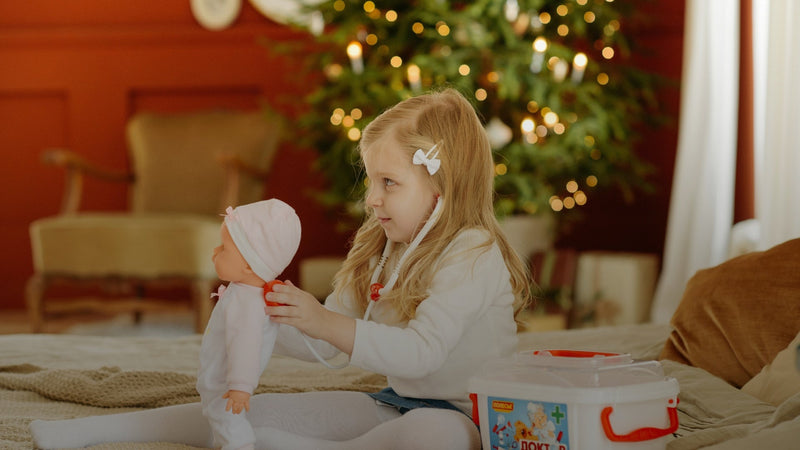
2. The Doctor's Clinic
A soft toy can become the patient.
A small bag can become a doctor's medical kit.
A blanket can become the hospital bed.
Your child can decide what is wrong with the patient and how they will help.
This can also give children an opportunity to recreate familiar experiences in their own way.
3. Animal Rescue Centre
Gather soft toys or animal figures and create an imaginary rescue centre.
Perhaps one animal has hurt its paw.
Another has become lost.
Your child can decide how the animals are cared for and where they go afterwards.
The story can change as often as they like.
4. Pretend Shop
Use empty food containers, a basket and some paper.
Your child can arrange the "products", create prices and decide who works at the shop.
You might be the customer.
Then swap roles if your child suggests it.
5. Space Mission
Turn a cardboard box or a small play space into a spaceship.
Where are you going?
What do you need to pack?
Who is travelling with you?
Let your child decide.
There is no need to make the science accurate.
The purpose is to create a story.
6. Camping Adventure
Build a tent using blankets and cushions.
Pack an imaginary backpack.
Pretend to cook dinner.
Look for "wild animals".
Tell stories around an imaginary campfire.
A living room can become a forest when imagination takes over.
7. Post Office
Create letters using scraps of paper.
Make envelopes from folded paper.
Give your child a small bag for deliveries.
They can decide who receives the letters and where the post office is located.
This can naturally encourage drawing, mark-making and storytelling.
8. Bakery
Set up a pretend bakery using bowls, wooden spoons and safe kitchen items.
Your child can invent cakes, biscuits and bread.
They might create a menu and decide what each customer wants.
If they ask you to be the baker, follow their instructions.
9. Construction Site
Use blocks, cardboard boxes and toy vehicles to create a building site.
What are they constructing?
A house?
A bridge?
A zoo?
A giant robot?
Let your child decide what the builders are working on.
10. Family Home
Sometimes the most interesting pretend play comes from ordinary family life.
Your child can pretend to cook dinner, put a toy to bed, go shopping or look after a baby.
These familiar routines give children opportunities to recreate experiences they see around them.
The American Academy of Pediatrics encourages parents to provide simple, safe objects that allow children to copy everyday actions and explore their interests through play.
Why Simple Pretend Play Often Works Best
Parents sometimes feel pressure to create elaborate activities.
But children do not need a Pinterest-perfect setup.
A few objects can be enough.
In fact, too many props can sometimes make it harder for children to decide what to do.
A scarf can become a superhero cape.
A cardboard tube can become a telescope.
A basket can become a boat.
A blanket can become a river.
The fewer instructions an object gives, the more room the child has to interpret it.
That is one reason open-ended materials are so valuable.
More Imaginative Play Ideas for Toddlers and Preschoolers
The beauty of pretend play is that it can grow with your child.
A toddler may be happy pretending to feed a teddy bear. A preschooler might turn the same teddy into a patient at a busy animal hospital, complete with appointments, treatments and a waiting room.
This progression does not require parents to constantly introduce more complicated toys. Children naturally add complexity as their language, experiences and imagination develop.
The best approach is often to provide a simple starting point and then let your child decide where the story goes.
The following ideas are designed as invitations rather than instructions. You can introduce the basic scenario, provide a few simple props and then step back.
11. Pirate Adventure
Turn a room, garden or play space into a pirate ship.
A cardboard box can become the ship's control room, while a scarf can become a pirate flag. Hide a few safe objects around the room as "treasure".
Your child can decide who the pirates are, where they are sailing and what happens when they discover the treasure.
You could ask, "Where are we sailing today?" and let their answer shape the adventure.
12. Dinosaur Expedition
Create an imaginary dinosaur expedition using toy dinosaurs, blocks, cardboard tubes or natural objects.
Your child could become the explorer searching for dinosaur tracks.
Perhaps they discover a dinosaur nest or have to find a safe way across a prehistoric river.
There does not need to be a correct storyline.
The value comes from giving children opportunities to create one.
13. Weather Station
Turn your child into a weather presenter.
Give them paper, crayons and perhaps a cardboard tube as an imaginary microphone.
They can look outside and announce the weather.
Then allow the imaginary forecast to become more adventurous.
Perhaps a snowstorm is approaching.
Maybe the garden is experiencing a hurricane.
What should everyone do?
This type of pretend play can combine observation with storytelling while allowing children to invent their own scenarios.
14. Fire Station
Create a pretend fire station using cardboard boxes, toy vehicles or household objects.
Your child can decide who the firefighters are and where they need to go.
A cushion might become a building that needs rescuing.
A soft toy could be waiting for help.
The story can encourage children to think about problems and possible solutions without turning the activity into a formal lesson.
15. Train Journey
Arrange chairs in a line to create a pretend train.
One child can become the driver while another becomes a passenger or ticket inspector.
Where is the train going?
What happens at the next station?
Who gets on?
Who gets off?
The beauty of this game is that the journey can change completely depending on what your child imagines.
16. Airport Adventure
Create an imaginary airport with paper tickets, a small bag and a few chairs.
Your child can check passengers in, pack luggage and announce departures.
Perhaps the flight is going to the moon.
Perhaps it is heading to a tropical island.
Maybe the plane has to make an unexpected stop.
These changes give children opportunities to develop narratives while keeping the activity open-ended.
17. Garden Centre
A collection of pots, leaves, toy plants or safe gardening tools can become an imaginary garden centre.
Your child can decide what is for sale.
They might create signs, arrange the plants and help customers choose what to take home.
If you have a real garden, the pretend activity can naturally connect with genuine gardening.
This combination of imaginative and practical experiences can be particularly engaging for young children.
18. Magical Kingdom
Give your child a few blankets, cushions, soft toys or dress-up materials and allow them to create a kingdom.
Who lives there?
Is there a castle?
Are there friendly dragons?
Who protects the kingdom?
The important thing is not the props.
It is the freedom to create an entire world from a few simple materials.
19. Underwater Expedition
Turn a play space into the bottom of the ocean.
Blue fabric or a blanket can represent water.
Soft toys can become sea creatures.
A cardboard box might become a submarine.
Your child can decide what the explorers discover.
Perhaps there is a hidden underwater city.
Maybe a friendly whale needs help.
The imaginary world can become as elaborate as your child wants.
20. Jungle Exploration
Create a pretend jungle using cushions, blankets, plants and animal figures.
Your child can become an explorer searching for hidden animals.
Perhaps they discover a new species.
Maybe they need to cross a river.
Maybe they are helping an animal find its family.
These scenarios give children opportunities to create problems, develop solutions and build stories.
Let Everyday Objects Become the Props
One of the simplest ways to encourage pretend play is to stop thinking of household objects only according to their intended purpose.
A cardboard box does not have to remain a box.
A blanket does not have to remain a blanket.
A wooden spoon does not have to remain a kitchen utensil.
Children can transform ordinary objects through imagination.
Try keeping a small basket of safe, open-ended items available for play.
You might include:
-
Scarves.
-
Cardboard boxes.
-
Empty containers.
-
Wooden spoons.
-
Cushions.
-
Blankets.
-
Paper and crayons.
-
Soft toys.
-
Cardboard tubes.
-
Old bags.
The purpose is not to create a themed activity.
It is to provide materials that children can reinterpret.
Give Children Time to Develop the Story
One of the easiest mistakes parents make is ending an activity too quickly.
A child might spend the first five minutes arranging objects without appearing to do much.
Then suddenly, a story begins.
The chairs become a train.
The train travels to a castle.
The castle becomes a hospital.
The hospital needs a rescue team.
What looked like "nothing happening" was actually the beginning of the play.
Children sometimes need time to move from exploration into deeper imaginative play.
This is particularly important when encouraging independent play.
Instead of asking, "What are you going to play with?" every few minutes, give your child time to discover it themselves.
Follow Their Ideas Instead of Directing Them
Imagine your child tells you that the sofa is a spaceship.
You might be tempted to suggest where the spaceship should go.
Instead, try asking,
"Where are we going?"
Your child might say Mars.
Then perhaps the next destination is the ocean.
Then suddenly Mars has disappeared because the sofa is now a submarine.
This flexibility is part of pretend play.
Children do not need to follow a logical sequence.
Their imaginary world can change instantly.
Following their ideas allows them to remain the creative decision-maker.
Expert Insight
The quality of play matters more than creating a perfect activity.
Research on pretend play suggests that richer, more complex pretend experiences can be associated with positive developmental outcomes, but the evidence does not support treating pretend play as a guaranteed way to improve individual skills.
For parents, the practical lesson is reassuring. You do not need to maximise every play opportunity. Focus on creating conditions where children can become genuinely engaged, make their own choices and enjoy the experience.
Common Mistakes That Can Limit Pretend Play
Pretend play works best when children have ownership of the experience.
Parents can unintentionally reduce that freedom by trying to make the activity too structured.
Giving Too Many Instructions
If you tell your child exactly what to do, where to put each object and what should happen next, the activity becomes adult-led.
Offer an idea instead.
Then step back.
Correcting Their Imagination
If your child says that a dinosaur can fly, you do not need to explain that dinosaurs did not have wings.
They are not writing a science textbook.
They are creating a story.
There is room for facts elsewhere.
Providing Too Many Props
A room full of themed toys can sometimes be less inspiring than a small collection of versatile objects.
Children need space to contribute their own ideas.
Expecting Long Periods of Independent Play Immediately
Independent play develops gradually.
Some children will happily play alone for extended periods.
Others need an adult nearby or prefer shorter periods of independent exploration.
Follow your child's developmental stage rather than comparing them with another child.
Creating a Space for Imagination
The environment can make imaginative play easier.
Children are more likely to return to pretend play when materials are accessible, and they have a predictable place where their ideas can unfold.
A cosy corner can become a reading space.
A blanket can become a fort.
A small basket can hold dress-up accessories.
A low shelf can display a few favourite books and open-ended toys.
The aim is not to create a perfectly themed playroom.
It is to create an environment that invites children to begin.
Where ZeeZee Adventures Fits Into Pretend Play
A dedicated imaginative play environment can give children a sense that they have somewhere to create, retreat, and build their own stories.
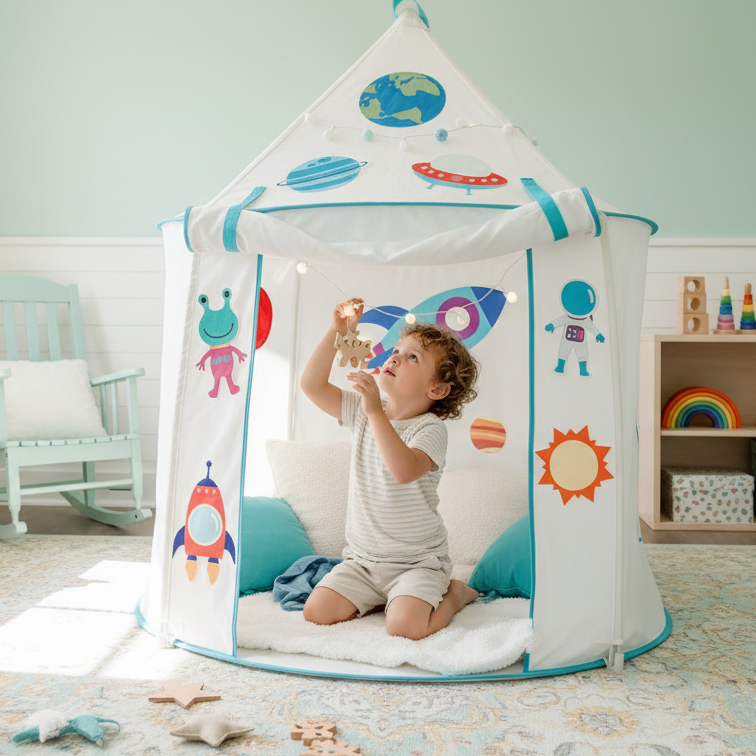
The ZeeZee Adventure Tent is designed around this idea. Its interchangeable StickeeZ themes allow the same familiar play space to become different imaginative worlds, giving children new starting points for storytelling without requiring an entirely new play environment.
One day the tent might become a jungle expedition.
Another day it might become a magical castle.
Later, it could simply become a quiet place to read or play with favourite toys.
The environment provides the setting, but the child decides what happens inside it.
That distinction is important.
The purpose is not to tell children how to play.
It is to give them a space where they can create their own adventures.

More Pretend Play Ideas, A Parent Checklist and FAQs
Pretend play can begin with something as simple as a toy animal or a cardboard box, but as children grow, their imaginary worlds can become increasingly detailed. They may create characters, invent rules, solve imaginary problems, and build stories that continue from one day to the next.
At this stage, parents do not need to make play more complicated. Instead, they can provide opportunities for children to take greater ownership of their stories. A few open-ended materials, an inviting environment, and uninterrupted time can be enough to encourage rich imaginative play.
The final ten ideas in this guide are designed to give older toddlers and preschoolers fresh starting points while still leaving plenty of room for their own creativity.
21. The Pretend Library
Create a small library using books your child already owns.
Your child can become the librarian, organise books, issue pretend library cards and help imaginary visitors choose stories.
You can even create a small desk using a table and some paper.
Let your child decide the rules of the library.
22. Space Station
Take the space mission one step further and create an entire space station.
A cardboard box can become a control panel.
Paper can become imaginary maps.
A few blocks can become equipment.
Your child might decide that astronauts need to repair the station, discover a new planet, or communicate with another spaceship.
There is no need for the scenario to follow real-world science.
The objective is to create an environment where your child can invent problems and solutions.
23. Veterinary Clinic
Soft toys make wonderful patients.
Your child can examine them, create imaginary treatments, and decide what each animal needs.
Perhaps a rabbit has hurt its paw.
Maybe a puppy is frightened.
Perhaps a lion needs a check-up before returning to the jungle.
This type of play can also create opportunities to explore caring relationships.
24. Detective Agency
Give your child a notebook and a pencil.
Hide a safe object somewhere in the room.
Now your child can become a detective searching for clues.
They might interview family members, draw maps, or create their own theories about what happened.
The mystery can be as simple or elaborate as your child wants.
25. Pretend Café
Set up a small café using cups, plates, napkins and paper menus.
Your child can decide what food is available and who works there.
Perhaps you are a customer.
Maybe a soft toy becomes another guest.
Encourage your child to create the menu and decide how the café operates.
26. Museum
Turn a shelf or table into an imaginary museum.
Your child can display toys, drawings, natural objects or small collections.
They can decide what each exhibit represents.
Then invite them to give you a museum tour.
This encourages storytelling while allowing your child to become the expert.
27. Theatre
Create a simple stage using a blanket or open space.
Your child can choose the characters and create a story.
Soft toys can become the audience.
Perhaps your child writes or draws tickets.
The performance does not need to be polished.
The process of creating the story is the important part.
28. Treasure Hunt
Hide a few safe objects around the home or garden.
Give your child a simple clue to begin.
They can then create their own treasure map and decide where the adventure leads.
Once they understand the idea, let them create a treasure hunt for you.
This reversal can be especially engaging because your child becomes the person designing the adventure.
29. Inventor's Workshop
Provide cardboard, paper, tape and other safe craft materials.
Tell your child they are an inventor.
What are they building?
A machine that cleans the house?
A flying vehicle?
A robot that looks after animals?
There is no need for the invention to work.
The imaginary design process is the play.
30. Step Inside a Storybook
Choose a favourite children's book and invite your child to recreate the story.
They might become the main character.
You could play another character.
Or your child might decide to change the ending completely.
Ask, "What would happen if the story went differently?"
That one question can turn a familiar book into a completely new imaginary adventure.
Let Children Change the Rules
One of the most important things to remember about pretend play is that children do not have to follow adult logic.
A library can suddenly become a spaceship.
A dinosaur can become the librarian.
A café can move underwater.
A teddy bear can become the mayor.
This flexibility is not a problem to correct.
It is imagination at work.
Children are allowed to change the rules because the imaginary world belongs to them.
When adults constantly correct these changes, we risk turning imaginative play into an exercise in following instructions.
Instead, allow the story to evolve.
What Parents Can Do When Play Seems to Stop
Sometimes children appear to run out of ideas.
That does not necessarily mean they need another toy.
They may simply need a small prompt.
Try introducing a problem rather than a solution.
"The café has run out of cups. What should we do?"
"The astronaut can't find the way home. How can we help?"
"The puppy is lost. Where should we look?"
A good prompt creates a new direction while leaving the solution to the child.
That preserves their role as the problem-solver.
Don't Be Afraid of Boredom
There can be a strong temptation to rescue children from boredom.
The moment they say, "I'm bored," an adult may offer an activity, switch on a screen or suggest something new.
But boredom can sometimes be the beginning of imaginative thinking.
When there is nothing immediately entertaining a child, they may begin looking around.
A cushion becomes a mountain.
A box becomes a vehicle.
A blanket becomes a hiding place.
An old cardboard tube becomes a telescope.
Not every moment of boredom will lead to elaborate pretend play, and children should not be expected to entertain themselves indefinitely.
But giving them occasional space to find their own ideas can be valuable.
Expert Insight
You do not need to maximise every play opportunity.
Pretend play is valuable because it is enjoyable and meaningful to children, not because parents need to turn every game into a developmental exercise. Research suggests relationships between pretend play and areas such as social competence and executive function, but it is important not to overstate the evidence or treat pretend play as a standalone intervention.
A balanced approach is therefore best: provide opportunities, observe your child and allow play to remain play.
A Parent's Pretend Play Checklist
Before introducing another activity, consider whether your child's environment already gives them enough freedom to imagine.
Create the conditions for imaginative play
☐ Keep a small collection of open-ended materials accessible.
☐ Provide books that can inspire stories.
☐ Allow safe household objects to become play props.
☐ Create a comfortable space where children can play without constant interruption.
☐ Give children enough uninterrupted time to develop their own ideas.
Follow rather than direct
☐ Ask your child what they are imagining.
☐ Let them choose the characters.
☐ Follow their rules when joining their game.
☐ Avoid correcting imaginary scenarios.
☐ Offer occasional prompts rather than constant instructions.
Encourage independent imagination
☐ Allow your child to play alone when they are comfortable doing so.
☐ Resist the urge to provide a new activity every time they become bored.
☐ Let favourite imaginary games continue across several days.
☐ Rotate a few props rather than constantly buying new toys.
☐ Remember that your child's imagination does not need to look like yours.
Conclusion
Thirty pretend play ideas can provide inspiration, but the real goal is not to work through a list.
It is to help children discover that they can create their own ideas.
Once a child understands that a blanket can become a cave, they no longer need an adult to tell them what to play.
The blanket becomes whatever their imagination needs it to be.
That is the beauty of child-led pretend play.
It can start with a simple suggestion and then become something completely unexpected.
A restaurant becomes a hotel.
The hotel becomes a spaceship.
The spaceship lands in a jungle.
The jungle becomes a dinosaur world.
The story keeps changing because the child keeps changing it.
This flexibility gives pretend play its remarkable richness.
And parents do not need to be involved in every moment.
You can provide the materials.
You can create an inviting environment.
You can join when your child asks.
Then you can step back.
Your child may surprise you with what happens next.
The purpose of pretend play is not to produce the perfect imaginary world.
It is to give children the freedom to create one.
Frequently Asked Questions
What is the best pretend play activity for toddlers?
There is no single best activity. Simple scenarios based on familiar experiences, such as playing restaurant, caring for a soft toy or going shopping, can be particularly accessible for toddlers.
How can I encourage pretend play?
Provide open-ended materials, give children uninterrupted time and follow their interests. You can introduce a simple idea or prop, then allow your child to decide how the story develops.
Do children need special toys for pretend play?
No. Everyday objects such as cardboard boxes, blankets, wooden spoons, paper, cushions and safe household containers can become imaginative props.
Should I play pretend with my child?
You can, particularly when your child invites you into their game. Try following their ideas rather than directing the story.
Is pretend play good for independent play?
Pretend play can provide opportunities for children to create and direct their own stories. Some children naturally engage in independent imaginative play, while others prefer playing with adults or peers.
What if my child says they are bored?
Boredom can sometimes lead to independent ideas, although children should not be expected to manage boredom constantly. Offer time and space before immediately providing another activity.
How long should pretend play last?
There is no ideal duration. Children vary considerably. A child may play for five minutes one day and become deeply absorbed for much longer on another occasion. Follow their interest rather than focusing on a specific target.
Internal Linking Suggestions
For a strong ZeeZee Adventures content cluster, naturally link this article to:
-
Why Pretend Play Is Essential for Child Development
-
The Benefits of Open-Ended Play for Child Development
-
How Montessori Play Encourages Independence
-
Montessori Play Ideas You Can Try at Home Today
-
Why Screen-Free Play Improves Focus and Creativity
-
50 Screen-Free Activities Kids Will Actually Love
-
How to Keep Kids Entertained Without Screens
Author Bio
The ZeeZee Play Experts
The ZeeZee Play Experts are dedicated to helping families create calmer, more imaginative childhoods through purposeful play. Drawing on insights from child development, occupational therapy, and early childhood education, they create practical, evidence-informed resources for parents. Their work encourages children to explore, imagine and develop confidence through meaningful, screen-free experiences.




Comment (0)