
Open-Ended Toys vs Electronic Toys: Which Is Better?
Introduction
Walk into almost any toy shop today, and you will find two very different kinds of play sitting side by side.
On one shelf, there are wooden blocks, puzzles, books, dolls, building sets, and art materials.
On another, there are toys that sing, flash, move, talk, respond to touch, or connect to a digital device.
For parents, the choice can feel surprisingly complicated.
Are traditional toys better for development?
Do electronic toys make children less creative?
Should you avoid toys with lights and sounds?
Or are we making the decision far too complicated?
The answer is more nuanced than simply choosing one category over the other.
Open-ended toys and electronic toys can both have a place in childhood. What matters is the kind of experience each toy creates and how children are able to participate in that experience.
An electronic toy may provide structure, feedback, and entertainment. An open-ended toy may leave more of the decision-making to the child.
Neither automatically makes a toy good or bad.
The more useful question is:
Does this toy encourage my child to actively think, create, explore, and interact, or does it do most of the work for them?
That is where the real comparison begins.
Quick Answer
Open-ended toys are often particularly valuable for imaginative, child-led play because they allow children to decide what to create and how to use the materials. Electronic toys can also offer enjoyable and purposeful experiences, particularly when children actively participate rather than simply watch or follow predetermined prompts. For most families, the best approach is not choosing one category exclusively, but creating a balanced toy environment with different kinds of play.
Key Takeaways
-
Open-ended toys generally give children greater freedom to decide how play unfolds.
-
Electronic toys can provide structure, feedback and interactive experiences.
-
Neither category is automatically better in every situation.
-
A balanced toy collection can provide opportunities for imaginative, physical, social and structured play.
-
The most important consideration is the quality of the child's interaction with the toy.
What Is an Open-Ended Toy?
An open-ended toy is a play material that can be used in multiple ways and does not have one predetermined outcome.
Think about wooden blocks.
A child can use them to build a tower, house, bridge, road or imaginary city.
The toy does not dictate the story.
The child does.
Other examples include:
-
Building blocks
-
Construction materials
-
Dolls and figures
-
Art supplies
-
Play dough
-
Books
-
Loose parts
-
Pretend-play props
-
Dress-up materials
-
Blankets and cushions
-
Imaginative play environments
The defining characteristic is possibility.
The child has to contribute something.
What Is an Electronic Toy?
Electronic toys use batteries, electricity, or digital technology to provide some form of interaction.
They might make sounds, move, light up, respond to touch, or offer programmed activities.
Examples include interactive books, talking toys, electronic games, programmable robots and app-connected toys.
These toys can provide children with clear feedback and structured experiences.
They may be useful in particular contexts.
But the way a child interacts with an electronic toy matters.
There is a meaningful difference between a child actively programming a simple robot and a child repeatedly pressing a button simply to trigger the same animation.
The technology itself does not tell us everything about the quality of play.
The Biggest Difference: Who Controls the Play?
Perhaps the simplest way to compare the two categories is to ask:
Who is making most of the decisions?
With an open-ended toy, the child often has to decide what happens next.
With a highly programmed electronic toy, many decisions may already have been made by the designer.
For example, a set of blocks might require a child to decide:
"What should I build?"
An electronic toy might instead ask:
"Can you press the red button?"
Both can be engaging.
But they exercise different kinds of thinking.
Open-ended play tends to leave more space for children to generate their own ideas.
Open-Ended Toys and Creativity
Creativity needs room.
When children play with open-ended materials, there is usually no single correct outcome.
A drawing can become anything.
A block structure can take any shape.
A pretend-play story can change halfway through.
This freedom encourages children to make decisions.
They can experiment.
They can change direction.
They can combine materials.
They can invent problems and solutions.
The child becomes the creator rather than simply the participant.
That distinction is one of the strongest arguments for including open-ended materials in a child's toy collection.
Electronic Toys Can Provide Useful Structure
It would be unfair to suggest that electronic toys offer no developmental value.
Some electronic toys can introduce concepts, provide feedback or encourage children to engage with a particular challenge.
For some children, clear rules and predictable responses can make an activity particularly appealing.
Structured play also has value.
Children can learn to follow rules, wait for turns and work towards a defined goal.
The concern arises when highly programmed experiences dominate a child's play environment and leave little opportunity for children to invent their own activities.
Balance matters.
Expert Insight
Look beyond the toy category.
Child development experts generally agree that play quality depends on more than whether a toy is traditional, electronic, expensive or educationally branded.
Consider the child's role.
Are they making decisions?
Communicating?
Moving?
Problem-solving?
Creating?
Experimenting?
Or mainly responding to instructions provided by the toy?
That distinction can tell parents far more than the label on the packaging.
Open-Ended Toys and Independent Play
Independent play becomes easier when children have materials they can access and understand without constant adult assistance.
A child can pick up a book.
Start drawing.
Build with blocks.
Arrange toy animals.
Create a pretend shop.
These activities can continue without an adult providing the next instruction.
Electronic toys can also be used independently, but the experience depends heavily on the design.
A highly programmed toy may continue directing the child from one activity to another.
An open-ended toy generally requires the child to generate more of the activity themselves.
This is why open-ended materials are particularly useful when parents want to gradually encourage self-directed play.
What About Sensory Play?
Another important difference is the physical experience.
Open-ended toys often involve direct interaction with materials.
Children can feel the weight of blocks.
Shape modelling dough.
Turn the pages of a book.
Move pieces around a puzzle.
Draw across paper.
Build a structure with their hands.
Electronic toys can certainly involve physical interaction, but the experience may be more closely tied to the programmed response.
For families interested in creating sensory-rich play environments, a mixture of tactile, movement-based, and imaginative materials can provide valuable variety.
Comparison: Open-Ended Toys vs Electronic Toys
|
Open-Ended Toys |
Electronic Toys |
|
Usually have multiple possible uses |
Often have programmed functions |
|
Encourage children to create scenarios |
May provide predefined scenarios |
|
Leave more room for imagination |
Can provide structured interaction |
|
Often support child-led play |
May guide children through activities |
|
Can change as children develop |
Some may be outgrown more quickly |
|
Often require children to generate ideas |
Often provide prompts or feedback |
|
Can encourage physical manipulation |
May combine physical and digital responses |
|
Often support flexible storytelling |
Can provide clear rules and outcomes |
This comparison is not a judgement.
It simply highlights that different toys can create different kinds of experiences.
So Which Is Better for Creativity?
If the goal is to give children maximum freedom to invent stories, create scenarios and explore possibilities, open-ended toys generally have an advantage.
A child has to provide the missing pieces.
They decide what the blocks represent.
They create the characters.
They invent the rules.
They decide when the story changes.
Electronic toys can support creativity too, particularly when they allow children to design, programme, construct or create rather than simply consume.
The important distinction is not "electronic versus traditional".
It is active creation versus passive consumption.
So Which Is Better for Independent Play?
Again, the answer depends on the design.
A simple construction set can allow a child to begin playing without adult involvement.
A highly programmed electronic toy may also allow independent use, but it may provide most of the structure.
If your goal is to encourage children to generate their own activities, open-ended toys are often a strong choice.
They provide a starting point without necessarily providing the entire experience.
The Role of Boredom
There is another reason open-ended toys can be valuable.
They can encourage children to create their own entertainment.
When a child has a limited number of materials and plenty of time, they may eventually begin combining them in unexpected ways.
A blanket becomes a cave.
Blocks become a city.
A box becomes a spaceship.
A child who initially says "I'm bored" may eventually discover an idea.
Boredom does not guarantee creativity.
But children need some opportunities to experience moments when nobody else is providing the entertainment.
Choosing the Right Toy for Your Child
Rather than asking whether open-ended or electronic toys are universally better, consider your child's needs.
Ask:
What does my child already enjoy?
Do they need more opportunities for imaginative play?
Would they benefit from a structured challenge?
Can they use this toy without constant adult support?
Will they be able to use it in different ways?
Does it encourage active participation?
Can it grow with their abilities?
These questions lead to better decisions than simply following trends.
Don't Feel Guilty About Owning Electronic Toys
This deserves to be said clearly.
If your child's toy box contains electronic toys, you have not failed at creating an imaginative childhood.
Children can enjoy both.
A talking toy might be fun.
A digital game might be engaging.
A building set might encourage creativity.
A book might provide quiet concentration.
A pretend-play space might inspire an entire imaginary world.
Childhood does not need to be divided into "good toys" and "bad toys".
It needs variety.
Creating a Balanced Toy Collection
A thoughtful toy collection might include a mixture of experiences.
You could have a few structured games alongside open-ended building materials.
Some books alongside pretend-play resources.
Creative materials alongside favourite electronic toys.
The goal is not to count how many toys belong to each category.
Instead, ask whether your child has opportunities to:
-
Imagine.
-
Build.
-
Create.
-
Move.
-
Communicate.
-
Solve problems.
-
Explore independently.
-
Follow rules.
-
Play socially.
-
Enjoy quiet concentration.
A balanced collection can support a balanced childhood.
How ZeeZee Adventures Fits Into Open-Ended Play
The philosophy behind ZeeZee Adventures is closely connected to the value of open-ended play.
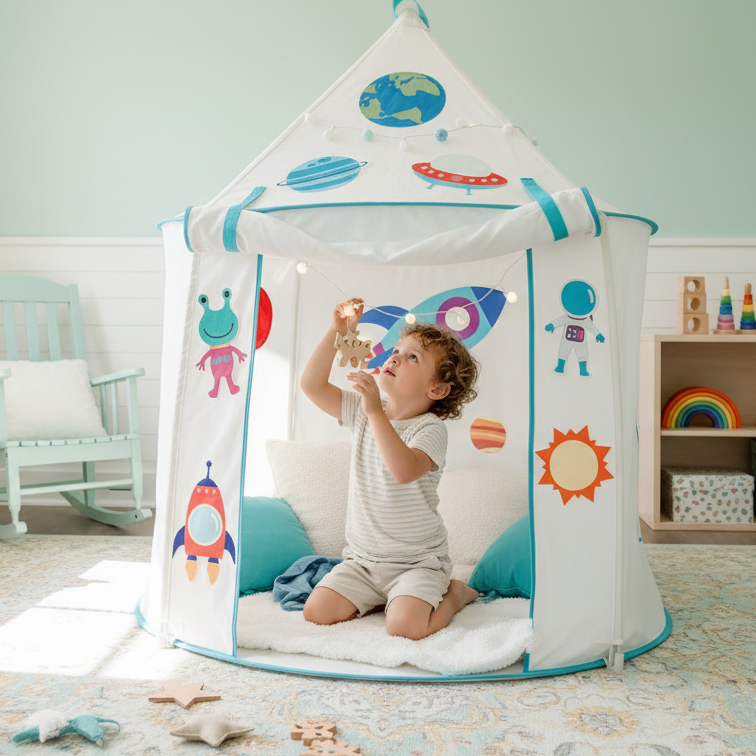
The ZeeZee Adventure Tent is designed as a calm, sensory-friendly environment where children can read, imagine, create, and explore without relying on screens.
Its interchangeable StickeeZ themes allow the same familiar environment to become different imaginary settings.
The tent might become a jungle one afternoon.
A castle the next.
A space station later.
The product does not provide a fixed storyline.
The child creates one.
That is what makes the environment useful for imaginative and independent play.
It provides the setting while leaving the story open.

The Best Toy Is Not Always the Most Advanced
We often assume that newer means better.
In technology, that assumption can make sense.
In play, it is less straightforward.
A more sophisticated toy is not necessarily more imaginative.
Sometimes the toy that does less gives the child more to do.
That is the quiet strength of open-ended play.
It leaves room.
Room for questions.
Room for mistakes.
Room for experimentation.
Room for stories.
Room for a child to decide:
"What should happen next?"
And that may be one of the most valuable questions a toy can encourage.
Understanding What Different Toys Offer Children
The most useful way to compare open-ended and electronic toys is not to ask which category is universally better.
Instead, ask what kind of experience each toy creates.
Some toys give children a clear structure. Others provide an almost blank canvas. Some encourage children to follow rules, respond to prompts or reach a specific outcome. Others ask children to invent the rules, create the story and decide when the activity is finished.
Children can benefit from both experiences.
The challenge for parents is making sure that highly structured or stimulating play does not become the only kind of play available. A balanced play environment gives children opportunities to follow, respond, create, imagine, move and lead.
Open-Ended Toys and Creativity
Creativity flourishes when children have opportunities to make choices.
Consider a building set.
If the instructions provide every step and the finished model is the main objective, the child is practising following a sequence and constructing towards a specific outcome.
That can be valuable.
But if the same materials are available without a fixed design, the child has to decide what to build.
Perhaps it becomes a house.
Then a bridge.
Then a vehicle.
Then something that nobody expected.
This is where open-ended play becomes particularly interesting.
The child is not simply completing an activity.
They are generating possibilities.
Electronic Toys and Structured Learning
Electronic toys can offer a different kind of experience.
A toy might introduce a child to letters, numbers, music, patterns or problem-solving through prompts and immediate feedback.
For some children, that structure can be engaging.
Clear instructions can make an activity easier to understand, particularly when a child is learning a new concept.
The important consideration is how actively the child participates.
An electronic toy that asks children to solve problems or make choices creates a different experience from one where the child primarily watches animations or repeatedly presses a button to trigger a predetermined response.
Technology itself is not the deciding factor.
The child's role is.
Which Type Encourages More Independent Play?
Independent play is about more than whether a child is physically alone.
It is about whether they can initiate and direct an activity.
Open-ended toys often lend themselves naturally to this because they do not provide every next step.
A child can pick up some blocks and decide what to build.
They can open a book and look through the pages.
They can take some crayons and create a picture.
They can arrange toy animals and invent a story.
Electronic toys can also support independent play, particularly when children can use them without adult assistance.
However, highly programmed toys may continue to provide the prompts, storyline and structure.
If your goal is to give your child more opportunities to generate their own ideas, including open-ended materials in their play environment can be especially useful.
What About Concentration?
Both structured and open-ended activities can require concentration.
The difference is often in what children need to concentrate on.
With a puzzle, children may need to remember shapes, compare pieces and persist when something does not fit.
With a construction activity, they may need to plan, balance materials and adjust their design.
With an electronic game, they may need to follow rules, respond quickly or remember instructions.
The most useful approach is not to assume that one category automatically produces better concentration.
Instead, give children different opportunities to focus in different ways.
Some activities can provide clear goals.
Others can allow children to determine their own goals.
Problem-Solving Looks Different in Different Types of Play
Problem-solving is another area where both types of toys can offer valuable experiences.
Imagine a child building a tower.
It falls.
They try again.
Perhaps they change the base.
Perhaps they use larger blocks.
Perhaps they decide to make it shorter.
They have encountered a problem and created their own solution.
An electronic game might present a different challenge.
The child has to work out how to complete a level, remember a sequence or respond to a particular problem.
Both experiences involve thinking.
The difference is that open-ended play often allows the child to define the problem themselves.
That can create a particularly rich form of exploration because the child decides what they are trying to achieve.
Sensory and Physical Experiences
Open-ended toys can also provide extensive opportunities for hands-on exploration.
Children can feel different textures.
Move objects.
Stack materials.
Squeeze modelling dough.
Turn pages.
Draw lines.
Build structures.
Carry and arrange objects.
These activities connect play with physical movement and sensory exploration.
Electronic toys can involve physical interaction too, but their sensory experience is often connected to the programmed response.
A button produces a sound.
A movement triggers an animation.
A touch activates a feature.
Again, neither is automatically better.
They simply provide different experiences.
For families wanting to create a rich sensory play environment, a mixture of tactile materials, movement opportunities, and imaginative resources can be useful.
Imaginative Play Gives Children a Voice
Pretend play is one area where open-ended materials can be particularly powerful.
A child can take a simple object and give it an entirely new meaning.
A block becomes a phone.
A blanket becomes a river.
A chair becomes a train.
A soft toy becomes a patient waiting to see the doctor.
Children create characters, relationships and stories.
They can also explore experiences that are difficult to talk about directly.
A child who has recently visited the doctor might recreate the experience through pretend play.
A child preparing for a new sibling might use dolls to act out family routines.
The adult does not always need to interpret these stories.
Sometimes children simply need the freedom to explore them.
Social Play: Where Both Types Can Have a Place
Play also provides opportunities for children to learn how to interact with others.
Board games can teach children to take turns and follow agreed rules.
Construction activities can encourage cooperation.
Pretend play can involve negotiation and shared storytelling.
Electronic games can sometimes provide social interaction too, particularly when children play cooperatively.
The important thing is not whether an activity is electronic.
It is whether children have regular opportunities to communicate, negotiate, listen and respond to other people.
A balanced play environment can provide many different ways to practise these skills.
Expert Insight
Children do not need every play experience to look educational.
Play is valuable because children are actively making sense of their world.
A child does not need to complete a worksheet or use a toy designed around a particular learning objective for development to be taking place.
Building, pretending, drawing, talking, and experimenting can all provide meaningful opportunities to practise developing skills.
Open-Ended Toys Often Have Long-Term Play Value
One of the biggest advantages of open-ended materials is that their possibilities can change as children develop.
A toddler may stack blocks.
A preschooler may construct buildings.
An older child may create an entire imaginary world.
The same materials can remain relevant because the child brings new abilities and ideas to them.
Some electronic toys have similar longevity, particularly when they offer increasingly complex challenges.
Others can become less interesting once the child has learned all the available functions.
This is worth considering when evaluating value.
The question is not simply:
"How long will my child own this toy?"
It is:
"How many different experiences can this toy support?"
Choosing Toys Based on Your Child's Interests
There is no universal toy collection that works for every child.
A child fascinated by animals may spend far longer engaged with animal figures and books than with a sophisticated electronic learning toy.
A child who loves construction may become deeply absorbed in blocks.
Another child may prefer puzzles.
Another may enjoy drawing.
Another may love music.
Pay attention to what your child repeatedly chooses.
Their interests can give you useful clues about what is likely to encourage sustained play.
You do not have to follow every trend.
Your child's curiosity is often the better guide.
How to Build a Balanced Toy Collection
A balanced toy collection does not need to contain equal numbers of open-ended and electronic toys.
Instead, think about whether your child has access to different kinds of experiences.
You might include:
Open-ended materials for imagination and creativity.
Construction toys for building and problem-solving.
Books for language and quiet engagement.
Puzzles and games for structured challenges.
Creative materials for self-expression.
Pretend-play resources for storytelling.
Electronic toys for appropriate interactive and structured experiences.
The objective is variety.
Children should have opportunities to both follow and lead.
You Don't Need to Remove Every Electronic Toy
If your home already contains electronic toys, there is no reason to feel guilty.
You don't need to throw them away to create a more imaginative play environment.
Instead, consider how they fit within your child's wider play experience.
You might establish periods when screens are put away and open-ended materials become more accessible.
You could also keep a mixture of toys available and allow your child to move between different forms of play.
Balance is more realistic than perfection.
Create an Environment That Encourages Choice
Sometimes parents focus so heavily on the toy that they overlook the environment.
A child may own wonderful open-ended materials but still struggle to engage with them if everything is buried in a large storage box.
Try making a small selection visible and accessible.
Keep books within reach.
Create clear floor space for construction.
Place creative materials somewhere your child can safely access them.
Give imaginative play its own space.
When children can see their options, they may find it easier to initiate play without waiting for an adult to organise it.
How ZeeZee Adventures Fits Into the Picture
A play environment can add another dimension to open-ended play by giving children a setting for their imagination.
The ZeeZee Adventure Tent is designed as a calm, sensory-friendly space where children can read, create, imagine, and explore away from screens.
Its interchangeable StickeeZ themes allow the same familiar environment to support different imaginative scenarios.
The tent might become a jungle.
Then a castle.
Then a space station.
The child decides what the environment represents.
This means the product is not designed to replace a child's existing toys.
Blocks, books, soft toys, dolls and other favourite materials can become part of the adventure.
The tent simply provides a setting in which those materials can be used differently.
That is the strength of an open-ended environment.
It does not dictate the story.
It gives children somewhere to create one.
A Better Question Than "Which Is Better?"
After comparing the two categories, the answer becomes clearer.
Instead of asking:
"Are open-ended toys better than electronic toys?"
Ask:
"Does my child have enough opportunities to actively create, explore and direct their own play?"
If the answer is yes, you are probably providing a healthy variety of experiences.
If the answer is no, you do not necessarily need to buy a completely new toy collection.
Start with what you already have.
Bring out the blocks.
Make the books accessible.
Put some crayons on the table.
Create a cosy space.
Turn off the screen for a while.
Then give your child time.
Sometimes the most valuable part of play is not what the toy does.
It is what the child is able to do because the toy leaves room for them.
How to Make the Right Choice for Your Child
After comparing open-ended and electronic toys, the answer is not that one category needs to disappear from your child's life.
The better approach is to think about balance, purpose and participation.
A child can enjoy an electronic toy and still need plenty of time with blocks, books, puzzles, art materials and pretend-play resources. Likewise, owning a room full of wooden toys does not automatically guarantee imaginative or independent play.
What matters most is the experience your child is having.
Are they actively involved?
Are they making decisions?
Are they creating?
Are they communicating?
Are they solving problems?
Are they sometimes able to decide what happens next?
These are much more useful questions than simply asking whether a toy is electronic or traditional.
A Simple Framework for Choosing Toys
Before buying a toy, try thinking about it through five questions.
1. What does my child actually enjoy?
Start with your child's interests rather than the latest trend.
If they love building, look for construction materials.
If they love stories, consider books and pretend-play resources.
If they enjoy drawing, make creative materials accessible.
Children are more likely to engage deeply with something that connects to their existing curiosity.
2. Who controls the experience?
Does the toy provide the entire activity?
Or does your child have to make decisions and contribute ideas?
The more opportunities children have to direct their own play, the more space there is for self-expression.
3. Can the toy be used in different ways?
A toy with multiple possibilities can remain interesting for longer.
Think about blocks, dolls, figures, art materials, and construction sets.
4. Can my child eventually use it independently?
If the toy requires constant adult assistance, it may be less suitable for independent play.
5. Will it still be useful as my child develops?
Look for materials that can become more interesting as your child's skills and imagination grow.
Think About Your Child's Stage of Development
There is no universal "best toy" for every age.
A toy that is perfect for a preschooler may be too difficult for a toddler.
Likewise, a toy that fascinates a two-year-old may become less challenging later.
For younger children, simple activities such as stacking, sorting, matching, looking at books and manipulating large objects can provide valuable opportunities for exploration.
As children become more capable, they can often manage more complex construction, puzzles, pretend play, crafts and games.
Rather than buying something because it carries an impressive age recommendation, observe your child.
Look for the point where the activity is challenging enough to be interesting but not so difficult that it becomes discouraging.
Let Your Child Lead
One of the easiest ways to make play more meaningful is to step back.
This can be surprisingly difficult for adults.
We see the blocks and immediately think:
"Let's build a house."
We see the art materials and think:
"Let's make this picture."
We see the puzzle and want to show the child where each piece belongs.
But sometimes children benefit from figuring things out themselves.
Instead of demonstrating everything, try asking:
"What do you think you could make?"
Then wait.
Give your child time to experiment.
If they ask for help, provide support.
But avoid solving every problem before they have had a chance to try.
When Electronic Toys Can Be Useful
Electronic toys can provide structured experiences that some children enjoy.
They may introduce concepts through interactive activities, provide immediate feedback or create opportunities to follow rules and complete challenges.
Some children may also find predictable responses engaging.
The important thing is to consider how the technology is being used.
An electronic toy that encourages active problem-solving creates a different experience from one that primarily asks children to watch, listen or repeatedly activate a predetermined response.
Parents do not need to choose between technology and traditional play.
Instead, consider whether your child has enough variety.
Create a "Both, Not Either" Toy Collection
A healthy toy environment does not need to be completely open-ended or completely electronic.
Think about creating a collection that gives children different ways to play.
You might have:
Building materials for construction and problem-solving.
Books for quiet engagement and storytelling.
Art materials for creativity and self-expression.
Pretend-play resources for imagination and social development.
Puzzles and games for structured challenges.
Electronic toys for interactive experiences.
The goal is not to make every activity educational.
It is to give children different opportunities to think, create, move, communicate and explore.
Toy Rotation Can Make Play Feel New Again
If your child seems uninterested in their toys, you may not need to buy anything.
Try putting some away.
Keep a smaller selection accessible.
After some time, rotate the materials.
A construction set that has been ignored for several weeks can suddenly feel interesting again.
Toy rotation can also reduce visual clutter and make it easier for children to choose an activity.
The objective is not to create a perfectly minimalist playroom.
It is simply to make play feel manageable.
Build Around Your Child's Interests
Your child's interests are one of the best guides you have.
If they are fascinated by animals, create a small animal world with figures, books and building materials.
If they love space, provide opportunities to draw planets, construct rockets and invent stories about astronauts.
If they love cooking, let them participate in age-appropriate kitchen activities.
This approach can transform ordinary materials into deeply engaging play.
You do not necessarily need a themed toy for every interest.
Often, children can create the theme themselves.
Common Mistakes Parents Make
Parents often feel pressure to make the "perfect" choice.
But toy selection does not need to be complicated.
Avoid these common mistakes:
Buying toys solely because they are labelled educational.
A toy's value comes from how a child interacts with it, not simply from the wording on the packaging.
Assuming more features mean more value.
More sounds, lights and functions do not necessarily create better play.
Buying too many toys.
A smaller selection can sometimes make it easier for children to focus.
Expecting independent play immediately.
Children develop this skill gradually.
Taking over when play becomes difficult.
Give children time to attempt problems before stepping in.
Comparing your child with other children.
Some children naturally prefer longer periods of independent play. Others need more interaction.
The Play Environment Can Be More Important Than the Toy
Consider the difference between these two situations.
In one room, toys are scattered everywhere.
Books are mixed with building blocks.
Art materials are difficult to find.
There is little clear floor space.
In another, a small selection of materials is accessible.
There is a comfortable place to sit.
Books are easy to reach.
There is enough space to build.
There is a dedicated area for imaginative play.
The toys might be identical.
The experience can still feel completely different.
A calm environment can help children understand their choices and become more comfortable initiating their own play.
A Dedicated Space Can Encourage Imagination
Children often enjoy having somewhere that feels like their own.
A reading corner can become a retreat.
A small table can become an art studio.
A section of the bedroom can become a construction area.
A play tent can become an entire imaginary world.
This is one of the principles behind ZeeZee Adventures.
The ZeeZee Adventure Tent provides a calm, sensory-friendly environment designed for imaginative, screen-free play.
Its interchangeable StickeeZ themes allow the same space to change with a child's interests.
One day, the tent might become a jungle.
Another day, it might be a castle.
Later, it could become a cosy reading corner.
The environment provides the setting.
The child creates the story.
That makes it complementary to other open-ended materials rather than a replacement for them.
A Balanced Childhood Does Not Need Perfect Balance Every Day
Some days will be screen-heavy.
Perhaps your child is ill.
Perhaps the weather is terrible.
Perhaps you have work to finish.
Perhaps everyone simply needs a quiet afternoon.
That is family life.
You do not need to compensate for every screen-based experience with an elaborate educational activity.
Instead, think about the overall rhythm of your child's life.
Do they regularly have opportunities to play outdoors?
Create?
Read?
Build?
Talk?
Move?
Imagine?
Explore independently?
If the answer is generally yes, you are already creating a varied play environment.
The Five-Question Toy Test
When you're standing in a shop or browsing online, remember these five questions:
1. Will my child actively participate?
2. Can they make choices?
3. Can they use it in different ways?
4. Can it grow with their abilities?
5. Does it complement the other types of play they already have?
If a toy passes several of these questions, it may be worth considering.
And if it does not, that does not necessarily mean it is a bad toy.
It simply means you should understand what kind of experience it is designed to provide.
The Real Question Is Not "Which Is Better?"
Open-ended toys and electronic toys serve different purposes.
Electronic toys can provide structure, feedback and interactive experiences.
Open-ended toys can provide freedom, imagination, and opportunities for children to create their own outcomes.
The strongest approach is often to make room for both while ensuring that children regularly experience play where they are the ones directing the action.
Because children need opportunities to follow instructions.
But they also need opportunities to invent them.
They need to complete activities.
But they also need opportunities to decide when an activity becomes something completely different.
They need entertainment.
But they also need imagination.
Conclusion
The debate over open-ended toys versus electronic toys can easily become a debate about "good" and "bad" parenting.
It does not need to be.
Technology is part of modern childhood.
So are blocks, books, drawing, pretend play, outdoor exploration and quiet moments of imagination.
The goal is not to eliminate one category.
It is to make sure children have access to a wide variety of experiences.
When choosing toys, look beyond the label.
Look at the child.
Look at the environment.
Look at the possibilities.
Ask whether the toy gives your child opportunities to create, decide, explore, and experiment.
Sometimes the most valuable toy in the room is not the one with the most features.
It is the one that leaves enough space for the child to add something of their own.
And that space is where imagination begins.
Frequently Asked Questions
Are open-ended toys better than electronic toys?
Neither category is universally better. Open-ended toys often provide more opportunities for child-led imagination, while electronic toys can provide structure and interactive feedback. A balanced collection can include both.
Do electronic toys reduce creativity?
Not automatically. The effect depends on how the toy is designed and used. Electronic experiences that involve active creation and problem-solving can be very different from experiences where children mainly watch or respond to predetermined prompts.
What are examples of good open-ended toys?
Blocks, construction materials, art supplies, dolls, toy animals, modelling materials, books and imaginative play resources are common examples.
Which toys are best for independent play?
Toys that children can access and use without constant adult assistance can support independent play. Blocks, books, puzzles, art materials and pretend-play resources are useful options.
Should I remove electronic toys from my child's playroom?
Not necessarily. Instead of removing them completely, consider whether your child also has regular opportunities for hands-on, imaginative, physical, and social play.
How many toys should a child have?
There is no universal number. A manageable selection can make it easier for children to focus and choose activities. Rotating toys can also help maintain interest.
Can a play tent encourage independent play?
Yes. A dedicated play environment can give children somewhere familiar to read, imagine, and explore. The benefit depends on how the child is encouraged to use the space and whether they have freedom to direct their own play.
Internal Linking Suggestions
For the ZeeZee Adventures content ecosystem, naturally link this article to:
-
Why Screen-Free Toys Are Making a Comeback
-
How to Choose Toys That Encourage Independent Play
-
Why Screen-Free Play Improves Focus and Creativity
-
50 Screen-Free Activities Kids Will Actually Love
-
The Ultimate Guide to Raising Screen-Smart Kids
-
Cozy Culture Goes Big as Screen-Free Play Tops 2026 Toy Trend Lists
-
How Montessori Play Encourages Independence
Author Bio
The ZeeZee Play Experts
The ZeeZee Play Experts are dedicated to helping families create calmer, more imaginative childhoods through purposeful play. Drawing on insights from child development, occupational therapy, and early childhood education, they create practical, evidence-informed resources for modern parents. Their work focuses on sensory-friendly, imaginative play environments that give children space to explore, create, and develop confidence.




Comment (0)