
A Parent's Guide to Building a Screen-Free Toy Collection
Part 1: Building a Toy Collection That Invites Children to Play
Walk into almost any home with young children, and you will probably find the same thing.
A basket overflowing with toys.
A shelf filled with puzzles.
A cupboard full of forgotten craft supplies.
Perhaps a few toys that were exciting for a week and then quietly disappeared beneath everything else.
And yet, when children are asked what they want to play with, they may still say:
"I don't know."
This is one of the reasons building a screen-free toy collection is not simply about buying more toys.
It is about choosing better opportunities for play.
A thoughtful collection does not need to contain dozens of products. It needs enough variety to support different kinds of play while giving children plenty of room to make their own decisions.
The goal is not to recreate a toy shop at home.
It is to create an environment where children can easily find something that invites them to build, imagine, create, explore, or simply become absorbed in their own ideas.
Quick Answer
A good screen-free toy collection should include a balanced selection of open-ended, creative, building, pretend-play, sensory, and quiet-play materials. Focus on toys that children can use in multiple ways, that match their developmental abilities and that can grow with their interests. You do not need hundreds of toys. A smaller, thoughtfully chosen collection can provide more meaningful opportunities for independent and imaginative play.
Key Takeaways
-
A screen-free toy collection is about quality and variety, not quantity.
-
Open-ended toys can give children more freedom to create their own play.
-
A balanced collection should offer different ways to build, imagine, create, explore, and relax.
-
Toys that grow with children can provide value for much longer.
-
Toy rotation can reduce clutter while keeping familiar materials interesting.
-
The play environment is just as important as the toys themselves.
What Is a Screen-Free Toy Collection?
A screen-free toy collection is simply a selection of physical play materials that children can use without relying on screens, apps, or digital entertainment.
It might include building blocks, books, puzzles, art materials, dolls, toy animals, construction sets, pretend-play props and sensory resources.
There is no single formula.
The right collection depends on your child's age, interests, abilities, and personality.
The important thing is to create variety without overwhelming the child.
A collection should provide different possibilities for play while remaining manageable enough for children to see what is available.
You Don't Need a Toy-Filled House
One of the easiest assumptions to make is that more toys automatically create more opportunities for play.
It sounds logical.
More toys should mean more choices.
But an enormous number of choices can sometimes make play more difficult to initiate.
When every shelf, basket, and corner is filled with something competing for attention, children may struggle to decide where to begin.
This is one reason a smaller collection can sometimes feel more inviting.
Instead of asking:
"How many toys should my child have?"
Consider asking:
"Does my child have enough different ways to play?"
That is a much more useful question.
A child may need something to build, something to create, something to imagine with, something to read, and something to explore physically.
They do not necessarily need ten versions of each.
Start With Different Types of Play
A useful screen-free collection should provide opportunities for different kinds of play.
Think about your child's day.
Sometimes they may want to build.
Sometimes they want to pretend.
Sometimes they need something quiet.
Sometimes they want to make a mess and create.
Sometimes they simply want to move.
A balanced collection can accommodate those changes.
Building and Construction
Blocks and construction materials encourage children to create physical structures and experiment with balance, shape and space.
They can build towers, houses, roads, bridges or completely imaginary creations.
The possibilities change as children develop.
Creative Play
Paper, crayons, washable paints, modelling materials and age-appropriate craft supplies provide opportunities for children to create something that did not exist before.
There does not need to be a finished product.
The process itself can be the play.
Pretend Play
Dolls, animals, costumes, and simple props allow children to create stories and explore different roles.
Pretend play can transform an ordinary afternoon into an elaborate imaginary adventure.
Quiet Play
Books, puzzles and simple tabletop activities provide opportunities for children to slow down and concentrate.
Not every play experience needs to involve movement or noise.
Sensory and Hands-On Play
Materials that children can touch, manipulate, pour, squeeze, stack or move can provide rich physical experiences.
The key is always to choose materials that are safe and appropriate for the child's age and developmental stage.
Open-Ended Toys Are Especially Valuable
If there is one quality to prioritise when building a screen-free toy collection, it is versatility.
Open-ended toys can be used in multiple ways and do not dictate one specific outcome.
A wooden block can be a building block.
It can also become food in a pretend kitchen.
A phone in an imaginary game.
A wall in a castle.
A stepping stone in an indoor adventure.
The toy does not change.
The child's interpretation does.
This gives children opportunities to practise decision-making and imagination while allowing the same materials to remain interesting over time.
Expert Insight
Think about what the child contributes.
Child development professionals often value play experiences that allow children to make choices, experiment, and create their own ideas. When a toy leaves room for the child to decide what happens next, the child becomes an active participant rather than simply following a predetermined sequence.
When building your collection, ask:
"How much of the play is coming from the toy, and how much is coming from my child?"
That question can be surprisingly revealing.
Choose Toys That Grow With Your Child
A toy collection becomes much more sustainable when the materials can evolve alongside your child.
Consider blocks again.
A young toddler may enjoy stacking them.
A slightly older child may build simple structures.
A preschooler may create elaborate buildings.
Later, those same structures may become part of a complex imaginary world.
The blocks have not become more advanced.
Your child has.
This is why toys with multiple levels of possibility can offer excellent long-term value.
You are not simply buying something for today's interest.
You are choosing something that may continue to support play as your child's abilities change.
Follow Your Child's Interests
There is no universal list of toys that every child needs.
A collection should reflect the child who is actually living in your home.
If your child loves animals, a few animal figures and books may provide endless possibilities.
If they love building, construction materials may become the centre of their play.
If they love stories, books and pretend-play props might be more valuable.
If they are fascinated by drawing, creative materials may be the most frequently used items in the house.
Observe what your child repeatedly returns to.
Their interests are useful information.
You do not need to force variety simply for the sake of variety.
Instead, use their natural curiosity as a starting point.
Quality Does Not Always Mean Expensive
Building a thoughtful toy collection can become expensive if you assume every item needs to be premium, handcrafted, or made from a particular material.
That is not necessary.
Quality is about more than price.
A quality toy should be safe, durable enough for its intended use, and capable of providing meaningful opportunities for play.
A cardboard box can be incredibly valuable.
So can a stack of paper.
A blanket.
A collection of wooden blocks.
A well-loved book.
The value of a play material comes from the experience it creates, not simply its price tag.
Create Space for Imagination
A screen-free toy collection becomes much more powerful when children have somewhere to use it.
A child may have beautiful building materials, but if there is nowhere to spread them out, construction becomes difficult.
They may have dozens of books, but if they are stored out of reach, choosing one requires adult help.
They may have pretend-play props, but without enough space to move around, the story may never develop.
This is why the environment matters.
Children benefit from having accessible materials and enough physical space to explore them.
A small, comfortable corner can be enough.
It does not need to be a dedicated playroom.
Don't Forget the Value of Nothing
This might sound strange in an article about building a toy collection.
But leaving some space empty is important.
Children need physical space to move.
They need visual space to focus.
And they need imaginative space to decide what happens next.
If every moment is filled with a toy, activity, or screen, there may be fewer opportunities for children to create their own ideas.
A thoughtful toy collection therefore includes something parents cannot buy.
Time.
Time to explore.
Time to repeat.
Time to become bored.
Time to invent.
Time to return to something familiar and discover a completely new way to use it.
A Simple Starting Point
If your current toy collection feels overwhelming, don't try to reorganise the entire house in one afternoon.
Start with one small area.
Choose a few materials from different categories.
Perhaps:
One building activity.
One creative activity.
One pretend-play activity.
A few favourite books.
One puzzle or quiet activity.
Then observe.
What does your child choose?
What do they ignore?
What do they return to?
What do they combine?
Those observations can help you build a collection around actual play rather than assumptions about what children "should" enjoy.
The Goal Is Not a Perfect Toy Collection
There is no perfect shelf.
No perfect number of toys.
No perfect Montessori-style arrangement that guarantees independent play.
Children are individuals.
Their interests change.
Their energy changes.
Their needs change.
Some days your child may spend an hour constructing something.
Other days they may want to sit beside you and read.
Both experiences matter.
A thoughtful screen-free toy collection simply makes it easier for children to find opportunities for meaningful play when they are ready.
Where ZeeZee Adventures Fits In
A screen-free collection does not have to be limited to individual toys.
The environment itself can become part of the play.
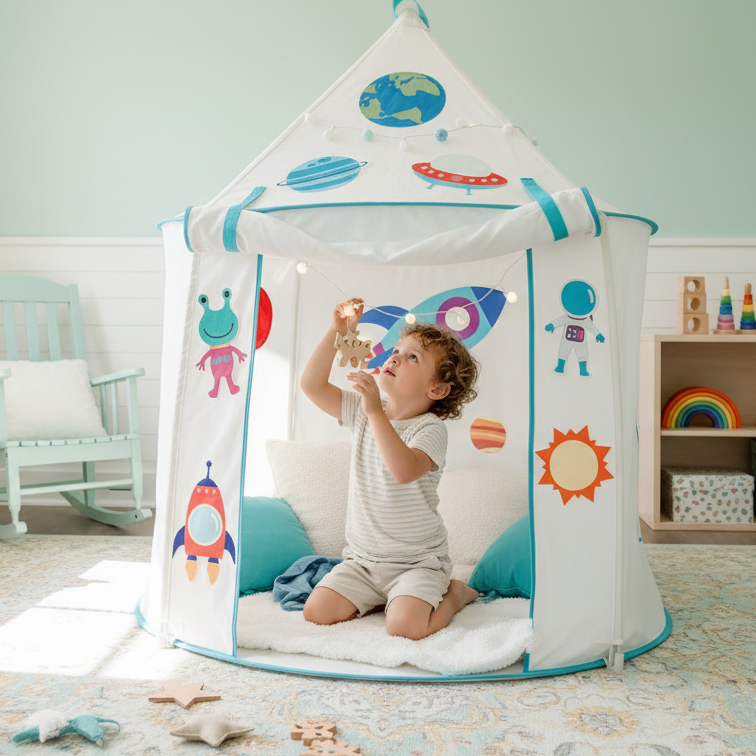
The ZeeZee Adventure Tent is designed as a calm, sensory-friendly space where children can read, imagine, and create their own adventures.
Its interchangeable StickeeZ themes allow the same familiar environment to evolve with a child's interests.
One day, the tent can become a jungle.
Another day, a castle.
Another day, a cosy reading retreat.
The physical space stays familiar, but the possibilities change.
This makes it easy to combine the tent with other screen-free materials already in your home.
Books can become part of a reading nook.
Soft toys can become characters.
Building blocks can become part of an imaginary world.
Art materials can inspire stories.
The tent provides the setting.
Your child decides what happens there.

Building a Screen-Free Collection Is Really About Building Possibilities
The best screen-free toy collection is not the one with the most products.
It is the one that gives children enough possibilities to discover their own interests.
Something to build.
Something to imagine.
Something to create.
Something to read.
Something to explore.
And enough empty space between those things for a new idea to appear.
That is the real purpose of a thoughtful toy collection.
Not keeping children constantly occupied.
Not creating a picture-perfect playroom.
But giving them the materials, environment, and freedom to become active participants in their own childhood.
How to Build a Collection That Works for Your Family
Once you stop thinking about a toy collection as a shopping list, the process becomes much easier.
You do not need one perfect toy from every category. You do not need to buy everything at once. And you certainly do not need to recreate an expensive playroom you have seen online.
Instead, think about possibilities.
Can your child build something?
Can they make something?
Can they pretend?
Can they solve a problem?
Can they read quietly?
Can they move and explore?
Can they use familiar materials in a completely new way?
A well-balanced screen-free collection gives children access to different types of experiences while leaving enough room for them to decide what they want to do.
The Essential Categories for a Screen-Free Toy Collection
A useful collection can be built around a handful of broad play categories.
These categories are not rules. They are simply a way to identify whether your child has enough variety.
Building and Construction
Blocks, stacking materials, and construction sets can provide opportunities for children to explore balance, size, shape, and space.
The same materials can support different levels of play as children develop.
A toddler may stack two or three blocks.
A preschooler may construct a house.
An older child may create a complex structure and incorporate it into an imaginary story.
Building materials are therefore particularly useful when you want toys that can remain relevant for years.
Creative Materials
Creative play gives children a way to make something rather than simply interact with something that has already been made.
Paper, crayons, washable paints, modelling dough and age-appropriate craft materials can all provide opportunities for self-expression.
Try not to make every creative activity about producing a particular finished object.
A child does not always need to make a perfect butterfly, house or flower.
Sometimes drawing lines, mixing colours or experimenting with materials is enough.
The process is part of the play.
Pretend and Imaginative Play
Pretend play allows children to transform ordinary objects into extraordinary experiences.
A toy animal can become a family member.
A chair can become a bus.
A blanket can become a cave.
A cardboard box can become a shop.
Simple props can provide the starting point, but children create the story.
This makes pretend-play materials particularly useful for a screen-free collection because they can provide endless variations without needing to constantly introduce something new.
Books and Quiet Activities
Not every part of a toy collection needs to be energetic.
Books, puzzles and simple tabletop activities can create opportunities for quieter engagement.
A comfortable reading corner can encourage children to return to favourite stories independently.
Puzzles can provide a manageable challenge.
Memory games and simple board games can introduce rules, turn-taking and concentration.
These quieter experiences can be especially useful during transitions, such as before bedtime or after a busy day.
Sensory and Hands-On Materials
Children experience their environment through movement and touch.
Simple materials can offer rich sensory experiences without requiring sophisticated equipment.
Water.
Sand.
Modelling dough.
Natural materials.
Fabric.
Wood.
Paper.
These can all become part of play when used safely and appropriately.
Remember that sensory preferences differ between children. Some children seek particular textures and movements, while others may find certain sensations uncomfortable.
Follow your child's cues rather than assuming every sensory activity will be enjoyable.
How to Choose Toys for Different Ages
A screen-free toy collection should evolve as your child develops.
For toddlers, choose materials that are simple to understand and physically manageable. Large building pieces, board books, chunky art materials, stacking toys and simple pretend-play objects can provide accessible opportunities for exploration.
As children approach the preschool years, their play often becomes more elaborate. They may enjoy construction, role play, puzzles, drawing, storytelling and activities involving more than one step.
Older children can often handle greater complexity, including more advanced construction, crafts, strategy games and imaginative projects.
The important thing is to observe the individual child.
Age recommendations are useful safety guidance, but they cannot tell you everything about what will engage your child.
Interest, ability, and temperament matter too.
Building a Screen-Free Toy Collection on a Budget
A screen-free collection does not need to be expensive.
Start with what you already have.
Before buying anything, look around your home for safe everyday materials that could become part of imaginative or creative play.
A cardboard box can become a playhouse.
Old fabric can become part of a pretend costume.
Paper can become maps, menus or storybooks.
Kitchen utensils can become props for pretend play when used safely and with appropriate supervision.
Nature can provide leaves, sticks and stones for exploration outdoors.
The goal is not to replace every commercial toy with household objects.
It is to recognise that children do not need expensive products to experience meaningful play.
Quality Over Quantity
When buying new toys, consider long-term usefulness rather than short-term excitement.
A toy that fascinates your child for three days and then sits untouched may not offer the same value as a simple material they use repeatedly for years.
Ask whether the toy can:
-
Be used in different ways.
-
Combine with other materials.
-
Encourage imaginative play.
-
Develop alongside your child.
-
Be used independently.
-
Support repeated exploration.
This approach can make a collection smaller, more manageable, and more intentional.
Toy Rotation: A Simple Way to Reduce Clutter
If your home is overflowing with toys, rotation can be useful.
Instead of keeping every toy accessible at once, choose a smaller selection and store the rest safely.
After some time, exchange a few materials.
A familiar toy can suddenly feel interesting again.
Rotation can also make it easier for children to see their options.
If there are twenty different activities spread across the floor, choosing one can feel overwhelming.
If there are four or five visible choices, the decision may feel much simpler.
You do not need a strict schedule.
Observe your child's interest and rotate when the available materials begin to lose their appeal.
How to Reduce Toy Clutter Without Creating Conflict
Decluttering children's toys can be surprisingly emotional.
A toy that looks completely useless to an adult may be incredibly important to a child.
Instead of suddenly removing large amounts of belongings, involve your child where appropriate.
You can create simple categories such as:
Keep: Toys your child regularly uses.
Store: Special items or toys that may be useful later.
Donate: Items your child has clearly outgrown and is comfortable passing on.
Recycle or discard: Broken or unsafe items that cannot be reused.
For younger children, parents will naturally make more of these decisions themselves.
The aim is not to achieve minimalism.
It is to create a play environment where children can actually engage with what they have.
Open-Ended Versus Single-Purpose Toys
A balanced collection can contain both.
Single-purpose toys can provide structure.
Open-ended toys provide flexibility.
For example, a simple puzzle has a clear objective.
A set of blocks does not.
Both can be valuable.
The important thing is to avoid creating a collection where every toy has a predetermined outcome.
Children also need materials that allow them to invent their own rules and stories.
A useful balance might include a few puzzles and games alongside building materials, creative supplies, and pretend-play resources.
Create Combinations, Not Just Categories
One of the easiest ways to extend play is to allow different toys to work together.
Imagine combining:
Blocks + toy animals + books
The child might build a zoo and then create stories about the animals.
Or:
Art materials + cardboard boxes + pretend play
Now the child can design signs for their imaginary shop.
Or:
Books + soft toys + a cosy play space
The child can create their own reading retreat.
This is where a thoughtfully chosen collection becomes more than a group of individual products.
The materials begin interacting.
One toy provides the setting.
Another provides the characters.
Another provides the story.
The child connects everything together.
The Environment Can Do Some of the Work
Parents often focus heavily on the toys themselves.
But the environment matters just as much.
If children can see their books, they are more likely to choose one.
If building materials are accessible, they can begin constructing without asking for help.
If there is enough floor space, they can spread out.
If there is a comfortable corner for quiet play, they have somewhere to retreat when they need less stimulation.
This is why a play environment should be considered part of the collection.
You are not simply choosing objects.
You are designing possibilities.
Don't Become Your Child's Activity Director
There is a subtle trap that can happen when parents become enthusiastic about screen-free play.
We start creating activities constantly.
"Let's make this."
"Now let's build that."
"Why don't we try this activity?"
The intention is wonderful.
But children also need time to initiate their own ideas.
Instead of filling the day with structured activities, provide materials and allow your child to decide what to do.
You can occasionally introduce a suggestion, then step back.
Your child does not need you to turn every afternoon into a lesson.
Sometimes they simply need permission to explore.
Expert Insight
A good toy collection should support different levels of adult involvement.
Some activities are naturally social and work best with a parent or sibling.
Others can be explored independently.
A balanced collection gives children opportunities for both. The goal is not to remove adults from play, but to make sure children also have materials they can confidently explore on their own.
A Screen-Free Collection Should Feel Personal
There is no universal shopping list.
One family's ideal collection may be filled with construction materials.
Another may revolve around books and pretend play.
Another may have art materials everywhere.
The right collection reflects the child.
Pay attention to what they return to.
What makes them curious?
What do they talk about?
What do they build?
What stories do they repeat?
Those observations can guide future purchases far better than trends or advertisements.
Where ZeeZee Adventures Fits Into the Collection
Sometimes the most valuable addition to a screen-free toy collection is not another toy.
It is a place where the toys can come together.
The ZeeZee Adventure Tent is designed as a calm, sensory-friendly environment for imaginative, independent, and screen-free play.
Its interchangeable StickeeZ themes allow the same familiar space to evolve as children's interests change.
A child might bring books inside and use it as a quiet reading corner.
They might take soft toys inside and create an imaginary family.
They might combine building materials with the themed environment and construct an entire adventure around it.
The tent becomes part of the story without controlling the story.
That is an important distinction.
It creates a setting where children can bring their own ideas rather than simply consuming someone else's.
Building a Toy Collection Is an Ongoing Process
You do not need to complete your collection this weekend.
In fact, it is probably better not to.
Start with what your child already enjoys.
Notice what is missing.
Add slowly.
Rotate regularly.
Remove what is no longer useful.
Let the collection evolve alongside your child.
A thoughtful toy collection is not a finished product.
It is something that changes as children change.
And perhaps that is the most important thing to remember.
You are not trying to create the perfect playroom.
You are creating opportunities for your child to discover what they can do.
A Practical Guide to Creating a Collection That Lasts
Building a screen-free toy collection is not about reaching a magic number of toys.
It is about creating a collection that works for your child, your home, and your family's everyday routine.
The most useful collection is one that offers different ways to play without overwhelming children with too many choices. It should give them opportunities to build, create, imagine, read, solve problems, and explore, while leaving enough room for them to decide what they want to do.
And perhaps most importantly, it should not create more pressure for parents.
You do not need to become a toy curator.
You simply need to become a thoughtful observer of your child's play.
The Screen-Free Toy Collection Checklist
Before buying another toy, take a look at what your child already has.
A balanced collection might include opportunities for:
Building
☐ Blocks or construction materials
☐ Stacking or connecting toys
☐ Materials that encourage creating structures
Creativity
☐ Paper and drawing materials
☐ Modelling materials
☐ Age-appropriate craft supplies
Imaginative Play
☐ Dolls or figures
☐ Toy animals
☐ Pretend-play props
☐ Costumes or simple dress-up materials
Quiet Play
☐ Books
☐ Puzzles
☐ Simple tabletop games
Sensory and Physical Exploration
☐ Materials with different textures
☐ Opportunities for pouring, sorting, or manipulating
☐ Safe opportunities for movement and exploration
Independent Play
☐ Toys your child can access independently
☐ Materials they already understand how to use
☐ A comfortable place where they can play without constant adult direction
You do not need something from every category.
The checklist is simply a way to identify whether your child's collection offers enough variety without unnecessary duplication.
A Simple Balanced Collection
If you are starting from scratch, avoid buying everything at once.
Instead, begin with a small foundation.
For a toddler, this might include a few board books, large building blocks, simple puzzles, chunky drawing materials, and a handful of pretend-play objects.
For a preschooler, you might add more complex construction materials, imaginative-play props, art supplies, puzzles and simple games.
As children grow, you can gradually introduce materials that require more planning, problem-solving, and creativity.
The collection should evolve.
It does not need to be completed.
Common Mistakes Parents Make
Building a screen-free collection can become surprisingly complicated when we allow marketing to make the decisions for us.
One toy promises to develop creativity.
Another promises early learning.
Another claims to improve concentration.
Soon, the playroom is full.
Yet the child still wants to play with the same three things.
There is nothing wrong with choosing toys that support development, but children do not need every toy to have a measurable learning objective.
Play itself is valuable.
Mistake 1: Buying too many toys
More choices do not always create better play.
Start with fewer materials and observe what your child actually uses.
Mistake 2: Buying according to trends
A toy can be popular without being right for your child.
Your child's interests are a much better guide.
Mistake 3: Choosing toys that are too difficult
A toy that constantly requires adult help may discourage independent exploration.
Look for manageable challenges.
Mistake 4: Replacing everything at once
You do not need to remove every electronic or single-purpose toy from your home.
Add alternatives gradually.
Mistake 5: Directing too much play
If you constantly show children what they should make, they have less opportunity to develop their own ideas.
Offer an invitation and then step back.
How to Maintain Your Collection Over Time
A good toy collection needs occasional attention.
Every few months, look at what is actually being used.
Are there toys your child has clearly outgrown?
Are there broken items that need replacing?
Are there materials that could be stored for later?
Are there toys that could be combined to create new play possibilities?
You might also notice that your child's interests have changed.
A child who once loved toy animals may now be fascinated by construction.
A child who previously wanted to draw may suddenly become interested in pretend play.
Your collection should be allowed to change with them.
Try a Toy Rotation
If your home feels overwhelmed by toys, consider rotating them.
Keep a smaller selection available and store some safely away.
After a period of time, replace a few items.
This can make familiar toys feel interesting again.
It also makes the play environment easier to navigate.
Instead of walking into a room filled with possibilities, your child sees a manageable selection.
That can make it easier to choose.
There is no perfect rotation schedule.
You can simply change things when your child begins losing interest.
Don't Forget the Most Important Things
A screen-free toy collection needs more than toys.
It needs time.
Children need enough uninterrupted time to become absorbed in what they are doing.
They need space.
They need somewhere to build, draw, read and move.
And they need freedom.
Freedom to make mistakes.
Freedom to change their minds.
Freedom to use a toy in a way you did not expect.
This is why parents should not feel pressure to constantly introduce new activities.
Sometimes the most valuable thing you can provide is time to explore what is already there.
What About Family Play?
Independent play is important, but children also need shared experiences.
A healthy toy collection should provide opportunities for both.
A board game can bring everyone together.
A construction project can become a parent-child activity.
A pretend restaurant can involve siblings.
A book can become part of a bedtime routine.
The purpose of independent play is not to remove adults from children's lives.
It is to give children opportunities to experience themselves as capable creators while still enjoying connection with the people they love.
Expert Insight
Look for balance rather than a perfect formula.
There is no single toy collection that works for every child. Children have different interests, developmental profiles, and temperaments. A balanced collection offers opportunities for independent exploration, imaginative play, creative expression, movement, quiet concentration, and social interaction.
The best collection is the one your child actually uses.
Frequently Asked Questions
How many screen-free toys should a child have?
There is no universal number. A smaller collection with a good variety of play possibilities can be more useful than a large collection filled with similar toys.
What are the best screen-free toys for independent play?
Open-ended materials such as blocks, books, art supplies, puzzles, construction sets, and pretend-play resources can encourage children to direct their own activities.
Are wooden toys better than plastic toys?
Material alone does not determine the value of a toy. What matters is how children can use it. A plastic toy can support excellent open-ended play, just as a wooden toy can be highly restrictive.
How often should I rotate my child's toys?
There is no fixed schedule. Rotate toys when your child seems to have lost interest or when the play environment becomes difficult to manage.
Should I remove electronic toys?
Not necessarily. A balanced childhood can include technology alongside plenty of opportunities for physical, social, imaginative and screen-free play.
How can I encourage my child to play independently?
Make suitable toys accessible, create a comfortable play environment, start with short periods and gradually step back from directing the activity.
Is a play tent useful for a screen-free toy collection?
A play tent can become an additional environment for reading, pretend play, quiet time, and imaginative exploration. Its value depends on how children choose to use the space.
A Final Thought for Parents
You do not need a perfect playroom.
You do not need hundreds of toys.
And you certainly do not need to keep buying something new every time your child says they are bored.
A thoughtful screen-free collection is much simpler than that.
Give children a few interesting materials.
Make them accessible.
Create enough space to use them.
Protect some uninterrupted time.
Then allow imagination to do its work.
Children are naturally curious.
They want to understand how things work.
They want to tell stories.
They want to build.
They want to pretend.
They want to explore.
Our role is not to fill every moment with entertainment.
It is to create the conditions in which children can discover their own reasons to play.
Creating a Space for Screen-Free Adventures
Sometimes a toy collection needs a place where everything can come together.
The ZeeZee Adventure Tent is designed as a calm, sensory-friendly environment where children can read, imagine, and explore independently.
The interchangeable StickeeZ themes allow the same familiar space to evolve with children's interests.
A child might turn it into a jungle one day, a castle the next, and a quiet reading nook another day.
Books, soft toys, building materials, and other screen-free resources can all become part of the experience.
The tent does not determine the story.
The child does.
That is what makes it a natural complement to a thoughtfully built screen-free toy collection.




Comment (0)