
How to Choose Toys That Encourage Independent Play
What makes a toy genuinely useful for independent play, and how can parents choose materials that encourage children to explore, imagine and problem-solve without constant adult direction?
Introduction
There is a particular moment many parents know well.
You have finally finished making breakfast. The washing is waiting. Your coffee has gone cold. Your child has a room full of toys, yet somehow they are standing beside you saying:
"Play with me."
It is completely normal.
Young children are not born knowing how to play independently for long periods. Independent play develops gradually as children become more confident exploring their environment, making decisions and sustaining their own ideas.
The toys available to them can either support this process or make it harder.
A toy that requires an adult to operate, explain or constantly participate may keep a child entertained, but it does not necessarily encourage independent play. By contrast, an open-ended toy that a child can access, understand and use in different ways can give them greater ownership of their experience.
Choosing toys for independent play is therefore not simply about finding something that will keep your child occupied.
It is about asking a more meaningful question:
"What does this toy allow my child to do?"
The answer can tell you a great deal about whether it is likely to support creativity, concentration, problem-solving, and independent exploration.
Quick Answer
The best toys for independent play are accessible, age-appropriate, and open-ended enough for children to make their own choices. Look for toys that can be used in multiple ways, do not require constant adult direction, and can grow with your child's developing abilities. Blocks, books, art materials, pretend-play resources, puzzles, and imaginative play spaces can all support independent exploration when children are given enough time and freedom to use them.
Key Takeaways
-
Independent play is a skill that develops gradually, not something children are expected to master immediately.
-
Toys should invite children to make decisions rather than simply follow instructions.
-
Open-ended materials can encourage creativity, problem-solving and imaginative thinking.
-
A child's environment is just as important as the toys themselves.
-
Parents can support independent play without becoming their child's full-time entertainer.
What Does Independent Play Actually Mean?
Independent play means a child is able to engage with an activity without needing an adult to direct every part of the experience.
It does not necessarily mean playing completely alone.
A child might play independently while a parent is reading nearby, preparing dinner or working in the same room.
The important part is that the child is directing the play.
They decide what to do.
They decide how to use the materials.
They decide when to change the story or try something different.
For younger children, independent play may last only a few minutes. As children develop confidence and concentration, those periods can gradually become longer.
This is why parents should avoid treating independent play as a test.
The goal is not to see how long a child can entertain themselves.
The goal is to help them become increasingly comfortable initiating and sustaining their own play.
Independent Play Is Not the Same as Leaving a Child Alone
This distinction matters.
Giving a child a room full of toys and walking away does not automatically create independent play.
Children need a foundation of security, connection, and appropriate opportunities before they can confidently explore without constant adult involvement.
Parents still have an important role.
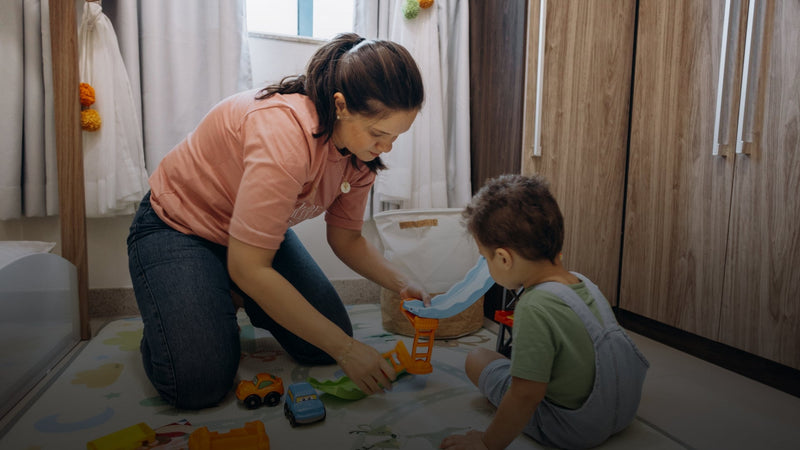
You might introduce a new material, demonstrate how something works, help when a child becomes genuinely stuck, and then gradually step back.
Think of yourself as creating the conditions for independent play rather than managing every moment of it.
This approach can be especially helpful for toddlers and preschoolers who are still learning how to sustain attention and develop their own play ideas.
What Makes a Toy Good for Independent Play?
Not every toy needs to be open-ended.
A simple puzzle can encourage independent problem-solving.
A favourite book can support quiet exploration.
A construction set can encourage planning and creativity.
What matters is the relationship between the child and the toy.
Before buying something new, consider whether it offers opportunities for your child to take the lead.
A strong independent-play toy will often have several characteristics.
It is accessible.
It is understandable.
It can be used without constant adult assistance.
It allows some choice.
It can be repeated.
It may have more than one possible outcome.
Most importantly, it gives the child something meaningful to do rather than simply asking them to watch.
1. Choose Open-Ended Toys
Open-ended toys have no single correct way to be used.
Blocks are a classic example.
They can become buildings, roads, animals, furniture, or imaginary worlds.
Art materials work in a similar way.
A sheet of paper can become a drawing, a map, a storybook, or part of a larger craft project.
Open-ended materials give children room to make decisions.
That freedom can support creativity because the child has to generate ideas rather than simply respond to instructions.
2. Choose Toys That Match Your Child's Abilities
A toy can be wonderful and still be wrong for your child at a particular moment.
If it is far too difficult, the child may quickly become frustrated.
If it is far too simple, they may lose interest.
Look for the middle ground.
The toy should be achievable with some effort while still offering room for growth.
For toddlers, this might mean large blocks, simple puzzles, chunky crayons, stacking materials, or practical activities.
For preschoolers, it might include more complex construction materials, pretend-play resources, drawing materials, and simple board games.
The right level of challenge can make independent play feel rewarding rather than overwhelming.
3. Look for Toys That Do Not Need an Adult to Operate Them
Ask yourself how much involvement the toy requires from you.
Does your child need you to switch it on?
Do you need to explain what happens next?
Does the activity have a fixed sequence that requires adult assistance?
Or can your child simply pick it up and begin?
The easier it is for children to initiate play themselves, the greater the opportunity for genuine independence.
This does not mean electronic toys have no place in childhood.
It simply means parents should consider whether their child's toy collection includes materials that allow them to become the active creator of the experience.
Expert Insight
Independent play begins with ownership.
Child development professionals generally recognise that children benefit from opportunities to make choices and direct their own activities. When children can access suitable materials and decide how to use them, they practise skills such as planning, problem-solving and self-directed attention.
4. Choose Toys That Grow With Your Child
The most useful toys do not necessarily become irrelevant when a child reaches the next developmental stage.
A set of blocks can grow with a child.
So can books, art materials, pretend-play resources, and many construction toys.
At first, a toddler may simply stack blocks.
Later, they may build structures.
Eventually, they may use those structures as part of elaborate imaginative stories.
The toy remains familiar.
The child's abilities change.
This is one reason open-ended materials can offer excellent long-term value.
5. Look for Opportunities for Imaginative Play
Imaginative play gives children the opportunity to create their own worlds.
A cardboard box can become a house.
A blanket can become a cave.
A chair can become part of a train.
A collection of toy animals can become the characters in an elaborate story.
When choosing toys, consider whether they leave room for this kind of transformation.
The more a child has to contribute to the story, the more ownership they have over the play.
6. Consider Sensory Experiences
Children learn through their senses.
Touching.
Moving.
Building.
Pouring.
Squeezing.
Drawing.
Manipulating.
Screen-free toys naturally provide many opportunities for physical interaction.
Wooden blocks have weight and texture.
Modelling materials can be squeezed and shaped.
Art materials leave visible marks.
Construction toys require children to physically manipulate objects.
These experiences can make play feel more engaging because children are actively interacting with the physical world.
The Play Environment Matters
Even the best toy may struggle to hold a child's attention if the environment is overwhelming.
Imagine a room filled with toys.
Cars everywhere.
Books scattered across the floor.
Art materials mixed together.
Building blocks under the furniture.
When everything is available at once, children may struggle to decide where to begin.
A calmer environment can make independent play easier.
Try offering a smaller selection of materials.
Keep them visible and accessible.
Give each type of toy a clear place.
Create enough floor or table space for children to work.
This does not require a minimalist home.
It simply means making it easier for children to see their choices.
You Don't Need to Buy More Toys
This may be the most important point in the entire article.
If your child struggles with independent play, buying another toy is not always the answer.
Look at what you already have.
Could you rotate some materials?
Could you create a quieter play area?
Could you remove some visual clutter?
Could you give your child more uninterrupted time?
Could you introduce one familiar activity and allow them to explore it without immediately stepping in?
Sometimes changing the environment is more effective than adding another product.
What About Electronic Toys?
Electronic toys can certainly be enjoyable.
They can introduce sounds, stories, and interactive experiences.
The issue is not whether they are good or bad.
It is whether they are balanced with other types of play.
A child who has access only to highly programmed toys may have fewer opportunities to practise creating their own play scenarios.
Providing a mixture of materials gives children different ways to engage.
Some toys can provide structure.
Others can provide freedom.
Both can have a place.
The important thing is to make sure children regularly have opportunities to be the ones deciding what happens next.
Common Mistakes Parents Make
Choosing toys for independent play can become unnecessarily complicated.
Parents sometimes assume that more expensive means more valuable, or that a toy needs to have an educational purpose to be worthwhile.
Neither is necessarily true.
|
Common Mistake |
A Better Approach |
|
Buying too many toys at once |
Offer a manageable selection |
|
Choosing toys with too many features |
Look for opportunities for child-led exploration |
|
Expecting instant independent play |
Build the skill gradually |
|
Taking over when a child struggles |
Give them time to attempt solutions |
|
Demonstrating exactly how to play |
Show the basics, then allow experimentation |
|
Choosing toys based only on age labels |
Consider your child's actual interests and abilities |
|
Treating boredom as a problem |
Give children time to generate their own ideas |
How ZeeZee Adventures Encourages Independent Play
A thoughtfully designed play environment can give children more than somewhere to sit.
It can give them somewhere to begin.
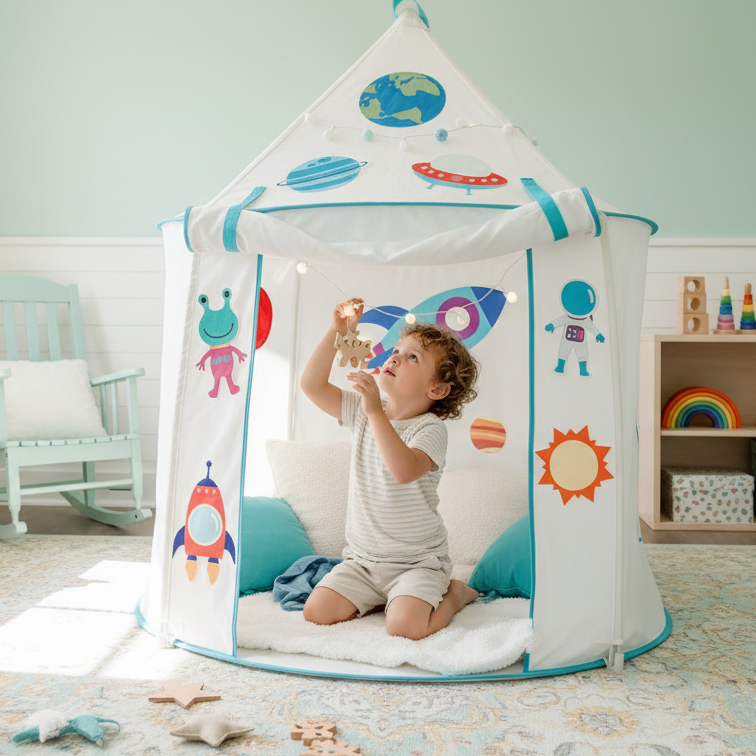
The ZeeZee Adventure Tent is designed as a calm, sensory-friendly space where children can read, imagine, create, and explore without relying on screens.
Its interchangeable StickeeZ themes allow the environment to change as children's interests change. The same tent can become a jungle, a castle, a space station, or a quiet reading retreat.
This combination of familiarity and possibility creates room for children to direct their own experiences.
The tent does not tell a child what story to create.
It provides a setting.
The child supplies the imagination.
That is at the heart of independent play.
Helping Children Build the Confidence to Play Independently
Choosing the right toys is only one part of encouraging independent play.
Even the most open-ended toy cannot automatically teach a child how to play independently. Children need time to develop confidence, learn how to use materials and discover that they are capable of creating their own play experiences.
For some children, independent play comes naturally. Others prefer constant interaction with a parent, sibling or caregiver. Both are completely normal.
The goal is not to force a child to play alone. It is to gradually create the conditions in which independent play feels comfortable, enjoyable and achievable.

Start Small and Build Gradually
If your child is used to having an adult involved in every activity, suddenly expecting them to play independently for an hour is unlikely to work.
Instead, begin with short periods.
Sit nearby while your child explores a familiar activity. Resist the temptation to direct every movement or suggest what they should do next.
You might say:
"I'm going to sit here while you build."
Then allow your child to take the lead.
Over time, you can gradually increase the distance and duration.
This approach helps children understand that independent play does not mean being abandoned. A trusted adult is still nearby, but the child is increasingly responsible for deciding what happens.
Create a Predictable Play Routine
Children often find independent play easier when it becomes part of their normal routine.
For example, you might have a short period of independent play after breakfast or before dinner.
It does not need to be long.
What matters is consistency.
When children know that there is a regular opportunity to choose an activity and explore without constant adult direction, the experience becomes familiar rather than unusual.
A predictable routine can also reduce the expectation that adults will provide entertainment every time there is a quiet moment.
Make Favourite Materials Easy to Access
Children cannot independently choose something they cannot reach.
This is why accessibility matters.
Keep a small selection of appropriate toys on low shelves or in open baskets.
Instead of storing everything away in large boxes, consider displaying a few options where your child can see them.
For younger children, this might include:
-
A few board books.
-
Building blocks.
-
Simple puzzles.
-
Drawing materials.
-
Pretend-play objects.
-
Soft toys.
-
Open-ended construction materials.
You do not need to display the entire toy collection.
In fact, offering fewer choices can sometimes make it easier for children to decide what they want to do.
Rotate Toys Instead of Constantly Buying New Ones
Children do not necessarily need a continuous supply of new toys.
Sometimes familiar materials become interesting again when they have been away for a while.
Toy rotation can also help reduce clutter.
You might keep several activities accessible while storing others away. After a week or two, swap some of the materials.
The experience can feel new without requiring another shopping trip.
More importantly, rotation gives children opportunities to rediscover toys they may have previously overlooked.
Let Your Child Repeat Activities
If your child wants to build the same type of tower every afternoon, let them.
If they want to read the same book repeatedly, that is fine too.
Repetition is an important part of learning.
Each time a child returns to an activity, they may notice something different or develop greater control.
A toddler stacking blocks is practising more than stacking.
They are exploring balance.
They are developing coordination.
They are learning what happens when something becomes unstable.
They are discovering cause and effect.
Independent play becomes richer when children have enough time to repeat and refine their ideas.
What to Do When Your Child Says, "I'm Bored"
This is one of the hardest moments for parents.
The natural reaction is often to offer a solution immediately.
"Why don't you play with your blocks?"
"Would you like me to find a game?"
"Shall we put on a programme?"
Sometimes, however, it can be helpful to pause.
You might respond:
"I wonder what you could think of."
Then give your child time.
There may be some complaining first.
That's okay.
Children do not always transition instantly from structured entertainment to self-directed play.
The important thing is not to make boredom feel like something adults are responsible for eliminating.
Over time, children can become more comfortable generating their own ideas.
Encourage Without Taking Over
Parents can play an important role in helping children get started.
Imagine your child has a box of blocks but seems unsure what to do.
Rather than building the entire structure yourself, offer a small invitation.
"I wonder if you could make a home for your animals."
Then stop.
Let your child decide what happens next.
If they ask for help, provide enough support to move forward without taking control.
This is sometimes referred to as scaffolding.
The adult provides temporary support while the child gradually takes more responsibility for the activity.
Expert Insight
The goal is not to make children independent as quickly as possible.
Children develop independence at different rates. What matters is providing appropriate opportunities while maintaining emotional security. A child may happily play independently one day and seek more adult connection the next. That variation is normal.
Independent play works best when it is treated as a developmental skill rather than a performance target.
Choose Toys That Encourage Different Types of Play
A balanced toy collection can include materials that support different kinds of experiences.
Building Toys
Blocks, construction materials and magnetic building sets can encourage planning, problem-solving and spatial exploration.
Creative Materials
Paper, crayons, washable paints, modelling dough and other age-appropriate art materials allow children to create without a predetermined outcome.
Pretend-Play Materials
Dolls, animals, costumes and simple props can support storytelling and imaginative exploration.
Books
Books can provide opportunities for quiet independent engagement while supporting language and imagination.
Puzzles and Games
Age-appropriate puzzles can encourage concentration, persistence, and problem-solving.
The goal is not to own every category.
A few versatile materials can be enough.
Open-Ended Toys Versus Highly Directed Toys
Both types of toys can have a place in childhood, but they encourage different experiences.
|
Open-Ended Toys |
Highly Directed Toys |
|
Children decide how to use them |
The toy often has a specific intended use |
|
Encourage imagination |
Often provide more structure |
|
Can have many possible outcomes |
Usually have a defined outcome |
|
Can change as the child develops |
May be easier to outgrow |
|
Encourage children to create scenarios |
Often provide the scenario themselves |
Neither category is automatically "good" or "bad".
The important thing is variety.
Children benefit from having some activities with clear rules and others where they are free to invent the rules themselves.
Pay Attention to Your Child's Interests
The best toy for independent play is not necessarily the toy that is most popular online.
It is the one that connects with your particular child.
Does your child love animals?
Offer animal figures and books.
Are they fascinated by construction?
Provide blocks or building materials.
Do they enjoy stories?
Create a comfortable reading space.
Are they constantly drawing?
Keep paper and crayons accessible.
Following your child's interests can make independent play much easier because the motivation already exists.
Don't Expect Every Child to Play the Same Way
Some children naturally spend long periods absorbed in one activity.
Others move quickly between several activities.
Some prefer quiet play.
Others need plenty of movement.
Some children love pretend play.
Others prefer construction or puzzles.
Independent play should reflect these individual differences.
A child who moves between three activities in twenty minutes may still be playing independently.
The objective is not a particular duration.
It is increasing your child's ability to initiate and direct play without requiring an adult to organise every moment.
The Environment Can Encourage Independence
Think about what happens when a child enters a play space.
If everything is stored out of reach, they immediately need an adult.
If materials are accessible and organised, they have choices.
This is why a thoughtfully designed play environment can be so valuable.
A dedicated space gives children somewhere to return to.
Somewhere familiar.
Somewhere where their materials are available.
Somewhere they can leave a construction project unfinished and return to it later.
This sense of ownership can encourage children to become more invested in their play.
How ZeeZee Adventures Supports Independent Play
A play environment can be particularly useful when it gives children a sense of ownership over their own space.
The ZeeZee Adventure Tent is designed to provide a calm, sensory-friendly environment for reading, imaginative play and independent exploration.
Its interchangeable StickeeZ themes allow children to transform the same familiar tent into different imaginary settings. The physical space remains consistent, while the story can change according to the child's interests.
This creates an opportunity for children to make choices.
They can decide what their tent becomes.
They can bring books, soft toys, building materials, or pretend-play objects inside.
They can create their own stories.
They can return to the same space repeatedly and discover new ways to use it.
The value is not that the tent entertains a child by itself.
The value is that it provides a starting point for the child's imagination.
When Parents Should Step In
Independent play should never mean ignoring a child who genuinely needs support.
There are times when adults should intervene.
If a child is becoming overwhelmed, needs emotional reassurance or encounters a safety issue, your support matters.
The challenge is learning to distinguish between "I need help" and "This is difficult and I need a little more time."
Before stepping in, try pausing.
Observe.
Give your child a moment.
You might ask:
"Would you like some help, or would you like to try again?"
That simple question gives children an opportunity to communicate what they need while preserving their sense of control.
A Simple Way to Think About Independent Play
When choosing toys and creating a play environment, remember three words:
Access. Choice. Time.
Children need access to appropriate materials.
They need choices about what to do.
And they need enough uninterrupted time to become absorbed in the experience.
Remove any one of these and independent play can become harder.
Give children all three, and you create much stronger conditions for curiosity and self-directed exploration.
The Goal Isn't to Keep Children Busy
This may be the most important distinction of all.
Independent play is not simply a strategy for keeping children occupied while parents get things done.
It can give children an opportunity to experience themselves as capable creators.
They decide.
They experiment.
They make mistakes.
They change direction.
They solve problems.
They create stories.
And gradually, they learn that they do not always need someone else to tell them what to do next.
That is a valuable skill far beyond playtime.
A Practical Guide for Parents
Choosing toys that encourage independent play is ultimately less about finding the perfect product and more about creating the right conditions for your child to explore.
A toy can be beautifully designed, highly rated and marketed as educational, but if it requires an adult to operate it or tells the child exactly what to do, it may offer fewer opportunities for genuine self-directed play.
The most useful question is simple:
Does this toy give my child something to do, or does it do most of the work for them?
The best choices often leave room for children to make decisions, experiment, repeat activities, and develop their own ideas.
And remember, independent play is not a race. Some children will happily explore alone for longer periods, while others need more connection and reassurance. Both are normal.
Your role is not to force independence.
It is to gradually make independence possible.
The Independent Play Toy Checklist
Before bringing a new toy into your home, consider the following.
Look for toys that:
☐ Can be used in several different ways.
☐ Encourage imagination and creativity.
☐ Allow your child to make decisions.
☐ Are accessible without constant adult assistance.
☐ Match your child's current developmental abilities.
☐ Provide enough challenge without causing unnecessary frustration.
☐ Can remain interesting as your child develops.
☐ Encourage hands-on exploration.
☐ Allow repetition.
☐ Can be combined with other toys and materials.
☐ Do not rely entirely on flashing lights, sounds, or digital stimulation.
☐ Give your child opportunities to create their own stories or outcomes.
You do not need every toy in your home to meet every point.
The purpose of this checklist is simply to help you think about the experiences your child's toys are creating.
A Simple Test Before You Buy
There is one question I recommend parents ask before purchasing a toy:
"What will my child actually do with this?"
Imagine the child playing with it.
Are they building?
Creating?
Sorting?
Pretending?
Drawing?
Solving?
Moving?
Experimenting?
Or are they mainly pressing buttons and watching something happen?
There is nothing inherently wrong with the latter. Some children enjoy interactive toys, and they can have a place in family life.
The key is variety.
Children need opportunities to be the audience sometimes, but they also need plenty of opportunities to be the author.
Don't Confuse Independent Play With Parenting Less
One of the most important things to remember is that encouraging independent play does not mean becoming less involved as a parent.
Connection remains important.
Children need responsive adults who notice their emotions, answer questions, offer reassurance, and join them when they genuinely want company.
Independent play simply adds another experience.
It gives children time to discover what they can do without an adult directing every step.
You might sit nearby while your child builds.
You might read your own book while they draw.
You might prepare dinner while they explore a familiar play space.
Your presence can provide security without taking control of the activity.
What If My Child Always Wants Me to Play?
This is very common, particularly with younger children.
Try resisting the urge to jump straight into the activity.
Instead, help your child get started.
You might build the first few blocks together.
Then say:
"I'm going to make dinner now. You can keep building if you'd like."
At first, your child may follow you.
That's okay.
Independent play develops through repeated experiences.
You can gradually increase the amount of time your child spends directing their own activity while remaining available when needed.
What If My Child Gets Bored?
Let them.
Not indefinitely, and not without considering their age and needs, but give them an opportunity to experience the feeling without immediately solving it.
Boredom can create a pause between structured entertainment and self-directed activity.
A child may initially complain.
Then they may find something interesting.
A box becomes a vehicle.
A blanket becomes a tent.
Blocks become a city.
A few toy animals become the characters in a story.
That transition is worth allowing.
Children need opportunities to practise generating ideas, not just following them.
How Many Toys Should Be Available?
There is no perfect number.
What matters more is whether your child can actually see and use what is available.
If toys are overflowing from every shelf and basket, children may find it harder to choose an activity.
Try offering a manageable selection.
Perhaps a few books, some building materials, a puzzle, creative supplies, and a small collection of pretend-play resources.
You can then rotate some materials when your child's interest changes.
This keeps the environment fresh without constantly buying new toys.
Think About the Environment, Not Just the Toy
A child's play environment can either support or hinder independent exploration.
If materials are inaccessible, children need an adult.
If everything is scattered, children may struggle to concentrate.
If there is nowhere to sit, build or create, even a wonderful toy can become difficult to use.
A thoughtfully arranged play area can make a significant difference.
Consider creating:
-
A low shelf for books.
-
Accessible baskets for toys.
-
A comfortable reading corner.
-
Clear floor space for building.
-
A small table for creative activities.
-
A dedicated space for imaginative play.
The environment does not need to look perfect.
It simply needs to work for your child.
Expert Insight
Familiarity can be more valuable than novelty.
Children often develop deeper engagement when they have opportunities to revisit familiar materials. Instead of constantly introducing something new, give children time to explore the same resources in increasingly complex ways.
A set of blocks can support simple stacking today and elaborate construction months later.
The material stays the same.
The child's skills change.
When Screen-Free Play Becomes Especially Valuable
Screens are now part of everyday family life.
The goal is not to make parents feel guilty about using them.
Instead, consider whether your child has enough opportunities to engage in experiences that are fundamentally different from screen-based entertainment.
Building.
Drawing.
Reading.
Pretending.
Moving.
Creating.
Solving.
These activities allow children to interact physically with their environment and make decisions about what happens next.
A balanced toy collection can make these alternatives easier to access.
Choosing Toys That Support Long-Term Play
A useful toy does not necessarily need to be expensive.
In fact, some of the most versatile materials are remarkably simple.
Blocks.
Books.
Paper.
Crayons.
Fabric.
Puzzles.
Dolls.
Animal figures.
Construction materials.
These toys can be combined, adapted, and revisited.
The same materials can support different kinds of play as children grow.
That is what makes them valuable.
The aim is not to fill your home with products.
It is to create opportunities.
How ZeeZee Adventures Fits Into Independent Play
Independent play becomes easier when children have a place that feels like their own.
The ZeeZee Adventure Tent is designed as a calm, sensory-friendly environment where children can read, imagine, create, and explore without needing a screen to provide the entertainment.
The interchangeable StickeeZ themes add another layer of open-ended possibility. The familiar tent can become a jungle, castle, space station, or another imaginative setting according to the child's interests.
This means the play environment can evolve without requiring a completely new toy every time.
More importantly, the child remains in control.
They decide what the space becomes.
They choose the story.
They decide which toys to bring inside.
They can play quietly, create an imaginary adventure, or simply use the tent as a comfortable place to read.
The product provides the setting.
The child provides the imagination.
That distinction is at the heart of independent play.
A Final Thought for Parents
If your child does not immediately spend thirty minutes playing independently, don't assume you've chosen the wrong toy.
Independent play is a developmental skill.
It takes time.
It requires confidence.
And it looks different for every child.
Instead of measuring success by how long your child plays alone, look for smaller signs of progress.
Perhaps they choose an activity without asking you.
Perhaps they solve a small problem themselves.
Perhaps they continue playing while you step into another room.
Perhaps they invent a story without needing you to provide it.
Those moments matter.
They show that your child is beginning to trust their own ability to create an experience.
And that is ultimately what good toys should help children discover.
Not that they can stay busy without us.
But that they are capable of making something meaningful happen on their own.
Frequently Asked Questions
1. What toys are best for independent play?
Open-ended toys such as blocks, construction materials, books, art supplies, puzzles, pretend-play resources, and imaginative play environments can encourage children to make decisions and direct their own activities.
2. How do I choose a toy for independent play?
Look for toys that are accessible, age-appropriate, and versatile. Consider whether your child can use the toy without constant adult assistance and whether it leaves room for imagination and decision-making.
3. Are electronic toys bad for independent play?
Not necessarily. Electronic toys can be enjoyable and useful, but children should also have access to physical, open-ended materials that allow them to create and direct their own play.
4. How long should a child play independently?
There is no universal target. Independent play develops differently for every child. Younger children may manage only short periods, while older children may gradually sustain play for longer.
5. How can I encourage my child to play independently?
Start with familiar activities, stay nearby, and gradually reduce your involvement. Make suitable toys accessible and give your child enough uninterrupted time to explore.
6. Should I leave my child alone when they are playing?
Independent play does not require complete separation. Young children often benefit from knowing that a trusted adult is nearby while they gradually become more confident directing their own activities.
7. Can a play tent encourage independent play?
A play tent can provide a dedicated environment for imaginative and quiet play. When children are able to decide how to use the space and what stories to create, it can become a useful setting for independent exploration.
Author Bio
The ZeeZee Play Experts
The ZeeZee Play Experts are dedicated to helping families create calmer, more imaginative childhoods through purposeful play. Drawing on insights from child development, occupational therapy and early childhood education, they create practical, evidence-informed resources that help parents nurture independence, creativity and confidence. Their work focuses on designing sensory-friendly and imaginative play environments where children can explore and grow at their own pace.




Comment (0)