
How Boredom Fuels Creativity and Problem-Solving in Children
Introduction
Few phrases make parents react as quickly as, "I'm bored."
Within seconds, many of us begin offering suggestions. We pull out another toy, recommend a new activity, hand over a tablet, or start planning something to fill the empty space. Our instinct is understandable. We want our children to be happy, engaged, and learning.
But what if boredom isn't a problem to solve?
What if it's one of childhood's most valuable opportunities?
In today's fast-paced world, children have access to more entertainment than any generation before them. Streaming platforms, educational apps, organized activities, interactive toys, and endless digital content mean there's rarely a quiet moment. Yet despite having more options than ever, many parents still hear the same complaint: "There's nothing to do."
The irony is that creativity rarely begins when every moment is planned. It often begins when there is nothing obvious to do.
Psychologists and child development experts have long recognized that boredom can act as a catalyst for imagination. When children aren't immediately entertained, their brains begin searching for possibilities. They invent games, create stories, build imaginary worlds, and solve problems using the resources around them. What looks like inactivity on the surface is often the beginning of meaningful cognitive work.
This doesn't mean children should be left feeling lonely or neglected. Healthy boredom is very different from emotional isolation. Instead, it refers to those ordinary pauses in the day when children have the freedom to decide what comes next.
These moments strengthen far more than imagination. They also help children develop resilience, flexible thinking, emotional regulation, and the confidence to create their own fun without depending on constant external stimulation.
In this article, we'll explore the science behind boredom, what happens inside a child's brain when they're not being entertained, and why allowing occasional boredom may be one of the greatest gifts parents can offer.
Key Takeaways
Before exploring the research, here are the most important ideas to keep in mind:
-
Boredom is a normal and healthy part of childhood.
-
Moments of boredom encourage imagination and original thinking.
-
Creative problem-solving often begins when children have unstructured time.
-
Constant entertainment can reduce opportunities for independent thinking.
-
Open-ended play helps children transform boredom into creativity.
-
Parents don't need to solve every "I'm bored" moment immediately.
-
Quality downtime supports executive function and emotional resilience.
-
The goal isn't to eliminate boredom but to help children learn how to use it.
Why "I'm Bored" Isn't a Parenting Emergency
Our Relationship With Boredom Has Changed
For much of history, boredom was simply part of everyday life.
Children spent long afternoons outdoors, invented neighborhood games, built forts from blankets, explored backyards, or created imaginary adventures using whatever materials they could find. Adults weren't expected to entertain them every hour of the day.
Today, childhood often looks very different.
Many children move from school to extracurricular activities, followed by homework, screen time, scheduled playdates, and structured family routines. Even moments of waiting, such as sitting in a restaurant or riding in the car, are frequently filled with digital devices.
While these conveniences offer many benefits, they also reduce opportunities for children to practice creating their own entertainment.
As a result, boredom can begin to feel unfamiliar and uncomfortable.
Instead of seeing it as an invitation to think creatively, children may expect someone else to solve it for them.
Why Parents Feel Pressure to Eliminate Boredom
Modern parenting often comes with an unspoken expectation that good parents should keep children constantly engaged.
Social media reinforces this idea.
Parents scroll through images of elaborate crafts, educational sensory bins, perfectly organized playrooms, and endless family activities. It's easy to feel that every free moment should become a learning opportunity.
But development doesn't require constant stimulation.
In fact, children's brains also need periods of rest, reflection, and self-directed exploration.
When every minute is filled by adults, children have fewer chances to ask themselves important questions such as:
-
What interests me?
-
What could I create?
-
How can I solve this problem?
-
What happens if I try something different?
These questions form the foundation of creativity.
The Difference Between Productive and Harmful Boredom
Not all boredom is the same.
Understanding this distinction helps parents respond appropriately.
Productive Boredom
Healthy boredom occurs when children have their basic emotional and physical needs met but are not immediately entertained.
During these moments they begin exploring possibilities independently.
For example:
-
creating imaginary characters
-
building with household objects
-
inventing games
-
drawing stories
-
experimenting with nature
-
reading voluntarily
-
asking curious questions
This type of boredom stimulates exploration.
Harmful Boredom
Persistent boredom can sometimes reflect something different.
Children who feel emotionally disconnected, chronically isolated, anxious, or depressed may describe boredom because they struggle to engage with activities they once enjoyed.
Likewise, children with unmet sensory or developmental needs may require additional support.
The key difference is that healthy boredom eventually leads toward exploration, while harmful boredom often remains emotionally distressing.
Most everyday "I'm bored" moments fall into the first category.
What Happens Inside a Child's Brain During Boredom?
The Brain Doesn't Stop Working
From the outside, a bored child may appear inactive.
Inside the brain, however, something remarkable begins happening.
When children aren't focused on an external task, the brain shifts into what neuroscientists call the Default Mode Network (DMN).
This network becomes active during quiet moments of rest, daydreaming, imagination, and self-reflection.
Far from being "idle," the brain starts connecting ideas in new ways.
It revisits memories.
Imagines future possibilities.
Explores hypothetical situations.
Builds stories.
Generates creative solutions.
Many breakthroughs in art, science, and innovation have emerged during moments when people allowed their minds to wander.
Children benefit from this same process.
Daydreaming Is Mental Exercise
Adults often mistake daydreaming for distraction.
For children, it can be an important developmental tool.
During imaginative thinking, children mentally rehearse situations before experiencing them in real life.
A cardboard box becomes a pirate ship.
The living room transforms into a rainforest.
A stuffed bear opens a bakery.
Although imaginary, these scenarios strengthen real cognitive skills.
Children practice:
-
planning
-
sequencing
-
storytelling
-
empathy
-
flexible thinking
-
decision-making
Every invented scenario becomes an opportunity to exercise the brain.
Boredom Encourages Divergent Thinking
One reason boredom supports creativity is that it encourages divergent thinking.
Unlike convergent thinking, which searches for one correct answer, divergent thinking explores many possible answers.
For example:
If an adult hands a child a toy spaceship, there is usually one obvious purpose.
But if a child receives a cardboard tube with no instructions, it might become:
-
a telescope
-
a dragon's tail
-
a pirate's spyglass
-
a rocket engine
-
a magic wand
-
a microphone
The absence of instructions forces the brain to generate possibilities.
That process strengthens creativity.
Imagination Begins Where Instructions End
Highly structured activities have their place.
Children enjoy puzzles, board games, and guided crafts because they teach valuable skills.
But these activities often have predetermined outcomes.
Open-ended situations are different.
When children experience a little boredom, there is no script.
They become both the storyteller and the audience.
They invent rules.
Change characters.
Solve unexpected problems.
Rewrite endings.
This freedom develops creative confidence.
Instead of asking, "What's the right answer?" children begin asking, "What could happen next?"
That subtle shift lays the foundation for innovation throughout life.
Why Creativity Matters More Than Ever
The future will increasingly reward skills that cannot easily be automated.
Creativity.
Adaptability.
Problem-solving.
Communication.
Original thinking.
These qualities don't appear overnight.
They grow gradually through experiences that encourage children to imagine, experiment, and persist.
Ironically, many of those experiences begin during the very moments adults often try to eliminate.
When children are given time to wonder, explore, and create without constant direction, they begin building abilities that extend far beyond childhood.
How Boredom Builds Creativity
Creativity is often misunderstood.
Many people associate it exclusively with painting, music, or writing.
In reality, creativity is the ability to generate original ideas, connect unrelated concepts, and imagine possibilities that don't yet exist.
Every child is born with creative potential.
The question is whether they have enough opportunities to exercise it.
Boredom provides exactly that opportunity.

Creativity Begins Without Instructions
Imagine giving two children different activities.
The first receives a coloring book with numbered sections that tell them exactly which color belongs where.
The second receives a blank sheet of paper.
Both are creating.
But only one must decide:
-
What should I draw?
-
Where should I begin?
-
Which colors fit together?
-
What story does this picture tell?
The second child is engaging in far more creative thinking because the brain is generating ideas instead of following instructions.
Boredom works in much the same way.
When children don't immediately know what to do, their brains begin creating possibilities.
Imagination Grows Through Open Questions
Open-ended situations invite curiosity.
Instead of asking:
"What game should I play?"
Children begin asking:
"What could this become?"
A blanket becomes a cave.
A cardboard box becomes a pirate ship.
A pillow fort becomes a secret laboratory.
A dining table transforms into an enchanted forest.
Nothing changed except the child's imagination.
These transformations represent sophisticated cognitive work.
The child is combining memory, storytelling, visual thinking, planning, and emotional expression into one continuous experience.
Creativity Requires Mental Space
One reason constant entertainment can reduce creativity is that it leaves very little room for internal idea generation.
Highly stimulating media constantly supplies:
-
characters
-
stories
-
sounds
-
visuals
-
rewards
-
solutions
Children become consumers of someone else's imagination.
During unstructured time, the opposite happens.
Children become creators.
Instead of receiving stories, they invent them.
Instead of solving predetermined challenges, they create entirely new ones.
Boredom Strengthens Problem-Solving Skills
Creativity and problem-solving are closely connected.
Creative thinkers ask:
"What could I make?"
Problem-solvers ask:
"How can I make this work?"
Boredom naturally encourages both.
Every Small Challenge Builds Thinking Skills
Imagine a child who wants to build a bridge across a pretend river.
The blocks keep falling.
No adult steps in.
The child experiments.
Perhaps they build a wider base.
Perhaps they add supports.
Perhaps they choose different materials altogether.
Each failed attempt teaches something valuable.
This process develops persistence far more effectively than immediately providing the correct answer.
Trial and Error Is Learning
Adults often see mistakes as something to avoid.
Children learn through them.
When boredom encourages independent exploration, children naturally experience:
-
failed ideas
-
unexpected outcomes
-
small frustrations
-
creative adjustments
Each cycle strengthens flexible thinking.
Rather than giving up, children begin asking:
"What else could I try?"
That question forms the foundation of lifelong problem-solving.
Resourcefulness Develops During Unstructured Play
Children rarely complain about limited materials once their imagination becomes active.
A cardboard tube.
Kitchen bowls.
Cushions.
Paper.
Leaves.
Sticks.
Suddenly ordinary objects become valuable resources.
Resourcefulness isn't about having more.
It's about seeing more possibilities within what already exists.
This mindset benefits children long after childhood.
Executive Function Thrives During Independent Exploration
One of the most important areas strengthened by open-ended play is executive function.
Executive function refers to the brain's management system.
It includes skills such as:
-
planning
-
working memory
-
attention control
-
self-regulation
-
organization
-
flexible thinking
These abilities predict many aspects of future success, including academic achievement, emotional wellbeing, and healthy relationships.
The remarkable part is that children strengthen these skills naturally while playing.
Planning Without Adult Direction
Suppose a child decides to build an imaginary zoo.
Before anything happens, they begin planning.
Where will the animals live?
What should visitors see first?
How will food reach each enclosure?
None of these questions were assigned by an adult.
The child created them independently.
That self-directed planning strengthens executive function in meaningful ways.
Self-Regulation Develops Through Play
Independent play requires children to manage their own emotions.
Perhaps the tower collapses.
Maybe the pretend restaurant runs out of food.
The superhero loses their magical powers.
Children learn to recover from disappointment without immediately relying on adults to fix every challenge.
Over time this builds emotional resilience.
Why Modern Childhood Leaves Little Room for Boredom
Today's children live in one of the most stimulating environments in history.
Entertainment is available almost instantly.
Streaming platforms.
Interactive games.
Educational apps.
Smart toys.
Voice assistants.
Video content.
While each has potential benefits, the cumulative effect can unintentionally reduce opportunities for self-directed thinking.
The Brain Adapts to Constant Stimulation
The human brain naturally becomes accustomed to its environment.
When children receive frequent novelty, rapid visual changes, and immediate rewards, slower activities may initially feel less exciting.
Reading quietly.
Drawing.
Building.
Pretend play.
These activities require children to generate the excitement themselves.
That takes practice.
Allowing occasional boredom helps children strengthen this ability.
Overscheduled Childhood
Many children spend nearly every afternoon moving from one organized activity to another.
Sports.
Music lessons.
Tutoring.
Clubs.
Playdates.
Homework.
Each activity offers valuable experiences.
But together they may leave little unscheduled time.
Ironically, some of childhood's greatest discoveries happen during the empty spaces between planned events.
Those quiet moments give children permission to wonder.
Why Open-Ended Play Works So Well
Not all toys encourage the same type of thinking.
Some toys perform nearly every function themselves.
Others depend almost entirely on the child's imagination.
Open-ended materials remain engaging because they never have only one purpose.
Examples include:
-
wooden blocks
-
magnetic tiles
-
art supplies
-
puppets
-
costumes
-
dolls
-
natural materials
-
cardboard boxes
Children revisit these materials repeatedly because every play session becomes different.
Rather than reaching an endpoint, imagination continues evolving.
This is one reason adaptable play environments often remain interesting much longer than single-purpose toys.
For example, instead of replacing one themed toy with another as children's interests change, environments that can transform alongside their imagination encourage children to return again and again with entirely new ideas. This principle is reflected in the design philosophy behind ZeeZee Adventures, where interchangeable StickeeZ themes allow one familiar play space to become countless imaginative worlds over time, supporting longer periods of open-ended, screen-free play.
The Link Between Boredom and Innovation
History offers countless examples of inventions, stories, and creative breakthroughs emerging during periods of quiet reflection rather than constant activity.
Children experience a similar process on a smaller scale every day.
When there is no obvious solution, the brain begins searching.
It combines memories.
Experiments with possibilities.
Imagines alternatives.
Connects ideas that previously seemed unrelated.
This is the very definition of innovation.
Parents often assume creativity comes from giving children more activities.
Sometimes creativity comes from giving them fewer.
A little more silence.
A little less structure.
A little more freedom to wonder.
Why Parents Often Eliminate Boredom Too Quickly
Hearing "I'm bored" can trigger an immediate response.
Without thinking, many parents begin suggesting activities, pulling out toys, or offering a screen to fill the silence.
These reactions come from a place of love. We want our children to feel happy and engaged.
But when every moment of boredom is solved by an adult, children miss valuable opportunities to practice self-directed thinking.
The Pressure to Keep Children Busy
Modern parenting often celebrates busyness.
Calendars are filled with sports, music lessons, tutoring, birthday parties, educational activities, and carefully planned outings.
While these experiences have value, they can unintentionally leave very little room for free exploration.
Children begin expecting someone else to organize their time.
Eventually, they may struggle to answer a simple question:
"What would I like to do?"
Learning to answer that question independently is an important developmental milestone.
The Entertainment Trap
Technology has made entertainment available within seconds.
If a child feels bored, it's easy to hand over a phone or tablet.
The problem isn't screens themselves.
The challenge is that digital entertainment often provides:
-
instant rewards
-
constant novelty
-
rapid visual changes
-
ready-made stories
-
endless stimulation
Independent play asks children to generate these experiences from their own imagination.
If every quiet moment is replaced with external entertainment, children have fewer chances to strengthen those creative muscles.
How to Respond When Your Child Says, "I'm Bored"
The next time your child announces they're bored, resist the urge to immediately solve the problem.
Instead, think of boredom as an invitation.
Your response can gently encourage curiosity rather than dependency.
Acknowledge Their Feelings
Children first want to feel heard.
You might respond:
"It sounds like you're looking for something interesting to do."
This validates their experience without rushing to provide a solution.
Give Them Time to Think
Silence can feel uncomfortable for adults.
For children, it's often where creativity begins.
Instead of offering ideas immediately, simply wait.
Many children begin exploring possibilities after a few minutes.
They might gather pillows.
Start drawing.
Build a fort.
Invent a game.
The solution often appears when adults step back.
Ask Open-Ended Questions
If your child truly feels stuck, ask questions that encourage independent thinking.
For example:
-
"What have you enjoyed doing this week?"
-
"If your toys could come alive, what would they do?"
-
"What could you build using things around the house?"
-
"Can you invent a new game?"
-
"How many different uses can you find for this cardboard box?"
Notice that none of these questions provide answers.
They simply encourage imagination.
Avoid Becoming the Entertainment Director
Parents don't need to create every activity.
Children benefit from learning that they can generate ideas independently.
Rather than organizing the next game, create an environment where interesting materials are already available.
Then allow your child to take the lead.
Practical Ways to Encourage Creative Boredom
Children don't need expensive toys to become creative thinkers.
Often, the simplest environments inspire the richest play.
Create an Invitation Rather Than an Activity
Instead of preparing elaborate crafts, try leaving out a few open-ended materials.
For example:
-
cardboard boxes
-
blankets
-
tape
-
crayons
-
wooden blocks
-
fabric scraps
-
recycled containers
Don't explain what to make.
Let curiosity lead.
The absence of instructions encourages experimentation.
Rotate Toys Instead of Buying More
Children often lose interest not because they need new toys, but because they see the same collection every day.
Rotating toys every few weeks creates novelty without additional purchases.
A toy stored for a month often feels brand new.
More importantly, fewer visible choices reduce decision fatigue and encourage deeper engagement.
Protect Uninterrupted Play Time
Creative ideas take time to develop.
Children may spend the first ten minutes gathering materials.
The next twenty minutes experimenting.
Only then does imaginative play truly begin.
Frequent interruptions, even well-intentioned ones, can end this process before it reaches its most valuable stage.
Whenever possible, allow children extended periods without unnecessary interruptions.
Create Spaces That Invite Imagination
Children often play longer when they have a space that feels uniquely theirs.
This doesn't require a dedicated playroom.
A reading nook.
A blanket fort.
A small corner with art supplies.
A cozy tent.
These environments create a sense of ownership that encourages children to return and continue developing their ideas over time.
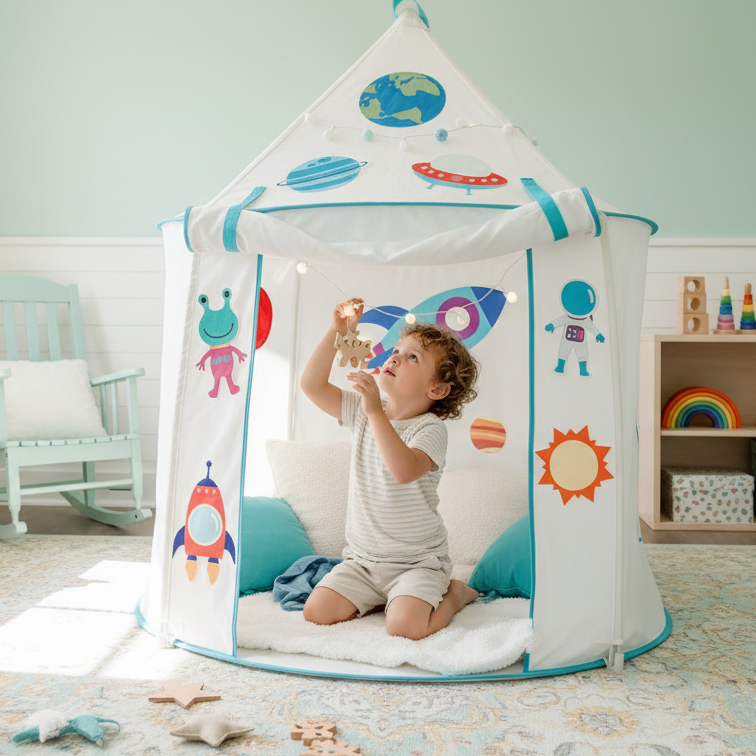
Many families find that adaptable imaginative spaces work especially well because they grow alongside a child's changing interests. Rather than offering only one fixed experience, environments that can transform into different worlds encourage children to revisit the same space with fresh ideas. This philosophy sits at the heart of ZeeZee Adventures, whose interchangeable StickeeZ themes allow one play tent to become a spaceship, dinosaur cave, magical kingdom, underwater world, or quiet reading retreat, helping children create their own stories instead of following someone else's.
Mistakes That Accidentally Reduce Creativity
Sometimes the greatest obstacle to imagination isn't a lack of toys.
It's too much adult involvement.
Solving Every Problem
When adults immediately rescue children from every challenge, children lose opportunities to develop resilience.
If a tower falls, allow time for rebuilding.
If a game doesn't work, encourage experimentation before offering solutions.
Mistakes often become the most valuable teachers.
Praising Only Finished Results
Creativity is a process.
Instead of saying:
"That's a beautiful drawing."
Try saying:
"You kept trying different ideas until you found one you liked."
This shifts attention toward persistence rather than perfection.
Expecting Immediate Creativity
Not every moment of boredom produces instant brilliance.
Children often need time to transition from external stimulation to internal imagination.
The first few minutes may involve wandering, complaining, or looking around the room.
This is completely normal.
Eventually, many children begin generating their own ideas.
Parents simply need patience.
Why Boredom Builds Emotional Resilience
Boredom doesn't only strengthen thinking skills.
It also helps children become more emotionally resilient.
Whenever children experience boredom, they face a small emotional challenge.
They must tolerate discomfort without expecting immediate relief.
This teaches an important life lesson.
Not every uncomfortable feeling requires someone else to fix it.
Children gradually learn that they can move through uncertainty and create positive experiences for themselves.
This confidence extends beyond play.
It supports learning, friendships, school challenges, and future problem-solving.
Creativity Is a Habit, Not a Talent
Many adults believe creativity is something children either have or don't have.
Research suggests something different.
Creativity grows through repeated opportunities to imagine, experiment, and explore without fear of making mistakes.
Every time children invent a story, redesign a game, solve an unexpected problem, or transform ordinary objects into extraordinary adventures, they strengthen the mental habits that support innovation.
Boredom simply provides the opening.
What children choose to do next becomes the practice.
When Boredom May Signal Something More
Most everyday boredom is healthy.
A child finishes playing, looks around the room, sighs, and says, "I'm bored."
A few minutes later, they're building a fort or pretending the couch is a pirate ship.
That's productive boredom at work.
However, there are situations where boredom deserves closer attention.
When Boredom Persists
If a child consistently struggles to engage with activities they previously enjoyed, it may reflect something deeper than a lack of entertainment.
Persistent boredom accompanied by changes in mood, sleep, appetite, or social behavior can sometimes be linked to emotional or developmental challenges.
Parents should pay attention if their child:
-
rarely enjoys activities they once loved
-
seems withdrawn or unusually irritable
-
avoids interaction with family or friends
-
appears anxious during free play
-
becomes distressed by even small periods of unstructured time
These signs don't automatically indicate a serious problem, but they do warrant a conversation with a pediatrician or child development professional if they continue.
Children With Different Developmental Needs
Some children process information differently.
For example, children with sensory processing differences, attention-related challenges, or neurodevelopmental conditions may need additional support when navigating unstructured time.
Independent play may develop differently, and that's perfectly okay.
Rather than comparing them to other children, focus on gradual progress that matches their individual strengths and needs.
The objective is never to force independence. It's to provide opportunities that help each child succeed in their own way.
Frequently Asked Questions
Is boredom actually good for children?
Yes, in moderation.
Healthy boredom encourages children to generate ideas, solve problems, and explore their imagination. It helps shift entertainment from something provided by others to something created from within.
The key is ensuring children have a safe, supportive environment and access to open-ended opportunities for play.
How long should I let my child stay bored?
There isn't a specific time limit.
Some children move from boredom to creativity within a few minutes.
Others need longer.
Rather than watching the clock, observe whether your child begins experimenting, exploring, or inventing new activities on their own.
If frustration continues escalating without any signs of engagement, a gentle prompt or shared activity may help restart the process.
What should I say when my child says, "I'm bored"?
Instead of immediately suggesting activities, try responding with curiosity.
Examples include:
-
"I wonder what you'll think of."
-
"What sounds interesting to you today?"
-
"What could you create with the things you already have?"
-
"If you invented a brand-new game, what would it look like?"
These responses encourage children to generate ideas rather than waiting for them.
Does screen time make boredom harder to handle?
Screens are not inherently harmful, but highly stimulating digital experiences can make slower, self-directed activities feel less exciting by comparison.
Balancing screen time with unstructured, imaginative play gives children opportunities to practice creating their own entertainment instead of consuming someone else's.
Do children need expensive toys to become creative?
Not at all.
In fact, some of the richest imaginative play happens with simple, open-ended materials such as blocks, art supplies, cardboard boxes, blankets, recycled objects, or natural materials collected outdoors.
Children's creativity comes from what they do with materials, not how much those materials cost.
Is it okay if my child prefers quiet play?
Absolutely.
Quiet play can be deeply meaningful.
Reading, drawing, building, storytelling, and pretend play all strengthen important cognitive and emotional skills.
Children don't need to be constantly active or noisy to be learning.
How Parents Can Create a Home That Encourages Creativity
Helping children become creative thinkers doesn't require elaborate activities or expensive equipment.
Small, intentional changes often have the greatest impact.
Protect Time for Unstructured Play
Avoid filling every afternoon with organized activities.
Leave space for children to decide what interests them.
Creativity needs room to breathe.
Embrace Open-Ended Materials
Choose toys and resources that can be used in many different ways rather than only one.
Blocks become cities.
Blankets become castles.
Boxes become spaceships.
Simple materials often inspire the richest stories.
Resist Solving Every Problem
Children grow when they discover solutions independently.
Offer encouragement before offering answers.
Sometimes the most helpful response is simply:
"Keep trying. I think you'll figure it out."
Create Calm, Inviting Spaces
The environment shapes how children play.
A quiet corner, a reading nook, or a dedicated imaginative play area helps children feel comfortable returning to their ideas over time.
Many parents find that adaptable play environments encourage this type of sustained creativity because they evolve with a child's interests rather than becoming obsolete after a few weeks. ZeeZee Adventures was created with this philosophy in mind, offering a play space that transforms through interchangeable StickeeZ themes, calming lighting, and sensory-friendly accessories. Instead of replacing one toy with another, children can reinvent the same familiar space as their imagination grows, supporting longer periods of meaningful, screen-free play.
The Long-Term Benefits of Letting Children Be Bored
Parents often focus on what children are doing today.
The bigger question is who they're becoming.
Each time children work through boredom, they strengthen abilities that will continue serving them throughout life.
They learn to:
-
think independently
-
tolerate uncertainty
-
experiment without fear of failure
-
adapt when plans change
-
generate original ideas
-
persevere through challenges
-
trust their own imagination
These qualities matter far beyond childhood.
Future careers, relationships, and everyday life increasingly reward creativity, adaptability, and resilience.
Ironically, these strengths often begin during the quiet moments adults are tempted to eliminate.
Final Thoughts
Childhood doesn't need constant entertainment.
It needs space.
Space to wonder.
Space to imagine.
Space to experiment.
Space to make mistakes.
Space to become curious.
When children occasionally experience boredom, they aren't wasting time.
They're learning to create opportunity where none seems to exist.
That's a skill far more valuable than always having the next activity planned.
As parents, we don't have to fill every empty moment.
Sometimes our greatest contribution is simply stepping back and trusting that our children are capable of discovering something wonderful on their own.
Because often, the most creative ideas begin with four simple words:
"I don't know what to do."





Comment (0)