
Why Some Kids Can Play for Hours While Others Lose Interest Quickly
Introduction
If you've ever watched one child disappear into an imaginary world for an entire afternoon while another asks, "What should I do now?" every few minutes, you're not alone. Many parents wonder whether their child's ability to stay engaged in play reflects personality, intelligence, attention span, or even future success.
The reality is far more nuanced.
Children are not born with identical approaches to play. Their ability to remain immersed in an activity is influenced by a combination of developmental stage, temperament, sensory preferences, executive functioning, emotional regulation, environment, and the opportunities they have to explore independently.
Understanding these differences is important because play is much more than entertainment. It is one of the primary ways children develop language, creativity, problem-solving skills, resilience, emotional intelligence, and self-confidence. The length of time a child spends playing is only one piece of a much larger developmental picture.
Some children naturally enjoy building elaborate imaginary worlds, inventing stories, or experimenting with open-ended materials for long periods. Others prefer frequent changes, social interaction, movement, or adult participation. Neither pattern is automatically better or worse. What matters most is whether a child's play experiences support healthy development and genuine curiosity.
Instead of asking, "Why can't my child play for hours?" a more helpful question is, "What helps my child become more deeply engaged in meaningful play?"
This article explores the science behind sustained play, the developmental factors that shape attention during play, and practical ways parents can nurture longer periods of independent exploration without pressure or unrealistic expectations.
Key Takeaways
Before diving deeper, here are the most important insights parents should understand:
-
Every child has a unique play style shaped by biology, development, and experience.
-
Independent play develops gradually rather than appearing overnight.
-
Attention span naturally increases as children grow.
-
Sensory preferences significantly influence how children engage with different activities.
-
Open-ended toys often encourage longer and more creative play than highly structured toys.
-
Frequent interruptions and constant entertainment can reduce opportunities for sustained focus.
-
Boredom can be a valuable starting point for creativity.
-
Quality of play matters more than the total amount of time spent playing.
-
Parents can gently support longer independent play through environment and routine rather than pressure.
Why Play Matters More Than Parents Realize
Play Is a Child's Primary Learning System
Adults often separate learning from play. Children do not.
When children build towers, pretend to run restaurants, create obstacle courses, or invent imaginary adventures, they are strengthening neural pathways that support cognitive, emotional, social, and physical development.
During play, children learn to:
-
solve problems independently
-
experiment without fear of failure
-
develop language naturally
-
practice emotional regulation
-
negotiate social situations
-
strengthen working memory
-
improve planning skills
-
build resilience through trial and error
These developmental benefits emerge because play requires active thinking rather than passive observation.
Unlike structured lessons, play gives children ownership over decisions. They choose goals, test ideas, adjust strategies, and evaluate outcomes on their own.
The Hidden Power of Deep Play
Researchers often describe "deep play" as periods when children become fully absorbed in an activity. During these moments, they may lose track of time, ignore minor distractions, and remain focused on solving self-created challenges.
Deep play supports:
Creative Thinking
Children invent characters, scenarios, and solutions that have no predetermined answers.
Executive Function
Planning, organizing, remembering rules, switching strategies, and controlling impulses all develop during complex play experiences.
Emotional Growth
Pretend play allows children to process fears, excitement, disappointment, and curiosity within a safe environment.
Confidence
Each independently solved problem teaches children that they are capable learners.
The goal is not simply to increase the number of minutes a child plays alone. The goal is to create opportunities for meaningful engagement that strengthen these lifelong skills.
Why Some Kids Can Play for Hours While Others Can't
There is no single explanation.
Instead, sustained play emerges from the interaction of multiple developmental systems working together.
Some of the most influential factors include:
-
temperament
-
age
-
executive functioning
-
sensory processing
-
attention development
-
emotional security
-
previous play experiences
-
home environment
-
sleep quality
-
opportunities for independent exploration
Each child has a unique combination of these influences.
For example, two four-year-olds may have similar intelligence but very different play patterns because one enjoys predictable routines while the other constantly seeks new sensory experiences.
Understanding these differences helps parents replace comparison with realistic expectations.
The Role of Temperament in Independent Play
Every Child Is Wired Differently
Temperament refers to the natural behavioral tendencies children are born with.
Long before parenting style shapes behavior, babies already show differences in activity level, adaptability, emotional intensity, and curiosity.
These early characteristics often continue influencing play throughout childhood.
Some children naturally become deeply absorbed in solitary activities.
Others are energized by interaction, conversation, movement, or collaboration.
Neither style indicates better development.
Children Who Naturally Sustain Play
Some children tend to:
-
enjoy quiet exploration
-
repeat activities many times
-
focus intensely on details
-
create elaborate imaginary stories
-
remain comfortable playing independently
These children often appear capable of entertaining themselves for surprisingly long periods.
Children Who Prefer Frequent Change
Other children may:
-
seek movement
-
crave novelty
-
enjoy social interaction
-
switch rapidly between activities
-
ask adults to participate frequently
This pattern reflects differences in nervous system preferences rather than poor behavior.
Parents sometimes mistake these children as having short attention spans when they are actually seeking different kinds of stimulation.
Comparing Siblings Can Be Misleading
Even siblings raised in the same home may display dramatically different play behaviors.
One child may spend ninety minutes building intricate cities with blocks.
Another may happily rotate through drawing, dancing, pretend cooking, outdoor games, and puzzles within the same hour.
Both children can be developing appropriately.
The objective is not to make every child play identically but to help each child gradually strengthen their capacity for focused engagement.
How Age and Development Shape Play Duration
Babies Learn Through Exploration
Infants rarely engage with one activity for extended periods.
Instead, they learn through repeated sensory experiences involving sight, touch, sound, movement, and interaction with caregivers.
A few minutes of focused exploration is entirely developmentally appropriate.
Toddlers Thrive on Short Bursts
Toddlers often alternate rapidly between activities.
Their brains are developing quickly, but sustained attention remains limited.
Many toddlers enjoy exploring:
-
stacking
-
pouring
-
climbing
-
pretend feeding
-
simple puzzles
-
sensory bins
Frequent transitions are normal during this stage.
Parents should not expect hour-long independent play sessions from most two-year-olds.
Preschoolers Begin Developing Longer Focus
Between ages three and five, many children begin extending play naturally.
Pretend play becomes richer.
Stories become more complex.
Problem-solving becomes increasingly independent.
This is often when parents notice children creating imaginary worlds that continue across multiple days.
However, development still varies considerably.
Some preschoolers remain highly social and active while others happily immerse themselves in solo creative projects.
Both patterns fall within the broad range of healthy development.
Quality Matters More Than Duration
One of the biggest misconceptions about childhood play is that longer always means better.
A child who spends thirty deeply engaged minutes designing an imaginary animal hospital may gain more developmental benefit than another who passively manipulates toys for two hours without meaningful engagement.
Parents should look beyond the clock and observe questions such as:
-
Is my child curious?
-
Are they solving problems?
-
Are they creating something new?
-
Are they experimenting?
-
Are they expressing emotions through play?
-
Are they making independent decisions?
These indicators reveal far more about developmental growth than duration alone.
As children receive consistent opportunities for open-ended exploration, many naturally increase both the quality and length of their independent play.
Creating environments that invite imagination, rather than prescribing every activity, can make a significant difference. Open-ended spaces, storytelling prompts, and adaptable play environments, such as those encouraged by ZeeZee Adventures, help children build imaginative worlds that evolve with their interests instead of limiting them to a single scripted experience.
How Executive Function Influences Play
One of the most overlooked reasons children differ in how long they stay engaged in play is executive function. These mental skills act as the brain's management system, helping children plan, focus, remember instructions, and adapt when challenges arise.
Executive function is not fully developed in young children. It grows steadily throughout childhood and adolescence, supported by everyday experiences, including unstructured play.
When a child decides to build a castle, create a pretend grocery store, or organize a treasure hunt, they are using executive function to make decisions, solve problems, and adjust their ideas as they go. These processes require concentration and flexibility, both of which strengthen over time through repeated practice.
Working Memory Supports Complex Play
Working memory allows children to hold and manipulate information in their minds.
Imagine a child pretending to run a veterinary clinic. They remember which stuffed animal is waiting for treatment, what medicine each "patient" needs, and which family member is playing the role of receptionist. These details may seem simple, but they require constant mental organization.
Children with stronger working memory often sustain imaginative play for longer because they can build on previous ideas without losing track of the storyline.
Cognitive Flexibility Encourages Creativity
Rarely does play unfold exactly as planned.
A block tower collapses. A toy train becomes a spaceship. A pirate suddenly transforms into a firefighter.
Cognitive flexibility allows children to adapt instead of becoming frustrated. Rather than ending the activity when something changes, they adjust the story and continue exploring.
Children who are still developing this skill may abandon activities more quickly when they encounter obstacles.
Inhibitory Control Helps Maintain Focus
Another component of executive function is inhibitory control, which allows children to resist distractions and remain engaged with a chosen activity.
This ability develops gradually.
Young children are naturally drawn toward every interesting sound, object, or movement around them. As inhibitory control matures, they become increasingly capable of maintaining focus despite distractions.
Parents sometimes interpret frequent activity switching as poor behavior when it is simply a reflection of normal brain development.
Sensory Processing Shapes How Children Play
Every child experiences the world through their senses, but not every nervous system processes sensory information in the same way.
Sensory processing refers to how the brain receives, organizes, and responds to information from sight, sound, touch, movement, taste, smell, and body awareness.
These differences have a significant impact on play.
Children Who Seek Sensory Input
Some children constantly look for movement, noise, texture, or physical activity.
They may enjoy:
-
jumping
-
climbing
-
spinning
-
dancing
-
building obstacle courses
-
digging in sand
-
splashing water
Because they crave varied sensory experiences, they may move quickly from one activity to another without appearing to settle into extended periods of quiet play.
This does not necessarily indicate a short attention span. Instead, their brains are seeking richer sensory experiences.
Children Who Prefer Predictable Sensory Experiences
Other children feel most comfortable in calm, organized environments.
These children often enjoy:
-
puzzles
-
drawing
-
reading
-
construction toys
-
pretend play
-
crafts
They may naturally remain engaged for longer periods because the environment supports their preferred sensory style.
Neither sensory profile is superior. Understanding your child's preferences allows you to offer activities that match their needs while gently encouraging flexibility over time.
Emotional Security Creates Better Play
Children play most freely when they feel emotionally safe.
A child who feels secure is more willing to take creative risks, invent stories, experiment with ideas, and solve problems independently.
When children are anxious, overwhelmed, overtired, or experiencing significant life changes, their play often changes as well.
They may become more dependent on adults, abandon activities quickly, or seek constant reassurance.
Parents sometimes assume their child has "lost interest" in play when the underlying issue is emotional stress.
Changes such as:
-
starting school
-
moving house
-
welcoming a new sibling
-
family conflict
-
disrupted routines
can temporarily reduce a child's ability to concentrate during play.
Providing predictable routines, emotional support, and opportunities for quiet connection often helps restore confidence and independent exploration.
The Environment Matters More Than Many Parents Realize
Children's attention is influenced not only by who they are but also by where they play.
An environment filled with constant distractions makes sustained focus difficult for almost anyone, including adults.
Too Many Toys Can Reduce Engagement
Many parents assume that more toys create more opportunities for learning.
Research and practical observation often suggest the opposite.
When dozens of toys compete for attention, children may spend more time deciding what to play with than actually playing.
A carefully curated selection of open-ended materials often leads to deeper engagement.
Rotating toys every few weeks can make familiar items feel new again without requiring constant purchases.
Open-Ended Toys Encourage Longer Play
Open-ended toys do not have a single correct way to use them.
Examples include:
-
wooden blocks
-
magnetic tiles
-
art supplies
-
dolls
-
stuffed animals
-
costumes
-
loose parts
-
cardboard boxes
Because these materials invite imagination rather than predetermined outcomes, children often return to them repeatedly, creating increasingly sophisticated scenarios.
Each play session becomes an opportunity to invent something different.
Dedicated Play Spaces Reduce Distractions
Children benefit from having a space where play can continue without being packed away immediately.
When a pretend city or construction project remains intact overnight, children can return to it the next day and expand their ideas instead of starting over.
Even a small corner of a room designated for imaginative play can encourage longer periods of engagement.
Does Screen Time Affect Independent Play?
One of the most common questions parents ask is whether digital entertainment influences a child's ability to play independently.
The answer is not entirely straightforward.
Screen time itself is not inherently harmful, but the type, duration, and context matter.
Highly stimulating digital experiences provide constant novelty, rapid visual changes, immediate rewards, and endless entertainment.
Independent play asks children to generate those experiences internally.
For some children, especially after extended screen use, this transition can feel difficult.
Activities that once seemed exciting may briefly appear less stimulating by comparison.
This does not mean screens permanently damage imagination.
However, balancing screen time with opportunities for creative, child-led play allows children to practice generating ideas rather than simply consuming them.
The Value of Boredom
Many parents instinctively solve boredom the moment it appears.
Yet boredom often serves an important developmental purpose.
When children are not immediately entertained, their brains begin searching for possibilities.
This process may look uncomfortable at first.
A child wanders around the room.
They complain.
They insist there is nothing to do.
If adults resist the urge to provide instant solutions, something remarkable often happens.
Children begin creating their own entertainment.
A blanket becomes a cave.
A cardboard box transforms into a spaceship.
Kitchen utensils become musical instruments.
Boredom acts as a bridge between external entertainment and internal creativity.
Allowing children occasional unstructured time helps strengthen imagination, problem-solving, and independent thinking.
Why Parent Involvement Still Matters
Encouraging independent play does not mean withdrawing from your child.
Children who feel connected to their caregivers often find it easier to explore independently because they know support is available when needed.
A helpful approach is to alternate between shared play and independent exploration.
For example:
-
Spend fifteen minutes building together.
-
Introduce an interesting challenge.
-
Step back while remaining emotionally available.
-
Rejoin later to celebrate what your child created.
This pattern gradually builds confidence without making children feel abandoned.
Parents become secure bases rather than constant entertainers.
Building a Home That Invites Imagination
Creating a play-friendly environment does not require expensive toys or elaborate playrooms.
What matters most is providing children with opportunities to direct their own experiences.
Simple additions can make a meaningful difference:
-
baskets of open-ended materials
-
dress-up clothes
-
art supplies within easy reach
-
building materials
-
natural objects collected outdoors
-
reading corners
-
flexible play spaces
Brands that focus on imaginative, adaptable play environments, such as ZeeZee Adventures, reflect this philosophy by encouraging children to invent their own stories rather than following fixed scripts. When play environments evolve alongside a child's imagination, children often remain engaged longer because they become active creators instead of passive users.

10 Practical Ways to Encourage Longer Independent Play
Parents often ask whether independent play can be taught. The answer is yes, but not by forcing children to "go play by themselves."
Instead, longer play develops when children have the right combination of skills, environment, and support. The goal is not to keep children occupied. It's to help them become confident, creative thinkers who enjoy exploring ideas on their own.
Here are evidence-informed strategies that make a meaningful difference.
1. Start With Connection Before Independence
Children are far more likely to play independently after spending quality time with a caregiver.
Developmental psychologists often describe this as filling a child's "connection cup."
Try spending 10 to 15 minutes following your child's lead. Let them choose the activity while you participate without directing or correcting.
Once they're deeply engaged, excuse yourself naturally.
You might say:
"I'm going to fold the laundry. I'll come back in a little while to see what you've built."
This gradual transition feels much safer than suddenly expecting independent play.
2. Rotate Toys Instead of Displaying Everything
Many families unintentionally overwhelm children by keeping every toy available all the time.
Research suggests that children often engage more deeply when fewer choices are available.
Instead of displaying everything:
-
Store half the toys away.
-
Rotate them every two to four weeks.
-
Keep favorite comfort toys accessible.
-
Introduce "new" toys from storage periodically.
Children frequently rediscover old toys with renewed excitement.
3. Choose Open-Ended Materials
The longest play sessions usually happen with toys that don't tell children exactly what to do.
Examples include:
-
Wooden blocks
-
Magnetic tiles
-
Cardboard boxes
-
Dress-up clothes
-
Play silks
-
Art supplies
-
Loose parts
-
Stuffed animals
These materials invite imagination rather than limiting it.
One day they're castles.
The next day they're pirate ships.
The following week they're veterinary clinics.
The possibilities never truly end.
4. Create a Cozy Play Space
Environment influences attention more than many parents realize.
Children often play longer when they have a space that feels safe, calm, and separate from household distractions.
This doesn't require an elaborate playroom.
A simple reading nook, blanket fort, or dedicated imaginative play corner can become a child's favorite place.
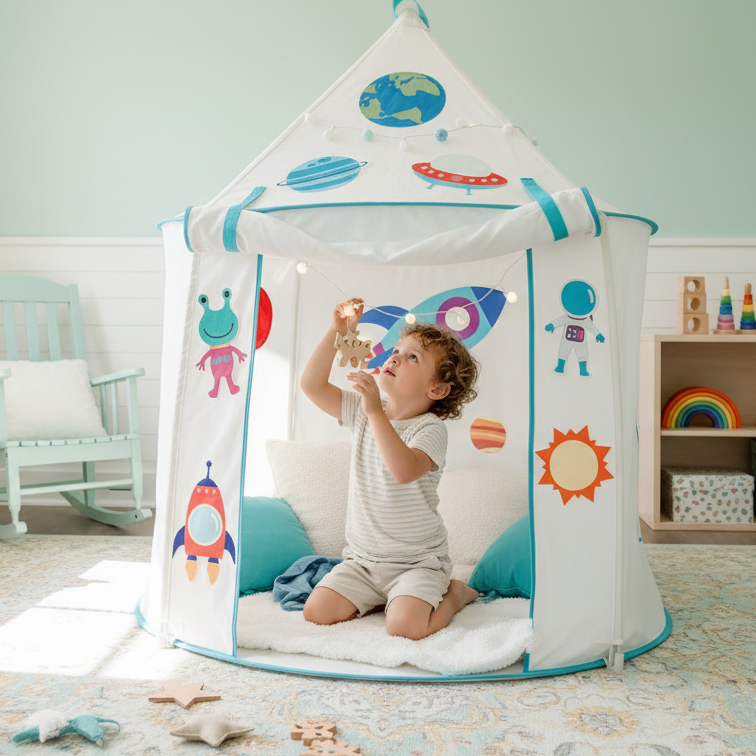
Some families choose adaptable play spaces like the ZeeZee Adventures play tent because the environment itself becomes part of the story. Rather than offering only one fixed design, the interchangeable StickeeZ themes allow the same space to become a castle one day, an underwater world the next, or a quiet reading retreat whenever children need calm. The goal isn't simply adding another toy. It's creating a familiar place that evolves with a child's imagination, encouraging them to return to it again and again instead of quickly moving on. The tent was designed specifically around longer, screen-free imaginative play with changeable themes and sensory-friendly features.
5. Don't Interrupt Deep Play
Adults often interrupt children without realizing it.
Questions like:
-
"What are you making?"
-
"Can I help?"
-
"Isn't that a dinosaur?"
seem harmless.
But frequent interruptions break concentration.
If your child appears deeply focused, consider simply observing quietly.
Flow states are precious.
Protecting them helps children strengthen sustained attention.
6. Allow Safe, Productive Boredom
Boredom often makes adults uncomfortable.
But it is frequently the doorway to creativity.
Instead of immediately solving boredom, allow children time to work through it.
You might hear:
"I'm bored."
Resist offering entertainment immediately.
Instead ask:
"I wonder what you'll think of."
Within minutes many children begin inventing entirely new games.
7. Reduce Background Noise
Television playing in the background, constant music, or multiple conversations can all compete for children's attention.
Quiet environments help many children remain engaged longer.
Even if nobody is actively watching television, background media reduces opportunities for sustained concentration.
8. Respect Different Play Styles
Not every child enjoys pretend play.
Some children prefer:
-
building
-
sorting
-
drawing
-
collecting
-
creating patterns
-
outdoor exploration
Independent play doesn't need to look a certain way.
The objective is meaningful engagement, not a specific activity.
9. Give Children Ownership
Children value spaces and activities they feel belong to them.
Allow them to:
-
arrange materials
-
decorate play areas
-
organize costumes
-
build ongoing projects
-
leave creations unfinished
Ownership increases investment.
Investment increases engagement.
10. Celebrate Process, Not Products
Instead of praising finished outcomes, notice effort.
Rather than saying:
"That's a beautiful castle."
Try saying:
"You kept working even after it fell over."
This reinforces persistence rather than perfection.
Over time children become more willing to stay with challenging activities.
Common Mistakes That Accidentally Shorten Play
Many loving parents unknowingly make independent play more difficult.
Here are some common habits worth reconsidering.
Providing Constant Entertainment
If adults solve every moment of boredom, children have fewer opportunities to generate their own ideas.
Buying Too Many Toys
Novelty fades quickly.
Meaningful play comes from creativity, not quantity.
Scheduling Every Minute
Children need downtime.
Overscheduled days leave little room for imagination to unfold naturally.
Expecting Long Play Too Soon
A three-year-old may play independently for only 10 to 20 minutes.
That is perfectly typical.
Attention grows gradually.
Interrupting for Photos
Many parents understandably want to capture adorable moments.
But repeated interruptions often end the very play they're trying to preserve.
Sometimes the best memories are the ones simply enjoyed in the moment.
Comparing Siblings
Every child's developmental timeline is unique.
Comparisons create unnecessary pressure for both parents and children.
Focus on growth rather than comparison.
When Short Attention During Play Is Completely Normal
Parents often worry because their child doesn't play independently for hours.
In reality, expectations are sometimes unrealistic.
Typical attention spans vary considerably.
Although every child is different, many experts suggest approximate averages like these:
|
Age |
Typical Independent Play |
|
1–2 years |
3 to 10 minutes |
|
2–3 years |
10 to 20 minutes |
|
3–4 years |
20 to 30 minutes |
|
4–5 years |
30 to 45 minutes |
|
5–7 years |
45 to 60+ minutes |
These are not rules.
Children naturally vary based on temperament, environment, sleep, sensory preferences, and emotional wellbeing.
A child who enjoys 15 minutes of focused play every day may be developing perfectly well.
Quality matters more than duration.
When Parents May Want Professional Guidance
Occasionally, difficulties with play can signal an underlying developmental concern.
Consider discussing your observations with your pediatrician or an occupational therapist if your child consistently:
-
cannot engage with any activity for even a few minutes
-
becomes extremely distressed whenever play changes
-
avoids all imaginative play beyond developmental expectations
-
struggles significantly with sensory experiences
-
experiences difficulties across multiple settings including home, preschool, and childcare
These situations do not automatically indicate a diagnosis.
However, early support is always valuable when concerns arise.
Many children simply benefit from targeted strategies that make play easier and more enjoyable.
Every Child's Play Journey Looks Different
One of the greatest gifts parents can give themselves is permission to stop comparing.
Social media often shows children happily playing alone for hours inside beautifully designed playrooms.
Real childhood looks different.
Some children create elaborate imaginary worlds.
Some spend hours building intricate structures.
Others prefer collecting rocks, drawing maps, inventing games outside, or reading quietly in a cozy corner.
All of these experiences support healthy development.
The question isn't:
"Why doesn't my child play like someone else's?"
A more helpful question is:
"What kind of play helps my child thrive?"
When parents shift their perspective from duration to quality, play becomes less about meeting expectations and more about nurturing curiosity.
The Bigger Picture: Play Builds More Than Childhood Memories
Independent play is not simply a way to keep children busy while adults complete household tasks.
It develops skills that continue serving children long after the toys are packed away.
Through play, children learn to:
-
solve problems independently
-
regulate emotions
-
tolerate frustration
-
think creatively
-
communicate ideas
-
build confidence
-
make decisions
-
persist through challenges
These abilities support success in school, friendships, and everyday life.
When a child spends twenty minutes inventing stories with stuffed animals, they're not "just playing."
They're practicing life skills.
Creating an Environment Where Imagination Can Grow
Children don't necessarily need more toys.
They need environments that invite creativity.
A few thoughtful changes can dramatically improve the quality of independent play:
-
Reduce clutter.
-
Rotate toys regularly.
-
Include plenty of open-ended materials.
-
Protect uninterrupted playtime.
-
Create cozy spaces where children feel secure.
-
Allow boredom occasionally.
-
Follow your child's interests instead of directing every activity.
Many families also discover that adaptable play environments remain engaging longer than single-purpose toys. ZeeZee Adventures was created around this very idea after its founders noticed how quickly children outgrew traditional themed tents. Instead of replacing one tent with another, the same play space transforms through interchangeable StickeeZ scenes, helping children revisit familiar surroundings while creating entirely new adventures. The brand also incorporates calming elements and sensory-friendly accessories to support imaginative, independent play across different stages of childhood.
Frequently Asked Questions
Is it normal for my child to switch activities every few minutes?
Yes.
Toddlers and preschoolers naturally have shorter attention spans than older children. Frequent transitions are part of healthy development, particularly for younger children.
Does screen time reduce imaginative play?
Not necessarily.
However, long periods of highly stimulating digital entertainment may make it temporarily more difficult for children to transition into slower, self-directed play.
Balance is more important than perfection.
How much independent play should my child have each day?
There is no universal number.
Many child development professionals recommend providing opportunities for daily child-led play rather than focusing on a specific time target.
Even 20 to 30 minutes of uninterrupted imaginative play can provide meaningful developmental benefits.
Are expensive toys better for longer play?
No.
Open-ended materials often encourage far richer play than toys with only one intended purpose.
Simple items frequently become children's favorites because imagination does the rest.
What if my child always wants me to play too?
This is very common.
Try beginning play together before gradually stepping away.
Children build independence through repeated experiences of feeling connected and confident.
Final Thoughts
Every child is wired differently.
Some naturally become absorbed in imaginative worlds for hours.
Others explore through movement, experimentation, or shorter bursts of curiosity.
Neither approach is inherently better.
Rather than asking how to make every child play longer, parents can ask how to create environments where curiosity feels safe, creativity is encouraged, and exploration happens naturally.
Independent play isn't measured by the clock.
It's measured by the confidence, imagination, resilience, and joy children develop while directing their own adventures.
Those qualities will last long after childhood itself.





Comment (0)