
Sibling Rivalry: How to Reduce Comparisons and Encourage Cooperation
“Why does she always get to do that?”
“He got a bigger piece than me!”
“You love him more than you love me.”
Sibling rivalry can show up in the smallest moments: a disagreement over a toy, a competition to sit beside a parent, or a sudden argument about who is better at something. Even children who enjoy each other's company can find themselves competing for attention, fairness, and a sense of belonging.
For parents, the constant negotiating can be exhausting. You want your children to feel close, but you may also wonder whether every argument needs your intervention.
The goal isn't to make siblings agree all the time. Disagreements are part of learning to live with other people. The opportunity lies in helping children understand their feelings, resolve conflicts respectfully, and recognize that another child's success doesn't diminish their own.
Reducing rivalry begins with a simple shift: stop treating siblings as measures of one another, and start helping them understand themselves and work together.
1. Understand What Sibling Rivalry Is Really About
Sibling arguments often appear to be about possessions or privileges. One child wants the toy another is holding, or both insist on choosing the family movie.
Sometimes, that's exactly what the conflict is about. But other disagreements can reflect a deeper concern: “Do I matter as much?” “Will I get a turn?” “Does my parent understand my side?”
Children share space, routines, family resources, and often their parents' attention. They may also have very different needs, personalities, abilities, and levels of independence. Those differences can become sources of friction, especially when children are still learning to communicate frustration.
Before deciding how to resolve an argument, try to understand its pattern.
-
Do disagreements happen when you're busy with another child?
-
Does one child frequently feel that the other gets special treatment?
-
Are they fighting over a particular toy, activity, or shared space?
-
Does conflict increase when they're hungry, tired, or overwhelmed?
You don't need to analyze every squabble. Simply noticing recurring situations can help you prevent some arguments before they begin.
Research-informed guidance from the Child Mind Institute emphasizes identifying the source of sibling conflict, establishing clear expectations, and encouraging positive interactions—not merely responding to each fight as it happens. Read its guide to helping siblings get along.
2. Stop Comparisons, Even When They Seem Positive
It's easy to compare children without intending to hurt them.
“Your sister gets ready so quickly. Why can't you?”
“Look how neatly your brother has finished his work.”
“You're the athletic one, and she's the artistic one.”
Even praise can create pressure when it places one child above another. The child receiving the compliment may feel expected to maintain that position, while the other may begin to believe that a particular strength belongs to their sibling rather than to them.
Comparisons can also turn ordinary family life into a competition for approval. Instead of enjoying an accomplishment, a child may start wondering whether it was better than their brother's or sister's.
Try to make observations about each child without ranking them.
Instead of “Your brother is so much better at sharing,” say, “I noticed you offered her a turn after you finished.”
Instead of “Why can't you be more organized like your sister?” try, “Let's find a way to make getting ready easier for you.”
The difference is important. One approach makes a sibling the standard; the other helps a child understand their own behaviour and what they can practise next.
You don't need to pretend your children have identical abilities. They won't. You can acknowledge one child's achievement while helping the other pursue a different goal.
Fairness doesn't require children to be the same. It requires each child to feel valued, respected, and supported.
3. Make Room for Each Child's Individual Identity
Siblings can love the same things, but they don't have to.
One child may enjoy elaborate pretend games while another prefers puzzles. One might be eager to perform in front of a crowd, while the other enjoys quiet activities. One may need more help with a task even if their sibling can already manage it independently.
Allowing these differences to exist without ranking them helps children explore their interests without feeling they must compete for a family identity.
Be thoughtful about labels, too. Calling one child “the clever one,” another “the sensitive one,” or one “the responsible one” may seem harmless, but labels can become restrictive when children feel expected to behave in a particular way.
Instead, describe what you notice in the moment.
“You kept trying different ways to solve that puzzle.”
“You noticed your friend was upset.”
“You came up with a surprising idea for your story.”
These observations recognize a child's actions without assigning them a permanent role.
Individual time with each child can also help. It doesn't have to involve expensive outings or elaborate plans. A few minutes of drawing together, a bedtime conversation, a walk, or letting one child choose a shared activity can offer space for them to feel noticed as an individual.
The American Academy of Pediatrics recommends making time for each child separately, alongside shared family experiences. These moments can help children feel heard without needing to compete for attention. Explore its guidance on sibling relationships.
4. Teach Children What Fairness Looks Like in Real Life
One child gets to stay up later. Another needs more help getting dressed. An older sibling may have different responsibilities from a younger one.
Sooner or later, someone will announce that the arrangement is unfair.
Rather than trying to make every detail identical, explain the reason behind differences when it is appropriate to do so.
“You have different bedtimes because you're at different stages and need different amounts of sleep.”
“Your brother is getting help with his homework right now. I'll come and read with you when we're finished.”
Children may still feel disappointed, and they are allowed to express that disappointment. Understanding a rule doesn't automatically make the feeling disappear.
You can acknowledge both the feeling and the boundary: “I understand that you wish you could stay up too. Tonight, your bedtime is still eight o'clock.”
For shared resources, predictability can prevent repeated arguments. If the children fight over choosing a movie, alternate who chooses. If they disagree over a favourite toy, establish clear turn-taking rules before play begins.
Some possessions can be shared, while others can remain personal. Children are more likely to cooperate when they know what belongs to them, what they need to ask permission to use, and how disagreements will be handled.
5. Respond to Conflict Without Becoming the Family Judge
When children argue, parents can feel compelled to establish exactly who started it and who deserves the blame.
But if every disagreement becomes a trial, children may focus more on proving that their sibling is wrong than on finding a solution.
You don't have to ignore conflict or avoid setting limits. Your first responsibility is to keep everyone safe. If children hit, threaten, or deliberately hurt one another, intervene clearly and calmly.
When the immediate situation is safe, help them describe what happened.
“You both wanted the same truck. Let's hear what each of you needs.”
“You're angry that your drawing was knocked over. You're upset because you wanted to use the table.”
This doesn't mean treating harmful behaviour as acceptable or pretending both children are equally responsible in every situation. It means listening carefully before deciding what support or consequences are needed.
For younger children, you may need to offer concrete choices: take turns with a timer, choose another toy, or play in separate spaces for a while.
Older children can be invited to suggest solutions themselves.
Try asking, “What could we do differently next time?” rather than insisting on an immediate apology. A meaningful repair might involve rebuilding a knocked-down tower, returning a toy, helping replace something damaged, or giving a sibling space.
Children learn cooperation through repeated opportunities to practise it, with adult guidance when necessary.
6. Create Opportunities to Work Together
Children who spend most of their time competing for resources or parental approval may have fewer chances to experience the satisfaction of solving something together.
Look for activities where cooperation is more useful than winning.
You could invite siblings to:
-
Build a blanket fort with different jobs for each child.
-
Create a story in which each person contributes a character.
-
Prepare a simple snack together, with age-appropriate tasks.
-
Complete a scavenger hunt by sharing clues.
-
Design an imaginary town, spaceship, or animal sanctuary.
-
Make a family artwork where every child's ideas contribute to the final result.
The activity itself doesn't need to be complicated. What matters is giving children a shared goal without making one sibling responsible for the other's success.
Be mindful of age and ability differences. An older child may be able to cut paper safely with appropriate tools, while a younger one chooses colours or places stickers. Both contributions can matter without needing to be identical.
Notice cooperation when it happens.
“You found a way to use both ideas.”
“You asked your sister what she wanted to add.”
“You disagreed, then worked out a plan together.”
Specific observations help children recognize the behaviours that make teamwork possible.
7. Use Imaginative Play to Explore Different Perspectives
Pretend play can give siblings a low-pressure way to practise negotiation, shared decision-making, and flexible thinking.
Imagine two children building a pretend restaurant. One wants to be the chef; the other wants to be the chef, too. Rather than immediately assigning roles yourself, ask what could happen in their story.
Could they run the restaurant together? Could one prepare the food while the other welcomes guests? Could they switch roles after a few minutes?
There isn't always one perfect solution. The opportunity is to help children generate possibilities and discover that a disagreement doesn't have to end with someone losing.
Storytelling can also help children consider another person's perspective. A character might feel left out when a friend changes the rules of a game, or frustrated when someone uses a favourite object without asking.
Ask questions such as, “What do you think each character wants?” or “How could they solve this without hurting each other's feelings?”
Let children change the story, offer unexpected solutions, and experiment with different outcomes. Avoid turning every play session into a lesson about kindness. Shared enjoyment matters, too.
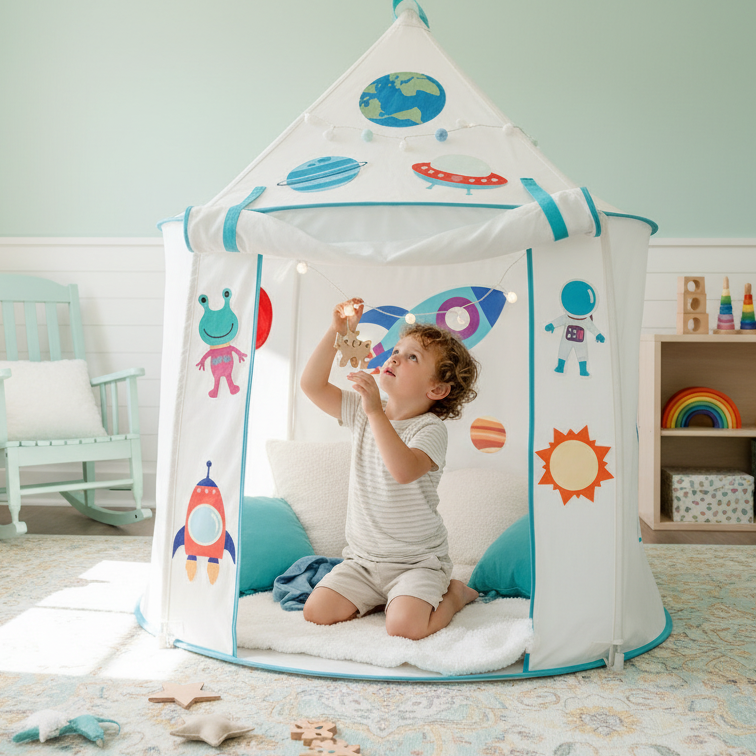
An adaptable play environment can make room for these changing ideas. ZeeZee Adventures offers a customizable play tent with changeable StickeeZ themes, giving children opportunities to create new settings, invent stories, and decide together what their imaginary world becomes.
The aim isn't to prevent disagreement through a particular toy or activity. It's to create opportunities for children to experience shared play as something they can shape together.
8. Help Children See Cooperation as More Than Sharing
Sharing is only one part of getting along.
Cooperation also involves asking permission, respecting boundaries, taking turns making decisions, listening to another idea, and recognizing when someone needs space.
A child should not have to hand over every treasured possession to prove they are kind. Nor should an older sibling always be expected to give in simply because they are older.
Help children distinguish between items that are shared, items that belong to an individual, and activities that require everyone's agreement.
You might say, “You can keep that special toy for yourself. If you want to play with your sister, let's find something you both want to use.”
When a child says no to sharing a personal object, respect that boundary where possible. When a shared activity is involved, help the children negotiate a solution that considers everyone's needs.
And when cooperation doesn't work, it's okay to pause. Children don't have to play together every moment of the day. Time apart can sometimes protect a relationship better than forcing them to continue an activity while frustrated.
A More Cooperative Family Starts With Small Changes
Sibling rivalry doesn't disappear because parents find the perfect phrase or activity. Children will continue to disagree, compare, and test boundaries as they grow.
But family habits can influence what happens next.
Reduce comparisons. Make room for individual interests. Explain differences in rules. Intervene when safety requires it, then help children practise resolving manageable conflicts. Create shared experiences in which both children have something meaningful to contribute.
Most importantly, avoid making closeness another expectation your children can fail to meet. They don't have to be best friends every day to build a respectful relationship.
At home, ZeeZee Adventures can be one setting for shared storytelling and imaginative play, where siblings contribute ideas and create new adventures together. What matters most, however, is the atmosphere around that play: each child has a voice, disagreements can be worked through, and no one has to outperform a sibling to be appreciated.
Children don't need to become identical to get along. They need opportunities to discover that their differences can coexist—and that there is room for both of them to belong.
Suggested FAQs
1. Is sibling rivalry normal?
Yes. Siblings may compete over attention, possessions, privileges, or a sense of fairness. Occasional conflict is common, although persistent aggression or distress deserves closer attention.
2. How can I stop comparing my children?
Focus on each child's individual effort, interests, and progress. Avoid ranking abilities or using one sibling's behaviour as the standard for another.
3. Should parents intervene when siblings fight?
Intervene immediately when someone is unsafe or being hurt. For manageable disagreements, listen to both children and guide them toward age-appropriate solutions rather than automatically deciding who is right.
4. How can I encourage siblings to cooperate?
Try shared projects, collaborative games, imaginative storytelling, and predictable turn-taking rules. Notice specific examples of teamwork instead of focusing only on arguments.
5. Is it fair to have different rules for different children?
Fairness doesn't always mean identical treatment. Explain age-appropriate differences in responsibilities, privileges, or support, while making sure each child feels respected.
6. Should siblings be expected to share everything?
No. Children can learn to share communal toys and activities while retaining reasonable boundaries around personal belongings. Cooperation includes asking permission and respecting a sibling's “no.”
7. When should I be concerned about sibling rivalry?
Seek advice from a pediatrician or qualified child-development professional if conflict involves repeated aggression, intimidation, persistent distress, or significant disruption to family life.




Comment (0)