
Creating Calm Through Play: A Parent's Guide
Introduction
Every parent has witnessed it.
One moment, your child is cheerful and engaged. Next, they're overwhelmed by emotions that seem to appear out of nowhere.
Perhaps they burst into tears because the wrong cup was used at breakfast.
Maybe they become frustrated after a small disagreement with a sibling.
Or they struggle to settle after a busy birthday party, a long school day, or an afternoon filled with activities.
As adults, we often look for solutions that calm children quickly. We offer distractions, negotiate, explain, or sometimes simply hope the storm passes.
But emotional regulation isn't something children learn in the middle of a meltdown.
It's something they develop gradually through everyday experiences.
One of the most powerful of those experiences is play.
Not every type of play, however.
Children benefit most from play that slows the pace instead of speeding it up. Play that encourages imagination instead of constant stimulation. Play that allows children to process emotions rather than avoid them.
In today's world, childhood is often fast-paced.
Schedules are busy.
Screens compete for attention.
Background noise rarely stops.
Even well-intentioned enrichment activities can leave children moving from one structured experience to another without enough time to simply breathe, imagine, and recharge.
That's why calm play has become increasingly important.
Calm play isn't about keeping children quiet.
It isn't about preventing excitement.
And it certainly isn't about asking children to suppress their emotions.
Instead, it's about creating opportunities where children naturally feel safe, focused, and emotionally balanced.
During these moments, they learn to recognize feelings, recover from disappointment, solve problems independently, and build the resilience they'll carry throughout life.
The encouraging news is that creating these opportunities doesn't require expensive toys, perfectly designed playrooms, or elaborate daily routines.
Often, the most calming experiences begin with simple things.
A blanket fort.
A box of building blocks.
A storybook.
A walk through the woods.
A quiet corner with soft cushions.
Or an imaginative adventure that unfolds entirely through a child's own ideas.
In this guide, we'll explore how calm play supports children's emotional development, why modern childhood often leaves little room for emotional recovery, and how parents can create everyday environments that help children feel secure, confident, and emotionally resilient.
Why Children Need Calm More Than Constant Entertainment
Modern Childhood Is Full of Stimulation
Today's children experience more sensory input than ever before.
Bright screens.
Busy classrooms.
Organized sports.
Music lessons.
Traffic.
Television playing in the background.
Smart devices that buzz, ring, and flash throughout the day.
Many of these experiences are positive.
The challenge isn't that children experience stimulation.
It's that they experience so much of it with very little time between activities to slow down and process everything they've encountered.
Imagine attending meetings, answering messages, listening to music, traveling through heavy traffic, and solving problems from morning until bedtime without ever having a quiet moment.
Most adults would feel mentally exhausted.
Children experience similar fatigue, even if they express it differently.
Sometimes it looks like irritability.
Sometimes it appears as hyperactivity.
Sometimes it becomes withdrawal or emotional outbursts.
These behaviors aren't always signs that something is wrong.
Often, they're signs that the nervous system needs a chance to recover.
Calm Doesn't Mean Bored
Parents sometimes worry that creating calm means reducing fun.
In reality, calm and joyful often exist together.
Think about a child carefully building a castle from wooden blocks.
A preschooler reading stories to stuffed animals.
Siblings creating an imaginary café beneath the dining table.
A family painting together on a rainy afternoon.
These activities are enjoyable without being overwhelming.
Children remain deeply engaged because the pace allows them to think, imagine, and create rather than constantly react to new stimulation.
Calm play isn't empty.
It's rich with curiosity.
Why Emotional Recovery Matters
Children experience countless emotions every day.
Excitement.
Disappointment.
Pride.
Frustration.
Jealousy.
Curiosity.
Fear.
Joy.
Each emotion requires the brain to process information and respond appropriately.
Without opportunities to slow down, children may carry emotional tension from one activity into the next.
A difficult morning at school may still affect bedtime.
A disagreement during lunch may influence evening play.
Calm experiences create natural opportunities for emotional recovery.
They allow children to return to a balanced state before facing the next challenge.
What Does "Calm Through Play" Actually Mean?
Calm play isn't a specific toy or activity.
It's an experience.
It's any form of play that helps children feel emotionally secure while encouraging gentle engagement instead of constant excitement.
Calm play usually shares several characteristics.
It is:
-
child-led rather than adult-directed
-
open-ended instead of highly structured
-
flexible rather than competitive
-
immersive instead of rushed
-
emotionally safe
-
free from pressure to perform
Most importantly, calm play gives children permission to follow their own pace.
Calm Play Supports the Whole Child
Although parents often think about calm in emotional terms, its benefits extend much further.
During peaceful, focused play, children strengthen:
Attention
Without constant interruptions, children practice sustaining concentration for longer periods.
Problem-Solving
Open-ended activities encourage experimentation without fear of making mistakes.
Creativity
Imagination flourishes when children have time to develop their own stories.
Confidence
Making independent decisions builds trust in their own abilities.
Communication
Pretend play and storytelling expand vocabulary while helping children express thoughts and emotions.
These skills develop together because play naturally combines thinking, feeling, and doing.
The Science Behind Play and Emotional Regulation
What Is Emotional Regulation?
Emotional regulation is the ability to recognize, understand, and respond to emotions in healthy ways.
For adults, this may look like taking a deep breath before responding during a disagreement.
For children, the process is much more gradual.
Young children are not born knowing how to manage frustration, disappointment, excitement, or anxiety.
They learn these skills through repeated experiences with supportive adults and safe environments.
Play provides one of those environments.
Play Helps the Brain Feel Safe
When children engage in meaningful, self-directed play, their bodies often begin to relax.
Breathing becomes slower.
Muscles loosen.
Attention narrows onto the activity in front of them.
As children feel emotionally safe, the brain becomes more available for learning, exploration, and creative thinking.
This doesn't happen because someone instructs them to calm down.
It happens because the activity itself supports regulation.
Imagination Creates Emotional Distance
Pretend play offers children something remarkably powerful.
Distance.
A child who feels worried about visiting the doctor might spend the afternoon pretending to treat stuffed animals.
A child adjusting to a new sibling may care for baby dolls.
Someone nervous about school might transform the playroom into a classroom.
By acting out experiences through imaginary stories, children safely explore emotions that may feel overwhelming in real life.
Adults often see a simple game.
Children are quietly processing their world.
Calm Play Supports Self-Regulation
At first, children rely heavily on adults to help regulate emotions.
This is known as co-regulation.
A comforting voice.
A reassuring hug.
A predictable routine.
Over time, repeated experiences help children develop self-regulation.
They begin recognizing when they need quiet.
They learn how to solve small problems independently.
They discover activities that help them feel better.
Calm play provides valuable opportunities to practice these skills without pressure.
Instead of adults solving every emotional challenge, children gradually develop confidence in their own ability to recover, adapt, and continue exploring.
Calm Is the Foundation for Curiosity
Curiosity thrives when children feel emotionally secure.
A child who feels rushed, overwhelmed, or overstimulated spends more energy managing stress than exploring new ideas.
When the environment feels calm, the opposite happens.
Children ask more questions.
Experiment more freely.
Take creative risks.
Remain engaged for longer.
In many ways, calm becomes the foundation upon which imagination, learning, and confidence are built.
Why Children Feel Overstimulated and How Calm Play Helps Them Reset
If you've ever watched your child melt down after what seemed like a wonderful day, you're not imagining things.
Perhaps they had fun at a birthday party, enjoyed a trip to the zoo, or spent the afternoon with friends. Yet by evening, even the smallest frustration led to tears, anger, or complete exhaustion.
Parents often ask:
"Why are they so upset? They had such a great day."
The answer often lies in something we don't immediately see.
Children's brains are constantly processing enormous amounts of information.
Even positive experiences require emotional energy.
Without opportunities to slow down, that emotional "bucket" eventually overflows.
Calm play helps empty that bucket before it reaches the top.
Why Today's Children Feel More Overstimulated
Modern childhood offers incredible opportunities.
Children can explore museums virtually, join sports teams, attend music lessons, and connect with friends across the world.
None of these experiences are harmful on their own.
The challenge is that many children move rapidly from one stimulating activity to another with very little time for recovery.
Their nervous systems remain constantly engaged.
Eventually, even enjoyable experiences become mentally exhausting.
Busy Schedules Leave Little Room to Recharge
Many children begin their day early.
School.
Homework.
After-school clubs.
Sports practice.
Music lessons.
Dinner.
Bath time.
Bedtime.
While each activity may be valuable, the cumulative effect often leaves very little unscheduled time.
Adults usually recognize when they need a quiet evening after a demanding day.
Children need that recovery time too.
The difference is that they often don't know how to ask for it.
Instead, they may become:
-
irritable
-
restless
-
unusually emotional
-
easily frustrated
-
unwilling to cooperate
These behaviors are sometimes mistaken for disobedience when they're actually signs of emotional fatigue.
Screens Add Another Layer of Stimulation
Technology is a normal part of modern family life.
Educational apps, video calls with relatives, and age-appropriate entertainment all have their place.
The issue isn't that children use screens.
It's that many digital experiences are designed to keep attention constantly engaged.
Fast scene changes.
Bright colors.
Sound effects.
Instant rewards.
Continuous novelty.
The brain has very little opportunity to pause.
After long periods of highly stimulating media, quieter activities such as reading, drawing, or building may initially feel less exciting.
Children aren't choosing the easier option because they're lazy.
Their brains have simply become accustomed to a faster pace.
Creating regular opportunities for calm, screen-free play helps restore balance.
Noise Is More Powerful Than We Think
Many homes are filled with constant background sound.
The television plays while dinner is prepared.
Phones buzz with notifications.
Music streams through speakers.
Kitchen appliances hum.
People talk across rooms.
Although adults often tune out these sounds, children continue processing them.
For some children, particularly those who are sensitive to sensory input, continuous background noise makes it difficult to settle into deep, focused play.
Even reducing unnecessary sound for a short period each day can noticeably improve concentration.
Signs Your Child May Need More Calm Play
Every child expresses overstimulation differently.
Some become louder.
Others become quieter.
The key is recognizing patterns rather than isolated moments.
Emotional Outbursts Over Small Problems
A broken crayon.
The wrong colored cup.
A sibling touching a toy.
These small events sometimes trigger unexpectedly large reactions.
Often, the immediate problem isn't the real cause.
It's simply the final challenge after a long day of accumulated stimulation.
Difficulty Playing Independently
Children who move rapidly from one activity to another may not be lacking imagination.
They may be struggling to settle.
If your child constantly says:
"I'm bored."
"What should I do?"
"This isn't fun anymore."
They may benefit from calmer environments that allow attention to develop more gradually.
Trouble Falling Asleep
Some children appear full of energy at bedtime.
Parents often assume they aren't tired.
In reality, an overstimulated nervous system sometimes makes relaxation more difficult.
Gentle play before bedtime, such as reading, drawing, puzzles, or quiet pretend play, can help children transition more comfortably into sleep.
Seeking Constant Entertainment
When children become accustomed to frequent stimulation, quiet moments can initially feel uncomfortable.
They may ask for:
-
another video
-
another activity
-
another snack
-
another game
Not because they need more excitement, but because stillness feels unfamiliar.
Learning to enjoy calm takes practice.
How Calm Play Supports Brain Development
Children don't simply become calmer during peaceful play.
Their brains are actively developing important lifelong skills.
Attention Grows Through Sustained Play
Deep concentration develops gradually.
When children spend extended periods building, drawing, reading, or pretending, they strengthen their ability to remain focused despite minor distractions.
This type of attention supports learning far beyond childhood.
Executive Function Becomes Stronger
Executive function refers to the brain's ability to:
-
plan
-
organize
-
remember instructions
-
manage emotions
-
adapt when plans change
-
control impulses
Calm, open-ended play naturally exercises these abilities.
Imagine a child building a pretend bakery.
They organize materials.
Create prices.
Assign roles.
Solve problems.
Adjust the story.
All without realizing they're practicing complex cognitive skills.
Emotional Awareness Develops Naturally
Children often express feelings more easily through play than through conversation.
A worried child may create a frightened teddy bear.
A frustrated child might invent a character overcoming obstacles.
Parents who observe quietly often gain valuable insight into emotions children cannot yet describe directly.
Play becomes another language.
The Best Types of Calm Play
Not all play has the same effect on the nervous system.
Highly competitive games and fast-paced digital activities can certainly be enjoyable, but they don't always create the same opportunities for emotional regulation as slower, child-led experiences.
Here are some of the most effective forms of calm play.
Pretend Play
Pretend play allows children to process real-life experiences through imagination.
Simple materials often work best.
Dress-up clothes.
Stuffed animals.
Toy food.
Blankets.
Cardboard boxes.
Because children control the story, they also control the emotional pace.
Building Activities
Blocks.
Magnetic tiles.
Construction toys.
Loose parts.
Building encourages concentration, patience, and persistence.
Mistakes become opportunities to experiment rather than reasons to quit.
Reading Together
Books create calm in remarkable ways.
Reading slows breathing.
Encourages closeness.
Expands vocabulary.
Stimulates imagination.
Strengthens emotional understanding through stories.
Even ten minutes of shared reading each day can become a powerful emotional anchor.
Art Without Instructions
Children often become deeply absorbed when creating freely.
Instead of giving step-by-step craft directions, provide:
-
paper
-
crayons
-
watercolor paints
-
clay
-
recycled materials
Then simply ask:
"What would you like to make today?"
Freedom encourages expression.
Nature Play
Nature naturally encourages slower observation.
Children notice:
-
birds
-
insects
-
leaves
-
clouds
-
flowers
-
stones
-
flowing water
Unlike digital entertainment, nature rarely rushes.
It invites curiosity instead.
Sensory Play
Simple sensory activities can help children feel grounded.
Examples include:
-
kinetic sand
-
play dough
-
water play
-
rice bins
-
fabric textures
-
natural materials
These experiences encourage gentle exploration while supporting emotional regulation through touch and movement.
Calm Play Works Best in Calm Environments
The activity matters.
The environment matters just as much.
Children often remain engaged longer when the space itself feels peaceful.
Soft lighting.
Organized materials.
Comfortable seating.
Reduced background noise.
Cozy corners.
These elements communicate safety and predictability.
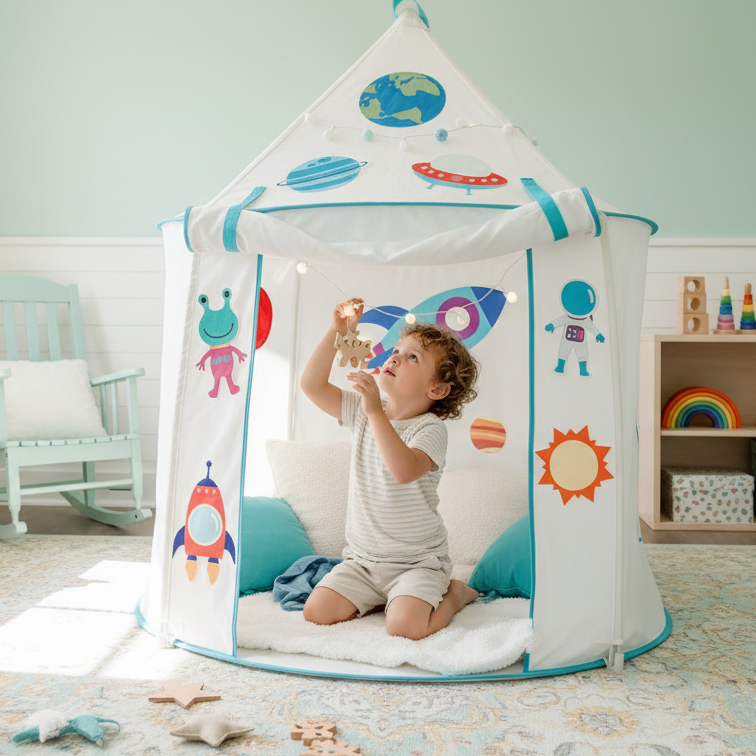
Many families intentionally create dedicated calm play spaces because children naturally associate those environments with relaxation and creativity. This philosophy is reflected in ZeeZee Adventures, where adaptable play tents are designed to become cozy, sensory-friendly retreats that evolve with a child's imagination. Through interchangeable StickeeZ themes, one familiar space can transform from a quiet reading nook into a magical forest or an underwater adventure while maintaining the sense of comfort and emotional security that helps children settle into deeper, more meaningful play.
Creating Calm Through Play: A Parent's Guide
Part 3: Designing a Home That Supports Calm, Confidence, and Emotional Wellbeing
Children don't become calm simply because we ask them to.
Phrases like "Take a deep breath," "Calm down," or "Relax" are well-intentioned, but they rarely work on their own, especially when emotions are already running high.
Children first need an environment that helps their nervous system feel safe.
Only then can they begin regulating their emotions independently.
The encouraging news is that parents don't need to redesign their entire home to achieve this.
A few thoughtful changes can transform ordinary spaces into places where children naturally slow down, focus more deeply, and feel emotionally secure.
Why the Environment Matters
Every room sends subtle messages to a child's brain.
Some spaces encourage movement and excitement.
Others invite relaxation and reflection.
Think about how differently you feel walking into:
-
a busy shopping mall
-
a quiet library
-
a peaceful garden
-
a cozy coffee shop
Children experience the same contrast.
They instinctively respond to their surroundings, often without realizing why.
When a play environment feels calm, predictable, and welcoming, children can devote more mental energy to creativity instead of constantly processing distractions.
Create One Dedicated Calm Space
One of the most effective ways to encourage emotional regulation is by creating a place that children naturally associate with comfort and imaginative play.
This doesn't need to be an entire room.
A small corner works beautifully.
It might include:
-
soft cushions
-
a comfortable rug
-
favorite books
-
stuffed animals
-
blankets
-
a basket of open-ended toys
The goal isn't creating a "time-out" area.
Instead, it's creating a place children genuinely enjoy visiting.
Over time, this space becomes emotionally meaningful.
Children begin choosing it themselves whenever they want to read, imagine, build, or simply rest.
Calm Corners Are Different From Punishment Spaces
Some parents worry that creating a quiet corner feels similar to sending children away after difficult behavior.
The difference lies in purpose.
A punishment space says:
"You need to leave."
A calm space says:
"You're always welcome here."
Children should associate these areas with safety rather than consequences.
Invite them to use the space before emotions become overwhelming.
Read stories together there.
Draw together.
Build together.
Positive experiences create positive associations.
Lighting Shapes Mood
Lighting influences how both adults and children experience a room.
Bright overhead lights can sometimes feel energizing.
Soft, natural lighting often feels more relaxing.
Whenever possible, create play areas near:
-
windows
-
natural daylight
-
warm table lamps
-
gentle indirect lighting
As evening approaches, reducing harsh lighting can also help children transition toward bedtime.
The objective isn't darkness.
It's creating an atmosphere that feels peaceful.
Reduce Unnecessary Noise
Children rarely mention background noise, but their brains continue processing it.
Consider how many sounds may exist simultaneously:
-
television
-
phones
-
kitchen appliances
-
conversations
-
traffic
-
music
-
notifications
Not every sound needs to disappear.
However, reducing unnecessary background media often makes a noticeable difference.
A quieter environment allows children to become absorbed in stories, building projects, and imaginative play without frequent interruptions.
Organize Without Overstimulating
Parents often believe displaying every toy encourages more play.
In reality, fewer visible choices usually encourage deeper engagement.
Rotate Instead of Replacing
Rather than buying new toys regularly, rotate existing ones.
Store part of the collection and exchange materials every few weeks.
Children often rediscover familiar toys with fresh enthusiasm.
Rotation also keeps play spaces visually calmer.
Keep Materials Easy to Find
Children play more confidently when they know where things belong.
Simple organization helps.
Books together.
Art supplies together.
Building materials together.
Dress-up clothes in one basket.
When children spend less time searching, they spend more time creating.
Daily Rituals That Help Children Feel Calm
Calm isn't created only through physical spaces.
Family routines matter just as much.
Predictable rituals provide emotional security because children know what to expect.
Even brief daily habits can become powerful anchors.
Morning Quiet Time
Instead of beginning every day with screens or rushed schedules, spend a few quiet minutes together.
Read a short story.
Look outside.
Talk about the day ahead.
Build something simple.
A calm beginning often influences the rest of the day.
After-School Reset
Many children return home carrying emotional and mental fatigue.
Rather than immediately asking about homework or starting another activity, allow time to decompress.
Some children benefit from:
-
drawing
-
building
-
reading
-
imaginative play
-
outdoor exploration
This transition period helps children process the school day before moving into evening routines.
Bedtime Play Rituals
Bedtime isn't only about sleep.
It's also an opportunity to strengthen emotional connection.
Gentle activities such as:
-
storytelling
-
reading together
-
quiet pretend play
-
puzzles
-
soft music
-
drawing
Help children transition naturally from active thinking into rest.
These routines also become cherished family memories.
Common Mistakes Parents Make
Parents work incredibly hard to support their children's emotional wellbeing.
Sometimes, however, small habits unintentionally make emotional regulation more difficult.
Recognizing these patterns allows simple adjustments.
Mistake 1: Solving Every Emotional Challenge
It's natural to want children to feel better quickly.
However, immediately fixing every problem can prevent children from practicing recovery.
Instead of solving the situation immediately, try asking:
-
"What do you think would help?"
-
"Would you like to try again?"
-
"How can we solve this together?"
These questions build confidence and resilience.
Mistake 2: Filling Every Quiet Moment
Many adults feel uncomfortable when children appear bored.
They suggest activities.
Offer screens.
Introduce new toys.
Yet quiet moments often become the beginning of meaningful play.
Giving children space to discover their own ideas strengthens independence.
Mistake 3: Expecting Emotional Regulation Too Soon
Young children are still developing the brain systems responsible for managing strong emotions.
When adults expect calm behavior immediately after disappointment, frustration often increases.
Instead, focus on connection first.
Once children feel understood, they become much more capable of calming themselves.
Mistake 4: Overcomplicating Play
Parents sometimes feel pressure to create elaborate crafts or educational activities.
Children usually need much less.
A few building blocks.
Paper and crayons.
A blanket fort.
Natural objects collected outdoors.
Simple materials leave more room for imagination.
Why Cozy Spaces Encourage Emotional Safety
Across cultures and generations, children consistently create small, enclosed spaces.
Blanket forts.
Cardboard boxes.
Reading tents.
Treehouses.
Spaces beneath tables.
These places provide something remarkably important.
A sense of control.
Inside these environments, children decide:
-
what happens
-
who enters
-
What story unfolds
-
when the adventure changes
That ownership helps children feel emotionally secure.
Many families intentionally include cozy, imaginative spaces within their homes for exactly this reason. ZeeZee Adventures embraces this developmental principle by creating adaptable play tents that feel both comforting and inspiring. Instead of directing children toward one specific activity, the interchangeable StickeeZ themes allow the same familiar space to become whatever the child needs that day, whether it's a peaceful reading retreat, a magical forest, an underwater expedition, or a quiet place to simply recharge. The consistency of the environment combined with the flexibility of imaginative play helps children feel both safe and creatively free.
Calm Grows Through Consistency
Children don't develop emotional resilience from one peaceful afternoon.
They build it through hundreds of small experiences.
Every quiet story before bed.
Every uninterrupted building session.
Every cozy reading corner.
Every imaginative adventure.
Every opportunity to recover after disappointment.
Together, these moments teach children something incredibly valuable.
They learn that emotions come and go.
Those challenges can be solved.
That calm can be found again.
And that they already have many of the tools they need within themselves.
Frequently Asked Questions
Is calm play only for children who are anxious or highly sensitive?
Not at all.
Every child benefits from opportunities to slow down and regulate their emotions.
Some children naturally seek quiet activities, while others prefer energetic play. Both still need moments of calm to recharge their minds and bodies.
Think of calm play as emotional maintenance, much like healthy food supports physical wellbeing.
Can energetic children enjoy calm play?
Absolutely.
Children with lots of energy often enjoy alternating between active movement and quieter activities.
After running outdoors, they may naturally settle into building with blocks, drawing, reading, or imaginative storytelling.
The key isn't replacing energetic play.
It's balancing it with opportunities for recovery.
How much calm play should children have each day?
There isn't a universal rule.
Instead of focusing on a specific number of minutes, pay attention to rhythm.
Children benefit when their day includes a healthy balance of:
-
active movement
-
imaginative play
-
social interaction
-
quiet independent play
-
family connection
-
rest
Even twenty to thirty minutes of uninterrupted, child-led calm play can make a meaningful difference when practiced consistently.
What if my child says they're bored?
This is often the moment many parents accidentally interrupt creativity.
Instead of immediately suggesting an activity, respond with curiosity.
You might ask:
-
"What could you invent today?"
-
"What story hasn't been told yet?"
-
"What could you build with what's already here?"
Children frequently discover their most imaginative ideas after the initial discomfort of boredom passes.
Do I need special toys?
No.
Some of the most effective calm play materials are wonderfully simple.
Examples include:
-
books
-
wooden blocks
-
crayons and paper
-
play dough
-
cardboard boxes
-
blankets
-
dolls
-
stuffed animals
-
natural objects collected outdoors
These materials encourage children to contribute their own imagination instead of following predetermined instructions.
Practical Ways to Bring More Calm Into Everyday Life
Supporting emotional wellbeing doesn't require dramatic lifestyle changes.
Small, intentional habits often create the greatest long-term impact.
Protect Uninterrupted Play
Whenever possible, allow children enough time to become deeply engaged.
Many imaginative ideas don't appear during the first few minutes.
They emerge after children have settled into their own rhythm.
Try protecting at least forty-five to sixty minutes of uninterrupted play whenever your schedule allows.
Slow Down the Transitions
Modern family life often moves quickly.
School to activities.
Activities to dinner.
Dinner to homework.
Homework to bedtime.
Whenever possible, create gentle transitions.
A few quiet minutes with a book.
Drawing together.
A short walk.
Listening to nature outside.
These small pauses help children reset before moving into the next part of the day.
Model Calm Yourself
Children learn emotional regulation by watching the adults around them.
When parents demonstrate healthy ways to respond to stress, children begin developing those same habits.
This doesn't mean staying perfectly calm all the time.
It means showing children that it's okay to pause, take a breath, apologize when necessary, and begin again.
Emotional resilience is learned through observation as much as instruction.
Celebrate the Process
Children don't need every drawing to become a masterpiece.
Every tower doesn't need to stay standing.
Every story doesn't need a perfect ending.
Celebrate curiosity.
Persistence.
Experimentation.
Kindness.
Original thinking.
These qualities encourage children to continue exploring without fear of failure.
Calm Play Creates Lasting Family Traditions
Some of childhood's strongest memories aren't built around extraordinary events.
They're created through simple routines repeated over time.
Reading together before bed.
Saturday morning building projects.
Nature walks after dinner.
Rainy afternoons inside a blanket fort.
Storytelling while sharing hot chocolate.
These traditions offer more than entertainment.
They create emotional security.
Children begin to associate home with warmth, connection, and belonging.
Those feelings remain long after individual activities are forgotten.
A Home That Feels Safe Inspires Calm
Children don't need a perfectly decorated house.
They need a home where they feel accepted.
A place where mistakes become learning opportunities.
Where imagination is welcomed.
Where quiet moments are valued as much as busy ones.
Many families intentionally create small spaces dedicated to peaceful, imaginative play because children naturally return to environments where they feel emotionally secure. This philosophy is reflected in ZeeZee Adventures. Rather than encouraging constant novelty, its adaptable play tents and interchangeable StickeeZ themes provide children with a familiar, comforting space that evolves alongside their imagination. One day it may become a magical forest, the next a space station, and another a cozy reading retreat. The environment stays reassuring while the adventures continue to grow.
Final Thoughts
Childhood isn't meant to be a race from one activity to the next.
It's a season of exploration.
Wonder.
Questions.
Mistakes.
Discovery.
When children are constantly entertained, they may miss opportunities to discover what brings them peace.
When they are constantly directed, they may miss the chance to trust their own ideas.
Calm play creates room for something remarkable.
It allows children to listen to their own thoughts.
To process their emotions.
To build confidence through creativity.
To recover after difficult moments.
To experience the quiet satisfaction of creating something entirely their own.
As parents, we don't need to remove every challenge from childhood.
We simply need to provide environments where children feel safe enough to face those challenges.
Sometimes that looks like a blanket fort.
Sometimes it's reading together on the couch.
Sometimes it's building with blocks in comfortable silence.
And sometimes it's simply sitting nearby while your child disappears into an imaginary world they've created themselves.
Those ordinary moments are never really ordinary.
They become the foundation of emotional resilience, lifelong curiosity, and a childhood filled with calm, confidence, and connection.






Comment (0)