
The Creativity Crisis: Are Kids Losing the Ability to Imagine?
Introduction
Imagine asking a group of children to invent a game using nothing more than a cardboard box.
A generation ago, you might have seen pirate ships, race cars, castles, rocket launchers, grocery stores, and secret hideouts appear within minutes. The box itself wasn't important. It was simply the starting point for imagination.
Today, many children still possess that incredible creative spark. But increasingly, parents, educators, and child development experts are asking an important question:
Are children getting fewer opportunities to use it?
Modern childhood has changed dramatically in just a few decades.
Children have access to more information, more educational resources, and more technology than any generation before them. They can explore distant planets through virtual reality, learn coding through interactive apps, and instantly watch videos about almost any topic imaginable.
These innovations bring remarkable opportunities.
At the same time, they also create an unexpected challenge.
When entertainment, stories, games, and answers are always available at the touch of a screen, children may spend less time creating those experiences for themselves.
That distinction matters.
Creativity isn't simply about drawing beautiful pictures or writing imaginative stories. It's the ability to think differently, generate original ideas, solve unfamiliar problems, adapt to changing situations, and imagine possibilities that don't yet exist.
Those abilities are becoming increasingly valuable in a world shaped by rapid technological change and artificial intelligence.
The good news is that creativity isn't disappearing.
Children are not becoming less imaginative by nature.
Instead, many are growing up in environments that leave less room for imagination to flourish naturally.
The encouraging part is that creativity behaves much like a muscle. The more opportunities children have to practice it, the stronger it becomes.
In this guide, we'll explore what creativity really means, whether today's children are actually becoming less imaginative, how modern childhood has changed, and the practical steps families can take to nurture imagination in everyday life.
What Does Creativity Really Mean?
Creativity Is Not Just About Art
When people hear the word "creativity," they often picture painting, music, dance, or creative writing.
While these are wonderful forms of creative expression, they represent only one part of a much broader skill.
Creativity is the ability to produce ideas that are both original and useful.
It allows children to:
-
solve unexpected problems
-
invent games
-
imagine different possibilities
-
connect unrelated ideas
-
adapt when plans change
-
explore new approaches
In other words, creativity is a way of thinking rather than a specific talent.
Every child demonstrates creativity in different ways.
One child may invent elaborate imaginary worlds.
Another designs complex structures with building blocks.
A third creates unusual solutions during science experiments.
All are exercising the same underlying skill.
Creativity Is Closely Connected to Problem-Solving
Imagine two children building a bridge from wooden blocks.
Halfway through construction, the bridge collapses.
One child gives up.
The other begins experimenting.
They widen the base.
Change the materials.
Try a completely different design.
That child isn't simply playing.
They're thinking creatively.
Creative thinking helps children approach obstacles with curiosity instead of frustration.
Rather than asking,
"Why didn't this work?"
they begin asking,
"What else could I try?"
That shift in mindset supports lifelong learning.
Divergent Thinking: The Heart of Imagination
Psychologists often describe creativity using the concept of divergent thinking.
Divergent thinking means generating many possible solutions instead of searching for only one correct answer.
For example, ask a child:
"How many different uses can you think of for a spoon?"
The obvious answer is eating.
But imaginative children might also suggest:
-
a drumstick
-
a tiny shovel
-
a magic wand
-
a boat paddle for toy animals
-
a catapult
-
a musical instrument
-
a microphone
There isn't one correct response.
The exercise rewards possibility rather than perfection.
This type of thinking becomes increasingly valuable throughout life because real-world challenges rarely have only one solution.
Are Children Really Becoming Less Imaginative?
It's a question that generates passionate debate.
Some adults believe children today have shorter attention spans and less imagination than previous generations.
Others argue that creativity simply looks different because children now create digital worlds, design games, edit videos, and build virtual communities.
The reality is more balanced.
Children remain naturally imaginative.
What's changing is the amount of time available for child-led, open-ended creativity.
The Environment Has Changed
Today's children often experience:
-
busier schedules
-
more organized activities
-
increased academic expectations
-
greater access to digital entertainment
-
less unsupervised outdoor play
-
fewer opportunities for boredom
None of these changes automatically reduce creativity.
However, together they can reduce the amount of unstructured time where imagination naturally develops.
Creativity needs space.
Not constant instruction.
Children Are Creating Differently
It's also important to avoid romanticizing the past.
Modern children express creativity in exciting new ways.
Many enjoy:
-
digital storytelling
-
animation
-
coding
-
music production
-
robotics
-
filmmaking
-
photography
-
designing virtual worlds
These activities absolutely involve creativity.
The concern isn't technology itself.
The concern is balance.
Children also benefit from experiences where they generate ideas without relying on digital platforms to guide every step.
Both forms of creativity have value.
Why Creativity Matters More Than Ever
Ironically, creativity has become even more important as technology continues advancing.
Artificial intelligence can process enormous amounts of information.
It can recognize patterns.
Generate summaries.
Answer questions.
What remains uniquely human is our ability to imagine entirely new possibilities, connect emotions with ideas, and approach challenges through curiosity and empathy.
These are the qualities that creative play begins developing in early childhood.
Creativity Supports Every Area of Development
Creative experiences strengthen much more than imagination.
Children also develop:
Communication Skills
Pretend play encourages storytelling, conversation, and vocabulary growth.
Emotional Intelligence
Children process feelings by acting out experiences through imaginary characters and situations.
Flexible Thinking
Open-ended play teaches children to adapt when plans change.
Confidence
Each original idea reinforces the belief that their thoughts have value.
Collaboration
Shared imaginative play encourages negotiation, listening, and teamwork.
These skills influence learning, friendships, and future careers.
Creativity Begins Long Before School
Many adults associate creativity with art lessons or classroom projects.
In reality, it begins much earlier.
It begins when toddlers stack blocks in unusual ways.
When preschoolers turn blankets into castles.
When siblings invent secret languages.
When children transform ordinary household objects into extraordinary adventures.
These everyday moments build the foundation for innovative thinking.
Children don't need elaborate materials.
They need freedom.
They need time.
Most importantly, they need permission to explore without worrying about getting everything "right."
What's Changing Childhood and Why It Matters
Creativity doesn't disappear overnight.
It develops gradually through repeated opportunities to imagine, experiment, question, and solve problems. In the same way, creativity can become underused when children have fewer chances to practice those skills.
Today's children are not less capable of being creative than previous generations. They are growing up in a very different environment.
Understanding these changes helps parents move beyond blame and focus on creating opportunities where imagination can thrive.
The Hidden Shift in Modern Childhood
If childhood looked like a landscape, it would have changed dramatically over the past few decades.
Many children still enjoy playing outside, building with blocks, and pretending to be astronauts or veterinarians. At the same time, many families also navigate packed schedules, academic expectations, digital entertainment, and structured routines that leave less room for spontaneous exploration.
None of these changes are inherently negative.
The challenge lies in finding balance.
Creativity often grows in the spaces between structured activities.
When every moment has a plan, there are fewer opportunities for children to invent one themselves.
Overscheduled Lives Leave Less Room for Wonder
Parents naturally want to give their children every opportunity to succeed.
Sports.
Music lessons.
Language classes.
Tutoring.
Dance.
Coding camps.
Scouting.
Art classes.
Each activity offers valuable experiences.
However, when every afternoon is carefully planned, children have little unstructured time to follow their own curiosity.
Those quiet moments once spent wandering the backyard, inventing games with siblings, or building imaginary worlds are becoming increasingly rare.
Ironically, these unplanned moments often contribute just as much to healthy development as organized activities.
Constant Entertainment Changes Expectations
One of the defining features of modern childhood is immediate access to entertainment.
A child no longer has to wait for a favorite television program.
Movies, games, music, and videos are available within seconds.
This convenience has many advantages.
But it also changes what children expect from their environment.
Creative play unfolds slowly.
Children gather materials.
Experiment.
Make mistakes.
Change directions.
Invent characters.
Develop stories.
Digital entertainment often removes these steps by delivering excitement instantly.
Over time, slower forms of play may initially seem less appealing, not because they are less valuable, but because they require children to create the excitement themselves.
The Difference Between Consuming and Creating
Imagine two children spending an hour after school.
One watches an adventure unfold on a screen.
The other invents an adventure using blankets, pillows, stuffed animals, and a cardboard box.
Both experiences involve stories.
Only one requires the child to build the story from the ground up.
This distinction is important.
Consumption is not the opposite of creativity.
Children learn through books, films, documentaries, and educational media.
The concern arises when consuming stories consistently replaces creating them.
Children need opportunities to become storytellers rather than remaining audience members.
Why Pretend Play Is More Powerful Than It Looks
Adults sometimes underestimate pretend play because it appears simple.
A child pours imaginary tea.
A stuffed bear visits the doctor.
A couch becomes a pirate ship.
Behind these playful moments, the brain is performing remarkable work.
Pretend play combines language, memory, emotional understanding, planning, sequencing, and problem-solving into a single activity.
Few childhood experiences exercise so many developmental skills at once.
Imagination Helps Children Process Real Life
Pretend play isn't separate from reality.
It's one of the ways children make sense of it.
After visiting the doctor, a child may spend days pretending to examine stuffed animals.
After welcoming a new sibling, dolls may suddenly become babies requiring extra care.
Following a family vacation, the living room may transform into an airport.
These imaginary scenarios allow children to process emotions, rehearse experiences, and explore ideas in a safe environment.
Parents often see only the game.
The child is quietly making meaning of the world around them.
Open-Ended Play Encourages Flexible Thinking
Open-ended play differs from activities with predetermined outcomes.
There is no instruction manual.
No single correct answer.
No finished example to copy.
Children decide:
-
what the game will be
-
who the characters are
-
what problems arise
-
how those problems are solved
-
how the story ends
This continuous decision-making strengthens cognitive flexibility, one of the most valuable skills children can develop.
Flexible thinkers adapt more easily to new situations because they're accustomed to exploring multiple possibilities.
Why Boredom Is Creativity's Best Friend
One reason creativity appears to decline is that boredom has become increasingly rare.
The moment children feel unstimulated, adults often respond with suggestions, activities, or screens.
Yet boredom serves an important developmental purpose.
It creates the mental space where original ideas begin.
When children don't immediately know what to do, their brains begin asking:
"What could I create?"
That question activates imagination.
A stick becomes a fishing rod.
A cardboard box becomes a submarine.
A hallway becomes a racetrack.
Without boredom, many of these ideas never emerge.
The Science Behind Mind Wandering
Neuroscientists have found that the brain remains highly active during quiet moments.
When children daydream or let their minds wander, they strengthen connections between memory, imagination, and future planning.
These moments help children:
-
connect unrelated ideas
-
imagine different outcomes
-
solve problems creatively
-
reflect on experiences
-
generate original thoughts
What appears to be "doing nothing" often involves some of the brain's most meaningful work.
Creativity and Confidence Grow Together
Children become more willing to share ideas when they believe those ideas matter.
Creative play provides countless opportunities for success.
There isn't one perfect castle.
One perfect drawing.
One perfect story.
Every child contributes something unique.
When adults celebrate effort, experimentation, and imagination rather than perfection, children become increasingly confident in their own thinking.
Confidence encourages further creativity.
Creativity builds confidence.
Together they create a powerful cycle of growth.
Creating Environments That Inspire Imagination
The spaces where children play influence how they think.
Highly structured environments often encourage children to follow instructions.
Flexible environments invite exploration.
A few simple materials can support hours of imaginative play:
-
cardboard boxes
-
blankets
-
art supplies
-
costumes
-
building blocks
-
natural materials
-
books
-
loose parts
What matters isn't the quantity of toys.
It's whether children feel free to transform them into something new.
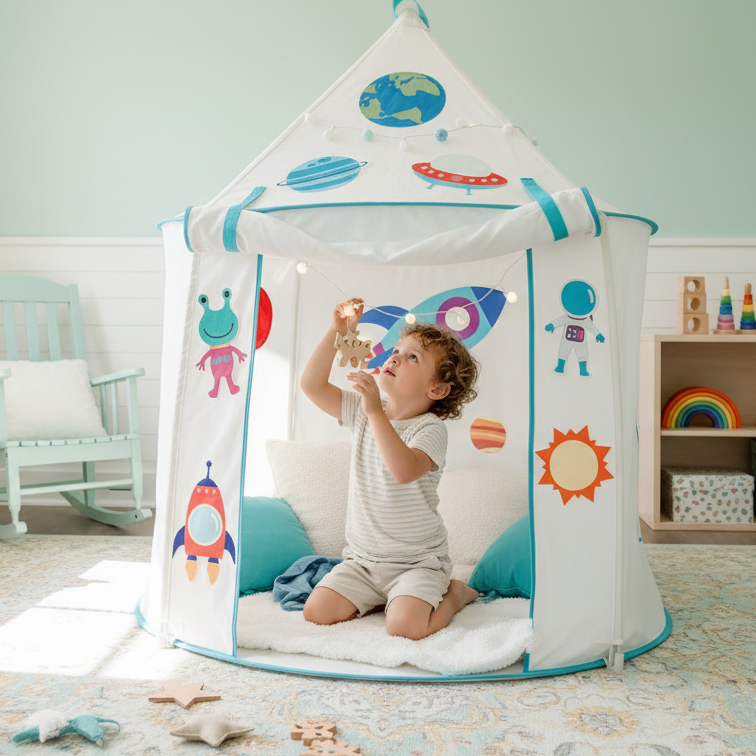
Many families intentionally create adaptable play spaces because they encourage children to return to the same environment with fresh ideas instead of quickly moving on to the next toy. This philosophy is reflected in ZeeZee Adventures, where one play tent becomes countless imaginative worlds through interchangeable StickeeZ themes. Instead of providing a scripted experience, the environment evolves with the child's stories, supporting creativity, independent play, and longer periods of engagement.
The Goal Isn't Less Technology. It's More Imagination.
Discussions about creativity often become debates about screens.
That misses the bigger picture.
Technology itself isn't the enemy of imagination.
Children can create extraordinary digital art, compose music, design games, and produce films using modern tools.
The real question is balance.
Do children also have opportunities to invent stories without prompts?
Build without instructions?
Solve problems independently?
Spend time wondering rather than consuming?
Creativity flourishes when children experience both the opportunities of modern technology and the freedom of open-ended exploration.
In Part 3, we'll explore practical ways parents can nurture creativity at home, common habits that unintentionally discourage imaginative thinking, and simple daily changes that can help children rediscover the joy of creating their own ideas.
How Parents Can Nurture Creativity in Everyday Life
If creativity grows through practice, then the encouraging news is this:
Parents don't need to be artists, teachers, or child development experts to help children become more imaginative.
Creativity isn't built through expensive toys or elaborate lesson plans.
It's built through everyday moments.
A rainy afternoon with cardboard boxes.
A walk where children invent stories about clouds.
A quiet hour spent building a city from blocks.
A conversation that begins with, "What if...?"
Small experiences, repeated consistently, shape how children learn to think.
The goal isn't to produce the next famous inventor or artist.
It's to raise children who feel confident exploring ideas, asking questions, and solving problems in creative ways.
Creativity Begins With Curiosity
Every creative breakthrough starts with curiosity.
Children are naturally curious.
Toddlers ask endless questions.
Preschoolers wonder why the moon follows the car.
School-aged children invent elaborate theories about how the world works.
Instead of rushing to answer every question, parents can encourage curiosity by exploring ideas together.
For example, if a child asks:
"Why do birds fly in groups?"
Rather than immediately explaining, try asking:
"What do you think?"
This simple response communicates something powerful.
Your ideas matter.
Curiosity grows when children feel safe exploring possibilities rather than worrying about finding the perfect answer.
Replace Instructions With Invitations
Many children's activities come with detailed directions.
Color inside these lines.
Follow these steps.
Build this exact model.
While structured activities have value, creativity flourishes when children have opportunities to make their own decisions.
Instead of saying:
"Let's build this castle."
Try saying:
"What could we build today?"
Instead of handing children a finished craft example, provide materials and ask:
"What would you like to create?"
Open invitations encourage ownership.
Ownership encourages imagination.
Protect Time for Unstructured Play
One of the greatest gifts parents can offer is time.
Not scheduled time.
Not instructional time.
Simply time.
Children need opportunities to begin activities without adults deciding exactly how they should unfold.
This might mean:
-
an afternoon with building blocks
-
free play outdoors
-
creating imaginary worlds with stuffed animals
-
drawing without a specific assignment
-
exploring nature
The absence of a predetermined outcome allows creativity to emerge naturally.
Celebrate Ideas Instead of Perfection
Many children stop sharing creative ideas because they fear making mistakes.
Parents can change this by praising the thinking process rather than only the finished result.
Instead of saying:
"That's a beautiful picture."
Try saying:
"I love how you thought of making the trees purple."
Or:
"Tell me about your drawing."
Questions communicate interest.
They invite children to explain their thinking.
Creative confidence grows when children feel their ideas are valued.
Encourage Storytelling Everywhere
Stories don't need books.
They happen in cars.
At the dinner table.
On walks.
Before bedtime.
Simple prompts can spark remarkable imagination.
Try asking:
-
What would happen if animals could vote?
-
If your bedroom became another country, what would it look like?
-
What would you invent to help people?
-
If your pet could talk for one day, what would it say?
These conversations strengthen language, creativity, humor, and flexible thinking.
More importantly, they become memorable family moments.
Let Children Solve Their Own Problems
One of the quickest ways to discourage creativity is solving every challenge immediately.
Imagine a child trying to build a bridge.
It keeps falling down.
Instead of demonstrating the solution, ask:
"What have you tried already?"
"What else could work?"
These questions encourage experimentation.
Creative thinkers aren't people who never fail.
They're people who keep testing ideas.
Every unsuccessful attempt teaches something valuable.
Creativity Loves Open-Ended Play
Children often play longest when there isn't one correct way to use a toy.
Open-ended materials encourage exploration because they invite possibility instead of instructions.
Examples include:
-
wooden blocks
-
magnetic tiles
-
cardboard boxes
-
costumes
-
art supplies
-
loose parts
-
dolls
-
puppets
-
natural materials
These resources become whatever children imagine.
One day they're castles.
The next day they're airports.
A week later they become dinosaur museums.
The materials remain the same.
Only the stories change.
Create Spaces That Inspire Imagination
Environment influences creativity more than many parents realize.
Children often think more creatively when they have spaces that feel inviting, comfortable, and flexible.
This doesn't require a dedicated playroom.
A reading corner.
A blanket fort.
A table covered with drawing supplies.
A quiet corner with cushions.
Even a small imaginative space can encourage children to return repeatedly with new ideas.
Many families appreciate adaptable environments because they grow alongside changing interests rather than becoming outdated after a single phase. ZeeZee Adventures embraces this concept by allowing children to transform one familiar play tent into countless imaginative worlds using interchangeable StickeeZ themes. Instead of replacing toys whenever interests shift, children can reinvent the same space as a castle, rainforest, space station, underwater world, or reading nook. This flexibility supports longer periods of imaginative, child-led play while encouraging original storytelling instead of scripted experiences.
Habits That Accidentally Limit Creativity
Parents rarely discourage creativity intentionally.
However, certain habits can unintentionally reduce opportunities for imaginative thinking.
Overscheduling Every Afternoon
Children need downtime.
When every hour is planned, creativity has little room to emerge.
Quiet moments matter.
Providing Immediate Answers
Curiosity grows through exploration.
Instead of answering every question instantly, encourage children to investigate.
Wonder together.
Research together.
Experiment together.
Focusing Too Much on Correctness
Creative thinking depends on possibility.
Children become hesitant when they believe every activity has one perfect outcome.
Celebrate unusual ideas.
Unexpected solutions.
Different perspectives.
Interrupting Deep Play
Children often reach their most imaginative thinking after twenty or thirty minutes of uninterrupted play.
Frequent interruptions can break concentration just as creativity begins unfolding.
Whenever possible, allow children to finish their stories before asking them to move on.
Creativity Prepares Children for an Uncertain Future
The world children inherit will almost certainly look different from today's.
Many future careers haven't even been invented yet.
Technology will continue evolving.
Artificial intelligence will automate many routine tasks.
Human strengths such as creativity, empathy, collaboration, adaptability, and original thinking will become increasingly valuable.
These abilities don't suddenly appear during adulthood.
They begin developing through everyday childhood experiences.
Every imaginary game.
Every homemade invention.
Every "What if...?" conversation.
Every cardboard spaceship.
Creative childhood becomes creative adulthood.
Imagination Is More Than Entertainment
When adults see children pretending, it's easy to assume they're simply passing time.
In reality, imagination is serious work.
Children are practicing:
-
decision-making
-
emotional regulation
-
storytelling
-
communication
-
leadership
-
collaboration
-
innovation
The pretend restaurant isn't really about serving imaginary food.
It's about organizing ideas.
The cardboard castle isn't really about knights.
It's about creating possibilities.
Play becomes the laboratory where children safely experiment with the skills they'll eventually use throughout life.
Raising Creative Thinkers in a Changing World
If there's one message to take away from this discussion, it's this:
Children are not losing their imagination.
They're growing up in a world that gives them fewer opportunities to use it.
That's an important distinction.
Creativity isn't something children either have or don't have. It's a skill that develops through experience, much like language, confidence, or physical coordination. When children regularly imagine, invent, question, build, and explore, those creative pathways become stronger. When those opportunities become less frequent, creativity simply has fewer chances to grow.
The encouraging news is that parents have more influence than they might realize.
Small changes in everyday family life can create powerful opportunities for imagination to flourish.
When Creativity Appears to Decline
Many parents notice a shift as children grow older.
A preschooler who once spent hours pretending to be a dragon trainer or astronaut suddenly seems more interested in screens, structured activities, or hobbies with clear rules.
This change can feel worrying, but it doesn't necessarily mean creativity has disappeared.
Often, several factors are happening at once.
Children become more aware of social expectations.
School places greater emphasis on correct answers.
Academic workloads increase.
Extracurricular schedules become busier.
Digital entertainment becomes more appealing.
Together, these influences can leave less time and confidence for imaginative exploration.
The goal isn't to recreate preschool forever.
It's to continue protecting spaces where curiosity remains welcome.
Creativity Evolves With Age
As children mature, creativity often changes its form.
A five-year-old may express creativity through pretend play.
A ten-year-old might design a board game.
A teenager may compose music, code an app, write fiction, or produce short films.
The expression changes.
The underlying thinking remains the same.
Parents should look beyond traditional forms of imagination and recognize creativity wherever children are generating original ideas, solving problems, or expressing themselves in meaningful ways.
Frequently Asked Questions
Are children today less creative than previous generations?
Research doesn't support the idea that children are inherently less creative.
Instead, many experts suggest that modern lifestyles provide fewer opportunities for spontaneous, child-led imagination.
Children remain naturally curious and creative when given time, freedom, and supportive environments.
Does screen time destroy creativity?
No.
Technology itself isn't the problem.
Digital tools can support creativity through animation, music production, photography, filmmaking, coding, and design.
The key is balance.
Children also need experiences that encourage imagination without relying on screens to provide every story or solution.
Can creativity be taught?
Creativity is best understood as something that can be developed rather than directly taught.
Adults can't force imagination.
They can, however, create conditions where it naturally grows.
Providing open-ended materials, protecting free play, encouraging curiosity, and celebrating original ideas all strengthen creative thinking over time.
What age is most important for developing creativity?
Creativity develops throughout life.
However, the early childhood years provide particularly rich opportunities because children naturally engage in imaginative play, storytelling, and exploration.
Supporting these experiences during the preschool and early elementary years helps establish habits of curiosity that continue into adolescence and adulthood.
Do expensive toys make children more creative?
Not necessarily.
In many cases, simple, flexible materials encourage richer imagination because children decide how to use them.
A cardboard box can become dozens of different things.
An electronic toy often has only one intended purpose.
Creativity depends far more on possibilities than price.
Practical Steps Parents Can Start Today
Helping children become more imaginative doesn't require dramatic lifestyle changes.
Often, small daily habits make the greatest difference.
Leave Space in the Schedule
Not every afternoon needs a planned activity.
Allow children time to become curious, even if that begins with a few minutes of boredom.
Those quiet moments often lead to surprising discoveries.
Ask More "What If?" Questions
Curiosity grows through possibility.
Questions like these encourage flexible thinking:
-
What if animals could build cities?
-
What would school look like on the moon?
-
How would you solve traffic if cars could fly?
-
If you invented a new holiday, how would people celebrate it?
There are no right answers.
That's exactly the point.
Encourage Long Periods of Play
Creativity rarely appears in the first five minutes.
Children often need uninterrupted time to settle into imaginative thinking.
Protecting thirty to sixty minutes of child-led play can produce far richer experiences than several shorter sessions interrupted by adult direction.
Value the Process More Than the Product
A finished drawing isn't the goal.
The thinking behind it is.
A cardboard invention doesn't need to look realistic.
It simply needs to represent the child's ideas.
Celebrate curiosity, experimentation, persistence, and originality.
These qualities matter more than perfection.
Create Flexible Play Environments
Children often revisit spaces that allow them to create new stories again and again.
Instead of relying only on toys with one intended purpose, consider environments that evolve with your child's imagination.
A reading corner can become a hidden library.
A blanket fort can become a mountain cabin.
A play tent can transform into a rainforest, a space station, or a magical kingdom depending on the day's adventure.
This philosophy is at the heart of ZeeZee Adventures. Rather than encouraging children to outgrow one themed play space after another, its interchangeable StickeeZ themes invite children to continually reinvent the same environment. The result is longer-lasting imaginative play where children become the authors of each new adventure instead of simply following a prewritten story.
Why Imagination Matters in the Age of Artificial Intelligence
As technology becomes increasingly capable of completing routine tasks, uniquely human strengths become even more valuable.
Artificial intelligence can analyze information, generate text, recognize patterns, and automate processes.
What it cannot replace is the deeply human ability to connect ideas through emotion, lived experience, empathy, curiosity, and imagination.
These qualities begin developing long before children enter the workforce.
They emerge during conversations.
Pretend play.
Storytelling.
Building.
Questioning.
Exploring.
Every opportunity children have to imagine a different possibility strengthens the mindset they'll need in a rapidly changing future.
Final Thoughts
Creativity isn't disappearing.
It's waiting.
Waiting for children to have enough uninterrupted time.
Waiting for adults to resist solving every problem.
Waiting for a cardboard box to become a rocket ship.
Waiting for a rainy afternoon to become an expedition.
Waiting for someone to ask,
"What do you think?"
Childhood has always been the training ground for imagination.
The stories children invent today become the problem-solving skills, confidence, adaptability, and innovation they carry into adulthood.
As parents, teachers, and caregivers, we don't have to provide every answer.
Sometimes the greatest gift we can offer is simply the freedom to wonder.
Because every remarkable invention, every unforgettable story, and every meaningful discovery once began as someone's imagination.
And imagination always starts with the courage to ask,
"What if?"





Comment (0)