
Rainy Day Activities Kids Won’t Get Bored Of
Rainy days can make the hours feel longer.
Outdoor play is suddenly off the table, energy builds up indoors, and before long, you may hear the familiar: “I’m bored.”
The easiest response is often to reach for a screen or bring out another toy. But rainy days can also create something valuable: a little extra space for children to invent their own ways to play.
The trick is not finding an activity that keeps a child entertained for exactly 30 minutes. It is finding activities with room to change games that can become stories, building projects that can become pretend worlds, and simple materials that can be used in more than one way.
Here are rainy day activities designed to do exactly that.
1. Turn the Living Room Into an Adventure World
You don't need special equipment to change the feeling of a room.
Move a few cushions, gather blankets, bring in some stuffed animals, and let your child decide what the space becomes.
It could be:
-
A jungle expedition
-
A secret cave
-
A space station
-
A pirate ship
-
A dinosaur research camp
-
A magical kingdom
-
A campsite in the mountains
Instead of giving children a finished game, give them the ingredients for creating one.
Ask:
“Where are we going?”
Then let them build the answer.
This kind of play can continue long after the original setup because the environment itself becomes part of the story.
2. Build a Blanket Fort—Then Give It a Story
A blanket fort is a rainy-day classic for a reason.
But the fort doesn't have to be the end of the activity. It can become the beginning.
Once the fort is built, ask your child to decide:
Who lives here?
Maybe it is a dragon's castle. Maybe it is a scientist's laboratory. Maybe it is a spaceship traveling to another planet.
Add drawings, pillows, books, flashlights, stuffed animals, or homemade signs.
The same fort can become something completely different the next day.
That is one of the strengths of open-ended play: the materials stay the same while the meaning changes.
3. Create an Indoor Treasure Hunt
Hide a few objects around the house and create clues that lead from one discovery to the next.
For younger children, the clues can be simple:
-
“Look somewhere soft.”
-
“Find something blue.”
-
“Your next clue is near something you use to eat.”
Older children can create riddles for siblings or parents.
You can also give the hunt a theme. Perhaps the family is searching for a missing treasure, finding supplies for an imaginary expedition, or helping a character complete a mission.
Once children start creating the clues themselves, the activity changes from simply finding things to designing a game.
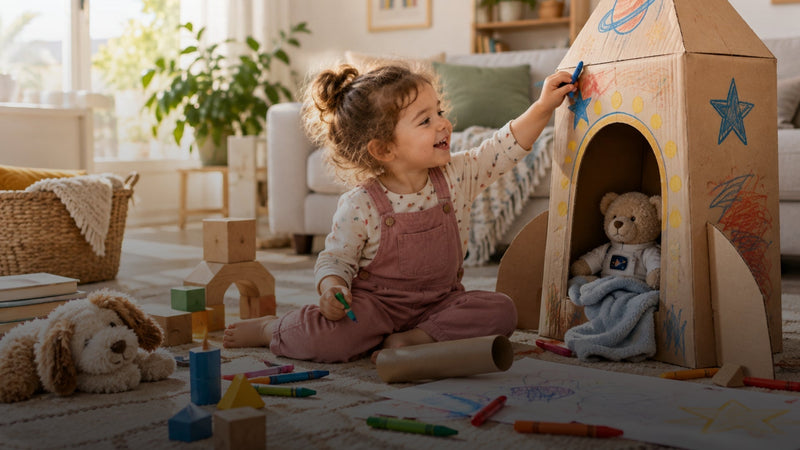
4. Turn Cardboard Boxes Into Something New
Before recycling that delivery box, give your child a chance to decide what it could become.
A box might become:
-
A rocket
-
A race car
-
A puppet theater
-
A dollhouse
-
A robot
-
A grocery store
-
A mailbox
-
A submarine
You don't need to make it perfect.
In fact, leaving some of the design unfinished can be useful. Children can decide where the windows go, what the controls look like, or what the imaginary machine is supposed to do.
The less finished the object is, the more room there can be for imagination.
5. Make a Story Together
Pick three random objects from around the house.
For example:
A spoon + a stuffed bear + a sock.
Now create a story that includes all three.
One person starts:
“One rainy morning, a bear found a mysterious sock…”
Then another person continues.
You can take turns adding one sentence at a time.
For younger children, parents can help keep the story moving. Older children might enjoy creating characters, settings, problems, and surprising endings.
This simple game can also become a drawing activity afterward. Ask your child to illustrate their favorite scene.
6. Have a “What Can We Build?” Challenge
Give your child a small collection of everyday materials.
Try:
-
Paper
-
Cups
-
Cardboard
-
Tape
-
Craft sticks
-
Blocks
-
String
-
Recycled containers
Then offer a challenge:
“Can you build a bridge for this toy?”
Or:
“Can you make a house for your stuffed animal?”
Or:
“Can you build something that can move?”
The goal isn't necessarily to create the perfect structure.
The interesting part is what happens when the first attempt doesn't work.
Children can change the design, test another idea, and try again.
That makes the activity less about the final product and more about experimentation.
7. Create an Indoor Obstacle Course
A rainy day doesn't necessarily mean children need to sit still all day.
Use safe household objects to create a simple indoor movement course.
For example:
-
Crawl under a table.
-
Walk around cushions.
-
Balance along a line of tape.
-
Toss a soft ball into a basket.
-
Jump over a pillow.
-
Finish with a silly dance.
Adapt the activity to your child's age and your available space, and keep potentially unstable furniture out of the course.
Then let your child redesign it.
They might invent a superhero training course, jungle mission, or rescue challenge.
8. Have a “Boredom Box”
Instead of searching for a new activity every time your child says “I'm bored,” create a box filled with simple prompts.
Write ideas on slips of paper such as:
-
Build a secret hideout.
-
Draw a map of an imaginary island.
-
Invent a new animal.
-
Make a puppet show.
-
Build something from cardboard.
-
Create a treasure hunt.
-
Design a new planet.
-
Tell a story using three objects.
-
Make a restaurant for stuffed animals.
-
Create a new game.
The important part is that the prompts shouldn't all have one correct outcome.
They should act as starting points, not instructions that children have to follow exactly.
9. Turn a Quiet Corner Into a Reading Adventure
Not every rainy-day activity needs to be energetic.
Sometimes children need a quieter option.
Create a comfortable reading space with cushions, blankets, books, and a small light.
Then give reading a little more context.
A book about animals could become the starting point for an imaginary safari. A space book could inspire a pretend mission to another planet. A fairy tale could lead to drawing castles or inventing a new character.
Reading doesn't have to remain separate from imaginative play. One can naturally lead into the other.
10. Let Children Change Their Play Environment
One of the simplest ways to prevent familiar activities from feeling repetitive is to change the environment, not necessarily the toys.
A stuffed animal that has been sitting on the shelf can suddenly become part of a camping adventure.
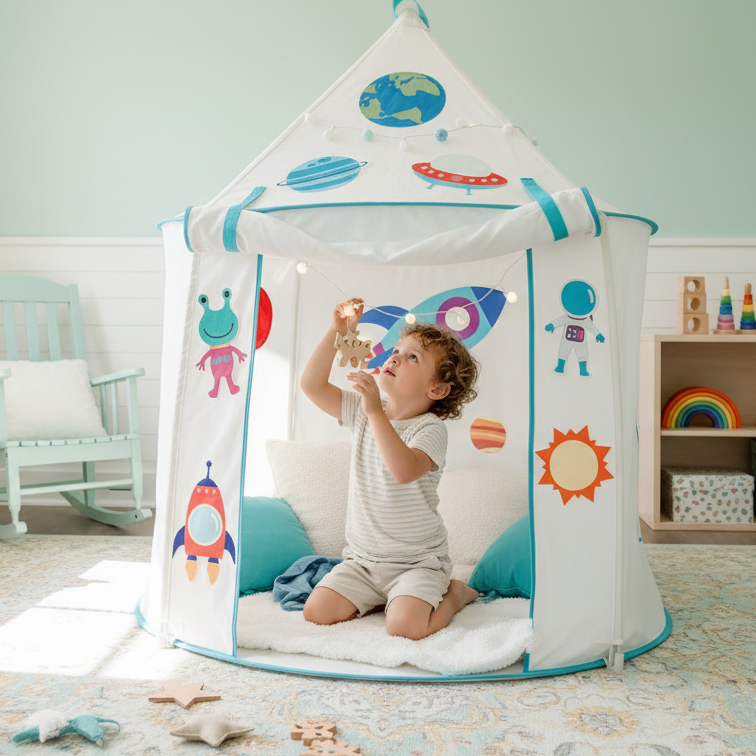
A play tent can become a spaceship one day and a reading hideaway the next.
A few cushions can become mountains, islands, or a pretend train.
For children, the physical environment can help shape the story they are creating.
That is why adaptable play spaces can be particularly useful on days when everyone is stuck indoors.
11. Create a Pretend Restaurant
Set up a small pretend restaurant using safe household items.
Your child can:
-
Create a menu
-
Name the restaurant
-
Take orders
-
Pretend to cook
-
Set the table
-
Serve stuffed animals
-
Make up a restaurant story
You can play the customer.
Then switch roles.
This kind of pretend play gives children control over the scenario while naturally incorporating conversation, storytelling, sequencing, and social interaction.
And tomorrow, the same space could become a grocery store or café.
12. Make a Rainy-Day Art Station
You don't need a complicated craft project.
Set out paper and a few art materials and give children a broad invitation:
“Draw what you think the world looks like from inside a raindrop.”
Or:
“Design a house for an imaginary creature.”
Or:
“Create a map to a place that doesn't exist.”
Open-ended prompts give children more control over what they create.
There is no single correct picture to copy, which means the activity can work for children with very different interests and abilities.
13. Create a Family Story Theater
Choose a familiar story or invent a new one.
Then turn it into a little performance.
Children can decide:
-
Who the characters are
-
What they wear
-
Where the story happens
-
What problem needs solving
-
How the story ends
Costumes don't have to be elaborate. A blanket can become a cape. A cardboard box can become a stage. A stuffed animal can become a character.
The fun often comes from improvising rather than getting every line right.
14. Make the Same Activity Different Tomorrow
One reason children get bored with activities is that the activity has a fixed endpoint.
Build the tower. Finish the worksheet. Complete the craft. Game over.
Open-ended activities can work differently.
A fort can become a spaceship.
The spaceship can become a rescue station.
The rescue station can become a veterinary clinic.
The veterinary clinic can become the setting for a completely new story.
The same physical materials can support different kinds of play depending on what the child imagines.
That flexibility is especially helpful when rainy weather keeps everyone indoors for several days.
Why Some Rainy-Day Activities Hold Attention Longer
The best rainy-day activity isn't necessarily the newest or most elaborate one.
Often, it is the one that gives children something to decide.
What should this become?
Who should we pretend to be?
What happens next?
Can I change it?
Can I try another way?
Those small decisions give children ownership over the play.
This is one reason open-ended materials can be so valuable. Instead of telling a child exactly what to do, they leave space for interpretation.
And that can turn a simple afternoon indoors into something much bigger: a story, a challenge, a game, a world, or an idea that keeps changing.
How ZeeZee Adventures Fits Into Rainy-Day Play
ZeeZee Adventures is built around the idea that a child's play environment can change along with their imagination.
Its play tent can be paired with changeable StickeeZ themes, allowing the same physical space to take on different stories and settings. One day it can become a magical kingdom; another day, a dinosaur world or an underwater adventure.
The larger idea is simple: children don't always need a completely new play space to experience something new. Sometimes they need a familiar space that can be reinterpreted.
That philosophy fits naturally into rainy-day play, when changing the environment can make familiar toys and materials feel fresh again.

A Simple Rainy-Day Play Formula
When you aren't sure what to suggest, try this:
Change the space + add a story + give your child a choice.
For example:
Change the space: Build a blanket fort.
Add a story: It is now a secret explorer's base.
Give a choice: “Are we exploring the jungle or the ocean?”
That's enough.
You don't need to plan an entire afternoon of activities. One idea can lead naturally into another when children have room to take the play somewhere unexpected.
And if your child eventually says, “I'm bored,” that isn't necessarily a sign that the activity failed.
Sometimes boredom is simply the moment when a child has to decide what comes next.
FAQs
1. What are good rainy-day activities for kids?
Blanket forts, treasure hunts, cardboard-building challenges, pretend restaurants, indoor obstacle courses, storytelling, art prompts, and imaginative play are flexible options.
2. How do you keep kids entertained on a rainy day without screens?
Offer activities with room for choice, such as building, pretend play, storytelling, drawing, movement games, and creating imaginary worlds.
3. What can kids do indoors when they are bored?
They can build a fort, invent a game, create a story, design something from cardboard, make an obstacle course, or transform an everyday object into something imaginary.
4. How can I make indoor play more interesting?
Change the environment, introduce a story or challenge, and let children decide what happens next.
5. Are rainy days good for imaginative play?
Being indoors can create opportunities for children to use familiar materials and spaces in new ways, particularly when activities are open-ended rather than fully scripted.
6. How can parents encourage independent play indoors?
Create a safe, accessible play area, provide a few flexible materials, and allow children time to explore their own ideas rather than directing every step.
Final Thought
Rainy days don't have to be filled with a constant stream of entertainment.
A cardboard box, a blanket, a few cushions, some paper, or a familiar play space can become something completely different when a child is given the freedom to reinterpret it.
So the next time the rain starts, instead of asking, “What activity can keep them busy?”
Try asking:
“What could this become?”
That question may be the beginning of the adventure.


Comment (0)