
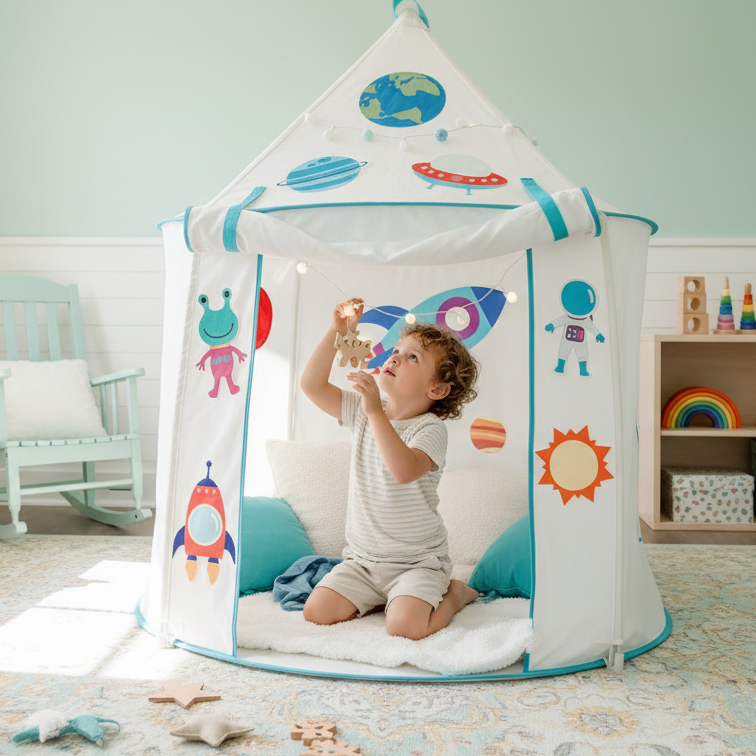

Indoor Adventure Ideas Using Imagination: 15 Ways to Turn Home Into a World of Possibilities
When children hear the word adventure, they often imagine somewhere far away.
A jungle.
A castle.
Outer space.
A mysterious island.
But adventure doesn't always require leaving the house.
Sometimes, it starts with a blanket on the floor, a cardboard box, a few cushions, or a familiar corner that suddenly becomes something completely different.
That is the power of imaginative play.
Instead of giving children a finished activity with one correct way to play, imaginative adventures give them room to decide what happens next. A living room can become a jungle. A play tent can become a spaceship. A pile of cushions can become a mountain range.
The objects stay the same.
The possibilities change.
If you're looking for indoor adventure ideas that can keep children engaged without relying on screens or constantly buying new toys, here are 15 ways to get started.
What Makes an Indoor Adventure Different?
An indoor adventure isn't necessarily a complicated game.
The simplest version can be:
A setting + a story + a problem to solve.
For example:
-
Setting: A jungle
-
Story: The explorers are looking for a lost animal
-
Problem: They need to cross a dangerous river
Suddenly, cushions become stepping stones, a blanket becomes a river, and stuffed animals become jungle creatures.
The child isn't simply completing an activity.
They're creating the activity while playing it.
That's what makes imaginative adventures so flexible. The child can change the characters, setting, rules, and ending as the story develops.
1. Go on a Jungle Expedition
Turn your living room into an unexplored jungle.
Use cushions, blankets, stuffed animals, and chairs to create different areas.
Perhaps the sofa is a mountain. A blanket is a river. A group of cushions becomes a rocky path.
Give your child a simple mission:
“Can you find the missing animal?”
They can crawl through the “jungle,” cross the river, discover clues, and decide what happens along the way.
You don't need to control the story.
Let your child surprise you.
2. Build a Secret Explorer Base
Every good adventure needs a base.
Use a play tent, blanket fort, or a corner of the room to create one.
Your child's explorer base might include:
-
A map
-
A flashlight
-
A notebook
-
Toy binoculars
-
Stuffed animals
-
Drawings
-
Homemade signs
Then ask:
“What are we exploring?”
Maybe the base belongs to a team searching for a hidden island.
Tomorrow, it could become a scientist's research station.
The physical space stays familiar, but the story can change completely.
3. Take a Trip Into Outer Space
You don't need a spaceship to visit another planet.
A cardboard box can become the cockpit. Chairs can become the control room. A blanket can mark the boundary of the spaceship.
Give your child a mission:
“Your spaceship has landed on an unknown planet. What do you discover?”
Maybe they find strange creatures.
Maybe the planet has floating mountains.
Maybe they need to repair the spaceship before returning home.
There doesn't need to be one correct answer.
The child gets to create the world.
4. Create a Dinosaur Rescue Mission
For dinosaur-loving children, turn the house into a prehistoric landscape.
Scatter stuffed animals or dinosaur figures around the room.
Then introduce a mission:
“Some dinosaurs are lost. Can you bring them safely back to camp?”
Children can create bridges, caves, rivers, and dinosaur habitats using whatever materials are available.
You can add new challenges as the story develops.
“What happens if the bridge breaks?”
“Where can the baby dinosaur hide?”
“Which dinosaur needs help?”
The questions keep the adventure moving without taking over the story.
5. Explore an Underwater World
Turn the floor into the ocean.
Blue blankets or sheets can become water. Cushions can become coral reefs. Stuffed animals can become sea creatures.
Your child might become:
-
A deep-sea explorer
-
A marine scientist
-
A submarine captain
-
A mermaid
-
An underwater rescue team
Give them something to discover.
Perhaps there's a mysterious treasure or a lost sea creature.
The adventure can continue for as long as the story remains interesting.
6. Turn a Play Tent Into a New World
A familiar play space can become especially interesting when its purpose changes.
One day, a tent might be a castle.
The next day, it could be a spaceship.
Another day, it might become a quiet reading hideaway.
ZeeZee Adventures is designed around this idea of an adaptable play environment. Its changeable StickeeZ themes allow children to transform the same tent into different imaginative settings, from magical kingdoms to dinosaurs, space, underwater adventures, and more.
The important idea isn't simply having different themes.
It's giving children a familiar physical space that can support different stories and different kinds of play.

7. Become Treasure Hunters
Hide a few objects around the house.
Then create a treasure map.
It doesn't have to be a realistic map. Let your child draw one showing mountains, rivers, caves, mysterious islands, or secret locations.
The “treasure” could be a favorite toy, a collection of stickers, or simply the final clue.
For older children, reverse the activity.
Let them hide the treasure and create the map for someone else.
Now they're not only playing the adventure.
They're designing it.
8. Open a Magical Kingdom
Give your child the opportunity to create an entire kingdom.
What is the kingdom called?
Who lives there?
Who is the ruler?
What creatures exist?
What is forbidden?
Where is the castle?
What problem does the kingdom have?
You can provide paper for flags, cardboard for buildings, blankets for royal robes, and toys for characters.
The story can become surprisingly elaborate once children start making their own rules and characters.
9. Create a Rescue Station
Pretend that your stuffed animals have all become patients who need help.
Your child can create a rescue station using a table, play tent, cardboard box, or small corner.
They might make:
-
Beds
-
Signs
-
Patient cards
-
Medicine bottles using pretend materials
-
Waiting areas
-
Rescue vehicles
Then introduce different situations.
“A puppy needs help.”
“A bird has lost its way.”
“A bear needs somewhere quiet to rest.”
The child decides what happens next.
10. Build a Secret Spy Mission
Create a mission for your little detective.
Maybe a mysterious object has disappeared.
Maybe there's a secret message hidden somewhere.
Maybe a stuffed animal needs rescuing.
Give your child clues to follow around the house.
For older children, let them write the clues themselves.
You can even introduce a secret code using symbols, drawings, or simple patterns.
The adventure becomes part puzzle, part storytelling, and part pretend play.
11. Travel Through Time
What would your child do if they could travel anywhere in history?
Maybe they're visiting:
-
Dinosaurs
-
Ancient castles
-
A future city
-
A Viking village
-
A world of robots
-
A prehistoric forest
Create a pretend time machine using a cardboard box or chairs.
Then ask:
“Where should we go?”
Once they choose, let them build the environment.
The activity becomes more interesting when children have to imagine what the world might look, sound, and feel like.
12. Create a Weather Adventure
This one works especially well on a rainy day.
Pretend the house is experiencing unusual weather.
Perhaps there's a snowstorm in the living room.
Maybe a giant rainstorm has flooded the “island.”
Perhaps the family is trapped inside a mountain during a blizzard.
Use cushions, blankets, and furniture to create safe paths and shelters.
Then let your child decide how everyone will get through the adventure.
The challenge doesn't need to have a predetermined solution.
13. Turn the Living Room Into a Mountain
Arrange cushions and blankets to create an imaginary mountain landscape.
Your child can climb carefully over safe, stable surfaces, move between “peaks,” and create a story about reaching the summit.
Maybe they're mountain explorers.
Maybe they're searching for a rare animal.
Maybe there's a secret village at the top.
For younger children, keep the physical challenge simple and supervised. The adventure can come mostly from the story.
14. Create Your Own Adventure Story
Sometimes you don't need a physical setup at all.
Start with:
“Once upon a time, there was a child who discovered a mysterious door…”
Then stop.
Ask your child:
“Where does the door lead?”
Whatever they answer becomes the next part of the story.
Continue taking turns.
You can introduce characters, problems, surprises, and new locations as the story develops.
Eventually, you can draw the story together or act it out.
15. Let Your Child Invent the Adventure
This may be the most open-ended idea of all.
Instead of giving your child a theme, give them a few materials and say:
“You are in charge. Create an adventure for us.”
They might build a spaceship.
They might create a restaurant.
They might invent a completely new world that makes very little sense to an adult—and perfect sense to them.
Follow their rules when you can.
Ask questions.
Play the role they give you.
Let them change the story.
This shifts the child from being a participant in an activity to becoming its creator.
How to Make Imaginative Adventures Last Longer
If an indoor adventure ends after ten minutes, that doesn't necessarily mean it failed.
Children's attention naturally changes, and different children enjoy different kinds of play.
But if you want to give an adventure more room to develop, try adding layers instead of more activities.
Start with a setting.
Then introduce a character.
Then add a problem.
Then let your child decide what happens.
For example:
Setting: Space station
Character: Young astronaut
Problem: The communication system stops working
Question: “How will you fix it?”
Now the child has something to respond to.
And once they solve that problem, you can ask:
“What happens next?”
That's often enough to create another chapter.
Why Open-Ended Adventures Can Be So Engaging
There is a difference between an activity that tells children what to do and an activity that gives them something to work with.
A coloring sheet has a defined task.
A blank piece of paper can become almost anything.
A board game has established rules.
A pretend world can develop new rules as the story changes.
A finished playset tells children what it represents.
A box, blanket, or adaptable play space leaves more room for interpretation.
Neither approach has to be better in every situation. Children benefit from different kinds of play at different times.
But when the goal is imaginative play, possibility matters.
Children can choose characters, change settings, solve problems, invent dialogue, and revisit familiar ideas from a different perspective.
A Simple Formula for Creating Indoor Adventures
When you don't know what to suggest, remember:
SPACE + STORY + CHOICE
Space: Where does the adventure happen?
Story: What is happening?
Choice: What can your child decide?
For example:
Space: A blanket fort
Story: It is a secret explorer's headquarters
Choice: Where should the explorers go first?
That's enough to begin.
You don't need a complicated activity schedule.
You need an opening.
Your child can help create the rest.
Let the Environment Change With the Story
One of the most interesting things about imaginative play is that children don't always need new objects to create new experiences.
They can reinterpret what is already around them.
A cushion becomes a mountain.
A blanket becomes a river.
A box becomes a spaceship.
A tent becomes a castle.
Then, tomorrow, those same objects can become something completely different.
This is one reason ZeeZee Adventures focuses on adaptable play environments rather than a single fixed theme. The brand's philosophy is built around the idea that children's interests and stories change, so their play space can change with them too.
A familiar environment can become a starting point for new adventures rather than something children quickly outgrow.
The Best Indoor Adventure May Be the One You Didn't Plan
Parents don't have to become entertainment directors every time children are indoors.
Sometimes the most interesting play begins when the adult steps back.
Give children a few materials.
Offer a question.
Follow their idea.
You might begin with:
“Let's make a spaceship.”
And ten minutes later, your child has turned it into a dinosaur hospital on another planet.
That's okay.
In fact, that's the point.
Imagination doesn't always follow the plan.
It changes direction.
It adds characters.
It creates problems.
It invents solutions.
And sometimes, the unexpected version is the most interesting one.
So the next time you're looking for something to do indoors, you don't necessarily need another activity to add to the list.
Look around the room.
Pick something ordinary.
Then ask:
“What could this become?”
That question can turn an ordinary afternoon into an adventure.
FAQs
1. What are some indoor adventure ideas for kids?
Children can create jungle expeditions, treasure hunts, space missions, dinosaur rescues, underwater adventures, secret bases, magical kingdoms, and other imaginative worlds indoors.
2. How can I encourage my child to use their imagination indoors?
Offer open-ended materials and simple prompts rather than giving children a complete set of instructions. Questions such as “What could this become?” can encourage children to create their own ideas.
3. What can children use to create an indoor adventure?
Everyday items such as blankets, cushions, cardboard boxes, paper, blocks, stuffed animals, and safe household materials can become part of imaginative play.
4. How can I make indoor play more engaging?
Try combining a physical setting with a simple story and giving children choices about what happens next.
5. Can a play tent be used for different types of imaginative play?
Yes. A familiar play space can become different settings depending on the child's story, such as a castle, spaceship, campsite, reading space, or explorer's base.
6. What is open-ended imaginative play?
Open-ended play allows children to decide how materials are used, what the story means, and what happens next rather than following one predetermined outcome.
7. How do I create an indoor adventure without buying new toys?
Use materials already available at home and change their context. A blanket can become a river, cushions can become mountains, and a cardboard box can become a vehicle or building.




Comment (0)