
What Happened to Imagination? Why Kids Seem Less Creative Today (And How to Bring It Back)
Quick Answer
Children haven't lost their imagination—but many have fewer opportunities to use it. Today's childhood often includes more structured schedules, more digital entertainment, and less uninterrupted free play than previous generations. The good news is that imagination isn't something children outgrow. When parents create time, space, and opportunities for child-led play, creativity naturally begins to flourish again.
Quick Facts
|
Topic |
Quick Answer |
|
Have children become less imaginative? |
Children are naturally imaginative, but modern lifestyles can reduce opportunities for creative play. |
|
What supports imagination? |
Child-led play, symbolic play, open-ended materials, boredom, and flexible play environments. |
|
What can limit imagination? |
Overscheduled routines, excessive passive entertainment, constant adult direction, and lack of free play. |
|
Why does imagination matter? |
It supports creativity, emotional development, language, problem-solving, and resilience. |
|
Can imagination be encouraged? |
Yes. Simple changes to daily routines and play environments can make a meaningful difference. |
|
Do children need expensive toys? |
No. Open-ended experiences often inspire more creativity than highly structured toys. |
Definition Box
What Is Imagination?
Imagination is the ability to create ideas, stories, possibilities, and solutions that don't exist in the present moment.
For children, imagination appears in everyday play:
-
pretending a blanket is a superhero cape
-
turning a cardboard box into a spaceship
-
inventing imaginary friends
-
creating magical worlds
-
making up stories for stuffed animals
Imagination isn't simply fantasy.
It's one of the foundations of creativity, flexible thinking, emotional expression, and lifelong learning.
Have Children Lost Their Imagination?
Quick Answer
No.
Children are just as capable of imagination today as previous generations. What has changed is the amount of time, freedom, and opportunity they have to use it.
Research Snapshot
Child development experts consistently describe play as one of the primary ways children learn and make sense of the world.
Today's children often experience:
-
more scheduled activities
-
greater access to digital entertainment
-
less unstructured free time
-
fewer opportunities to become bored
-
more adult-directed routines
These changes don't reduce children's ability to imagine.
They simply leave fewer moments for imagination to emerge naturally.
Expert Tip
Instead of asking,
"Why isn't my child imaginative?"
Ask,
"How often does my child have uninterrupted time to imagine?"
The answer may reveal more than you expect.
Parent Script
Child:
"What should I do?"
Instead of:
"Let's find another activity."
Try:
"What adventure do you think your imagination wants to create today?"
Bottom Line
Children haven't stopped imagining.
They simply need more opportunities to lead their own adventures.
Why Imagination Matters More Than Ever
Quick Answer
Imagination is much more than entertainment. It helps children solve problems, communicate ideas, adapt to change, express emotions, and approach the world with curiosity.
Research Snapshot
During imaginative play, children regularly practice skills that extend far beyond childhood.
They learn to:
-
think creatively
-
solve problems
-
adapt when plans change
-
communicate ideas
-
understand different perspectives
-
create stories
-
make independent decisions
These experiences contribute to healthy cognitive, emotional, and social development.
Expert Tip
Think of imagination as practice for real life.
Every pretend adventure encourages children to ask,
"What could happen next?"
That same flexible thinking supports learning, innovation, and resilience later in life.
Example
A child pretending to run a café isn't simply serving imaginary food.
They're organizing ideas.
Creating conversations.
Solving problems.
Making decisions.
Building confidence.
All through play.
Bottom Line
Imagination helps children prepare for a world where creativity and adaptability are increasingly valuable.
What Has Changed About Childhood?
Quick Answer
Modern childhood offers incredible opportunities, but it also leaves less room for spontaneous, child-led exploration.
Research Snapshot
Many families today balance busy schedules that include:
-
school
-
extracurricular activities
-
homework
-
organized sports
-
digital entertainment
-
structured learning
Each of these experiences can provide meaningful benefits.
However, when every moment is planned, children have fewer opportunities to invent games, create stories, and explore ideas independently.
The goal isn't to eliminate structure.
It's to create balance.
Expert Tip
Take a look at your child's weekly routine.
Ask yourself:
-
When do they choose their own activities?
-
When do they become bored?
-
When do they play without instructions?
Those moments are often where imagination begins.
Parent Script
Instead of:
"Here's today's activity."
Try:
"You have some free time. I'm excited to see what you decide to create."
Bottom Line
Children need both structure and freedom.
Imagination grows during the moments that belong to them.
Why Boredom Is Becoming Rare
Quick Answer
Many parents naturally want to keep children engaged, but constantly filling every quiet moment can unintentionally leave little room for imagination.
Research Snapshot
Boredom has an interesting role in childhood.
When children aren't immediately entertained, their brains begin searching for something meaningful to do.
This often leads to:
-
storytelling
-
building
-
drawing
-
pretending
-
inventing games
-
exploring new ideas
The transition may feel uncomfortable at first, but it frequently becomes the beginning of creative thinking.
Expert Tip
The next time your child says,
"I'm bored."
Pause.
You don't always need to solve it.
Sometimes boredom is simply imagination waiting for permission.
Parent Script
Instead of:
"Let's watch something."
Try:
"I wonder what you'll think of if we give your imagination a few minutes."
Bottom Line
Boredom isn't wasted time.
It's often where creativity begins.
Why Symbolic Play Is One of Childhood's Greatest Superpowers
Quick Answer
Symbolic play allows children to transform ordinary objects into extraordinary adventures, helping them explore ideas, relationships, and emotions through imagination.
Research Snapshot
Symbolic play develops when children use one object to represent another.
For example:
-
A spoon becomes a magic wand.
-
A sofa becomes a pirate ship.
-
A cardboard box becomes a castle.
-
A blanket becomes a mountain.
-
A chair becomes a race car.
This ability to think symbolically supports creativity, flexible thinking, language development, and communication.
It also gives children opportunities to explore everyday experiences in ways that feel meaningful to them.
At-a-Glance Table
|
Symbolic Play Example |
Skills Being Practiced |
|
Playing school |
Communication, empathy, storytelling |
|
Running a restaurant |
Planning, language, cooperation |
|
Becoming superheroes |
Confidence, creativity, problem-solving |
|
Camping indoors |
Exploration, flexibility, imagination |
|
Caring for stuffed animals |
Kindness, nurturing, responsibility |
Every child's stories are unique.
Rather than focusing on what the story means, parents can simply enjoy listening as children's ideas unfold.
Expert Tip
Join the story without directing it.
If your child says,
"We're sailing to Dragon Island."
Don't ask,
"Where did the dragon come from?"
Instead ask,
"What happens when we get there?"
Following the child's imagination encourages richer storytelling and longer play.
Bottom Line
Symbolic play transforms everyday objects into opportunities for extraordinary creativity.
Myth vs. Fact
|
Myth |
Fact |
|
Children today aren't imaginative anymore. |
Children remain naturally imaginative but often have fewer opportunities for child-led play. |
|
Creativity is something children are born with. |
Creativity grows through experiences, exploration, and practice. |
|
More toys create more imagination. |
Flexible environments and open-ended materials often inspire deeper creativity. |
|
Boredom is unhealthy. |
Short periods of boredom often encourage children to invent games, stories, and new ideas. |
Bottom Line
Imagination hasn't disappeared from childhood.
It has simply become easier to overlook in a world filled with constant activity, entertainment, and adult direction.
The encouraging news is that imagination doesn't need to be taught.
It simply needs time, trust, and opportunities to grow.
The ZeeZee IMAGINE Framework™: Helping Imagination Flourish Every Day
Children don't need to be taught how to imagine.
They need the freedom, time, and environment to use the imagination they already have.
The ZeeZee IMAGINE Framework™ is a practical approach to creating everyday opportunities for children to think creatively, explore confidently, and direct their own adventures.

I — Invite Curiosity
Quick Answer
Curiosity is the starting point of imagination. When children are encouraged to ask questions, explore ideas, and wonder "what if," creativity naturally follows.
Research Snapshot
Curiosity motivates children to explore, investigate, and experiment. Instead of searching for the "right" answer, curious children become comfortable asking new questions and discovering their own solutions.
These everyday moments of exploration lay the foundation for creative thinking.
Expert Tip
Instead of providing every answer immediately, invite your child to think first.
Ask:
-
"What do you think?"
-
"How could we find out?"
-
"What might happen next?"
Questions encourage imagination far more than instructions.
Parent Script
Instead of:
"That's not how it works."
Try:
"That's an interesting idea. Tell me more."
Bottom Line
Curiosity turns everyday moments into opportunities for imagination.
M — Make Time for Unstructured Play
Quick Answer
Creativity needs time. Children are far more likely to invent stories and imaginative worlds when they have uninterrupted opportunities to play.
Research Snapshot
Modern childhood is often carefully planned.
School.
Sports.
Homework.
Activities.
Screens.
While these experiences all have value, imagination usually appears during the spaces between structured activities.
Uninterrupted play allows children to become deeply engaged in their own ideas.
Expert Tip
Schedule less.
Protect more free play.
Not every hour needs an agenda.
Parent Script
Instead of:
"Let's hurry to the next activity."
Try:
"You've got some free time. I can't wait to see what you create."
Bottom Line
Imagination grows when children have time that truly belongs to them.
A — Allow Boredom
Quick Answer
Boredom often feels uncomfortable—but it's frequently the doorway to creativity.
Research Snapshot
When children aren't immediately entertained, their brains begin searching for new possibilities.
This process often leads to:
-
storytelling
-
building
-
pretending
-
inventing games
-
experimenting
-
exploring
Rather than avoiding boredom, children gradually learn to transform it into creativity.
Expert Tip
Pause before offering entertainment.
Many wonderful ideas arrive after a few quiet minutes.
Parent Script
Instead of:
"Here's something to do."
Try:
"I wonder what your imagination will think of."
Bottom Line
Boredom is often imagination's favorite starting point.
G — Give Open-Ended Materials
Quick Answer
Children create richer stories when the materials around them can become many different things.
Research Snapshot
Open-ended materials encourage flexible thinking because they have no predetermined purpose.
Examples include:
-
cardboard boxes
-
blankets
-
cushions
-
blocks
-
scarves
-
art supplies
-
wooden figures
-
natural objects
Children decide what these objects become.
That decision-making process strengthens imagination.
Expert Tip
Simple often beats sophisticated.
One cardboard box can become:
-
a submarine
-
a bakery
-
a castle
-
a cave
-
a race car
all within the same afternoon.
Bottom Line
The fewer instructions a toy gives, the more imagination children contribute.
I — Inspire Stories
Quick Answer
Stories help children connect ideas, emotions, relationships, and experiences through imagination.
Research Snapshot
Storytelling encourages children to:
-
organize ideas
-
develop language
-
understand perspectives
-
create characters
-
solve problems
Children don't need perfect plots.
They simply need permission to invent.
Expert Tip
Instead of reading every story exactly as written, occasionally ask:
"What do you think happens after the book ends?"
This keeps imagination growing long after the final page.
Parent Script
Instead of:
"That's the end."
Try:
"What happens next?"
Bottom Line
Stories don't end when books close.
They continue inside children's imagination.
N — Nurture Independence
Quick Answer
Children imagine more freely when they know adults trust them to lead the adventure.
Research Snapshot
Independent play encourages children to:
-
make decisions
-
solve problems
-
adapt stories
-
experiment
-
persist
-
build confidence
Every independent choice strengthens creative confidence.
Expert Tip
You don't have to entertain children.
Create opportunities where they can entertain themselves.
Parent Script
Instead of:
"Let's play my game."
Try:
"Show me your game."
Bottom Line
Confidence grows when children become the author of their own adventures.
E — Encourage Exploration
Quick Answer
Exploration allows children to discover ideas that adults would never think to teach directly.
Research Snapshot
Children naturally explore through:
-
movement
-
pretending
-
building
-
observing
-
experimenting
These experiences help children understand the world through curiosity rather than memorization.
Expert Tip
Allow play to change direction.
The best adventures rarely follow the original plan.
Bottom Line
Exploration transforms imagination into discovery.
Why Environments Matter More Than Toys
Quick Answer
Children don't simply play with objects—they play within environments.
The environment influences how deeply children imagine, how confidently they explore, and how long they remain engaged.
Research Snapshot
Many toys are designed around one activity.
Once children understand how they work, the novelty often fades.
Environments are different.
They provide a setting where stories can continue changing.
One day the space becomes:
-
a castle
The next:
-
a rainforest
Tomorrow:
-
a space station
Next week:
-
an animal rescue center
The environment remains.
The imagination evolves.
Expert Tip
When choosing play experiences, ask:
"Will this continue inspiring new stories six months from now?"
Long-term creativity grows through flexibility.
Bottom Line
Children remember adventures more than toys.
Symbolic Play: The Language of Imagination
Quick Answer
Symbolic play allows children to transform everyday objects into meaningful stories, giving them opportunities to explore ideas, relationships, and emotions through imagination.
Research Snapshot
When children pretend:
-
a teddy bear is sick
-
a dragon protects a castle
-
a cardboard box becomes a spaceship
-
stuffed animals run a school
they're practicing flexible thinking, communication, storytelling, and perspective-taking.
Relationship-based developmental approaches, such as DIR/Floortime®, also emphasize following a child's interests and engaging through meaningful, child-led interactions. While these approaches are used in many educational and developmental settings, the broader principle applies to all families: when adults join children's imaginative worlds with curiosity instead of control, richer interactions often follow.
It's important to remember that symbolic play isn't about finding hidden meanings in every story. Instead, it provides children with a natural way to experiment with ideas, relationships, and everyday experiences through make-believe.
Expert Tip
Instead of interpreting the story…
Join it.
Ask:
"Can I come on the adventure too?"
Children often expand their imagination when adults become curious participants rather than directors.
Bottom Line
Every imaginary story is an opportunity to practice creativity, communication, and flexible thinking.
Creating Adaptable Play Environments That Grow With Children's Imagination
By now, one idea has become clear:
Children don't need endless new entertainment.
They need environments that evolve alongside their imagination.
An adaptable play environment doesn't tell children what to imagine.
It gives them a place where imagination can continue changing.
This philosophy is increasingly reflected in homes and learning spaces that value child-led exploration over fixed activities.
Rather than centering play around a single storyline, adaptable environments encourage children to revisit familiar spaces while inventing new adventures, experimenting with different roles, and expressing fresh ideas each time they play.
This is the philosophy behind ZeeZee Adventures.
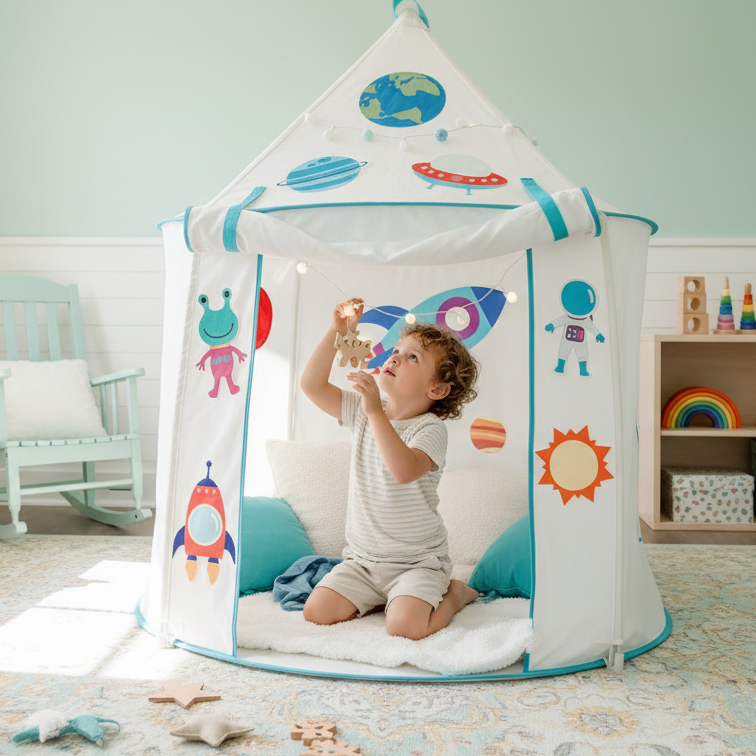
Instead of creating another toy with one predetermined purpose, ZeeZee was designed as an Adaptable Play Environment that grows with a child's imagination. The Adventure Tent can become a pirate ship today, an enchanted forest tomorrow, a reading retreat in the afternoon, or a space station next weekend through interchangeable StickeeZ Themes. The environment stays familiar while the possibilities continue expanding, encouraging children to create their own stories instead of following someone else's script.
For many families, this same environment also becomes a quiet place to read, draw, build, tell stories, or simply pause between adventures. Combining imaginative play with calming audio stories or guided relaxation can help children transition naturally between active exploration and quiet reflection.
Signs Your Child's Imagination Is Growing
Checklist
As imagination flourishes, you may notice your child:
-
Inventing increasingly detailed stories.
-
Turning everyday objects into imaginative props.
-
Spending longer periods in pretend play.
-
Creating recurring characters and imaginary worlds.
-
Asking more "What if…?" questions.
-
Returning to unfinished adventures over several days.
-
Solving problems creatively instead of giving up.
-
Inviting family members into imaginative worlds they've created.
These moments aren't just signs of creativity.
They're signs that your child is learning to think flexibly, explore confidently, and direct their own ideas.
Bottom Line
Imagination isn't disappearing from childhood.
It's waiting for opportunities to emerge.
When parents make time for curiosity, protect unstructured play, embrace boredom, and create adaptable environments that encourage child-led exploration, children rediscover something they already possess:
The extraordinary ability to imagine worlds that don't exist yet—and perhaps one day, to create them.
Frequently Asked Questions
1. Are children today less imaginative than previous generations?
Not necessarily.
Children are just as capable of imagination as they have always been. What's changed is the environment around them. Many children now have less unstructured time, more scheduled activities, and greater access to digital entertainment, leaving fewer opportunities for spontaneous, child-led play.
Bottom Line: Imagination hasn't disappeared—it simply needs more opportunities to flourish.
2. What is imaginative play?
Imaginative play is child-led play where children invent stories, characters, roles, and adventures.
Examples include:
-
Pretending to run a bakery
-
Becoming astronauts
-
Building a castle from cushions
-
Hosting a tea party for stuffed animals
-
Exploring a jungle made from blankets
Imaginative play allows children to create experiences rather than simply consume them.
3. What is symbolic play?
Symbolic play is when children use one object or action to represent something else.
For example:
-
A cardboard box becomes a spaceship.
-
A stick becomes a magic wand.
-
A blanket becomes an ocean.
-
A pillow becomes a mountain.
This type of play supports creativity, language development, communication, and flexible thinking.
4. Why is imagination important for child development?
Imagination supports many areas of healthy development, including:
-
Creative thinking
-
Problem-solving
-
Executive functioning
-
Language development
-
Emotional expression
-
Social understanding
-
Flexible thinking
-
Independent decision-making
These skills help children adapt, learn, and navigate new experiences throughout life.
5. Can too much structure reduce opportunities for imagination?
Structure is an important part of childhood, but when every moment is planned, children may have fewer opportunities to invent their own games, solve their own problems, and follow their own ideas.
Healthy childhood includes both structured learning and unstructured play.
6. How can parents encourage imagination at home?
Parents can encourage imagination by:
-
Protecting free play time
-
Reducing unnecessary distractions
-
Providing open-ended materials
-
Following children's interests
-
Asking curious questions
-
Embracing boredom
-
Creating adaptable play environments
-
Allowing children to direct their own stories
Small, consistent opportunities often have the greatest impact.
7. Why is boredom good for creativity?
Boredom gives children's brains an opportunity to generate ideas instead of receiving constant entertainment.
After the initial discomfort passes, many children naturally begin:
-
building
-
pretending
-
storytelling
-
drawing
-
inventing games
-
exploring new possibilities
Boredom often becomes the bridge to imagination.
8. What is an adaptable play environment?
An adaptable play environment is a flexible space that changes alongside a child's imagination instead of being limited to one theme or activity.
Rather than directing children's play, adaptable environments encourage them to create new stories, explore different roles, and revisit familiar spaces with fresh ideas over time.
9. Why do experts encourage child-led play?
Many child development professionals value child-led play because it encourages:
-
curiosity
-
creativity
-
confidence
-
communication
-
problem-solving
-
independence
-
flexible thinking
Relationship-based developmental approaches, including DIR/Floortime®, also emphasize following a child's interests during meaningful interactions. These educational principles can be incorporated into everyday family play by responding to children's ideas and joining their imaginative worlds with curiosity.
10. Do children need expensive toys to develop imagination?
No.
Some of the richest imaginative experiences happen with simple, open-ended materials such as:
-
cardboard boxes
-
blankets
-
blocks
-
art supplies
-
dress-up clothes
-
natural objects
-
household items
Children create the adventure—the materials simply support it.
About the Author
ZeeZee Adventures Editorial Team
The ZeeZee Adventures Knowledge Hub is written by child development specialists, pediatric occupational therapy consultants, parenting educators, early childhood researchers, and content strategists passionate about helping families create environments where imagination, creativity, confidence, and joyful exploration can thrive.
Our mission is to provide practical, evidence-informed guidance that empowers parents to support independent play, emotional well-being, and lifelong curiosity.
Continue the Adventure
Discover More Parenting Insights
Explore the ZeeZee Adventures Knowledge Hub for practical articles about symbolic play, independent play, emotional resilience, child-led learning, screen-free childhoods, and adaptable play environments.
Create Spaces That Inspire Imagination
Children don't need constant entertainment—they need opportunities to imagine.
Adaptable play environments encourage children to revisit familiar spaces while creating entirely new adventures each day. By designing environments that evolve alongside children's changing interests, families can support storytelling, symbolic play, creativity, and independent exploration for years to come.
The ZeeZee Adventure Tent and interchangeable StickeeZ Themes were created around this philosophy: one adaptable environment with endless possibilities, encouraging children to become the authors of their own adventures rather than simply following predefined stories.
Join the ZeeZee Community
Join parents, educators, and caregivers who believe childhood is richest when children have the freedom to imagine, explore, create, and lead their own adventures.





Comment (0)