
What Is Open-Ended Play? A Parent's Complete Guide
Quick Answer
Open-ended play is a type of child-led play without predetermined rules, goals, or "correct" outcomes. Instead of following instructions, children use their imagination to decide how objects are used, what stories unfold, and how play evolves. Research shows that open-ended play supports creativity, problem-solving, language development, emotional regulation, executive functioning, and independent thinking while encouraging children to learn through exploration rather than instruction.
Definition Box
What Is Open-Ended Play?
Open-ended play is child-directed play that has no single correct outcome. Children decide what to create, imagine, build, or pretend, allowing the activity to change naturally based on their interests and ideas.
Unlike activities with fixed rules or expected results, open-ended play encourages exploration, creativity, flexible thinking, and independent learning.
Simple definition: If a child can play with something in dozens of different ways, it's probably supporting open-ended play.
Introduction
A cardboard box becomes a spaceship.
Five minutes later, it's a pirate ship.
Then it's a bakery.
By bedtime, it's transformed into a dragon's cave complete with invisible treasure and an imaginary pet.
Nothing about the box changed.
The child's imagination did.
This is one of the clearest examples of open-ended play—a form of play where there is no script to follow, no right answer to discover, and no finish line to cross. Instead, children become the authors, architects, scientists, explorers, and storytellers of their own experiences.
In today's world, where many toys light up, talk back, and guide children through predetermined activities, opportunities for genuine imagination can sometimes become limited. While many structured toys have educational value, children also need moments where they are free to wonder, experiment, invent, and make decisions without constant direction.
Open-ended play provides exactly that opportunity.
Rather than asking, "Did I do this correctly?" children begin asking much more powerful questions:
"What else could this become?"
"What happens next?"
"Can I solve this differently?"
These moments may seem simple on the surface, but they are laying the foundation for skills that extend far beyond childhood. Every imaginative story, pretend adventure, and creative solution strengthens the cognitive, emotional, social, and language abilities children rely on throughout life.
As a Pediatric Occupational Therapist, I've seen that children rarely need more entertainment—they need more opportunities to think independently. When adults step back just enough to let children lead their own play, remarkable things happen. Confidence grows. Frustration becomes problem-solving. Curiosity replaces passive consumption. Play becomes learning in its most natural form.
In this guide, you'll learn what open-ended play really is, why child development experts value it so highly, how it differs from structured play, and practical ways to encourage it in everyday family life.
What Is Open-Ended Play?
At its heart, open-ended play is wonderfully simple.
It is any activity where the child—not the toy, the instructions, or the adult—decides what happens next.
There is no predetermined objective to complete. No single way to "win." No expectation that every child will produce the same outcome.
Instead, children are free to explore ideas, test possibilities, solve problems, and express themselves through their own imagination.
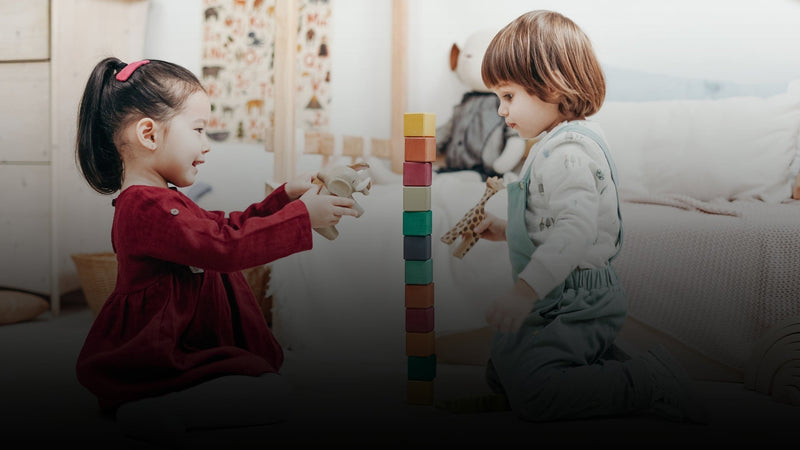
Think about a set of wooden blocks.
One child may build a castle.
Another creates a zoo.
A third stacks them into a bridge before knocking everything down and starting again.
Every version is equally successful because the goal isn't producing a perfect structure—it's the thinking, experimenting, adapting, and storytelling that happen throughout the process.
The same principle applies to many everyday materials:
-
A blanket becomes a superhero cape, a picnic blanket, or a mountain cave.
-
A wooden spoon transforms into a microphone, telescope, magic wand, or drumstick.
-
Leaves, sticks, stones, and cardboard become ingredients for countless imaginary adventures.
The materials themselves matter less than the freedom they offer.
Characteristics of Open-Ended Play
Open-ended play usually includes several defining qualities:
-
There is no single correct outcome.
-
Children make the decisions.
-
Play evolves naturally over time.
-
Mistakes become opportunities rather than failures.
-
Creativity is valued more than perfection.
-
Imagination drives the experience.
-
Activities can be revisited in new ways again and again.
Because children control the direction of play, they constantly practice making choices, adapting plans, and generating new ideas. These experiences strengthen both confidence and cognitive flexibility—skills that support learning across every stage of development.
Expert Insight
Occupational therapists often encourage child-led play because it naturally combines movement, sensory exploration, language, planning, emotional regulation, and problem-solving into one meaningful experience. Rather than teaching these skills separately, open-ended play allows children to develop them together in ways that feel joyful and intrinsically motivating.
Why Open-Ended Play Matters for Child Development
Children aren't simply passing time when they engage in imaginative play.
They're building the foundations for how they think, communicate, manage emotions, and solve problems for years to come.
Development doesn't happen only through formal lessons or educational apps. Much of it unfolds during everyday moments when children are experimenting, pretending, negotiating, creating, and discovering the world around them.
Open-ended play supports this process because it invites children to become active participants in their own learning rather than passive recipients of information.
When a child invents a story instead of following one, the brain is doing far more than entertaining itself.
It is planning.
Organizing.
Remembering.
Predicting.
Adapting.
Evaluating.
Creating.
These are all executive functioning skills that underpin learning, relationships, and emotional wellbeing throughout life.
Creativity also flourishes during open-ended play because children aren't working toward someone else's vision. They're producing original ideas, testing them, and refining them through experience. Over time, this strengthens cognitive flexibility—the ability to see multiple solutions to a single problem.
Language development grows naturally as children narrate stories, invent characters, negotiate roles with siblings or friends, and explain their ideas aloud. Even solitary pretend play often includes rich internal dialogue that helps organize thoughts and expand vocabulary.
Social-emotional development benefits as well. During imaginative play, children regularly experience excitement, disappointment, cooperation, frustration, empathy, and resilience within a safe environment. They practice understanding different perspectives, managing emotions, and recovering from setbacks—all through play that feels enjoyable rather than instructional.
Perhaps most importantly, open-ended play nurtures independence.
When children aren't constantly waiting for instructions, they begin trusting their own ideas.
Instead of asking,
"What should I do?"
they begin asking,
"What could I try next?"
That small shift represents one of the greatest gifts play can offer: the confidence to think for themselves.
The Science Behind Open-Ended Play
Open-ended play may look effortless on the surface—a child building a fort from cushions, pretending a stick is a fishing rod, or inventing a conversation between stuffed animals. Yet beneath these seemingly ordinary moments, the brain is working remarkably hard.
Developmental researchers have long recognized play as one of childhood's most powerful learning experiences. Unlike passive entertainment, open-ended play requires children to think actively, make decisions, solve problems, regulate emotions, and adapt to changing situations—all without external rewards or instructions.
This is why pediatric occupational therapists, early childhood educators, developmental psychologists, and speech-language professionals frequently encourage child-led play. It naturally integrates multiple areas of development into one meaningful activity.
When a child imagines that a blanket has become an ocean, they aren't simply pretending. Their brain is practicing symbolic thinking—the ability to let one object represent something entirely different. This ability forms the foundation for abstract thinking, reading comprehension, mathematics, and creative problem-solving later in life.
Similarly, when children negotiate roles during pretend play—deciding who will be the doctor, astronaut, chef, or explorer—they are strengthening communication skills, perspective-taking, cooperation, and emotional understanding.
Perhaps most importantly, open-ended play allows children to encounter manageable challenges.
A tower falls.
A story doesn't make sense.
The pretend bridge isn't strong enough.
Instead of an adult immediately providing the solution, children experiment, adapt, and try again.
This process strengthens executive functioning, a collection of cognitive skills responsible for planning, working memory, flexible thinking, impulse control, and self-regulation. These abilities influence everything from academic success to emotional wellbeing and social relationships.
Children also experience what psychologists call intrinsic motivation during open-ended play. They continue playing not because someone offers praise or rewards, but because curiosity itself becomes the reward. This internal drive encourages persistence, creativity, and a genuine love of learning.
Rather than memorizing information, children are constructing knowledge through experience.
That distinction matters.
Learning that comes through exploration is often deeper, more flexible, and more memorable than learning that simply follows instructions.
Expert Insight
Research consistently shows that imaginative, child-led play supports the development of executive functioning, language, creativity, and emotional regulation. The goal of open-ended play isn't to produce a perfect outcome—it's to strengthen the thinking processes children use while exploring, experimenting, and creating.
Why Boredom Can Be Good for the Brain
Many parents worry when they hear the familiar phrase:
"I'm bored."
It's tempting to immediately suggest an activity, hand over a device, or solve the problem for them.
But boredom isn't something children always need rescuing from.
In fact, boredom often serves as the starting point for creativity.
When the brain isn't constantly receiving entertainment, it begins generating ideas of its own. Children start noticing ordinary objects differently. A pile of pillows becomes a mountain. A cardboard box becomes a submarine. A few toy animals become an entire wildlife rescue mission.
These imaginative leaps happen because boredom encourages the brain's creative networks to activate.
While every child occasionally needs support getting started—especially younger children—allowing space for independent thinking teaches an invaluable lesson:
"I can create my own fun."
That confidence often becomes the beginning of lifelong curiosity.
Open-Ended Play vs. Closed-Ended Play
Both open-ended and closed-ended play have a place in healthy childhood development.
Structured activities teach valuable skills such as following directions, sequencing, accuracy, and perseverance.
Open-ended play develops a different—but equally important—set of abilities.
The healthiest play experiences usually include a balance of both.
The key difference lies in who controls the play experience.
|
Open-Ended Play |
Closed-Ended Play |
|
Child decides what happens |
Activity has predetermined rules |
|
Many possible outcomes |
One expected outcome |
|
Encourages creativity |
Encourages accuracy |
|
Flexible and adaptable |
Structured and predictable |
|
Imagination drives play |
Instructions guide play |
|
Can be revisited in countless ways |
Usually completed one way |
|
Develops problem-solving and innovation |
Develops specific knowledge or skills |
|
Focuses on the process |
Focuses on the finished result |
Neither approach is inherently better than the other.
For example, completing a jigsaw puzzle teaches visual perception, persistence, and spatial reasoning. Building an imaginary city from blocks teaches planning, storytelling, flexibility, collaboration, and creative thinking.
Children benefit from experiencing both.
However, because modern childhood often includes highly structured schedules, educational programs, and technology-driven entertainment, many children have fewer opportunities to experience the freedom that open-ended play provides.
Making intentional space for child-led play helps restore that balance.
Examples of Open-Ended Play
One of the biggest misconceptions about open-ended play is that parents need expensive toys or elaborate playrooms.
In reality, some of the richest play experiences begin with the simplest materials.
Children naturally see possibilities where adults see ordinary objects.
A cardboard box might become an airplane one morning, a grocery store after lunch, and a cozy reading nook by evening. The same object supports dozens of different stories because nothing about it dictates how it should be used.
Wooden blocks work in much the same way. One child may build a zoo while another creates a bridge, a castle, or an entire imaginary city. There is no "correct" structure because the value lies in planning, experimenting, rebuilding, and adapting.
Loose parts such as stones, pinecones, shells, bottle caps, fabric scraps, cardboard tubes, and wooden spoons encourage children to invent their own meanings. These everyday materials invite flexible thinking because they have no fixed identity.
Nature also offers countless opportunities for open-ended exploration. A walk through the park can become a treasure hunt, a fairy expedition, or a wildlife adventure depending entirely on the child's imagination.
Art materials provide another excellent example. Blank paper, washable paints, crayons, clay, and recycled materials allow children to express ideas without trying to reproduce someone else's design.
Pretend play is perhaps the purest form of open-ended play. Whether children are running a restaurant, caring for toy animals, exploring outer space, or hosting a puppet show, they constantly create new narratives, solve imaginary problems, and practice social communication.
Even reading can become open-ended when children continue the story after the final page, invent alternative endings, or imagine themselves inside the adventure.
The common thread isn't the object.
It's the freedom.
If children can continually invent new possibilities, they're engaging in open-ended play.
What Makes a Toy Open-Ended?
Many toys advertise themselves as educational.
Far fewer remain interesting months—or even years—after they're first opened.
Open-ended toys stand apart because they grow alongside a child's imagination instead of limiting it.
Rather than telling children what to do, they invite children to decide.
An open-ended toy typically has several characteristics:
-
It can be used in many different ways.
-
It doesn't rely on one fixed story or objective.
-
It adapts as children's interests and abilities change.
-
It encourages imagination instead of passive entertainment.
-
It supports both independent and collaborative play.
-
It remains engaging across multiple stages of development.
Think of building blocks, dress-up clothes, art materials, magnetic tiles, puppets, dolls, toy animals, play silks, loose parts, and natural materials.
These resources don't become obsolete once children master a single skill.
Instead, they evolve with every new idea.
As children mature, the stories become more sophisticated, the structures become more complex, and the imaginative worlds become richer.
This is one reason many child development specialists recommend investing in fewer versatile play materials rather than constantly purchasing highly specialized toys that offer limited replay value.
When children have opportunities to reinvent the same materials again and again, they spend less time seeking novelty and more time developing creativity.
Myth vs. Fact: Open-Ended Play
|
Myth |
Fact |
|
Open-ended play means children play without learning. |
Open-ended play supports learning across cognitive, language, motor, social, and emotional development. |
|
Children need expensive toys to be creative. |
Everyday household objects often inspire the richest imaginative play. |
|
Parents should constantly lead play to make it educational. |
Children often learn more deeply when adults provide support without directing every moment. |
|
More toys create better play. |
Too many toys can overwhelm children and reduce sustained engagement. Fewer versatile materials often encourage deeper creativity. |
|
Open-ended play is only for preschoolers. |
Children of all ages—including older children—benefit from imaginative, self-directed play experiences. |
|
Boredom is a problem that should be solved immediately. |
Short periods of boredom frequently spark creativity, independent thinking, and imaginative exploration. |
Open-Ended Play by Age
One of the greatest strengths of open-ended play is that it evolves alongside your child. Unlike many toys that are quickly outgrown, child-led play becomes more sophisticated as children's thinking, language, and imagination develop.
The activity may look different at age two than it does at age eight, but the underlying developmental benefits remain remarkably consistent.
Rather than introducing increasingly complex toys every year, parents can focus on providing opportunities for children to imagine, explore, and direct their own experiences.
Toddlers (1–3 Years)
For toddlers, open-ended play begins with exploration.
At this age, children are discovering how the world works through movement, touch, sound, and repetition. They may stack blocks only to knock them down moments later. They may repeatedly fill and empty containers or spend several minutes investigating the texture of fabric, leaves, or water.
Although these activities may seem simple to adults, they are incredibly valuable.
Toddlers are developing:
-
Cause-and-effect understanding
-
Fine and gross motor coordination
-
Early problem-solving
-
Sensory processing
-
Curiosity and confidence
The goal isn't to teach toddlers how to play.
It's to allow them enough freedom to discover what interests them.
Parents can support this stage by offering safe, versatile materials and narrating what children are doing without taking control.
Instead of saying,
"Let's build a tower."
Try saying,
"I wonder what you're making."
This small shift keeps the child in the role of creator.
Preschoolers (3–5 Years)
During the preschool years, imagination explodes.
Children begin inventing elaborate stories, assigning personalities to stuffed animals, pretending to run restaurants, fly spaceships, rescue dinosaurs, or become veterinarians caring for magical creatures.
At this stage, pretend play becomes an important way for children to process emotions, practice communication, and understand the world around them.
Role-playing allows children to experiment with different perspectives while building empathy and language skills.
They also become more willing to solve problems independently.
If the pretend bridge falls, they rebuild it.
If the dragon escapes, they invent a new ending.
Parents don't need to provide the story.
Simply providing the time and space often allows children's imagination to flourish naturally.
School-Age Children (6+ Years)
Open-ended play doesn't disappear once children enter school.
It simply becomes more sophisticated.
Older children often combine storytelling with engineering, art, science, construction, and collaborative play.
One afternoon they may design an imaginary city complete with maps and rules.
The next, they may write stories, build obstacle courses, direct puppet shows, or create fantasy worlds inspired by books they've read.
These experiences strengthen:
-
Creative thinking
-
Planning
-
Organization
-
Collaboration
-
Leadership
-
Critical thinking
-
Persistence
School-age children also benefit from opportunities to personalize their environment and return to ongoing projects over several days or weeks.
Rather than constantly introducing new entertainment, giving children ownership over their ideas encourages deeper engagement and longer periods of focused play.
Expert Insight
Open-ended play isn't something children "grow out of." As children mature, their imaginative worlds become more detailed, collaborative, and intellectually complex. The play changes—but the developmental value remains.
Common Mistakes Parents Make
Parents naturally want to support their children's development.
Sometimes, however, our enthusiasm unintentionally interrupts the very skills we're trying to encourage.
Fortunately, small adjustments can make a significant difference.
Solving Problems Too Quickly
When a child struggles, it's tempting to jump in with an answer.
But learning often happens during the struggle itself.
If a tower keeps collapsing or a pretend story reaches a dead end, resist the urge to immediately fix it.
Instead, try asking:
"What do you think might work?"
Questions encourage thinking.
Answers end it.
Over-Directing Play
Many adults unknowingly turn play into another lesson.
We suggest what children should build.
We explain how toys should be used.
We correct imaginary stories.
Although well-intentioned, too much direction shifts ownership away from the child.
Instead, become an interested observer.
Notice.
Wonder.
Encourage.
Allow children to remain the authors of their own ideas.
Scheduling Every Minute
Modern childhood is often wonderfully full—but sometimes too full.
Sports.
Music lessons.
Homework.
Clubs.
Appointments.
Structured activities provide important learning opportunities, but children also need unstructured time where creativity can emerge naturally.
Not every hour needs to be planned.
Sometimes the most valuable developmental experiences happen during quiet afternoons with no agenda at all.
Buying More Instead of Playing More
When children lose interest in a toy, many parents understandably assume they need something new.
Often, they simply need a new way to engage with what they already have.
Research suggests that fewer, more versatile play materials often encourage longer, deeper, and more creative play than an overwhelming number of toys.
Rotating materials, introducing loose parts, or simply changing the environment can refresh play without continually purchasing new items.
Expecting Immediate Independent Play
Independent play is a developmental skill—not an automatic ability.
Children learn it gradually.
Some children naturally play alone for long periods, while others need support building confidence.
Start with short periods of uninterrupted play.
Remain nearby without directing.
As confidence grows, most children gradually extend their own play naturally.
Patience is part of the process.
How to Encourage Open-Ended Play at Home
Supporting open-ended play doesn't require a dedicated playroom, expensive equipment, or perfectly organized shelves.
More often, it involves changing how we think about play itself.
Create Time for Unstructured Play
Children need moments where nothing has been planned for them.
Leaving intentional gaps in the day allows curiosity to emerge naturally.
These quiet moments often become the birthplace of imaginative adventures.
Provide Flexible Materials
Choose materials that invite many possibilities rather than one predetermined outcome.
Blocks.
Scarves.
Cardboard boxes.
Art supplies.
Natural objects.
Loose parts.
The simpler the material, the greater the opportunity for imagination.
Design a Calm Environment
Busy environments can make sustained attention more difficult.
Children often play longer when their surroundings feel calm, predictable, and inviting.
Reducing unnecessary visual clutter, limiting background television, and creating a cozy corner dedicated to play can make it easier for children to become deeply engaged.
The goal isn't perfection.
It's creating an environment where ideas can grow without constant distraction.
Follow Your Child's Interests
Children naturally return to themes that fascinate them.
One child may spend weeks exploring dinosaurs.
Another becomes captivated by space, castles, trains, oceans, or wildlife.
Instead of constantly introducing new themes, deepen the interests already present.
Repeated exploration strengthens learning far more effectively than constantly changing activities.
Become a Play Partner—Not the Director
Children benefit most when adults participate with curiosity rather than control.
Instead of leading every activity, try following your child's ideas.
Let them assign your role.
Accept the imaginary rules.
Ask open-ended questions.
Celebrate creative thinking rather than perfect outcomes.
Your presence matters far more than your instructions.
Creating a Play Environment That Grows With Your Child
As children grow, their interests naturally change.
A preschooler fascinated by dinosaurs today may become captivated by outer space, fairy tales, oceans, wildlife, or storytelling next year.
This constant evolution is one reason many families find themselves purchasing new toys over and over again, hoping to keep up with changing interests.
But meaningful play doesn't necessarily require replacing everything.
Sometimes, it simply requires creating an environment that can evolve alongside the child.
Rather than thinking only about individual toys, many child development specialists encourage parents to consider the play environment itself.
A consistent, comfortable space where children feel ownership often encourages deeper concentration, longer independent play sessions, and richer imaginative storytelling.
When children know they have a place that's truly "theirs," they're more likely to return to unfinished stories, continue creative projects, and build increasingly complex imaginary worlds.
How Thoughtfully Designed Play Spaces Can Support Open-Ended Play
Around this stage of development, many families begin looking for ways to create a dedicated play space without continually replacing toys.
This is where adaptable play environments can become especially valuable.
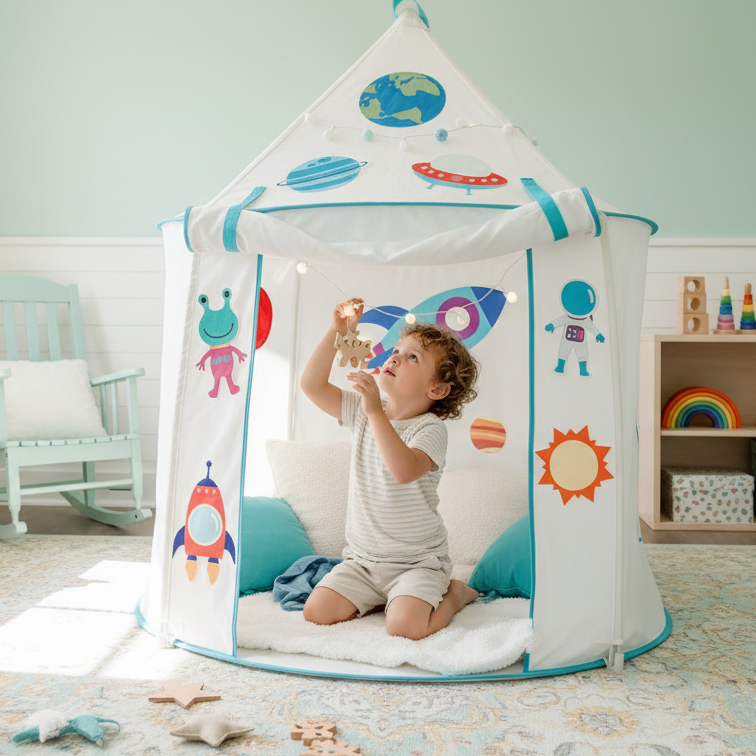
For example, ZeeZee Adventures approaches imaginative play by focusing on the environment rather than constantly introducing new toys. Instead of offering a play tent with a single permanent theme, the play space can evolve through interchangeable StickeeZ scenes, allowing children to transform familiar surroundings into new imaginative worlds as their interests change. This philosophy aligns with the brand's emphasis on one adaptable play space that supports changing interests through swappable themes.
Just as importantly, a dedicated play space can become more than a place for pretend adventures.
Many children naturally use cozy environments for reading, quiet time, storytelling, drawing, or simply taking a break from the stimulation of everyday life. For some families, having a calm, sensory-friendly area helps children transition between active and quiet play while maintaining ownership over their own creative experiences. ZeeZee's product philosophy similarly emphasizes a calming, sensory-friendly retreat that supports independent, screen-free play and grows with the child's imagination.
Ultimately, the goal isn't to create the "perfect" playroom.
It's to create a space that says to a child:
"Your ideas belong here."
When children feel safe to imagine, explore, experiment, and revisit their own stories, open-ended play becomes more than an activity.
It becomes part of how they learn, think, and grow.

Action Checklist: 10 Simple Ways to Encourage Open-Ended Play Today
You don't need to completely transform your home or buy a room full of new toys to encourage open-ended play. Small, intentional changes often make the biggest difference.
Here's a practical checklist you can begin using today.
✅ Leave at least 30–60 minutes each day for uninterrupted, child-led play.
✅ Offer versatile materials such as blocks, cardboard boxes, scarves, art supplies, or natural objects that can be used in many different ways.
✅ Resist solving every problem immediately. Give your child time to think, experiment, and discover their own solutions.
✅ Ask curiosity-based questions like "What happens next?" or "Tell me about your creation" instead of directing the activity.
✅ Rotate toys occasionally instead of constantly buying new ones. Familiar materials often become exciting again after a short break.
✅ Create a calm, inviting play space where children feel comfortable returning to unfinished projects and imaginative stories.
✅ Limit unnecessary background distractions such as television or constant digital entertainment during playtime.
✅ Follow your child's interests rather than introducing new themes every week. Deep exploration often leads to richer learning.
✅ Celebrate creativity rather than perfection. There is no "wrong" way to imagine.
✅ Most importantly, allow your child to lead. Your role isn't to entertain—it is to encourage.
Frequently Asked Questions
What is open-ended play?
Open-ended play is child-directed play with no predetermined outcome or single correct answer. Children use their imagination to decide how they play, solve problems, and create stories, allowing each play experience to unfold differently.
Why is open-ended play important?
Open-ended play supports many aspects of healthy child development, including creativity, executive functioning, language development, emotional regulation, problem-solving, confidence, and independent thinking. It encourages children to actively create rather than simply follow instructions.
What are examples of open-ended play?
Common examples include:
-
Building with blocks
-
Pretend play
-
Drawing and painting
-
Playing with cardboard boxes
-
Dress-up and role play
-
Loose parts play
-
Storytelling
-
Nature exploration
-
Building forts
-
Creating imaginary worlds
The defining feature isn't the material itself—it's the freedom children have to decide how to use it.
Are open-ended toys better than traditional toys?
Not necessarily.
Both structured and open-ended toys have developmental value.
Structured toys often teach specific skills such as sequencing, matching, or following directions, while open-ended toys encourage creativity, flexible thinking, and independent problem-solving.
A balanced play environment includes opportunities for both.
At what age should children begin open-ended play?
Open-ended play begins naturally during infancy and toddlerhood as children explore objects through movement and sensory experiences.
As children grow, their play becomes increasingly imaginative and complex.
There is no upper age limit—school-age children continue benefiting from child-led, imaginative play through storytelling, construction, art, dramatic play, and creative projects.
Can open-ended play reduce screen time?
Yes.
Children who have engaging opportunities for imaginative play often become less dependent on passive entertainment because they're actively creating their own experiences.
Open-ended play doesn't simply replace screen time—it offers a meaningful alternative that supports cognitive, emotional, and social development.
Is Montessori play the same as open-ended play?
They are closely related but not identical.
Many Montessori materials encourage exploration and independence, while open-ended play refers more broadly to any child-led activity without a predetermined outcome.
Open-ended play can occur within Montessori, Reggio Emilia, Waldorf, traditional, or play-based parenting approaches.
How much open-ended play does my child need each day?
There isn't one perfect number.
Instead of focusing on exact minutes, aim to provide regular opportunities for uninterrupted, child-led play throughout the week.
Even 30–60 minutes of protected imaginative play each day can become a valuable part of a healthy routine, especially when children are free to direct the experience themselves.
Do neurodivergent children benefit from open-ended play?
Many neurodivergent children—including autistic children and those with ADHD or sensory processing differences—can benefit from open-ended play when activities are adapted to their interests, communication styles, and sensory preferences.
A predictable, low-pressure environment often allows children to engage at their own pace while building confidence and self-expression.
Because every child is unique, parents should consider their child's individual strengths and support needs, and seek guidance from qualified healthcare professionals when appropriate.
Conclusion
Childhood has never been about finding the "right" answer.
It's about asking questions.
Exploring possibilities.
Trying something unexpected.
Beginning again.
Open-ended play creates the freedom for all of those moments to happen naturally.
When children are trusted to lead their own play, they aren't simply staying busy. They're learning how to think creatively, solve problems, communicate ideas, manage emotions, and develop confidence in their own abilities. These aren't skills that appear overnight—they grow through hundreds of small, imaginative experiences that unfold one story at a time.
As parents, it's easy to feel pressure to provide the newest toy, the perfect activity, or a carefully planned schedule. Yet some of the most meaningful learning happens when we step back, offer time and space, and allow children to follow their own curiosity.
Sometimes, a cardboard box really is enough.
Sometimes, a handful of blocks becomes an entire city.
Sometimes, a quiet corner becomes the setting for adventures that last all afternoon.
The materials may change.
The stories will certainly change.
But the opportunity remains the same: to give children the freedom to imagine, create, and discover who they are through play.





Comment (0)