

Why Quiet Time Supports Emotional Regulation and Creativity
Quiet time is often treated as the part of the day when children are expected to slow down, sit quietly, or take a break from active play.
But quiet time can offer children much more than a pause between activities.
When children have opportunities to step away from constant stimulation and spend time in a calmer environment, they can choose what interests them, revisit familiar activities, process experiences through play, and explore their own ideas.
For some children, that might mean reading quietly. For others, it could be drawing, building, storytelling, arranging toys, or creating an imaginary world.
The important part is not whether the room is completely silent.
It is whether children have space to pause, choose, imagine, and create.
What Is Quiet Time for Children?
Quiet time doesn't have to mean nap time or asking a child to sit still.
It is better understood as a period when children can engage in lower-pressure activities at their own pace, often with fewer instructions and less external stimulation.
A toddler might look through a picture book or sort objects.
A preschooler might draw, play with stuffed animals, or create a pretend world.
An older child might read, journal, sketch, build, write stories, or work on a puzzle.
Even the same child may need different kinds of quiet time on different days.
After a busy morning, they may want to curl up with a book. After a frustrating experience, they may prefer drawing or building. On another day, they might not want much quiet at all.
That variation is normal.
The purpose isn't to make every child behave calmly in the same way. It is to create opportunities for children to find activities that help them slow their pace and engage more independently.
Why Children Sometimes Need a Break From Constant Stimulation
Children experience a remarkable amount of stimulation throughout the day.
There are conversations, transitions, school or daycare, toys, movement, social interactions, errands, sounds, and—often—digital entertainment.
That doesn't mean stimulation is inherently bad. Children need active experiences, social connection, movement, exploration, and novelty.
But a day doesn't have to be full from beginning to end.
Periods of quieter activity can create a different rhythm.
Instead of moving immediately from one planned activity to another, children have an opportunity to settle into something at their own pace.
For some children, this may feel restorative. For others, it may simply provide a welcome change of pace.
The key is flexibility.
Quiet time should not become another demand placed on a child who is already overwhelmed.
Quiet Play Can Give Children More Choice
One of the most valuable features of quiet play is that it can be relatively open-ended.
A structured activity often has a clear beginning, a set of instructions, and an expected outcome.
Open-ended play works differently.
A child can decide what the materials mean and where the activity goes.
A blanket might become a cave.
A cardboard box might become a spaceship.
A few cushions might become mountains.
A collection of stuffed animals might become the characters in an elaborate story.
The child isn't simply following the activity.
They are creating it.
That small shift—from following instructions to making decisions—can make quiet play especially meaningful.
It gives children opportunities to experiment with ideas, change direction, solve small problems, and return to familiar stories in new ways.
How Quiet Time Creates Space for Creativity
Creativity doesn't always appear when children are specifically told to “be creative.”
Often, it emerges when they have enough freedom to wonder:
What could this become?
A child drawing a house might suddenly decide it is a castle.
A block structure might become a zoo.
A reading corner might become a secret headquarters.
The less an activity dictates the final result, the more room there is for imagination.
This is one reason open-ended materials can be so useful during quiet time. They don't require children to produce one particular thing.
Instead, they provide a starting point.
From there, children can experiment.
They can change their minds.
They can make something that doesn't work and try again.
They can abandon the original idea completely.
Those small moments are part of creative exploration.
Quiet Time and Emotional Expression Through Play
Play is also one of the ways children explore experiences and ideas that can be difficult to explain directly.
A child may recreate a familiar event with toys.
They might pretend a stuffed animal is nervous about going somewhere.
They may create a story about a character who gets frustrated, gets lost, solves a problem, or finds a safe place to rest.
That doesn't mean every pretend game has a hidden emotional message.
Children also play simply because playing is enjoyable.
But imaginative play can provide a flexible language through which children explore different situations, relationships, feelings, and possibilities.
Quiet environments can give that kind of play more room to develop because children aren't constantly being interrupted or redirected.
The Environment Can Influence How Children Play
The physical environment matters too.
A large, busy room filled with toys invites a different kind of play than a small, familiar corner with a few carefully chosen materials.
A cozy space can signal that it's okay to slow down.
A defined play area can give children a sense of ownership.
And an adaptable environment can support different kinds of play without requiring an entirely new setup every time a child's interests change.
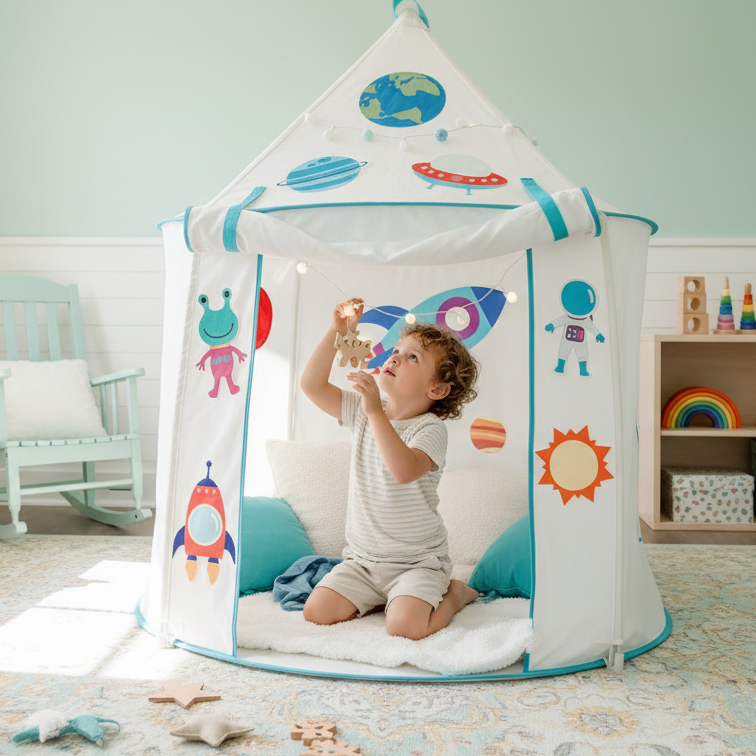
A familiar play space might be a reading nook one afternoon, a campsite the next, and a spaceship after that.
This is the thinking behind ZeeZee Adventures and its changeable play environments. Instead of designing a space around one permanent theme, ZeeZee is designed around the idea that children's interests and stories can change over time.
A child can reinterpret the same environment according to whatever captures their imagination that day.

Why Familiar Spaces Can Be Helpful
Children often return to the same activities and spaces repeatedly.
Adults sometimes see repetition as boredom.
For children, repetition can be a way of becoming more familiar with an idea.
The same story can change each time slightly.
The same pretend-play setting can develop new characters.
The same building materials can create completely different structures.
A familiar space can therefore become a kind of creative foundation.
The environment doesn't have to change every day.
The child's interpretation of it can change.
This is particularly useful when the space is flexible enough to support different activities.
A play tent, for example, could become a quiet reading space in the morning and an imaginary adventure environment later in the day.
That adaptability is central to the ZeeZee approach: one physical environment can support many different stories rather than being limited to one theme.
Quiet Time Doesn't Have to Mean Complete Silence
One common misconception is that quiet time should be completely quiet.
That's not realistic for many children.
A child might hum while drawing.
Another might whisper a story to their toys.
Someone building with blocks may move around quite a bit.
Another child may prefer to curl up with a book and barely move.
These can all be forms of quieter, more independent engagement.
The goal isn't to create a perfectly silent room.
It is to reduce some of the pressure to constantly perform, respond, transition, or consume new stimulation.
Children have different temperaments and different ways of engaging with their surroundings.
A useful quiet-time environment leaves room for those differences.
How Parents Can Create More Meaningful Quiet Time
You don't need a complicated activity schedule.
In fact, too much structure can work against the purpose of quiet play.
Instead, try creating a simple environment with a few accessible options.
You might include:
-
A small selection of books
-
Paper, crayons, or pencils
-
Building materials
-
Puzzles
-
Stuffed animals
-
Simple pretend-play objects
-
Journals for older children
-
A comfortable place to sit or lie down
-
A familiar space where children can play without constant interruption
Then offer a little choice.
Instead of:
“Go play quietly.”
Try:
“Would you like to read, draw, or build?”
For imaginative play, you can also offer an open-ended prompt:
“What kind of place could you create here?”
or
“What story could happen in this space?”
The goal is to provide a starting point without taking over the play.
Quiet Time Should Be an Opportunity, Not a Test
Not every child will respond to quiet time in the same way.
Some children naturally enjoy independent activities.
Others need more connection before they can settle.
Some may manage ten minutes comfortably while another child can spend much longer absorbed in a project.
Age, temperament, energy level, environment, and the events of the day can all influence how a child responds.
So quiet time doesn't need to become another measure of whether a child is “good” at playing independently.
If a child needs you nearby, you can sit with them.
If they want movement, a quiet activity can still involve movement.
If they aren't interested in the suggested activity, offer another choice.
The objective is not perfect independence.
It is creating occasional opportunities for children to experience a slower pace and follow their own ideas.
A Simple Formula for Meaningful Quiet Play
When you're creating a quiet-time environment, three ingredients can be especially useful:
Comfort + Choice + Creativity
Comfort gives children a welcoming place to settle.
Choice gives them some control over what happens next.
Creativity gives the activity room to evolve.
You don't need expensive toys or an elaborate setup.
Sometimes a comfortable corner, a few familiar materials, and enough uninterrupted time are sufficient.
And when the environment itself is adaptable, it can continue to support different interests as children grow.
Quiet Time Gives Children Room to Discover Their Own Ideas
Childhood doesn't need to be filled with constant activities.
There is value in giving children moments when nobody is telling them exactly what to make, what to play, or what the story should be.
They may discover that they enjoy drawing.
They may invent a character.
They may build something that collapses and try again.
They may simply sit with a favorite book.
Those moments can look small from the outside.
But inside them are opportunities for choice, imagination, exploration, and self-expression.
Quiet time isn't about making children perfectly calm.
And it isn't about keeping them occupied every minute.
It is about creating occasional space where children can pause, choose, imagine, and create.
Sometimes, that little bit of space is where their next adventure begins.
FAQs
1. What is quiet time for children?
Quiet time is a period when children can engage in calmer, lower-pressure activities at their own pace, such as reading, drawing, building, or imaginative play.
2. How does quiet time support creativity?
Quiet time can give children uninterrupted opportunities to make choices, experiment with ideas, create stories, and use familiar materials in new ways.
3. Does quiet time have to be completely silent?
No. Quiet time can include gentle movement, talking, humming, storytelling, or other forms of low-pressure play. The goal is not perfect silence.
4. Can quiet play help children express emotions?
Imaginative and pretend play can provide children with opportunities to explore experiences, relationships, and feelings through stories and play scenarios. Every child's play is different, so it should not automatically be interpreted as an indication of a particular emotion.
5. How can parents create a quiet-time space?
A comfortable, familiar area with a small selection of books, drawing supplies, building materials, puzzles, or pretend-play objects can provide a simple starting point for quiet play.
6. What if my child doesn't want to play independently?
That's completely okay. Children differ in temperament and need for connection. Parents can begin by staying nearby, offering choices, or participating briefly before gradually giving the child more room to lead.
7. What are some quiet-time activities for kids?
Reading, drawing, journaling, puzzles, building, storytelling, stuffed-animal play, simple crafts, and open-ended pretend play can all work well depending on the child's age and interests.
8. Can the same play space support different types of quiet play?
Yes. An adaptable space can become a reading nook, storytelling area, pretend-play setting, or cozy retreat depending on what the child wants to do.






Comment (0)