
20 Imaginative Play Ideas That Don't Require Expensive Toys
Quick Answer
Children don't need expensive toys to develop imagination. In fact, simple household items like cardboard boxes, blankets, wooden spoons, scarves, cushions, and recycled containers often inspire richer imaginative play than highly specialized toys. Open-ended materials encourage children to invent stories, solve problems, explore emotions, and build creativity because there isn't just one "correct" way to play.
Key Takeaways
-
Imagination grows through possibilities, not price tags.
-
Everyday household objects often inspire more creativity than expensive toys.
-
Open-ended play strengthens problem-solving, communication, and executive functioning.
-
The best imaginative play happens when children lead the story.
-
A simple environment filled with flexible materials can provide endless adventures.
Introduction
Walk into most toy stores, and you'll see shelves filled with flashing lights, electronic sounds, talking dolls, interactive gadgets, and toys designed to do almost everything for children.
It's easy to believe that the more expensive the toy, the more valuable it must be.
Many parents naturally wonder:
"Am I giving my child enough?"
"Do they need more educational toys?"
"Will they fall behind without the latest products?"
Yet something interesting happens in homes around the world.
The brand-new toy sits untouched after a few days.
Meanwhile...
The cardboard box it arrived in becomes a castle.
A spaceship.
A bakery.
A pirate ship.
A secret cave.
A race car.
A time machine.
The box wasn't designed to be any of those things.
The child did the designing.
And that's exactly where the learning begins.
As a pediatric occupational therapist, I've seen this countless times.
Children rarely remember whether a toy was expensive.
They remember the adventures they created.
The worlds they built.
The stories they invented.
The characters they became.
That's because imagination isn't purchased.
It's practiced.
Children don't develop creativity by following predetermined instructions.
They develop it by asking:
"What else could this become?"
That single question transforms ordinary objects into extraordinary adventures.
It also transforms ordinary moments into powerful learning opportunities.
The wonderful news for parents is that imaginative play doesn't require a large budget.
It doesn't require a perfectly designed playroom.
It doesn't even require many toys.
What children truly need is time, freedom, and a few open-ended materials that leave room for their own ideas.
In this article, we'll explore why simple objects often inspire the richest play experiences and share 20 imaginative play ideas that use items many families already have at home.
Why Children Don't Need Expensive Toys
Adults often judge toys by what they can do.
Children judge them by what they can become.
That's an important difference.
Imagine giving a child a toy spaceship with flashing lights, recorded voices, moving parts, and a button that launches a predetermined mission.
Now imagine handing another child an empty cardboard box.
At first glance, the spaceship seems far more impressive.
But something fascinating often happens.
The electronic spaceship already tells its story.
The cardboard box asks the child to create one.
One day it's a rocket.
The next day it's a submarine.
Tomorrow it's a bakery.
Next week it's a dinosaur laboratory.
Every new adventure begins with imagination instead of instructions.
Researchers and child development specialists have long recognized that open-ended materials encourage more flexible thinking because they don't prescribe a single way to play.
Instead of following someone else's narrative, children invent their own.
That process strengthens creativity far more than simply activating a toy's built-in features.
This doesn't mean expensive toys are "bad."
Many beautifully designed toys can absolutely support healthy development.
The important question isn't:
"How much did the toy cost?"
It's:
"How many different stories can my child create with it?"
The answer often has very little to do with price.
Why Simplicity Sparks Bigger Creativity
Imagine walking into an art studio with only one paint-by-number picture.
Every artist produces nearly the same result.
Now imagine walking into a room filled with blank paper and colorful paints.
Suddenly, anything becomes possible.
Play works much the same way.
The more possibilities children see, the more possibilities they create.
Simple materials leave space for imagination.
They invite children to decide:
Who are the characters?
Where does the story take place?
What's the problem?
How will it be solved?
Because there isn't one correct answer, children begin experimenting.
They test ideas.
They revise plans.
They invent new endings.
That flexibility supports several important areas of development, including:
-
Creative thinking
-
Problem-solving
-
Language development
-
Executive functioning
-
Emotional regulation
-
Confidence
-
Decision-making
Ironically, the fewer built-in features a toy has, the more work the child's imagination has the opportunity to do.
That's why objects adults barely notice often become children's favorite play materials.
A wooden spoon becomes a microphone.
A blanket becomes the ocean.
A scarf becomes superhero wings.
A laundry basket becomes a racing car.
A cardboard tube becomes a telescope exploring distant planets.
None of these objects changed.
The child's thinking did.
Expert Insight
Occupational therapists often recommend open-ended materials because they encourage children to generate ideas rather than follow instructions. Everyday objects like cardboard boxes, blankets, recycled containers, blocks, scarves, and cushions can support creativity, executive functioning, language development, and independent problem-solving in ways that many single-purpose toys cannot.
The Best Toy Is Often the One That Can Become Anything
Children are naturally imaginative.
They don't need adults to provide every storyline.
They simply need opportunities to create their own.
Think back to your own childhood.
Chances are, some of your strongest memories aren't tied to the most expensive toy you owned.
Perhaps it was the blanket fort built across the living room.
The pirate ship made from sofa cushions.
The secret club inside a cardboard box.
The stick that became a magic wand.
Or the rainy afternoon spent turning chairs into a train.
These moments stay with us because they belonged to us.
We weren't following someone else's script.
We were inventing our own.
That's exactly what makes imaginative play so powerful.
When children become the storytellers, they're also becoming:
-
Creative thinkers.
-
Problem-solvers.
-
Decision-makers.
-
Engineers.
-
Explorers.
-
Artists.
-
Leaders.
Every pretend adventure asks them to imagine possibilities that don't yet exist.
Those are the same thinking skills they'll use throughout school, work, relationships, and everyday life.
The wonderful thing is that none of those adventures require expensive equipment.
They simply require room for imagination.
20 Imaginative Play Ideas That Don't Require Expensive Toys
1. Turn a Cardboard Box Into Anything
What You'll Need
-
A cardboard box (any size)
-
Markers or crayons
-
Tape
-
Child-safe scissors (optional, with adult supervision)
-
Recycled materials for decoration
How to Play
Ask your child one simple question:
"What could this become?"
Then step back.
You might hear:
-
"It's a spaceship!"
-
"No, it's a bakery!"
-
"Actually...it's a dragon cave!"
Let your child decorate the box however they choose.
Tomorrow, the same box can become something completely different.
That's the beauty of open-ended play.
Skills Children Develop
-
Creative thinking
-
Problem-solving
-
Symbolic thinking
-
Planning
-
Storytelling
-
Executive functioning
Easy Variations
-
Fire station
-
Ice cream truck
-
Post office
-
Castle
-
Time machine
-
Animal shelter
2. Build a Blanket Fort Expedition
What You'll Need
-
Blankets
-
Pillows
-
Chairs
-
Cushions
-
Flashlight
-
Favorite books or stuffed animals
How to Play
Help your child create a cozy fort.
Then ask:
-
"Who lives here?"
-
"Where are you?"
-
"What's today's adventure?"
Maybe they're camping in the mountains.
Maybe they're exploring Antarctica.
Maybe they're hiding from friendly dragons.
The fort becomes the setting for endless stories.
Skills Children Develop
-
Spatial awareness
-
Collaboration
-
Creativity
-
Emotional regulation
-
Independent play
Easy Variations
-
Jungle camp
-
Secret headquarters
-
Arctic research station
-
Fairy forest
-
Pirate hideout
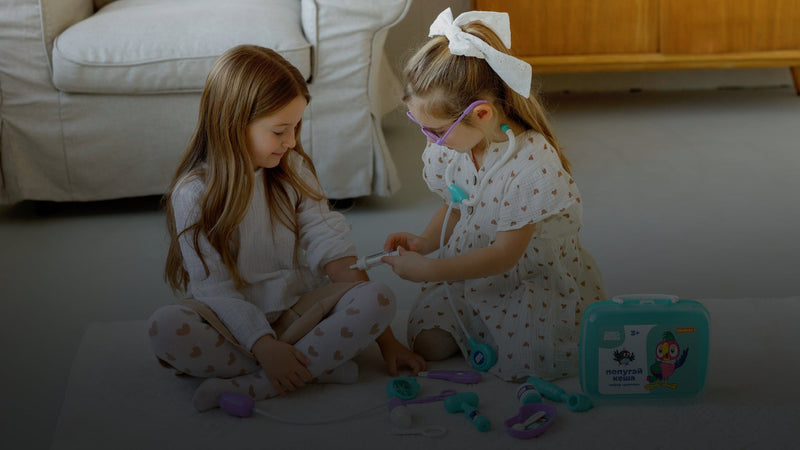
3. Open an Animal Rescue Center
What You'll Need
-
Stuffed animals
-
Blankets
-
Toy bandages (or strips of fabric)
-
Small boxes
-
Notebook for patient records
How to Play
Every stuffed animal arrives with a different problem.
Perhaps one has a sore paw.
Another is lost.
Another feels lonely.
Invite your child to diagnose, comfort, and care for each patient.
There are no right answers.
Only thoughtful ones.
Skills Children Develop
-
Empathy
-
Emotional intelligence
-
Communication
-
Problem-solving
-
Responsibility
Easy Variations
-
Wildlife rehabilitation center
-
Veterinary clinic
-
Pet hotel
-
Animal adoption day
4. Create a Homemade Restaurant
What You'll Need
-
Bowls and plates
-
Wooden spoons
-
Recycled food containers
-
Paper menus
-
Play money (or homemade paper money)
How to Play
Your child becomes the chef.
Or the waiter.
Or the restaurant owner.
Soon customers begin making unusual requests.
A dinosaur wants pancakes.
A unicorn orders rainbow soup.
A teddy bear is allergic to bananas.
Children naturally invent creative solutions while serving their guests.
Skills Children Develop
-
Communication
-
Planning
-
Numeracy
-
Decision-making
-
Flexible thinking
Easy Variations
-
Bakery
-
Pizza shop
-
Ice cream café
-
Food truck
-
Pancake restaurant
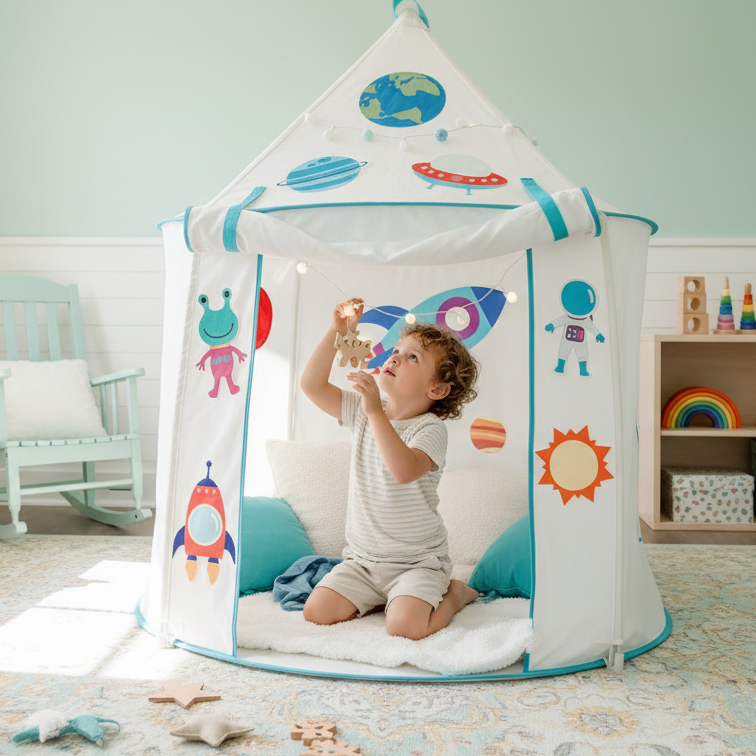
5. Blast Off on a Space Mission
What You'll Need
-
Cardboard box
-
Aluminum foil
-
Paper towel tubes
-
Flashlight
-
Stuffed animals as astronauts
How to Play
Prepare for launch.
Then let the adventure unfold.
Maybe the spaceship loses power.
Maybe an alien needs help.
Maybe a new planet has unusual weather.
Every unexpected event becomes a new opportunity to solve problems.
Skills Children Develop
-
Creativity
-
Scientific curiosity
-
Sequential thinking
-
Teamwork
-
Problem-solving
Easy Variations
-
Moon landing
-
Mars colony
-
Alien rescue
-
Space laboratory
Expert Insight
Notice that each activity begins with a question instead of instructions. Open-ended questions invite children to think independently, make decisions, and create original ideas rather than simply following directions. This type of child-led exploration supports deeper cognitive development and longer periods of engaged play.
6. Design a Treasure Hunt
What You'll Need
-
Small household objects
-
Paper clues
-
Pencil
-
Basket or small container
How to Play
Hide a few simple treasures around the house.
Instead of giving direct directions, create clues.
Older children can make maps.
Younger children can follow picture clues.
Better yet, let your child create the treasure hunt for someone else.
Designing the adventure is often even more valuable than completing it.
Skills Children Develop
-
Logical thinking
-
Sequencing
-
Planning
-
Observation
-
Creativity
Easy Variations
-
Pirate treasure
-
Fairy treasure
-
Dinosaur fossils
-
Nature scavenger hunt
7. Put On a Puppet Theater
What You'll Need
-
Socks
-
Paper bags
-
Markers
-
Googly eyes (optional)
-
Small blanket or table
How to Play
Create simple puppets together.
Then ask:
"What's their story?"
Children often invent characters with unique personalities.
One puppet may be shy.
Another brave.
Another silly.
Soon they'll create conversations, solve disagreements, and build entire imaginary worlds.
Skills Children Develop
-
Language development
-
Storytelling
-
Emotional expression
-
Creativity
-
Social understanding
Easy Variations
-
Fairy tale theater
-
Superhero show
-
Animal adventures
-
Space stories
8. Become Nature Explorers
What You'll Need
-
Leaves
-
Stones
-
Sticks
-
Pinecones
-
Magnifying glass (optional)
-
Notebook
How to Play
Head outdoors.
Collect interesting natural objects.
Then imagine you're scientists exploring a newly discovered planet.
Perhaps every leaf belongs to a magical tree.
Maybe the stones are dinosaur eggs.
Maybe the sticks are ancient tools.
Nature becomes the backdrop for endless imaginative adventures.
Skills Children Develop
-
Observation
-
Curiosity
-
Scientific thinking
-
Creativity
-
Appreciation of nature
Easy Variations
-
Fairy forest
-
Dinosaur excavation
-
Jungle expedition
-
Magical garden
9. Run a Grocery Store
What You'll Need
-
Empty food boxes
-
Shopping bags
-
Basket
-
Homemade money
-
Sticky notes for price labels
How to Play
Transform your kitchen into a grocery store.
Children can:
-
Stock shelves
-
Organize products
-
Shop for ingredients
-
Operate the checkout
-
Solve customer requests
Perhaps someone needs ingredients for dragon soup.
Or food for an elephant.
The sillier the requests, the more creative the thinking.
Skills Children Develop
-
Organization
-
Communication
-
Early math
-
Decision-making
-
Social skills
Easy Variations
-
Farmers' market
-
Toy shop
-
Flower market
-
Bookstore
10. Create a Superhero Training Camp
What You'll Need
-
Pillows
-
Tape
-
Blankets
-
Cardboard
-
Homemade capes
How to Play
Every superhero needs training.
Create obstacle courses.
Balance beams.
"Lava" made from cushions.
Rescue missions.
Invisible villains.
Children invent powers, solve challenges, and create their own heroic stories.
The goal isn't competition.
It's imagination.
Skills Children Develop
-
Gross motor skills
-
Confidence
-
Resilience
-
Planning
-
Creative problem-solving
Easy Variations
-
Ninja academy
-
Explorer training
-
Knight school
-
Dragon rescue team
-
Secret agent headquarters
.
11. Open a Magic Potion Laboratory
What You'll Need
-
Small cups or jars
-
Water
-
Measuring spoons
-
Food coloring (optional)
-
Flower petals, leaves, or herbs
-
Paper and crayons for potion labels
How to Play
Invite your child to become a wizard, scientist, fairy, or magical inventor.
Every potion has a special purpose.
Perhaps one helps dragons fly.
Another makes plants grow overnight.
One gives astronauts the courage to explore new planets.
Ask questions like:
-
"What does this potion do?"
-
"Who needs it?"
-
"How should we make it?"
Children naturally begin experimenting, predicting outcomes, and creating stories around each mixture.
Skills Children Develop
-
Scientific curiosity
-
Creativity
-
Language development
-
Sequencing
-
Problem-solving
Easy Variations
-
Fairy potion shop
-
Wizard school
-
Dinosaur medicine lab
-
Alien science laboratory
12. Sail Away on a Pirate Adventure
What You'll Need
-
Sofa cushions
-
Blanket
-
Cardboard tube
-
Homemade treasure map
-
Toy binoculars (or cardboard tubes)
How to Play
Transform the living room into the open sea.
Maybe pirates discover an island.
Perhaps a storm appears.
Maybe a sea turtle asks for help.
Children decide what challenges arise and how the crew overcomes them.
Every twist in the story encourages creative thinking.
Skills Children Develop
-
Teamwork
-
Planning
-
Leadership
-
Imagination
-
Decision-making
Easy Variations
-
Treasure island
-
Lost city expedition
-
Ocean rescue mission
-
Pirate school
13. Become Dinosaur Explorers
What You'll Need
-
Toy dinosaurs (optional)
-
Sand, rice, or soil in a tray
-
Paintbrush
-
Small shovel or spoon
-
Stones and sticks
How to Play
Imagine you've discovered a hidden dinosaur valley.
Children can:
-
Dig for fossils.
-
Build dinosaur habitats.
-
Rescue baby dinosaurs.
-
Create volcanoes.
-
Invent new dinosaur species.
The adventure grows with every discovery.
Skills Children Develop
-
Observation
-
Curiosity
-
Scientific thinking
-
Creativity
-
Fine motor skills
Easy Variations
-
Fossil museum
-
Jurassic safari
-
Dinosaur hospital
-
Volcano expedition
14. Camp Indoors
What You'll Need
-
Blanket fort
-
Flashlight
-
Sleeping bags or pillows
-
Stuffed animals
-
Storybooks
How to Play
Pretend you're camping somewhere extraordinary.
Maybe it's deep in the rainforest.
High in snowy mountains.
On the moon.
Under the ocean.
Listen for imaginary sounds.
Watch for magical creatures.
Cook pretend meals.
Tell stories before bedtime.
The destination changes every time you play.
Skills Children Develop
-
Storytelling
-
Emotional regulation
-
Creativity
-
Independent play
-
Communication
Easy Variations
-
Jungle safari
-
Arctic expedition
-
Space camping
-
Fairy forest
15. Start a Mail Delivery Service
What You'll Need
-
Envelopes
-
Paper
-
Stickers
-
Basket or bag
-
Homemade mailbox
How to Play
Children become neighborhood mail carriers.
They write letters.
Deliver invitations.
Create birthday cards.
Send treasure maps.
Deliver emergency messages to superheroes or dinosaurs.
Older children can invent addresses and organize delivery routes.
Skills Children Develop
-
Early literacy
-
Organization
-
Communication
-
Planning
-
Social understanding
Easy Variations
-
Magical owl post
-
North Pole mail
-
Space delivery service
-
Secret agent messages
Expert Insight
Everyday role-play activities naturally combine multiple developmental skills. A simple game of "mail carrier" encourages children to organize information, communicate ideas, solve problems, and sequence tasks—all while believing they're simply delivering letters.
16. Open a Toy Hospital
What You'll Need
-
Dolls or stuffed animals
-
Toy doctor kit (optional)
-
Blankets
-
Paper for patient charts
-
Bandages or strips of fabric
How to Play
Every toy arrives with a different challenge.
One has a sore wing.
Another feels scared.
Someone else needs a cast.
Encourage your child to examine each patient and decide how to help.
There are countless possible solutions.
Skills Children Develop
-
Empathy
-
Emotional intelligence
-
Responsibility
-
Communication
-
Creative thinking
Easy Variations
-
Teddy Bear Clinic
-
Dinosaur Hospital
-
Superhero Recovery Center
-
Wildlife Rescue Hospital
17. Become Family Detectives
What You'll Need
-
Magnifying glass (optional)
-
Notebook
-
Pencil
-
Small clues hidden around the house
How to Play
Someone has lost the birthday cake.
The museum's dinosaur egg has disappeared.
A mysterious footprint has appeared.
Children become detectives collecting clues, interviewing suspects, and solving mysteries.
There doesn't need to be one correct answer.
Every theory becomes part of the story.
Skills Children Develop
-
Logical reasoning
-
Observation
-
Communication
-
Problem-solving
-
Creativity
Easy Variations
-
Mystery mansion
-
Lost treasure investigation
-
Spy headquarters
-
Jungle detective team
18. Travel Through Time
What You'll Need
-
Cardboard box
-
Clock drawings
-
Costumes
-
Household objects
How to Play
Your cardboard box becomes a time machine.
Where will it go?
The age of dinosaurs?
Ancient Egypt?
The future?
A world filled with friendly robots?
Each destination creates new adventures and unexpected challenges.
Skills Children Develop
-
Historical curiosity
-
Storytelling
-
Flexible thinking
-
Creativity
-
Decision-making
Easy Variations
-
Medieval castle
-
Future city
-
Ancient explorers
-
Space-time adventure
19. Run Your Own Weather Station
What You'll Need
-
Paper
-
Crayons
-
Flashlight
-
Cotton balls
-
Blue fabric or paper
How to Play
Become weather scientists.
Predict tomorrow's weather.
Invent magical storms.
Track rainbow clouds.
Warn nearby villages about incoming dragon snow.
Children become meteorologists while creating imaginative weather reports.
Skills Children Develop
-
Observation
-
Scientific curiosity
-
Language development
-
Creativity
-
Confidence
Easy Variations
-
Storm chaser
-
Weather news station
-
Climate explorer
-
Magical weather laboratory
20. Become Story Builders
What You'll Need
-
A few everyday objects
-
Stuffed animals
-
Books
-
Blank paper
-
Crayons
How to Play
Gather three random objects.
Perhaps:
-
A wooden spoon
-
A teddy bear
-
A flashlight
Then ask:
"How are these connected?"
Children invent an entirely original story.
Maybe the teddy bear is searching for a magical spoon that lights up hidden caves.
Maybe the spoon is the key to an underwater kingdom.
No prompts.
No script.
Just imagination.
Every combination creates a brand-new adventure.
Skills Children Develop
-
Storytelling
-
Creative thinking
-
Communication
-
Executive functioning
-
Problem-solving
Easy Variations
-
Family storytelling night
-
Picture prompt stories
-
Story dice
-
Character swap challenge
How Parents Can Encourage Richer Imaginative Play
Children don't need adults to entertain them every minute.
They need adults who make space for their imagination.
Here are a few simple ways to encourage richer, child-led play:
Follow Their Lead
Rather than directing the story, become curious.
Ask questions like:
-
"What happens next?"
-
"How could they solve that problem?"
-
"What do you think the dragon is feeling?"
Open-ended questions encourage children to expand their ideas instead of looking for the "right" answer.
Resist Solving Every Problem
When adults immediately offer solutions, children miss the opportunity to think independently.
If the bridge falls down, ask:
"What could you try now?"
That simple question builds resilience far more effectively than fixing the problem for them.
Keep Materials Flexible
Children don't need dozens of single-purpose toys.
Instead, provide materials that can become many different things.
Examples include:
-
Cardboard boxes
-
Blankets
-
Scarves
-
Building blocks
-
Wooden spoons
-
Recycled containers
-
Cushions
-
Paper
-
Tape
-
Natural objects
The fewer built-in instructions an object has, the more imagination children contribute.
Protect Unstructured Time
Children need opportunities to become bored occasionally.
Boredom often becomes the spark that ignites creativity.
Instead of rushing to provide entertainment, give children time to invent their own adventures.
Some of childhood's most memorable stories begin with the words:
"What should we play?"
Creating Spaces That Grow With Children's Imagination
Imaginative play flourishes in environments that offer possibilities instead of prescriptions.
This is the philosophy behind ZeeZee Adventures. Rather than encouraging children to follow a single fixed storyline, the play environment is designed to evolve with their interests. Interchangeable StickeeZ themes—from dinosaurs and outer space to magical kingdoms and underwater adventures—allow the same familiar space to inspire entirely new stories over and over again.
Combined with everyday household items like blankets, cardboard boxes, flashlights, or stuffed animals, adaptable play spaces encourage children to become the authors of their own adventures. They decide the setting, invent the characters, solve the problems, and imagine what happens next. That freedom supports creativity, confidence, independent thinking, and longer periods of meaningful, screen-free play.
Because the most memorable adventures rarely come from the most expensive toys.
They come from the biggest imaginations.
Myth vs. Fact
|
Myth |
Fact |
|
Children need expensive toys to develop creativity. |
Creativity comes from how children use materials, not how much those materials cost. A cardboard box can inspire more imaginative play than a toy with only one function. |
|
Educational toys are always better than everyday household objects. |
Open-ended materials encourage children to invent stories, solve problems, and think independently because there isn't one "correct" way to use them. |
|
Parents need to entertain children for play to be meaningful. |
Children often create their richest imaginative worlds when adults step back and allow them to lead the play. |
|
More toys mean better play. |
Too many toys can overwhelm children and reduce creative thinking. A smaller selection of versatile materials often leads to deeper, longer-lasting play. |
|
Imaginative play is only for preschoolers. |
Pretend play continues to support creativity, storytelling, emotional intelligence, and problem-solving well into the elementary years and beyond. |
Action Checklist
Use this checklist to encourage imaginative play without spending money on new toys.
✅ Keep a cardboard box before recycling it.
✅ Create a basket filled with open-ended materials like scarves, blankets, wooden spoons, cardboard tubes, and recycled containers.
✅ Protect at least 30–60 minutes each day for uninterrupted child-led play.
✅ Rotate household materials occasionally to inspire fresh ideas.
✅ Ask open-ended questions like:
-
"Who lives here?"
-
"What happens next?"
-
"How could they solve that problem?"
✅ Resist the urge to direct the story.
✅ Let children make mistakes and discover their own solutions.
✅ Read books that inspire imaginative adventures, then continue the story through play.
✅ Celebrate creativity instead of perfection.
✅ Remember that the goal isn't creating the perfect activity—it's creating space for possibility.
Frequently Asked Questions
What is imaginative play?
Imaginative play, also called pretend play or make-believe play, is when children create stories, roles, and imaginary situations using their creativity. A blanket may become a cave, a cardboard box a spaceship, or a wooden spoon a magic wand. These experiences strengthen creativity, language, problem-solving, and emotional development.
Why are simple toys often better for imaginative play?
Simple toys and everyday objects leave room for children to create their own stories.
Unlike electronic or single-purpose toys, open-ended materials don't tell children how to play. Instead, they encourage flexible thinking, creativity, and independent decision-making.
What household items encourage imaginative play?
Many everyday items work beautifully, including:
-
Cardboard boxes
-
Blankets
-
Cushions
-
Wooden spoons
-
Scarves
-
Paper towel tubes
-
Recycled containers
-
Building blocks
-
Laundry baskets
-
Sticks, stones, and leaves
Children often see possibilities adults overlook.
How much imaginative play does my child need?
There's no perfect amount.
The most important factor is providing regular opportunities for uninterrupted, child-led play.
Even 20–30 minutes of open-ended imaginative play each day can support creativity, confidence, and independent thinking.
Should I join my child's pretend play?
Yes—if you're invited.
Rather than taking over the story, become a supporting character.
Ask curious questions.
Follow your child's ideas.
Allow them to remain the storyteller.
My child says, "I'm bored." What should I do?
Boredom isn't something to fear.
It's often the beginning of creativity.
Instead of immediately suggesting an activity, provide a few open-ended materials and allow your child time to invent their own adventure.
Many imaginative worlds begin with a quiet moment and a simple question:
"What could I do?"
Final Thoughts
It's easy to believe that inspiring childhood requires expensive toys, elaborate playrooms, or the newest educational gadgets.
But children's imaginations tell a different story.
They don't see a cardboard box.
They see a pirate ship sailing across dangerous seas.
They don't see a blanket draped over chairs.
They see a mountain cabin during a snowstorm.
They don't see a wooden spoon.
They see the microphone that introduces the world's greatest performer.
The magic isn't inside the object.
It's inside the child.
Every time children transform ordinary materials into extraordinary adventures, they're doing far more than playing.
They're learning to imagine possibilities where others see limitations.
They're practicing problem-solving before problems feel overwhelming.
They're discovering that there is rarely only one answer.
Perhaps most importantly, they're learning to trust their own ideas.
These are the skills that support lifelong creativity, resilience, communication, and confidence.
The wonderful news is that none of them depend on expensive toys.
They grow through curiosity.
Through freedom.
Through time.
Through stories children create for themselves.
As parents and caregivers, we don't have to provide every adventure.
Sometimes the greatest gift we can offer is something much simpler:
A few everyday objects.
An open space.
A little uninterrupted time.
And the freedom to ask,
"What could this become?"
Because when children are given permission to imagine, ordinary moments become extraordinary memories.




Comment (0)