
How to Encourage Imaginative Play Without Directing It
Quick Answer
The best way to encourage imaginative play is to support rather than direct it. Instead of telling children what to build, who to pretend to be, or how a story should unfold, provide open-ended materials, ask thoughtful questions, and give them the freedom to create their own ideas. Child-led play builds creativity, confidence, problem-solving, and independence because children become the authors of their own adventures.
Key Takeaways
-
Imaginative play is richest when children lead the story.
-
Parents can encourage creativity without controlling the outcome.
-
Open-ended questions inspire deeper thinking than giving instructions.
-
Boredom often becomes the starting point for imagination.
-
Supporting play doesn't mean entertaining children—it means trusting their ideas.
Introduction
Your child spreads blankets across the living room.
A few cushions become mountains.
A cardboard box sits in the middle of the floor.
You watch for a moment before saying,
"Why don't you make it into a castle?"
Your child pauses.
Looks at the box.
Then quietly says,
"It was going to be a submarine."
Without meaning to, you've changed the story.
Moments like this happen in almost every family.
As parents, we naturally want to help.
We want to encourage creativity.
Keep the play going.
Offer exciting ideas.
Sometimes we worry that if we don't join in, our child will become bored.
Or lose interest.
Or miss an opportunity to learn.
So we step in.
"What if the dragon comes?"
"You should build a taller tower."
"Pretend you're the doctor."
"Maybe the teddy bear is sick."
These suggestions come from a place of love.
But they can unintentionally shift ownership of the play from the child to the adult.
Instead of asking,
"What do I want to imagine?"
The child begins wondering,
"What does Mom or Dad want me to do?"
Over time, children may become less likely to invent their own ideas because they're waiting for the next suggestion.
Yet the greatest strength of imaginative play is that it belongs entirely to the child.
They're free to explore.
Experiment.
Change direction.
Make mistakes.
Invent impossible worlds.
And discover solutions that adults never would have imagined.
As a pediatric occupational therapist, I've often noticed something remarkable.
Children rarely need adults to provide better ideas.
They need adults who believe their own ideas are worth exploring.
When we resist the urge to direct the story, children often surprise us with their creativity, persistence, and problem-solving abilities.
In this article, you'll learn practical ways to encourage imaginative play while allowing your child to remain the storyteller, decision-maker, and creator of every adventure.
Why Parents Naturally Want to Help
Most parents don't intentionally take over play.
In fact, the opposite is true.
They step in because they care.
They want their child to learn.
To succeed.
To stay engaged.
To have fun.
When we see a child struggling to think of what comes next, our instinct is to help.
After all, that's what parenting often looks like.
We teach.
Guide.
Explain.
Protect.
Solve problems.
These instincts are incredibly valuable in many situations.
But imaginative play follows different rules.
Here, the goal isn't to arrive at the "best" story.
The goal is for the child to create one.
That can feel uncomfortable.
Especially when we see long pauses or hear the familiar words:
"I'm bored."
Many adults immediately begin offering activities.
"We could build a fort."
"You could play with your dinosaurs."
"Let's make a zoo."
These suggestions are well-intentioned.
But they also remove one of imagination's greatest teachers:
The opportunity to wonder.
Children often need a little time before an idea appears.
Those quiet moments aren't empty.
They're full of thinking.
Of imagining.
Of connecting ideas.
What looks like boredom from the outside is often the beginning of creativity on the inside.
The Temptation to Entertain
Modern parenting comes with enormous pressure.
Social media is filled with elaborate crafts.
Picture-perfect playrooms.
Educational activities.
Sensory bins.
Daily schedules.
Creative challenges.
It's easy to feel that good parenting means constantly providing meaningful experiences.
But children don't always need more activities.
Sometimes they simply need more freedom.
When adults become entertainers, children can begin expecting ideas to come from someone else.
Instead of asking themselves,
"What could I create?"
They wait for the next activity.
The next game.
The next suggestion.
Imagination becomes something they receive rather than something they generate.
Child-led play works differently.
The child becomes the inventor.
The storyteller.
The explorer.
The problem-solver.
That ownership is what makes imaginative play so powerful.
Expert Insight
Occupational therapists often encourage adults to think of themselves as "play supporters" rather than "play directors." Children build stronger creativity, executive functioning, and independent problem-solving when they have the freedom to generate ideas, experiment with solutions, and shape their own stories without constant adult direction.
Why Less Direction Often Leads to More Creativity
Imagine reading a book where someone tells you exactly what every character should say, how every chapter should end, and what every problem should look like.
There would be very little room for imagination.
The same is true during play.
Every time adults decide what should happen next, children lose an opportunity to decide for themselves.
When we step back, something remarkable happens.
Children begin asking questions we never would have thought of.
"What if dragons are afraid of the dark?"
"What if my bakery only sells dinosaur cookies?"
"What if astronauts need umbrellas in space?"
These ideas don't come from instruction.
They come from curiosity.
Curiosity is one of imagination's greatest fuels.
The less adults prescribe, the more children explore.
Instead of following directions, they begin making decisions.
Instead of searching for the "right" answer, they invent possibilities.
That freedom strengthens much more than creativity.
It also builds:
-
Independent thinking
-
Flexible problem-solving
-
Confidence
-
Executive functioning
-
Decision-making
-
Emotional resilience
-
Communication skills
Most importantly, it teaches children something deeply valuable:
"My ideas matter."
That belief often becomes the foundation for lifelong confidence.
Children who trust their own thinking are more willing to ask questions, experiment, take healthy risks, and recover from mistakes.
And it all begins with something surprisingly simple:
An adult choosing not to tell the next part of the story.
Becoming a Guide Instead of a Director
Supporting imaginative play doesn't mean becoming uninvolved.
Children still benefit from our presence.
Our encouragement.
Our curiosity.
The difference lies in how we participate.
A director decides what happens.
A guide creates space for discovery.
Instead of saying,
"Build a castle."
A guide asks,
"What are you building?"
Instead of saying,
"The dinosaur should chase the knight."
A guide wonders,
"What do you think the dinosaur wants?"
These small shifts completely change the experience.
One approach gives children answers.
The other invites them to create them.
And that's where imagination grows strongest.
10 Ways to Encourage Imaginative Play Without Taking Over
Encouraging imaginative play doesn't mean standing on the sidelines.
It means changing how we participate.
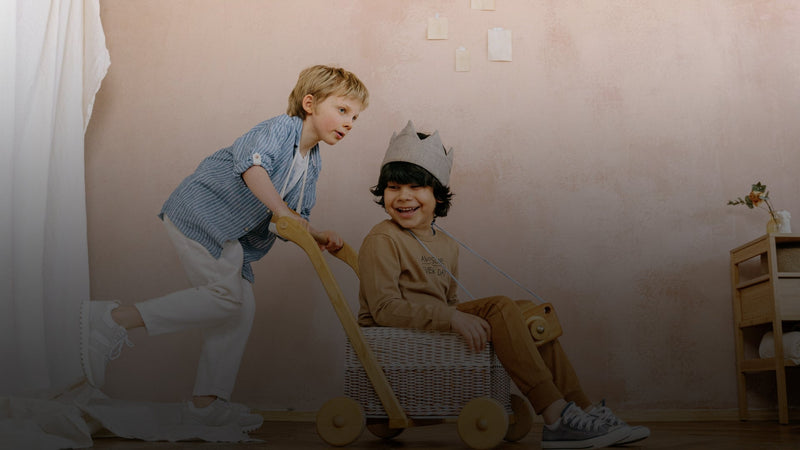
Instead of becoming the director of the story, we become the audience, the supporter, and occasionally, a fellow character.
Small changes in the way we respond can make a remarkable difference in how confidently children explore their own ideas.
Here are ten simple strategies that help imagination flourish while keeping your child in charge of the adventure.
1. Ask Questions Instead of Giving Ideas
One of the easiest ways to support imaginative play is to replace suggestions with curiosity.
When adults provide ideas, children often follow them.
When adults ask thoughtful questions, children begin creating their own.
Imagine your child has built something unusual with blocks.
Instead of saying,
"That looks like a castle."
Try asking,
"Tell me about what you've built."
You may discover it's actually a dragon's bakery, an underwater museum, or a train station for dinosaurs.
Questions invite children to think more deeply about their own ideas instead of adopting ours.
Some helpful prompts include:
-
"Who lives here?"
-
"What happens next?"
-
"How did that happen?"
-
"What problem are they trying to solve?"
-
"What do you think your character is feeling?"
Notice that none of these questions have right or wrong answers.
They're invitations to imagine.
Why It Works
Open-ended questions encourage children to organize their thoughts, expand stories, strengthen language skills, and develop confidence in their own creativity.
2. Let Boredom Do Its Job
Few phrases worry parents more than:
"I'm bored."
Our instinct is often to fix it immediately.
We suggest games.
Offer crafts.
Turn on music.
Find another activity.
But boredom isn't a problem.
It's often the doorway to imagination.
Before children create something interesting, there's usually a quiet pause.
Their minds wander.
Ideas begin connecting.
Eventually, curiosity takes over.
That empty cardboard box suddenly becomes a race car.
The cushions become mountains.
The hallway becomes a secret tunnel.
If adults rush to fill every quiet moment, children miss the opportunity to practice generating ideas independently.
The next time boredom appears, try responding with calm curiosity instead of immediate solutions.
You might simply say,
"I wonder what you'll think of."
Then give them time.
Why It Works
Boredom encourages independent thinking, creativity, initiative, and self-directed problem-solving.
Expert Insight
Research in child development suggests that periods of unstructured time encourage children to generate their own ideas, rather than relying on external entertainment. While boredom may feel uncomfortable at first, it often becomes the starting point for imaginative exploration and creative thinking.
3. Create Invitations, Not Instructions
There's an important difference between preparing an opportunity to play and telling children exactly how to play.
Imagine placing a basket on the floor containing:
-
A flashlight
-
A scarf
-
A cardboard tube
-
A few stuffed animals
-
A blanket
Then simply walking away.
No explanation.
No activity sheet.
No expected outcome.
Many children naturally begin inventing stories.
The scarf becomes superhero wings.
The flashlight becomes a lighthouse.
The cardboard tube becomes a telescope.
This is called creating an invitation to play.
The environment sparks curiosity, but the child decides what happens next.
Compare that with saying,
"Today we're pretending to be pirates."
The second approach already defines the story.
The first allows the child to invent one.
Why It Works
Invitations encourage ownership.
Children become explorers rather than followers.
4. Follow Your Child's Story
Adults often enter play with their own ideas.
Children usually have one already.
Imagine your child tells you,
"This dinosaur is opening a bakery."
Your first thought might be,
"Dinosaurs don't bake."
But imagination doesn't need realism.
Instead, lean into the story.
Ask:
"What's the dinosaur's favorite recipe?"
Or,
"Who buys dinosaur cupcakes?"
Following your child's ideas communicates something powerful:
"Your imagination is interesting."
That encouragement builds confidence far more effectively than correcting or redirecting the story.
Children who feel heard are more willing to continue creating.
Why It Works
Following children's ideas strengthens confidence, storytelling, communication, and creative thinking.
5. Resist Solving Every Problem
One of the greatest gifts adults can give children is the opportunity to struggle a little.
Imagine your child is building a bridge from blocks.
It keeps collapsing.
Your instinct might be to demonstrate a stronger design.
Instead, pause.
Ask,
"What could you try next?"
Perhaps they'll make the base wider.
Use different blocks.
Build two smaller bridges instead of one.
Even if their solution isn't perfect, they've learned something much more valuable than simply watching an adult solve the problem.
They've practiced thinking independently.
Pretend play naturally creates opportunities like these.
The dragon blocks the bridge.
The bakery runs out of flour.
The spaceship loses power.
Each obstacle invites children to experiment with solutions.
When adults immediately provide answers, children lose the chance to discover them for themselves.
Why It Works
Allowing children to solve manageable problems strengthens resilience, executive functioning, persistence, and flexible thinking.
The Goal Isn't Perfect Play
Many parents worry they're not "doing imaginative play correctly."
The truth is, there isn't a perfect script.
Children don't need constant ideas.
They don't need elaborate setups.
They don't need adults entertaining them every minute.
What they need most is someone who believes they're capable of creating wonderful ideas on their own.
Sometimes encouragement looks surprisingly quiet.
A smile.
A thoughtful question.
A few interesting materials.
And enough space for imagination to unfold naturally.
6. Offer Flexible Materials Instead of Fixed Toys
One of the simplest ways to encourage imaginative play is to look less at the toys themselves and more at how many possibilities they offer.
Some toys are designed to do one thing.
A toy cash register is a cash register.
A toy police car is a police car.
They certainly have value, but their purpose is largely predetermined.
Open-ended materials are different.
They don't tell children what they are.
They ask children to decide.
A cardboard tube can become:
-
A telescope
-
A pirate's spyglass
-
A magic wand
-
A microphone
-
A rocket launcher
-
A dragon's horn
The same object becomes something entirely different depending on the story.
That's why occupational therapists and early childhood educators often recommend keeping a collection of versatile materials that children can transform again and again.
Some of the best "toys" aren't toys at all.
Try creating an imagination basket with:
-
Cardboard boxes
-
Blankets
-
Scarves
-
Wooden spoons
-
Paper towel tubes
-
Building blocks
-
Recycled containers
-
Clothespins
-
Paper and crayons
-
Flashlights
Instead of constantly introducing new products, rotate these materials every few weeks.
Old objects suddenly feel new again.
Why It Works
Flexible materials encourage symbolic thinking, creativity, problem-solving, and longer periods of independent play because children—not the toy—provide the ideas.
7. Say "Yes" to Unusual Ideas
Adults naturally filter the world through logic.
Children don't.
And that's one of imagination's greatest strengths.
A child might tell you:
"The moon is visiting for dinner."
"Our cat is the school principal."
"The dinosaur wants to learn ballet."
Our instinct is sometimes to correct them.
"Dinosaurs don't dance."
"Cats don't go to school."
But imaginative play isn't about accuracy.
It's about possibility.
Instead of correcting the story, try joining it.
You could ask:
"I wonder what kind of ballet shoes a dinosaur wears?"
Or,
"Does the cat give homework?"
By accepting unusual ideas, you communicate something powerful:
"Your imagination is welcome here."
Children who feel their ideas are valued become more willing to take creative risks.
Those risks eventually grow into innovation, storytelling, flexible thinking, and confidence.
Why It Works
Accepting unusual ideas nurtures originality and helps children trust their own thinking instead of seeking adult approval.
Expert Insight
Creativity flourishes in environments where ideas are explored rather than evaluated. When adults respond with curiosity instead of correction, children become more willing to experiment, imagine, and develop original solutions—skills that support learning well beyond childhood.
8. Join as a Supporting Character—Not the Main Character
Parents often wonder,
"Should I play with my child?"
The answer is yes.
But not always in the way we imagine.
Children rarely need adults to become the hero of the story.
They usually need someone willing to support the adventure they've already created.
Imagine your child says,
"You're coming to my dinosaur bakery."
Instead of redesigning the game, simply ask,
"What would you like me to order?"
Or perhaps your child announces,
"We're flying to the moon."
Rather than taking over the mission, ask,
"Captain, where should I sit?"
Let your child assign the roles.
Set the rules.
Solve the problems.
Make the important decisions.
You become a supporting character rather than the director.
This keeps ownership exactly where it belongs—with the child.
Why It Works
Supporting roles strengthen children's leadership, confidence, communication, and decision-making while still allowing meaningful parent-child connection.
9. Leave Play Setups Intentionally Incomplete
Many adults love preparing beautiful play invitations.
A perfectly arranged dollhouse.
An elaborate train track.
A themed sensory bin.
While these can be wonderful, there is one simple adjustment that often sparks even richer imagination:
Leave something unfinished.
Instead of building the castle, leave out blocks and ask nothing.
Instead of arranging every animal in the zoo, place the animals in a basket.
Instead of decorating the spaceship, provide cardboard, tape, and markers.
An unfinished setup quietly asks,
"What do you think belongs here?"
Children naturally begin filling in the missing pieces.
They become designers instead of users.
Builders instead of observers.
The less complete the environment feels, the more opportunities children have to contribute their own ideas.
Why It Works
Incomplete environments invite creativity, planning, initiative, and independent thinking because children become active creators rather than passive participants.
10. Celebrate Effort, Not Outcomes
It's natural to praise children.
"That's amazing!"
"Great job!"
"I love your castle!"
Encouragement is important.
But when praise focuses only on the finished product, children may begin seeking approval instead of enjoying the creative process.
Instead, try noticing their thinking.
You might say:
-
"You worked hard to solve that problem."
-
"You kept trying different ideas."
-
"I noticed how your story kept changing."
-
"That was a creative solution."
-
"You really thought about what your characters needed."
These comments recognize curiosity, persistence, and imagination rather than perfection.
They remind children that creativity isn't about producing something impressive.
It's about exploring possibilities.
Why It Works
Process-focused encouragement builds intrinsic motivation, resilience, and confidence because children begin valuing their own thinking instead of relying on external praise.
Common Mistakes That Accidentally Interrupt Imaginative Play
Even with the best intentions, adults sometimes interrupt the very creativity they're trying to encourage.
Recognizing these habits can make a significant difference.
Taking Over the Story
Children may invite us into their world, but they rarely want us to rewrite it.
Follow their ideas before introducing your own.
Correcting the Fantasy
"There aren't purple elephants."
"The spaceship can't fly underwater."
In imaginative play, those "rules" don't matter.
Allow impossible ideas to exist.
They're often where creativity grows strongest.
Asking Too Many Questions
Curiosity is helpful.
Interrogation isn't.
A constant stream of questions can interrupt a child's concentration.
Sometimes the most supportive response is simply watching quietly.
Interrupting Deep Play
Children often become completely absorbed in imaginative worlds.
Unless necessary, avoid interrupting these moments for minor reasons.
Deep play supports concentration, executive functioning, and emotional regulation.
Rushing Cleanup
Children sometimes return to the same story over several days.
If possible, leave creations standing overnight.
A half-built castle or unfinished zoo often inspires even richer adventures the following day.
Supporting Imagination at Every Age
Every stage of childhood benefits from encouragement, but the type of support gradually changes.
Toddlers (1–3 Years)
Focus on simple pretend experiences.
Offer household objects, stuffed animals, and opportunities to imitate everyday life.
Keep language simple and follow their lead.
Preschoolers (3–5 Years)
This is often the golden age of pretend play.
Children create elaborate stories, assign roles, and invent imaginary worlds.
Ask open-ended questions and allow long periods of uninterrupted play.
Early Elementary (5–8 Years)
Stories become more detailed.
Children often combine books, science, history, fantasy, and real-life experiences into increasingly complex adventures.
Encourage world-building, storytelling, collaborative games, and creative problem-solving without controlling the narrative.
Creating Environments That Invite Imagination
Children don't need adults to constantly provide new ideas.
They need environments that quietly whisper,
"Anything is possible."
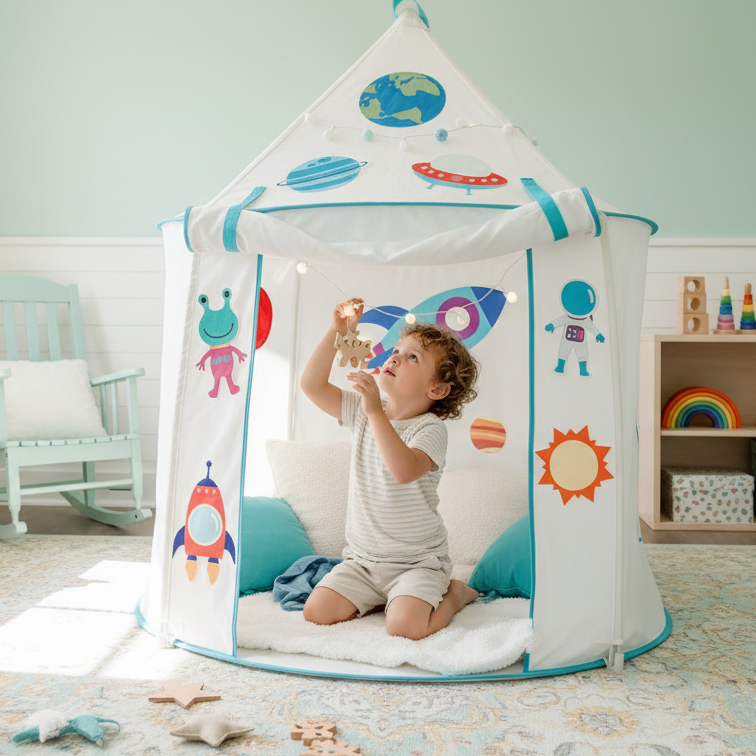
This philosophy is at the heart of ZeeZee Adventures. Instead of encouraging one fixed storyline, the play environment is designed to adapt to whatever children imagine. Interchangeable StickeeZ themes—from dinosaurs and outer space to magical kingdoms and underwater adventures—allow the same familiar space to become something entirely new as children's interests evolve. Combined with everyday materials like blankets, cardboard boxes, flashlights, or stuffed animals, these adaptable environments encourage children to create their own characters, invent challenges, and shape every adventure themselves.
Because imagination grows strongest when children aren't told what to think.
They're trusted to discover it on their own.
In the final section, we'll explore common myths about imaginative play, answer parents' most frequently asked questions, provide an easy action checklist, and summarize the simple ways adults can encourage creativity by stepping back instead of taking over.
Myth vs. Fact
|
Myth |
Fact |
|
Good parents should constantly entertain their children. |
Children develop stronger creativity when they're given time and space to create their own ideas rather than being continuously entertained. |
|
If my child says they're bored, I've failed to keep them engaged. |
Boredom is often the beginning of imagination. Many of the best play ideas emerge after children have time to wonder and think. |
|
Adults need to teach children how to pretend. |
Most children naturally develop imaginative play when they have open-ended materials, uninterrupted time, and supportive adults who follow their lead. |
|
More instructions make play more educational. |
Child-led play strengthens problem-solving, executive functioning, creativity, and decision-making because children generate the ideas themselves. |
|
Joining pretend play means becoming the leader. |
Parents are often most helpful when they become supporting characters instead of directing the story. |
Action Checklist
Use this simple checklist to encourage child-led imaginative play every day.
✅ Pause before offering suggestions.
✅ Replace directions with open-ended questions.
✅ Give your child time to think before stepping in.
✅ Welcome boredom as part of the creative process.
✅ Keep a basket of open-ended materials available.
✅ Follow your child's story—even when it seems unusual.
✅ Let children solve manageable problems independently.
✅ Join play only when invited.
✅ Praise creativity, persistence, and problem-solving instead of perfect outcomes.
✅ Leave unfinished creations out so stories can continue tomorrow.
Remember:
The goal isn't to create better stories for your child.
It's to help your child believe they can create wonderful stories on their own.
Frequently Asked Questions
Should I play with my child or let them play alone?
Both are valuable.
Independent imaginative play helps children develop confidence, problem-solving, and creativity.
Playing together strengthens connection and communication.
When you join, allow your child to remain the leader of the story while you take on a supporting role.
What if my child always asks me what to do?
This is common, especially if children are used to adult-led activities.
Instead of immediately giving ideas, respond with gentle curiosity.
You might ask:
-
"What do you think could happen?"
-
"What would your character do?"
-
"What sounds fun to you?"
At first, your child may hesitate.
With time, they'll become more comfortable generating their own ideas.
Is boredom actually good for children?
Yes.
Boredom provides an opportunity for children to practice independent thinking.
When adults don't immediately provide entertainment, children begin exploring their own interests, asking questions, and creating original ideas.
Those moments often become the beginning of imaginative play.
What if my child doesn't seem imaginative?
Every child expresses creativity differently.
Some immediately invent elaborate fantasy worlds.
Others enjoy realistic role-play like grocery stores, restaurants, or caring for stuffed animals.
Rather than expecting dramatic pretend play, focus on providing open-ended materials and following your child's interests.
Imagination grows with opportunity, not pressure.
How long should imaginative play last?
There isn't a perfect amount.
Some children become deeply engaged for fifteen minutes.
Others may spend an hour or more developing the same story.
Quality matters far more than duration.
The key is protecting uninterrupted periods where children can remain immersed in their ideas.
How can I encourage imaginative play if my child prefers screens?
Instead of removing screens without a plan, create attractive alternatives.
Leave simple materials available.
Protect daily screen-free time.
Model curiosity.
Invite play without forcing it.
Children are often more willing to explore imaginative activities when they feel ownership over the experience rather than being directed toward it.
Final Thoughts
One of the most surprising lessons about imaginative play is that helping less often accomplishes more.
As adults, we naturally want to encourage.
To teach.
To inspire.
To make play more exciting.
Those instincts come from love.
But imagination grows differently.
It grows when children have permission to think for themselves.
When they invent implausible stories.
When they solve problems no adult created.
When they discover ideas that surprise even them.
Our role isn't to provide every adventure.
It's to create the conditions where adventures can happen.
Sometimes that's a basket of simple materials.
Sometimes it's a quiet afternoon without a schedule.
Sometimes it's choosing curiosity instead of instruction.
The next time your child begins building something unusual, pause before offering an idea.
Instead, watch.
Listen.
Wonder.
You may discover that their imagination is capable of taking the story somewhere far more creative than you ever expected.
Children don't need adults to write better stories.
They need adults who trust that their own stories are worth telling.
And perhaps that's one of the greatest gifts we can give them—not another activity, another toy, or another suggestion.
But the confidence to believe:
"My ideas matter."
Because when children trust their own imagination, they aren't just creating stories.
They're building the creativity, confidence, resilience, and problem-solving skills they'll carry with them for the rest of their lives.





Comment (0)