
Why Pretend Play Is Essential for Child Development
Introduction
A cardboard box becomes a spaceship.
A blanket becomes a castle.
A wooden spoon becomes a magic wand.
A child picks up a toy phone and begins having a very serious conversation with someone who exists entirely in their imagination.
To an adult, it can look like simple make-believe.
But something much more interesting is happening.
Through pretend play, children experiment with ideas, practise different roles, recreate experiences and explore possibilities that do not exist in the physical world. They are not simply passing the time. They are using play to make sense of the world around them.
The American Academy of Pediatrics describes play as an important part of children's cognitive, physical, social and emotional development, and specifically notes that pretend play can involve experimenting with social roles, negotiating imaginary situations and using increasingly sophisticated language.
At the same time, it is important to be precise about what research can and cannot tell us. Pretend play is strongly associated with several positive developmental outcomes, but researchers do not consider every benefit to be proven as a direct causal effect of pretend play alone. A major review of the evidence found that the evidence for direct causal effects on language, emotion regulation, executive function, and social skills was still insufficient or mixed.
That nuance does not make pretend play less valuable.
It makes the conversation more useful.
Pretend play is one part of a rich developmental environment that gives children opportunities to communicate, cooperate, imagine, practise self-regulation and explore their own interests.
And importantly, children do not need elaborate toys or perfectly designed activities to experience it.
Sometimes all they need is time, space and permission to imagine.
Quick Answer
Pretend play supports child development by giving children opportunities to use language, explore social roles, practise problem-solving, express ideas and experiment with emotions in a low-pressure setting. It can also encourage cooperation and perspective-taking when children play together. Research supports a positive relationship between pretend play and several developmental skills, although it is more accurate to view pretend play as one valuable part of a broader developmental environment rather than a single cause of healthy development.
Key Takeaways
-
Pretend play allows children to explore ideas, roles, and experiences through imagination.
-
It creates natural opportunities for language and storytelling.
-
Social pretend play involves cooperation, negotiation and perspective-taking.
-
Children can use imaginary scenarios to explore feelings and difficult experiences.
-
Open-ended environments give children greater freedom to direct their own stories.
-
Pretend play is valuable, but it works alongside many other forms of play and learning.
What Is Pretend Play?
Pretend play is a form of play in which children use objects, actions, language or imagination to represent something that is not literally happening.
A child might hold an empty cup and pretend to drink tea.
They might use a cardboard box as a car.
They might pretend to be a doctor, teacher, parent, astronaut or shopkeeper.
As children develop, these scenarios can become increasingly elaborate. They may create characters, establish imaginary rules, assign roles to other children and develop entire stories that continue across several play sessions.
This is sometimes called symbolic or imaginative play because children are using one thing to represent another.
The important point is that the child is creating meaning.
The box does not need to look like a spaceship.
The child decides that it is one.
That ability to give objects and situations new meaning is one of the fascinating features of pretend play.
When Does Pretend Play Begin?
Pretend play develops gradually rather than appearing at one particular age.
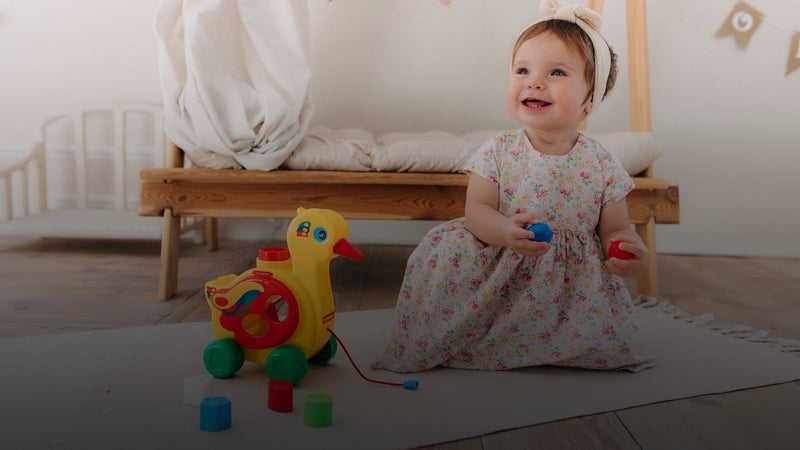
Toddlers may begin with very simple forms of pretending, such as pretending to drink from an empty cup, feeding a doll, or copying familiar household routines.
As children become older, their play often becomes more complex.
A simple pretend meal can turn into a restaurant.
The restaurant can become a hotel.
The hotel can become part of a whole imaginary town.
The American Academy of Pediatrics recommends providing young children with opportunities to create make-believe situations and, for older preschool children, giving them time and space to act out imaginary scenes, roles, and activities.
There is no need to rush this progression.
Children develop at different rates, and pretend play can look very different from one child to another.
Why Pretend Play Matters
Pretend play is valuable partly because it allows children to experiment without the consequences of real-world mistakes.
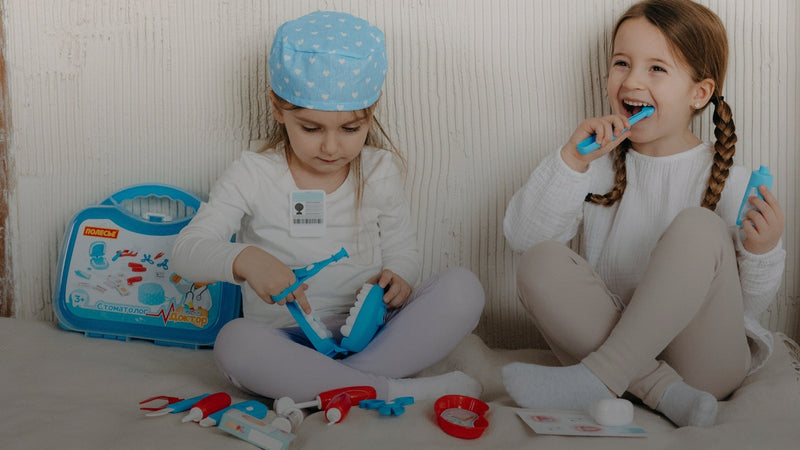
A child can become the doctor without actually being responsible for someone's health.
They can become the teacher without managing a real classroom.
They can pretend to be a parent, shopkeeper, firefighter, or astronaut.
These imaginary roles give children a safe space to explore how different people behave and communicate.
The AAP notes that social and pretend play can involve experimenting with social roles, negotiating imaginary rules and using more sophisticated language to establish shared scenarios.
This makes pretend play much more than fantasy.
It becomes a rehearsal space for understanding people, relationships and possibilities.
Expert Insight
Pretend play is best understood as one part of a wider developmental picture.
Research does not support the idea that pretend play alone automatically produces every developmental benefit sometimes attributed to it. However, pretend play creates rich opportunities for children to practise skills such as communication, cooperation, symbolic thinking and self-regulation. The strongest developmental environment is one that gives children access to varied forms of meaningful play.
Pretend Play and Language Development
Imagine two children playing restaurant.
One says, "What would you like?"
The other replies, "I want a sandwich, but no tomatoes."
Suddenly they are using language for a purpose.
They need to explain what they want.
They need to listen.
They need to respond.
They may create menus, invent names for dishes, and develop increasingly elaborate conversations.
Pretend play naturally creates these opportunities because children need language to build their imaginary worlds.
The AAP notes that pretend play can encourage children to use words and narratives to imitate, describe and explore experiences.
This is one reason pretend play can be especially valuable when adults resist the temptation to take over the conversation.
Instead of telling children what their story should be, parents can listen, respond and occasionally ask open questions.
"What happens next?"
"Where are you going?"
"Who is coming to the shop?"
The child remains the storyteller.
Pretend Play and Social Skills
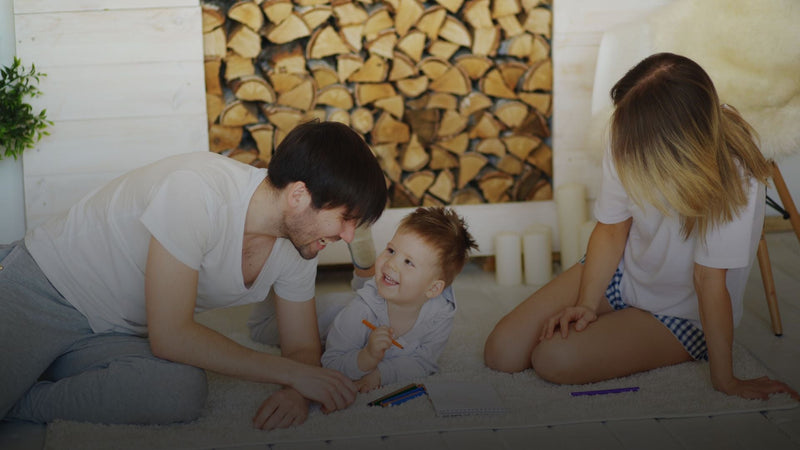
Pretend play becomes particularly interesting when children play together.
Two children rarely imagine exactly the same thing.
One wants to be the doctor.
The other wants to be the patient.
Someone wants the red cup.
Someone else has decided the red cup is the telephone.
Now they have to negotiate.
This process can be challenging, but it is also developmentally meaningful.
Children learn to explain their ideas, listen to other perspectives, compromise and establish shared rules.
A 2024 meta-analysis of 34 studies involving children aged 3 to 8 found a positive relationship between pretend play and social competence, with the quality of pretend play appearing more important than simply how much pretend play occurred.
That distinction is useful for parents.
More pretend play is not necessarily better.
Rich, engaged, and meaningful play may matter more than simply counting minutes.
Pretend Play and Emotional Understanding
Children experience big emotions long before they have the vocabulary to explain them.
Pretend play gives them another way to explore those experiences.
A child might make a teddy bear cry because it cannot find its parent.
Another might pretend a doll is frightened about going to school.
A child may create a superhero who defeats a monster.
These stories can provide opportunities to explore fear, separation, frustration, bravery and comfort.
The AAP specifically notes that pretend play can help young children learn about difficult feelings such as anger and fear.
This does not mean every pretend game is a form of therapy.
It simply means that imagination gives children a flexible language for exploring experiences that can sometimes be difficult to discuss directly.
Pretend Play and Executive Function
Pretend play can also involve a surprising amount of mental organisation.
Imagine a child playing "school".
They need to remember who is the teacher.
They need to follow the rules they've invented.
They may have to wait for another child to finish speaking.
They need to shift between different roles.
They may need to change the story when something unexpected happens.
These are demanding cognitive processes.
A 2026 meta-analysis of 26 studies found a significant relationship between pretend play and executive functions in early childhood, while noting that executive functions and pretend play are related rather than establishing that pretend play alone causes improvements in executive function.
This is an important distinction.
Pretend play may provide valuable opportunities to practise executive functioning, but children develop these skills through a broad range of experiences.
The Power of Open-Ended Materials
The best pretend-play materials do not always look like pretend-play toys.
A cardboard box can become almost anything.
A scarf can become a cape.
A wooden spoon can become a microphone.
A few cushions can become a mountain.
Open-ended materials are powerful because they leave room for the child to decide what happens next.
This is very different from a toy that performs a predetermined action every time a button is pressed.
Neither type of toy is automatically "good" or "bad".
But open-ended materials give children more responsibility for creating the experience.
And that is where imagination gets interesting.
Practical Ways to Encourage Richer Imaginative Play
Pretend play does not need to be complicated.
In fact, some of the richest imaginative experiences begin with very ordinary objects and a child who has enough time to decide what those objects could become.
A cardboard box can become a train. A blanket can become a cave. A few cushions can become a mountain range. A wooden spoon can become a microphone, a magic wand or a doctor's instrument.
The important part is not the object itself.
It is the child's opportunity to decide what happens next.
Pretend Play Ideas for Toddlers
Toddlers are still developing their ability to create longer, more organised imaginary stories, so pretend play at this age is often closely connected to experiences they see every day.
They may feed a teddy bear, pretend to cook dinner or put a doll to bed.
These simple scenarios are valuable because children are beginning to represent familiar experiences through play.
Create a Pretend Kitchen
You do not need a complete play kitchen.
A few safe household objects can be enough.
A wooden spoon, plastic bowls, empty food containers, and a tea towel can become the ingredients for an imaginary restaurant.
Allow your toddler to decide what they are cooking.
You can play along without controlling the story.
Instead of saying, "Now we're going to make soup," try asking, "What are you making?"
That small difference gives your child ownership of the story.
Play Doctor or Vet
A soft toy, a small blanket and a toy or household container can create a simple pretend clinic.
Your toddler might examine a teddy bear, give it medicine or decide that it needs to rest.
This type of play can help children recreate familiar experiences while practising communication and sequencing.
Pretend to Go Shopping
Give your child a small basket and a few safe household items.
They can choose what to "buy", organise their shopping and bring it to a pretend checkout.
As children become more familiar with the game, they may begin creating their own rules and conversations.
Pretend Play Ideas for Preschoolers
Preschoolers often begin creating more elaborate imaginary situations.
Their stories may involve several characters, different locations, and rules that they establish themselves.
This is a wonderful stage for giving children open-ended materials and enough uninterrupted time to develop their ideas.
Build a Pretend Camp
Use blankets, cushions and chairs to create a simple indoor campsite.
Your child might decide where the camp is located, who is travelling with them and what happens during the adventure.
You can provide the materials without deciding the story.
Create a Restaurant
A few plates, cups, paper and crayons can become a pretend restaurant.
Your child might design a menu, take orders and prepare imaginary meals.
This creates natural opportunities for conversation, storytelling and role play.
Turn the Garden Into an Adventure
Outdoor spaces can become anything a child imagines.
A garden might become a jungle.
The local park might become an archaeological expedition.
A walk might become a search for hidden treasure.
The less adults define the experience, the more opportunities children have to develop their own ideas.
How Parents Can Encourage Pretend Play Without Taking Over
This can be surprisingly difficult.
When adults see children playing, we naturally want to join in.
Sometimes we even start directing the story without realising it.
We might tell children what character to play, what should happen next or how the game should work.
There is nothing wrong with joining children's play.
The important thing is to leave enough space for them to remain the authors.
Try following their ideas instead of introducing your own.
If your child says, "We're going to the moon," resist the urge to explain how rockets work.
Instead, ask:
"What do we need to take with us?"
If they say, "You're the customer," become the customer.
If they decide the sofa is a spaceship, accept the rules of their imaginary world.
Your role is to support the story, not write it.
Give Children Props, Not Scripts
One of the most effective ways to encourage pretend play is to provide objects that can be interpreted in different ways.
A scarf can become a cape.
A cardboard tube can become a telescope.
A blanket can become a river.
A wooden box can become a treasure chest.
These objects are valuable precisely because they do not tell children what to do.
They invite interpretation.
This is why open-ended materials can have such lasting play value.
The same object can support dozens of different stories as a child's interests and abilities change.
Pretend Play and Independent Play
Pretend play does not always need an audience.
Children can develop elaborate imaginary worlds on their own.
A child might spend twenty minutes talking to toy animals, creating a story with dolls or building a small village with blocks.
This kind of independent pretend play gives children opportunities to make decisions without relying on an adult to provide the next idea.
It can also create space for children to practise concentration and creative problem-solving.
Parents do not need to fill every silence.
Sometimes the most supportive thing we can do is allow the story to belong entirely to the child.
Expert Insight
The adult's role is often to provide the conditions for play rather than control the outcome.
Child development experts generally encourage parents to follow children's interests during play, respond to their ideas, and allow them opportunities to lead. This does not mean adults should never participate. Instead, it means participation should support children's agency rather than replacing it.
What If My Child Doesn't Like Pretend Play?
Not every child will engage with pretend play in the same way.
Some children naturally invent elaborate stories.
Others prefer building, drawing, puzzles, sensory exploration, or physical play.
There is no need to force a child into a particular style of play.
Instead, observe what interests them.
If your child loves animals, introduce animal figures.
If they enjoy vehicles, provide cardboard boxes and ramps.
If they love books, encourage them to recreate favourite stories.
If they enjoy building, let the structures become part of an imaginary world when they are ready.
Pretend play often grows naturally when children have materials connected to their existing interests.
Common Mistakes Parents Make
Making the Story Too Complicated
Adults sometimes create elaborate play setups with too many props and instructions.
Children may actually prefer a simpler environment.
A few carefully chosen objects can provide more imaginative freedom than an entire room filled with themed toys.
Correcting the Story
If your child tells you that elephants can fly, there is no need to correct the science.
Pretend play is not a factual lesson.
The child is exploring possibilities.
There is a difference between imagination and misinformation, and pretend play provides a safe space where children can experiment with ideas.
Asking Too Many Questions
Questions can support language and storytelling, but constant questioning can interrupt the flow of play.
Instead of turning play into an interview, listen.
Comment occasionally.
Follow your child's lead.
Let moments of silence exist.
Expecting Children to Play Like Adults
Children's imaginary worlds rarely follow adult logic.
A dinosaur may attend school.
A teddy bear may become a doctor.
A cardboard box may be a submarine and a castle within the same afternoon.
That flexibility is part of the joy.
Creating an Environment That Invites Imagination
A child does not need an enormous playroom to develop imagination.
A small, predictable space can sometimes be enough.
Choose an area where your child can access a few open-ended materials independently.
Books can sit nearby.
Blankets can become forts.
Blocks can become buildings.
Art supplies can become props for stories.
The environment should feel inviting without telling children exactly how they are supposed to play.
This is particularly valuable for independent play.
When children know that a space belongs to them, they may feel more comfortable returning to ideas, continuing stories, and developing their own routines.
How ZeeZee Adventures Supports Pretend Play
A thoughtfully designed play environment can give children something extremely valuable: a place where imagination feels natural.
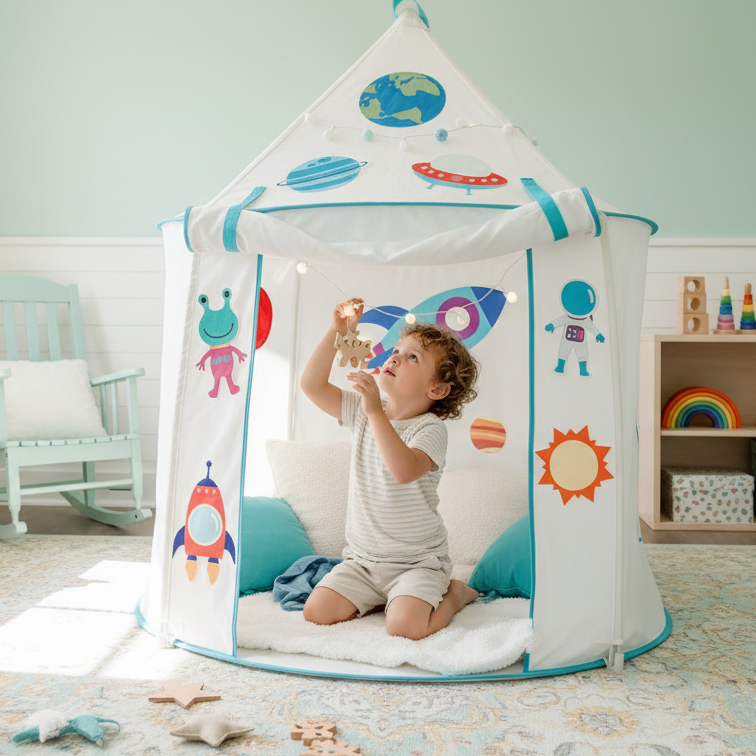
The ZeeZee Adventure Tent was inspired by two sisters who wanted a play tent that could change alongside their imaginations. Its interchangeable StickeeZ themes allow children to transform the same familiar space into different imaginative settings, creating opportunities for storytelling, role play, and child-led exploration.
The tent can become a castle one day and a jungle expedition the next. Because the environment can change without replacing the entire play space, children can return to familiar surroundings while creating completely different narratives. This supports the kind of open-ended exploration that gives pretend play its flexibility and long-term value.
For parents, the value is not simply having another place for children to sit and play. It is creating an environment where children can step away from constant digital stimulation, enter their own imaginative worlds and decide what happens next.
Conclusion
Pretend play may look like a child simply making things up.
But behind the imaginary tea parties, superhero missions, pretend shops and cardboard-box spaceships, children are practising how to understand their world.
They are experimenting with language.
They are exploring relationships.
They are testing ideas.
They are creating stories.
They are learning to negotiate.
And sometimes, they are finding a safe way to express feelings that are difficult to put into words.
That does not mean every pretend-play session needs to become a developmental exercise. In fact, turning play into a lesson can take away some of the freedom that makes it valuable in the first place.
Children need room to play simply because they want to.
The most helpful thing parents can often do is provide time, space, and materials that invite imagination, then follow the child's lead.
A blanket does not need to become a prescribed activity.
A cardboard box does not need instructions.
A play tent does not need a script.
Give children the opportunity to decide what these things become.
That is where imagination begins to take ownership.
And perhaps this is one of the most important lessons about pretend play.
Children do not need adults to create every adventure for them. They need enough freedom to create some adventures themselves.
A Simple Pretend Play Checklist for Parents
You do not need an elaborate playroom or a large collection of toys to encourage imaginative play.
Start with the environment you already have and make small changes that give your child more freedom to create.
Create opportunities for imagination
☐ Keep a small selection of open-ended materials accessible.
☐ Provide books that can inspire stories and role play.
☐ Keep blankets, cushions and safe household objects available for imaginative use.
☐ Allow children to transform their play space.
☐ Give them uninterrupted time to develop their own ideas.
Follow your child's lead
☐ Ask your child what they are imagining.
☐ Follow their story rather than directing it.
☐ Join their game when invited.
☐ Avoid correcting imaginary scenarios.
☐ Leave space for quiet, independent play.
Encourage richer play naturally
☐ Introduce props connected to your child's interests.
☐ Use everyday experiences as inspiration for pretend play.
☐ Encourage storytelling around familiar books.
☐ Allow children to revisit favourite imaginary worlds.
☐ Focus on enjoyment rather than measuring developmental outcomes.
Frequently Asked Questions
1. Why is pretend play important for child development?
Pretend play gives children opportunities to practise language, explore social roles, develop stories, solve problems and experiment with ideas. It can also provide opportunities to explore emotions and practise cooperation when children play together.
2. What age does pretend play begin?
Pretend play develops gradually. Toddlers may begin with simple actions such as pretending to feed a doll or drink from an empty cup. As children develop, their imaginary scenarios can become increasingly complex.
3. Does pretend play improve language development?
Pretend play creates rich opportunities for children to use language in meaningful contexts. Children may need to explain roles, describe imaginary situations, create narratives and communicate with other players. However, pretend play should be considered one part of a wider language-rich environment.
4. Can pretend play help children understand emotions?
It can provide opportunities for children to explore feelings through imaginary characters and situations. A child might use a doll or stuffed animal to act out experiences involving fear, sadness, frustration, or excitement.
5. Should parents join their children's pretend play?
Yes, when children want you to participate. The most supportive approach is often to follow their ideas rather than taking control of the story. Comment on what they are doing, respond to their ideas, and allow them to remain the leader of the imaginary world.
6. What are the best toys for pretend play?
There is no single best pretend-play toy. Open-ended materials such as dolls, animal figures, blocks, costumes, blankets, cardboard boxes, art materials, and simple props can all inspire imaginative play.
7. What if my child prefers other types of play?
That is completely fine. Children have different interests and strengths. Building, drawing, sensory exploration, physical activity, and puzzles are also valuable forms of play. Pretend play should be encouraged rather than forced.
Internal Linking Suggestions
This article can become part of a strong ZeeZee Adventures content cluster around imagination, independent play, and child development.
Recommended internal links include:
-
The Benefits of Open-Ended Play for Child Development
-
How Montessori Play Encourages Independence
-
What Is Montessori Play? Everything Parents Should Know
-
Montessori Play Ideas You Can Try at Home Today
-
Why Screen-Free Play Improves Focus and Creativity
-
50 Screen-Free Activities Kids Will Actually Love
-
How to Keep Kids Entertained Without Screens
These articles can be connected naturally throughout the site rather than added simply for SEO. For example, the section discussing independent pretend play can link to the independent-play content, while the section on open-ended materials can introduce the article about open-ended play.
Author Bio
The ZeeZee Play Experts
The ZeeZee Play Experts are dedicated to helping families create calmer, more imaginative childhoods through purposeful play. Drawing on insights from child development, occupational therapy, and early childhood education, they create practical, evidence-informed resources for parents. Their work focuses on helping children develop confidence, creativity and independence through meaningful, screen-free play experiences.
Call to Action
More Ideas for Imaginative, Screen-Free Play
Pretend play does not need complicated instructions or expensive equipment. Discover more practical ways to encourage creativity, independent play, and imagination in everyday family life.
Create a World They Can Imagine
The ZeeZee Adventure Tent provides children with a dedicated space where stories can begin and change as their imagination develops. With interchangeable StickeeZ themes, the same play environment can become a castle, jungle, space station or quiet reading retreat, giving children opportunities to create their own narratives rather than simply follow a predetermined activity.
See How Families Encourage Imagination
Discover how families are creating calm, inviting play environments where children can step away from screens, explore their imagination, and enjoy more independent, child-led adventures.



Comment (0)