
40 Toddler Activities That Boost Learning Through Play
Simple, screen-free ideas that turn everyday moments into opportunities for toddlers to explore, create, communicate, and grow.
Introduction
Toddlers are natural learners.
They touch, carry, stack, pour, scribble, imitate, and ask questions because they are constantly trying to understand the world around them. What looks like ordinary play to an adult can involve a surprising amount of learning for a young child.
A toddler pouring water from one cup into another is exploring cause and effect. A child sorting socks is noticing similarities and differences. Pretending to feed a toy animal can involve language, imagination, and social understanding.
This is why learning through play does not need to look like a lesson.
For toddlers, some of the richest learning experiences are playful, hands-on and connected to everyday life.
The aim is not to turn every activity into an educational exercise. It is to give children opportunities to explore at their own pace, follow their interests and practise emerging skills in ways that feel enjoyable and meaningful.
The 40 activities in this guide are designed around that principle. They use simple materials, everyday objects and familiar experiences to support different areas of toddler development while leaving plenty of room for imagination.
Quick Answer
The best toddler learning activities are simple, hands-on and playful. Activities such as sorting, pouring, building, drawing, singing, pretend play, water exploration, and nature walks can support language, fine motor skills, problem-solving, creativity, movement, and independence. Toddlers learn best when adults provide safe opportunities to explore rather than turning every activity into a structured lesson.
Key Takeaways
-
Toddlers learn through active exploration, repetition, and play.
-
Everyday household activities can provide meaningful learning opportunities.
-
Open-ended activities allow children to make choices and develop their own ideas.
-
Different types of play support different developmental skills.
-
Parents do not need complicated equipment or elaborate activities to support learning.
What Does Learning Through Play Mean?
Learning through play means children develop knowledge and skills while actively engaging with people, objects, and their environment.
For toddlers, this often happens naturally.
They do not need to know that they are practising coordination when they stack blocks. They simply want to see how high the tower can go.
They are not thinking about vocabulary development when they pretend to feed a teddy. They are simply acting out an experience they understand.
The learning happens through the experience.
This is why play should remain enjoyable rather than becoming another source of pressure for parents.
Child development experts generally agree that young children benefit from opportunities to explore, interact, move, communicate and practise new skills through developmentally appropriate play.
40 Toddler Activities That Support Learning
Rather than treating these as lessons to complete, think of them as invitations.
Choose the activities that match your child's current interests and abilities. Some may hold their attention for five minutes. Others may become favourites for weeks.
There is no need to complete all 40.
Fine Motor Skills and Hands-On Exploration
Fine motor development involves the smaller movements of the hands and fingers. Toddlers practise these skills constantly through everyday activities such as picking objects up, turning pages, drawing and manipulating toys.
The following activities give children opportunities to strengthen hand control while exploring simple concepts.
1. Stack the Blocks
Give your toddler a collection of large, age-appropriate blocks and invite them to build a tower.
Let them experiment with different arrangements.
Learning through play: coordination, balance, spatial awareness, and problem-solving.
Try this: Ask, "What happens if we put the big block at the bottom?"
2. Transfer Objects
Place large, safe objects in one container and provide another nearby.
Invite your child to move the objects from one container to the other.
Learning through play: hand-eye coordination, concentration, and controlled movement.
Use objects that are appropriate for your child's age and avoid anything that could present a choking hazard.
3. Peel and Stick
Offer large reusable stickers or age-appropriate adhesive materials.
Let your toddler peel them and place them on paper.
Learning through play: finger strength, coordination and visual-motor skills.
4. Thread Large Objects
Using an age-appropriate threading activity, invite your child to place large pieces onto a suitable cord or threading material.
Learning through play: hand coordination, concentration and sequencing.
Always supervise closely and choose materials designed for your child's age.
5. Scribble Studio
Put out paper and washable crayons and let your toddler experiment with marks.
There is no need to ask them to draw a particular object.
Learning through play: hand control, early mark-making and creative expression.
6. Play With Modelling Dough
Give your toddler child-safe modelling dough and encourage them to squeeze, roll, flatten and pull it.
Learning through play: hand strength, sensory exploration and creativity.
7. Simple Shape Sorting
Offer a suitable shape sorter or a small collection of large objects with clear differences.
Encourage your toddler to explore where different pieces belong.
Learning through play: visual discrimination, problem-solving and early spatial reasoning.
8. Tear and Stick Collage
Give your child suitable pieces of paper and let them tear or place them onto another sheet.
Learning through play: fine motor control, creativity and decision-making.
The finished collage does not need to look a particular way.
Language and Communication Through Play
Toddlers are developing language rapidly, and everyday play provides countless opportunities to hear new words and practise communication.
You do not need flashcards or formal language lessons.
Talking about what your child is already doing can be incredibly valuable.
Describe actions.
Ask questions.
Follow their interests.
Give them time to respond.
9. Picture Book Detective
Choose a familiar picture book and look through the pages together.
Instead of reading every word, talk about what you can see.
"Where is the dog?"
"What is the girl holding?"
Learning through play: vocabulary, attention, listening and communication.
10. Sound Hunt
Choose a familiar sound and explore where it comes from.
It might be a ticking clock, a bird outside, or water running.
Learning through play: listening, attention and environmental awareness.
11. Sing and Stop
Sing a familiar children's song and occasionally pause.
Give your toddler an opportunity to continue the next sound or word.
Learning through play: memory, language, anticipation, and participation.
12. Animal Talk
Use toy animals or pictures and make different animal sounds together.
Then introduce simple descriptive words.
"The cow is big."
"The duck is swimming."
Learning through play: vocabulary, imitation, and early sentence development.
13. What Is Missing?
Place a few familiar objects together.
Let your child look at them.
Then remove one while they are not looking and ask what has disappeared.
Learning through play: memory, attention, and vocabulary.
Keep it simple for younger toddlers.
14. Story Basket
Put a few familiar objects into a basket.
Choose one and create a simple story around it.
Then let your toddler choose another object.
Learning through play: language, imagination and sequencing.
Sensory Play
Sensory experiences are a natural part of toddlerhood.
Children learn by touching, moving, listening, looking, and experimenting with different materials.
Sensory play does not need to involve complicated setups.
Simple experiences can be enough.
Always choose materials that are safe for your child's age and supervise activities appropriately.
15. Water Pouring
Give your toddler a shallow container of water and a few suitable cups.
Let them pour water between containers.
Learning through play: coordination, cause and effect, and concentration.
16. Texture Basket
Collect safe objects with different textures.
Soft fabric.
Smooth wooden objects.
Rough natural materials.
Allow your child to explore them.
Learning through play: sensory discrimination, vocabulary and curiosity.
17. Nature Collection
During a walk, collect safe natural objects such as leaves or large stones.
Talk about their differences.
"This leaf is big."
"This one is smooth."
Learning through play: sensory exploration, observation and early comparison.
18. Squish and Shape
Use child-safe modelling materials and encourage your toddler to create simple shapes.
Learning through play: tactile exploration, hand strength and creativity.
Movement and Gross Motor Play
Toddlers need plenty of opportunities to move.
Running, climbing, balancing, jumping, and carrying all provide valuable physical experiences.
Movement also gives children opportunities to understand how their bodies interact with space.
19. Cushion Obstacle Course
Create a simple course using safe cushions and soft objects.
Invite your toddler to step over, around, or between them.
Learning through play: balance, coordination and body awareness.
20. Animal Walks
Invite your child to move like different animals.
Waddle like a penguin.
Stomp like an elephant.
Crawl like a bear.
Learning through play: gross motor skills, imagination and body awareness.
21. Follow the Leader
Take turns leading simple movements.
Walk.
Clap.
March.
Stretch.
Learning through play: imitation, listening and coordination.
22. Indoor Treasure Hunt
Hide a familiar object somewhere safe and give simple verbal clues.
Learning through play: movement, language, memory and problem-solving.
23. Dance and Freeze
Play music and invite your child to dance.
Pause the music occasionally and freeze together.
Learning through play: rhythm, listening, balance and self-control.
Creativity and Imagination
Creative play gives children opportunities to make choices without worrying about getting the "right" answer.
For toddlers, the process is more important than the final product.
Let them experiment.
Let them make unusual choices.
Let their picture become whatever they want it to become.
24. Paint With Household Objects
Use safe, washable materials and suitable objects to make prints.
For example, a sponge can create different patterns from a brush.
Learning through play: creativity, coordination, and sensory exploration.
25. Sticker Stories
Give your child stickers and paper.
Instead of asking them to create something specific, let them place the stickers wherever they want.
Then ask them what is happening in the picture.
Learning through play: creativity, language and storytelling.
26. Build a Den
Use blankets and cushions to create a simple den.
Your toddler can decide what belongs inside.
Learning through play: imagination, spatial awareness and pretend play.
27. Make a Pretend Shop
Use safe household objects as pretend groceries.
Invite your toddler to play shopkeeper or customer.
Learning through play: language, social interaction and imaginative play.
28. Toy Animal Rescue
Create a simple pretend scenario where animals need help getting home.
Your toddler can decide how to rescue them.
Learning through play: problem-solving, imagination, and empathy.
Early Problem-Solving
Toddlers are constantly experimenting.
What happens if I push this?
Can I fit this object inside that one?
What happens when the tower falls?
These are valuable learning experiences.
Give children enough time to attempt a solution before stepping in.
29. Build and Rebuild
Build a small tower together.
Knock it down.
Build it again.
Learning through play: cause and effect, persistence and coordination.
30. Container Challenge
Offer several suitable containers and objects.
Invite your child to discover what fits inside each one.
Learning through play: spatial reasoning, comparison and problem-solving.
31. Simple Matching Game
Match pairs of familiar objects or pictures.
Start with just a few pairs.
Learning through play: memory, visual recognition and attention.
32. Which One Doesn't Belong?
Place several similar objects together with one noticeably different object.
Ask your toddler to explore the group.
Learning through play: observation, categorisation and early reasoning.
Everyday Independence
Some of the best toddler activities are not really "activities" at all.
They are everyday responsibilities.
Children often enjoy being included in family life because the work has a genuine purpose.
Allow your child to participate safely and at an appropriate level.
33. Wash Fruit
Let your toddler help wash suitable fruit before eating.
Learning through play: practical life skills, sensory exploration and independence.
34. Set the Table
Give your child a simple, safe task such as placing napkins on the table.
Learning through play: responsibility, sequencing and coordination.
35. Match Socks
After laundry, invite your toddler to find pairs of socks.
Learning through play: visual discrimination, matching and participation in household routines.
36. Water the Plants
Give your child a suitable small watering container and supervise the activity.
Learning through play: responsibility, coordination and connection with nature.
Quiet and Independent Play
Not every learning experience needs an adult beside the child.
Toddlers can gradually develop confidence in exploring familiar materials independently.
Start with activities your child already understands.
Stay nearby.
Allow them to take the lead.
Over time, they may become increasingly comfortable directing their own play.
37. Book Basket
Create a small basket containing a few favourite books.
Allow your toddler to choose which one to explore.
Learning through play: early literacy, decision-making and independent engagement.
38. Building Basket
Place a manageable selection of large building materials in an accessible container.
Let your child decide what to create.
Learning through play: creativity, spatial reasoning and independent exploration.
39. Pretend-Play Corner
Create a small area with a few simple pretend-play resources.
Perhaps some soft toys, a blanket, a few safe household props and books.
Then allow your toddler to decide what happens.
Learning through play: imagination, language and independent play.
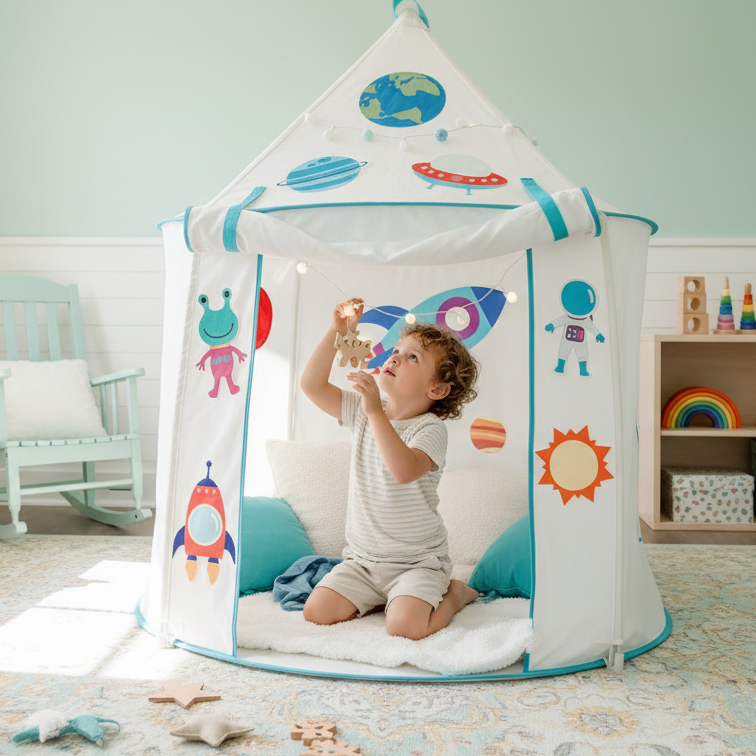
40. Create a Cosy Adventure Space
Give your toddler a dedicated space where they can read, play pretend and create their own stories.
A small play tent, reading nook or cosy corner can become a familiar place for independent exploration.
The space does not need to be complicated.
What matters is that your child knows:
"This is my place to play."
Learning through play: imagination, independence, emotional comfort, and child-led exploration.
The Most Important Part of Every Activity
It is easy to focus on the activity itself.
The materials.
The setup.
The developmental skill.
But there is something more important.
Follow your child's lead.
If they become fascinated by the water during a pouring activity, let them explore the water.
If they turn a matching game into a pretend restaurant, follow the restaurant.
If the carefully planned craft becomes something completely different, let it.
The purpose of play is not to produce the activity you imagined.
It is to give your child an opportunity to explore.
Expert Insight
You do not need to teach during every moment of play.
Parents sometimes feel pressure to ask questions constantly or explain everything their child encounters.
But children also learn through quiet observation and experimentation.
Try describing what your child is doing without turning it into a test.
Instead of asking, "What colour is that?" repeatedly, you might say:
"You've chosen the blue crayon. You're making lots of circles."
This keeps the interaction natural while giving your child language and information to work with.

A Simple Way to Make These Activities More Valuable
You can make almost any toddler activity richer by following three principles.
Follow
Notice what interests your child and build from there.
Wait
Give them time to attempt things before stepping in.
Wonder
Use open-ended comments and questions rather than always providing answers.
For example:
"I wonder where this piece could go."
"What could we build next?"
"I wonder what your animals are doing."
These invitations leave space for your toddler's ideas.
Conclusion
Learning through play does not require a complicated schedule.
It does not require expensive educational toys.
And it certainly does not require parents to become full-time activity planners.
Toddlers are already motivated to learn.
They want to touch.
Move.
Explore.
Copy.
Create.
Ask.
Repeat.
Your role is to provide safe opportunities and enough time for those natural instincts to develop.
Some days, that might mean building a tower.
Other days, it might mean washing fruit together.
Sometimes the best activity may simply be reading the same book for the tenth time.
The goal is not to maximise every minute of learning.
It is to create a childhood where learning and play can naturally exist together.
And you do not need to entertain your child every second.
Give them good materials.
Give them a safe environment.
Give them time.
Then give their imagination room to take over.
Frequently Asked Questions
What are the best learning activities for toddlers?
Simple, hands-on activities such as building, sorting, pouring, drawing, reading, pretend play, sensory exploration, and helping with everyday tasks can support toddler development.
How can I make learning fun for my toddler?
Follow your child's interests and keep activities playful. Avoid turning every activity into a lesson. Allow your toddler to experiment, repeat activities, and make their own choices.
What can toddlers learn through play?
Play can support language, movement, fine motor development, problem-solving, creativity, social understanding, early independence, and emotional development.
Do toddlers need educational toys?
No. Toddlers can learn from everyday objects, household activities, books, outdoor exploration and simple open-ended toys. The experience matters more than whether a product is labelled educational.
How long should a toddler spend on an activity?
There is no single appropriate duration. Toddlers naturally move between activities, and attention spans vary. Allow your child to stop when their interest has moved elsewhere.
How can I encourage independent play?
Start with familiar activities, make appropriate materials accessible, and remain nearby while gradually reducing your involvement. Independent play develops through practice.
Are screen-free activities better for toddlers?
Screen-free activities provide valuable opportunities for physical, social, sensory, and imaginative experiences. They are best viewed as part of a balanced childhood rather than as a requirement to eliminate technology completely.
Internal Linking Suggestions
Consider linking this article naturally to:
-
50 Screen-Free Activities Kids Will Actually Love
-
Why Screen-Free Play Improves Focus and Creativity
-
How to Choose Toys That Encourage Independent Play
-
What Is Montessori Play? Everything Parents Should Know
-
Montessori Play Ideas You Can Try at Home Today
-
How Montessori Play Encourages Independence
-
Why Screen-Free Toys Are Making a Comeback
Author Bio
The ZeeZee Play Experts
The ZeeZee Play Experts are passionate about helping families create calmer, more imaginative childhoods through purposeful play. Drawing on insights from child development, occupational therapy, and early childhood education, they create practical, evidence-informed resources for parents. Their work focuses on sensory-friendly, screen-free play environments that encourage creativity, curiosity and growing independence.




Comment (0)