
Affordable Montessori Play Activities for Toddlers
Introduction
One of the biggest misconceptions about Montessori is that it is expensive.
Search online for Montessori ideas, and you'll quickly find beautifully designed playrooms filled with handcrafted wooden toys, child-sized furniture, and carefully curated learning materials. While these spaces can certainly be inspiring, they often leave parents wondering whether Montessori is only for families with large budgets.
Fortunately, that could not be further from the truth.
The Montessori philosophy has never been about buying expensive products. It is about creating meaningful opportunities for children to learn through everyday life.
A simple jug of water can become a lesson in coordination.
A basket of clean laundry can teach sorting and responsibility.
A spoon, two bowls and a handful of dried pasta can strengthen fine motor skills and concentration.
Children do not learn because an activity is costly.
They learn because it is purposeful.
Toddlers are naturally curious. They want to imitate adults, explore their surroundings and participate in everyday routines. They are far more interested in doing real things than being constantly entertained with new toys.
That is why some of the most effective Montessori activities cost very little or nothing at all.
This guide shares practical, affordable Montessori-inspired activities that you can begin today using items you probably already have at home. These simple experiences will help your toddler develop confidence, independence, and a lifelong love of learning without placing unnecessary pressure on your family budget.
Quick Answer
Affordable Montessori play focuses on meaningful, hands-on experiences rather than expensive materials. Everyday household items such as bowls, spoons, measuring cups, laundry baskets, plants and books can become valuable learning tools. By encouraging toddlers to participate in practical life activities and child-led exploration, parents can nurture independence, concentration and confidence without purchasing specialist Montessori equipment.
Key Takeaways
-
Montessori activities do not require expensive toys or furniture.
-
Household objects often provide excellent opportunities for learning.
-
Practical life activities help toddlers build confidence and independence.
-
Simple, repeatable activities encourage concentration and fine motor development.
-
Creating a Montessori-inspired home is about thoughtful opportunities, not costly purchases.
Definition
What Are Affordable Montessori Activities?
Affordable Montessori activities are simple, purposeful experiences that encourage toddlers to learn through hands-on exploration using inexpensive or everyday household materials. Rather than relying on specialist educational products, these activities focus on developing independence, coordination, concentration, and practical life skills through meaningful participation in everyday family life.
Montessori Was Never Meant to Be Expensive
When Dr Maria Montessori developed her educational philosophy, her focus was not on creating premium toys or beautifully styled playrooms.
Her focus was children.
She observed that young children naturally wanted to explore, imitate adults and master practical skills. Given the right environment and appropriate opportunities, they became deeply engaged in their learning without requiring constant rewards or entertainment.
Over time, Montessori-inspired products have become increasingly popular, leading many parents to believe they need a complete collection of wooden learning materials before they can begin.
In reality, Montessori is not defined by what you buy.
It is defined by how children interact with their environment.
A measuring jug used for pouring water.
A sponge used to wipe a table.
A basket filled with natural objects collected during a walk.
These simple materials often provide richer learning opportunities than expensive toys because they encourage genuine participation in everyday life.
Montessori reminds us that meaningful learning is created through experience, not price.
Why Everyday Objects Make Excellent Learning Tools
Toddlers are fascinated by the things adults use every day.
They want to stir ingredients while cooking.
They want to carry shopping bags.
They want to wipe tables, water plants and help prepare meals.
These activities feel meaningful because they are real.
Unlike many electronic toys that entertain for a short period before losing their appeal, everyday household objects invite children to experiment, repeat and improve their skills over time.
A wooden spoon becomes a tool for transferring objects.
A set of measuring cups introduces size and sequencing.
A laundry basket encourages sorting and organisation.
Children are not concerned with whether an object is labelled "educational".
They are interested in discovering what they can do with it.
This natural curiosity makes everyday household items some of the most valuable Montessori materials available.
Expert Insight
Purpose matters more than price.
Montessori educators often explain that children benefit most from activities that encourage meaningful participation rather than passive entertainment. A simple household object used with intention frequently provides greater developmental value than an expensive toy designed to hold a child's attention for only a few minutes.
Creating a Budget-Friendly Montessori Environment
You do not need to redesign your home to create a Montessori-inspired environment.
Instead, begin by making everyday spaces more accessible to your toddler.
Place a small selection of books on a low shelf.
Keep crayons and paper within easy reach.
Store a few carefully chosen toys in baskets that your child can access independently.
Provide child-sized tools where practical, such as a small jug for pouring water or a lightweight cloth for wiping surfaces.
The goal is not to create a picture-perfect Montessori home.
It is to create an environment where your toddler can explore safely without needing constant adult assistance.
Simple adjustments like these encourage children to make choices, solve problems and participate independently throughout the day.
Practical Life Activities Using Household Items
Practical life is one of the cornerstones of Montessori education because it helps children develop confidence through real participation.
Fortunately, many practical life activities require little more than ordinary household objects.
1. Pouring Water
Fill a small jug with a little water and provide a child-sized cup.
Allow your toddler to pour slowly, accepting that spills are part of the learning process.
This simple activity develops:
-
Hand-eye coordination.
-
Fine motor control.
-
Concentration.
-
Independence.
2. Transferring Objects
Place dried pasta, cotton balls or large pom-poms in one bowl and provide an empty bowl alongside it.
Encourage your toddler to transfer the objects using a spoon.
This activity strengthens fine motor skills while encouraging patience and focus.
3. Wiping a Table
Provide a small cloth and a spray bottle containing a little water.
Toddlers often enjoy helping clean tables after meals.
This practical activity develops coordination while encouraging responsibility.
4. Matching Socks
After laundry, invite your child to find matching pairs of socks.
This inexpensive activity encourages observation, sorting, and early problem-solving skills.
5. Watering Plants
Give your toddler a small watering can and allow them to care for indoor plants.
Looking after living things helps children develop responsibility while strengthening gentle, controlled movements.
Affordable Sensorial Activities
Montessori also encourages children to refine their senses through direct exploration.
These activities do not require specialist sensory equipment.
Nature and household objects provide everything needed.
6. Mystery Bag
Place familiar objects inside a cloth bag.
Encourage your toddler to identify each object using only their sense of touch.
This activity develops tactile awareness, vocabulary and concentration.
7. Texture Basket
Collect a variety of safe household materials with different textures, such as a sponge, wooden spoon, soft fabric, smooth stone and pinecone.
Invite your child to explore how each one feels.
Discuss words such as smooth, rough, soft and hard to support language development.
8. Colour Sorting
Gather coloured bottle tops, building blocks or fabric scraps.
Invite your toddler to sort them into simple groups.
Sorting activities strengthen observation skills while introducing early mathematical thinking.
Why Repetition Is More Valuable Than Constantly Buying New Toys
Parents sometimes feel pressure to keep introducing new activities to maintain their toddler's interest.
Montessori encourages a different perspective.
Children learn through repetition.
A toddler may happily pour water every morning for several weeks.
They are not repeating the activity because they lack imagination.
They are refining a skill.
Each attempt develops greater control, confidence, and precision.
Rather than constantly purchasing new toys, allow your child the time to master familiar activities.
Meaningful learning often comes from returning to the same experience again and again, gradually discovering new levels of confidence through practice.
Affordable Montessori Activities That Build Fine Motor Skills
Toddlers develop fine motor skills through repeated, purposeful movements rather than complicated exercises.
Simple household objects often provide everything they need to strengthen the small muscles in their hands while improving coordination, concentration and confidence.
The goal is not to complete activities perfectly.
It is to allow children the opportunity to practise, experiment and gradually improve at their own pace.
These affordable activities encourage exactly that.
9. Peg and Clip Practice
Provide a small basket of wooden clothes pegs and the edge of a cardboard box or plastic container.
Encourage your toddler to clip the pegs around the edge.
This activity develops:
-
Hand strength.
-
Finger coordination.
-
Concentration.
-
Bilateral coordination.
10. Posting Coins into a Container
Cut a narrow slot into the lid of an empty container and provide large plastic counters, oversized craft sticks or cardboard discs.
Posting each item through the opening strengthens hand control while encouraging problem-solving.
11. Threading Large Pasta
Use uncooked penne pasta and a piece of thick string or a shoelace.
Invite your toddler to thread each piece carefully.
This simple activity improves:
-
Fine motor control.
-
Hand-eye coordination.
-
Patience.
-
Focus.
12. Tearing and Sticking Paper
Provide old magazines or coloured paper along with child-safe glue.
Allow your child to tear paper into small pieces before sticking them onto card.
Tearing paper naturally strengthens hand muscles needed later for writing.
13. Opening and Closing Containers
Collect a variety of safe household containers with different lids.
Children enjoy opening, closing, twisting and matching lids while developing practical hand skills.
Affordable Language and Communication Activities
Montessori encourages language development through real conversations and meaningful experiences rather than passive learning.
Many of the best language activities cost nothing at all.
They simply require time, curiosity, and interaction.
14. Picture Conversations
Choose a picture book with realistic illustrations.
Instead of reading every word immediately, pause to discuss what your child can see.
Ask simple questions.
"What is the dog doing?"
"What colour is the flower?"
"Can you find the bird?"
These conversations naturally expand vocabulary while encouraging observation.
15. Object Naming Basket
Place a few familiar household objects inside a basket.
Examples might include:
-
Spoon.
-
Cup.
-
Brush.
-
Ball.
-
Toy animal.
Invite your toddler to name each object before describing its colour, size or purpose.
16. Daily Story Time
Reading together remains one of the most valuable Montessori-inspired activities.
Rather than rushing through several books, spend time discussing the story.
Allow your child to turn pages, point at pictures, and ask questions.
The conversation is just as valuable as the story itself.
Affordable Nature-Based Montessori Activities
Nature offers endless learning opportunities without costing anything.
Outdoor exploration encourages observation, movement and curiosity while introducing children to changing seasons and living things.
Unlike many toys, nature constantly provides new experiences.
17. Nature Treasure Hunt
Go for a walk together and collect safe natural objects such as:
-
Leaves.
-
Pinecones.
-
Smooth stones.
-
Feathers.
-
Seed pods.
Once home, encourage your toddler to sort the objects by size, colour or texture.
18. Water and Mud Exploration
Provide a small bucket, cup and spoon outdoors.
Allow your toddler to pour, stir and experiment freely.
Simple water play develops coordination while encouraging scientific curiosity.
19. Cloud Watching
Lie on a blanket together and watch the clouds.
Ask your child what shapes they can see.
Cloud watching encourages language, imagination and careful observation.
20. Leaf Printing
Collect leaves of different shapes before using washable paint to create simple leaf prints.
Children naturally begin noticing patterns while expressing their creativity.
Everyday Household Items That Make Excellent Montessori Materials
Parents are often surprised by how many useful Montessori materials are already available at home.
Instead of purchasing specialist equipment, consider using:
-
Measuring cups.
-
Wooden spoons.
-
Mixing bowls.
-
Small jugs.
-
Egg cartons.
-
Muffin trays.
-
Laundry baskets.
-
Cardboard boxes.
-
Cloth napkins.
-
Empty food containers.
-
Child-safe mirrors.
-
Soft brushes.
-
Sponges.
-
Natural objects collected outdoors.
These familiar items encourage meaningful exploration because they are already part of everyday family life.
Why Less Can Often Be More
Modern childhood is often filled with toys that flash, sing, and offer constant stimulation.
Although these toys may capture attention quickly, they do not always encourage sustained engagement.
Montessori takes a different approach.
Offering a smaller number of carefully chosen activities often allows toddlers to concentrate more deeply.
When children are not overwhelmed by endless choices, they are more likely to repeat an activity, refine their movements, and remain absorbed in their learning.
This slower pace supports concentration while reducing unnecessary distractions.
Parents frequently discover that rotating a few simple activities every week creates far more engagement than continually buying new toys.
Common Mistakes Parents Make When Trying Montessori on a Budget
Many families assume they need to recreate the beautiful Montessori spaces they see online.
Fortunately, that is not necessary.
The philosophy is about purposeful learning, not perfect presentation.
|
Common Mistake |
A Better Approach |
|
Buying expensive Montessori products immediately. |
Start with everyday household objects already available at home. |
|
Offering too many activities at once. |
Introduce a few meaningful activities and allow repetition. |
|
Replacing every traditional toy. |
Keep toys that encourage creativity and purposeful play. |
|
Expecting toddlers to complete activities perfectly. |
Celebrate curiosity, effort and gradual improvement. |
|
Constantly introducing something new. |
Allow children to revisit familiar activities until they feel confident. |
Creating Rich Learning Experiences Without Spending More
The most memorable Montessori experiences rarely come from expensive purchases.
They come from ordinary moments shared together.
Preparing breakfast.
Sorting washing.
Collecting leaves.
Reading stories.
Watering plants.
Watching birds from the window.
These experiences teach children that learning is woven into everyday life rather than limited to special lessons or educational toys.
When parents begin looking at their home through this perspective, they often realise they already possess countless opportunities for meaningful learning.
How ZeeZee Adventures Complements Affordable Montessori Play
Affordable Montessori play is built on the idea that meaningful learning comes from purposeful experiences rather than constantly buying new toys. ZeeZee Adventures reflects this philosophy by offering long-term play value instead of short-lived entertainment.
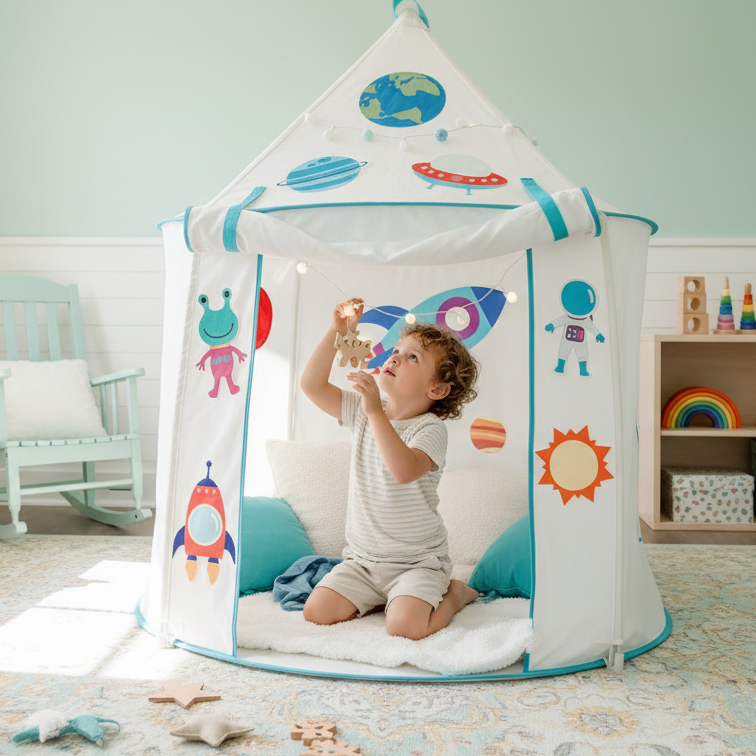
Rather than providing a toy with a single purpose, the ZeeZee Adventure Tent creates a calm, sensory-friendly environment that evolves with a child's imagination. Inspired by two sisters who dreamed of a play tent that could become endless different worlds, its interchangeable StickeeZ themes allow the same play space to transform into a jungle, castle, space mission, or underwater adventure without replacing the entire play environment. This encourages independent exploration, storytelling and creative thinking while providing lasting value for families.
The tent also complements Montessori-inspired homes by giving toddlers a child-sized space where they can read, play quietly, imagine and explore at their own pace. Combined with simple practical life activities and everyday household learning experiences, it helps create a balanced environment where confidence, curiosity and independence naturally grow.

Conclusion
Montessori does not ask parents to spend more.
It asks them to notice more.
Notice the moments when a toddler reaches for a spoon because they want to feed themselves.
Notice their determination to carry a small watering can across the garden.
Notice how proudly they smile after matching a pair of socks or wiping a table for the first time.
These everyday moments are where confidence begins.
One of the greatest misconceptions about Montessori is that meaningful learning depends on expensive wooden toys or beautifully designed playrooms.
In reality, toddlers learn through participation, repetition and purposeful experiences.
A measuring cup can teach coordination.
A basket of laundry can introduce sorting and organisation.
A nature walk can become a science lesson.
A picture book can spark curiosity and conversation.
What matters most is not the cost of the materials.
It is the opportunity they provide for children to explore, make choices and solve problems independently.
Parents often feel pressure to provide the newest educational toy or the latest activity.
Montessori offers a reassuring alternative.
Slow down.
Use what you already have.
Invite your child into everyday life.
Trust their curiosity.
Celebrate their effort.
When toddlers are given meaningful opportunities to participate, they begin developing confidence that extends far beyond childhood.
Remember, you do not need to create the perfect Montessori home.
You simply need to create an environment where your child feels trusted, capable and encouraged to learn through real experiences.
That is something every family can achieve, regardless of budget.
The most valuable gift you can give your toddler is not another toy.
It is the opportunity to discover what they can do for themselves.
Budget-Friendly Montessori Checklist
Use this simple checklist to begin introducing affordable Montessori-inspired learning into your daily routine.
Create a Child-Friendly Environment
☐ Place books on a low shelf where your toddler can reach them.
☐ Store a small selection of toys in accessible baskets.
☐ Keep art materials available for independent creativity.
☐ Use child-sized jugs, bowls and utensils where practical.
☐ Reduce clutter so your child can focus on one activity at a time.
Encourage Practical Life Skills
☐ Allow your toddler to pour their own drink.
☐ Invite them to wash fruit before snack time.
☐ Encourage them to help wipe tables.
☐ Let them water indoor or outdoor plants.
☐ Involve them in simple household routines every day.
Make the Most of Household Items
☐ Use measuring cups for pouring activities.
☐ Create sorting games using socks, bottle tops or kitchen utensils.
☐ Collect natural materials during family walks.
☐ Read together every day using books you already own.
☐ Rotate activities rather than buying new toys frequently.
Support Independent Learning
☐ Allow your toddler to repeat favourite activities.
☐ Give them time to solve simple problems independently.
☐ Celebrate curiosity rather than perfect results.
☐ Offer guidance without taking over.
☐ Remember that confidence develops gradually through practice.
Frequently Asked Questions
1. Can I practise Montessori without buying expensive toys?
Yes. Montessori is based on purposeful learning rather than costly materials. Everyday household items such as bowls, spoons, measuring cups, laundry baskets and books provide excellent opportunities for hands-on learning.
2. What are the best affordable Montessori activities for toddlers?
Simple activities such as pouring water, matching socks, watering plants, transferring objects with a spoon, washing fruit and reading together encourage independence, coordination and concentration while costing very little.
3. How many Montessori toys does my toddler need?
There is no ideal number. A small collection of carefully chosen materials that encourage meaningful engagement is often more beneficial than a large number of toys that quickly become overwhelming.
4. Can I combine Montessori with traditional toys?
Absolutely. Many families successfully combine Montessori-inspired practical life activities with open-ended toys such as blocks, dolls, art materials and pretend play resources.
5. How often should I introduce new activities?
There is no need to introduce something new every day. Toddlers learn through repetition. Allow them to revisit familiar activities until they naturally lose interest or master the skill.
6. Are homemade Montessori activities effective?
Yes. Homemade activities using everyday household objects often provide excellent learning experiences because they encourage real participation and problem-solving.
7. How do I know if an activity is helping my toddler?
A toddler who is deeply engaged will often become calm, focused and willing to repeat an activity several times. These moments of sustained concentration are strong indicators that the activity matches their developmental stage.





Comment (0)