

How Montessori Play Encourages Independence
Introduction
One of the greatest gifts we can give our children is not the ability to do everything for them.
It is the confidence to do things for themselves.
As parents, helping often comes naturally. We tie shoelaces because it is quicker. We pour drinks to avoid spills. We tidy toys because bedtime is approaching. These small acts come from love, yet they can sometimes prevent children from discovering just how capable they really are.
Montessori education invites us to think differently.
Rather than asking, "How can I help my child?" it encourages us to ask, "What can my child do independently if I simply give them the opportunity?"
This simple shift transforms the way children experience everyday life.
They begin preparing their own snacks.
They choose their own books.
They tidy their own play space.
They solve small problems before asking for help.
With every new skill, children gain something far more valuable than the task itself.
They gain confidence.
Independence is not about expecting children to do everything alone. It is about giving them age-appropriate opportunities to participate, make decisions and experience the satisfaction of achieving something through their own effort.
This guide explores why independence is at the heart of the Montessori philosophy, how it supports healthy child development, and practical ways parents can nurture confident, capable children through everyday play and family life.
Quick Answer
Montessori play encourages independence by creating environments where children can make choices, complete meaningful tasks and solve problems at their own pace. Through practical life activities, child-led exploration and carefully prepared spaces, children develop confidence, concentration and self-belief. Rather than doing everything for children, adults provide guidance while allowing them to experience the satisfaction of accomplishing tasks independently.
Key Takeaways
-
Independence develops through everyday opportunities rather than one big milestone.
-
Montessori encourages children to participate in real-life activities from an early age.
-
Small successes help children build lasting confidence.
-
Parents support independence by guiding rather than taking over.
-
A prepared environment makes it easier for children to explore and learn independently.
Definition
What Does Independence Mean in Montessori?
In Montessori education, independence means giving children the opportunity to do as much as they are developmentally capable of doing for themselves. This includes making choices, completing practical tasks, solving problems, and caring for their environment. Independence is viewed as a gradual process that builds confidence, responsibility and a lifelong love of learning.
Why Independence Matters
Children are born with an extraordinary desire to learn.
Long before they understand formal lessons, they are trying to feed themselves, climb stairs, carry objects and imitate the adults around them.
These early attempts are not simply playful experiments.
They are children's way of understanding the world and discovering what they are capable of achieving.
When adults consistently encourage these efforts, children begin to develop a powerful sense of competence.
They learn that challenges can be overcome.
Mistakes become opportunities to improve.
Success comes through persistence rather than perfection.
This confidence extends far beyond practical tasks.
A child who believes they can pour a drink, prepare fruit, or tidy their toys often becomes a child who is also willing to attempt new friendships, solve problems at school, and explore unfamiliar situations with greater confidence.
Independence is not only about learning practical skills.
It is about developing the belief that,
"I can figure this out."
That belief becomes one of the strongest foundations for lifelong resilience.
Expert Insight
Confidence grows through doing, not watching.
Occupational therapists and Montessori educators often observe that children develop stronger self-belief when they are actively involved in meaningful tasks rather than simply observing adults. Every opportunity to complete an age-appropriate activity independently strengthens both practical skills and emotional confidence.
Maria Montessori's Philosophy of Independence
Dr Maria Montessori believed that children possess an innate drive towards independence.
From infancy, they naturally seek opportunities to move, explore and participate in the world around them.
Rather than viewing children as passive learners waiting for instruction, Montessori saw them as active participants in their own development.
This philosophy led to one of Montessori's most famous ideas.
"Never help a child with a task at which he feels he can succeed."
The principle is not about refusing support.
It is about recognising the difference between helping and taking over.
Imagine a child trying to zip their coat.
It may take longer than if an adult simply completed the task.
The zip may catch several times.
There may be moments of frustration.
Yet each attempt strengthens coordination, patience, and confidence.
When the child finally succeeds, they experience something far more meaningful than having a zipped coat.
They experience achievement.
That feeling cannot be given.
It must be earned.
The Role of the Prepared Environment
Montessori often describes the environment as the child's silent teacher.
Rather than constantly reminding children what to do, the environment quietly supports independence.
A low bookshelf allows children to choose their own stories.
Accessible art materials encourage spontaneous creativity.
Hooks placed at child height make it possible to hang up coats without assistance.
Small jugs enable children to pour their own drinks.
Every thoughtful adjustment sends the same message.
"This space belongs to you too."
When children can reach, choose and organise their own materials, they begin making decisions independently throughout the day.
These decisions may seem small.
Together, they build responsibility and self-confidence.
Why Small Responsibilities Matter
Parents sometimes underestimate the importance of everyday household tasks.
Helping set the table.
Watering plants.
Folding tea towels.
Putting books back on a shelf.
To adults, these are ordinary routines.
To children, they are opportunities to contribute.
Being trusted with real responsibilities helps children understand that they are valued members of the family rather than passive observers.
It also encourages a sense of ownership.
Children often take greater pride in environments they have helped care for.
Practical life activities therefore become much more than chores.
They become lessons in responsibility, confidence and belonging.
Common Misconceptions About Independence
Many parents worry that encouraging independence means expecting children to manage without support.
Montessori suggests something quite different.
True independence develops through a balance of guidance and freedom.
|
Myth |
Reality |
|
Independent children should never need help. |
Independence develops gradually with gentle guidance and encouragement. |
|
Helping children is always the best approach. |
Sometimes stepping back allows children to discover their own abilities. |
|
Independence means children do everything alone. |
Adults continue providing emotional support while encouraging practical responsibility. |
|
Children are too young for real responsibilities. |
Even toddlers can participate in meaningful, age-appropriate tasks. |
|
Mistakes should be avoided. |
Mistakes are an essential part of learning and building confidence. |
The Long-Term Benefits of Independence
The skills children develop through independence extend well beyond childhood.
A child who regularly solves problems becomes an adult who approaches challenges with confidence.
A child who learns responsibility through everyday routines often carries that sense of ownership into school, work and relationships.
Independence also supports emotional wellbeing.
Children who trust their own abilities are often more willing to try unfamiliar experiences, recover from setbacks and persevere when something feels difficult.
These qualities cannot be taught through lectures alone.
They grow through repeated opportunities to participate, contribute and succeed.
Montessori reminds us that confidence is built one small experience at a time.
Montessori Activities That Build Independence at Every Age
Independence does not appear overnight.
It develops gradually through everyday experiences that match a child's stage of development. Montessori recognises that children are naturally motivated to do more for themselves as they grow. The role of parents is not to rush this process or hold it back, but to provide opportunities that are challenging enough to encourage growth while still being achievable.
By observing your child's interests and abilities, you can introduce activities that help them develop confidence one small success at a time.
Independence for Toddlers (2 to 3 Years)
Toddlers are determined to do things for themselves.
Although their movements may still be developing, their enthusiasm is remarkable. This is the ideal stage to introduce simple practical life activities that encourage participation rather than perfection.
Let Them Pour Their Own Drink
Provide a small jug containing a little water and a child-sized cup.
At first, there will almost certainly be spills.
That is perfectly normal.
Cleaning up afterwards is simply another part of the learning process.
Rather than rushing to prevent mistakes, allow your child to practise until their movements become more controlled.
Encourage Self-Feeding
Offer child-friendly cutlery and allow toddlers to feed themselves whenever possible.
Although meals may become slightly messier, children develop coordination, confidence and a sense of accomplishment through regular practice.
Invite Them to Tidy Up
Provide baskets or shelves where toys have a clear place.
Instead of tidying everything yourself, encourage your child to return one item at a time.
Simple routines like these help children understand responsibility from an early age.
Let Them Choose
Offer two weather-appropriate outfits or two healthy snack options.
Giving children simple choices encourages decision-making without overwhelming them.
Small choices help children develop confidence in their own judgement.
Independence for Preschoolers (3 to 5 Years)
Preschoolers are capable of far more than many adults realise.
At this age, children enjoy helping with genuine family responsibilities because they feel trusted and included.
Rather than inventing activities solely for learning, invite them into everyday routines.
Preparing Simple Snacks
Children can wash fruit, peel bananas, spread butter on toast or arrange vegetables on a plate using child-safe utensils.
Preparing food strengthens fine motor skills while encouraging independence and responsibility.
Caring for Plants
Watering flowers, checking soil moisture and removing dead leaves help children understand that living things require regular care.
These quiet routines also encourage patience and observation.
Setting the Table
Invite your child to place plates, napkins and cutlery before meals.
They begin recognising patterns, following routines and contributing meaningfully to family life.
Organising Their Belongings
Encourage children to place books back on shelves, hang up coats and organise art materials after using them.
Ownership of their environment often leads to greater pride in caring for it.
Independence for School-Aged Children (6 to 10 Years)
As children become older, independence naturally extends beyond practical tasks.
They become increasingly capable of planning, organising and managing responsibilities with less adult support.
Parents can gradually step back while remaining available for encouragement and guidance.
Planning a Simple Meal
Invite your child to help choose ingredients, prepare lunch or organise a picnic.
Planning encourages decision-making, sequencing and problem-solving.
Managing Personal Belongings
Encourage children to pack their own school bag, prepare clothes for the following day or organise homework materials.
These responsibilities strengthen executive functioning skills while reducing dependence on adults.
Caring for a Small Garden
Whether growing herbs, flowers or vegetables, gardening teaches patience, consistency and responsibility.
Children experience the rewarding connection between regular effort and long-term results.
Completing Small Projects
Building a bird feeder, creating a scrapbook or organising a book collection encourages children to plan, solve problems and complete tasks independently from beginning to end.
These experiences develop perseverance as much as practical ability.
Knowing When to Step In and When to Step Back
One of the greatest challenges for parents is recognising when to help.
Our instinct is often to step in the moment a child struggles.
Montessori encourages a different response.
Pause.
Observe.
Ask yourself whether your child is genuinely unable to continue or whether they simply need a little more time.
A child struggling to fasten a button may not need someone to finish the task.
They may only need encouragement to try once more.
Of course, there are times when support is appropriate.
If frustration becomes overwhelming or safety is a concern, adults should offer guidance.
The goal is not to leave children struggling alone.
It is to avoid solving problems they are capable of solving themselves.
This balance between support and freedom helps children become resilient while knowing they can always rely on trusted adults when needed.
Expert Insight
Independence develops through supported practice.
Occupational therapists often explain that children build confidence when adults provide opportunities that are challenging but achievable. Offering guidance without taking over allows children to develop problem-solving skills while knowing they are supported if they need assistance.
Common Mistakes That Limit Independence
Parents naturally want to protect their children from frustration.
However, some well-intentioned habits can unintentionally reduce opportunities for learning.
|
Common Mistake |
A More Supportive Approach |
|
Completing tasks because it is quicker. |
Allow extra time for children to practise independently. |
|
Correcting every small mistake immediately. |
Give children time to notice and solve problems themselves. |
|
Praising only perfect results. |
Celebrate persistence, effort and progress. |
|
Offering help before it is needed. |
Observe first and ask whether help is actually required. |
|
Expecting independence too quickly. |
Introduce responsibilities gradually according to your child's development. |
Creating a Home That Encourages Independence
Children are more likely to become independent when their environment is designed with them in mind.
This does not require a complete renovation.
Often, a few thoughtful adjustments make a significant difference.
Place books on shelves your child can reach.
Store art materials in clearly labelled containers.
Use child-sized tools where practical.
Provide hooks at child height for coats and bags.
Create routines where children know where things belong.
These simple changes reduce the need for constant adult assistance while encouraging children to make decisions throughout the day.
The environment quietly communicates an important message.
"You are capable of doing this."
How ZeeZee Adventures Supports Independent Play
Montessori encourages parents to prepare environments where children feel confident exploring without constant adult direction.
ZeeZee Adventures embraces this same philosophy by creating a calm, sensory-friendly play space that belongs to the child.
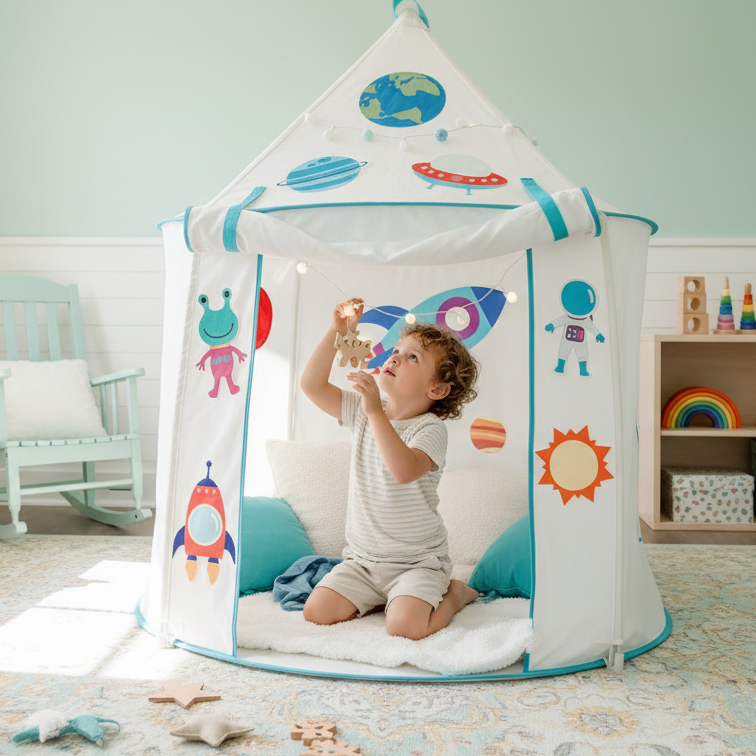
Rather than directing every activity, the ZeeZee Adventure Tent invites children to choose how they want to play. Inspired by two sisters who imagined a play tent that could become countless different worlds, its interchangeable StickeeZ themes allow children to create new adventures based on their own interests. One day it may become a rainforest, the next a castle or a journey into space, encouraging independent decision-making and creative ownership.
This child-led approach complements Montessori principles beautifully. While practical life activities develop competence in everyday tasks, the ZeeZee Adventure Tent extends independence into storytelling, imaginative thinking and self-directed exploration. Its thoughtfully designed sensory-friendly environment gives children a place where they can read, create, imagine and play confidently at their own pace.

Conclusion
Helping children become independent is not about expecting them to grow up too quickly.
It is about recognising that they are capable of far more than we sometimes realise.
Every child begins life with a natural desire to participate. They want to carry, pour, tidy, build, choose and explore. These everyday moments are not simply ways of passing the time. They are opportunities for children to discover what they can achieve through their own effort.
Montessori reminds us that confidence is rarely built through constant praise alone.
It grows through experience.
A child who successfully pours a drink, prepares a snack or tidies their own play space learns something much more valuable than the task itself.
They begin to believe,
"I can do this."
That belief becomes the foundation for resilience, curiosity, and lifelong learning.
The beauty of Montessori is that it does not require a perfect home or an expensive collection of educational materials.
It asks something much simpler.
Slow down.
Observe your child.
Trust them with meaningful responsibilities.
Allow them to make mistakes.
Celebrate persistence instead of perfection.
Over time, these small opportunities become powerful lessons in confidence and self-belief.
Remember, independence is not about leaving children to manage on their own.
It is about offering support when it is needed while allowing them the freedom to discover what they can accomplish for themselves.
Every small success prepares them for bigger challenges in the future.
Whether your child is learning to zip a coat, prepare breakfast, organise their belongings or invent an imaginary world inside a play space, every experience contributes to the capable, confident person they are becoming.
The goal is not to raise children who never ask for help.
The goal is to raise children who know they are capable of trying first.
That quiet confidence will serve them throughout their lives.
Montessori Independence Checklist
Use this checklist to encourage independence through everyday routines rather than waiting for special learning opportunities.
Build Independence Through Daily Life
☐ Allow your child to pour their own drink.
☐ Encourage them to prepare simple snacks.
☐ Invite them to help set and clear the table.
☐ Let them water plants or care for the garden.
☐ Give them opportunities to tidy their own belongings.
Encourage Independent Decision-Making
☐ Offer two suitable clothing options instead of choosing for them.
☐ Let your child select books independently.
☐ Encourage them to choose an activity without adult direction.
☐ Allow them to solve simple problems before offering help.
☐ Ask questions that encourage thinking instead of immediately providing answers.
Create an Environment That Supports Independence
☐ Keep books within easy reach.
☐ Organise toys so children can access and return them independently.
☐ Provide child-sized tools whenever practical.
☐ Create routines that children can follow consistently.
☐ Reduce unnecessary clutter that may distract from purposeful play.
Support Growth with Patience
☐ Allow extra time for children to complete tasks.
☐ Celebrate effort and persistence rather than perfect results.
☐ Accept mistakes as part of the learning process.
☐ Step in only when support is genuinely needed.
☐ Remember that independence develops gradually.
Frequently Asked Questions
1. Why is independence important in Montessori?
Montessori views independence as a foundation for confidence, responsibility and lifelong learning. By completing meaningful tasks independently, children develop practical skills while strengthening their belief in their own abilities.
2. At what age can children begin learning independence?
Children begin developing independence from infancy. As they grow, parents can introduce age-appropriate opportunities such as self-feeding, dressing, tidying toys and helping with simple household tasks.
3. Should I let my child struggle?
A small amount of manageable challenge helps children develop resilience and problem-solving skills. Parents should remain supportive while allowing children time to work through age-appropriate difficulties independently.
4. What if my child makes mistakes?
Mistakes are an essential part of learning. Rather than correcting every error immediately, encourage children to observe, reflect, and try again. This process builds confidence and perseverance.
5. Does independence mean children do everything alone?
No. Montessori independence is about giving children opportunities to do what they are developmentally ready to do while knowing that caring adults are available for guidance and reassurance when needed.
6. Can imaginative play encourage independence too?
Absolutely. Independent storytelling, role play and open-ended exploration help children make decisions, solve problems and express their own ideas without relying on constant adult direction.
7. How can I encourage independence without creating frustration?
Introduce one new responsibility at a time, demonstrate the activity calmly, provide encouragement, and allow plenty of time for practice. Gradual progress is more valuable than rushing towards independence.
Internal Linking Suggestions
Continue exploring child-led learning and purposeful play with these related ZeeZee Adventures articles:
-
What Is Montessori Play? Everything Parents Should Know
-
Montessori Play Ideas You Can Try at Home Today
-
Montessori vs Traditional Play: What's the Difference?
-
The Benefits of Open-Ended Play for Child Development
-
How Pretend Play Builds Real-Life Skills
-
Why Screen-Free Play Improves Focus and Creativity
-
The Ultimate Guide to Raising Screen-Smart Kids
-
Independent Play by Age: A Parent's Complete Guide
-
How to Create a Screen-Smart Home Without Going Extreme
-
50 Screen-Free Activities Kids Will Actually Love
Author Bio
The ZeeZee Play Experts
The ZeeZee Play Experts are dedicated to helping families nurture confident, curious, and emotionally resilient children through purposeful play. Combining insights from child development, occupational therapy, and early childhood education, they create practical, evidence-informed resources that empower parents to encourage independence, creativity, and lifelong learning. Their mission is to help every family build calmer, more connected childhoods where children are trusted to grow through exploration and meaningful experiences.






Comment (0)