
What Is Sensory Play and Why Is It Important?
A toddler squishes dough between their fingers.
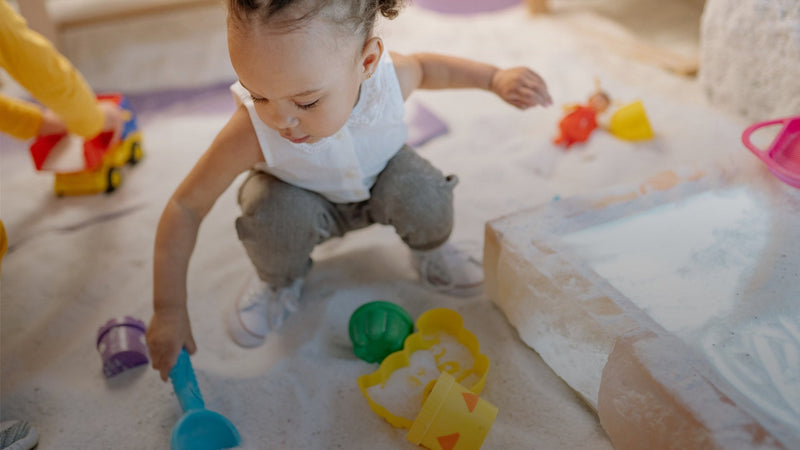
A preschooler pours water from one cup to another.
A child spins, climbs, digs through sand, listens to leaves crunch beneath their feet, or carefully arranges soft felt pieces into an imaginary world.
These activities may look very different, but they have something important in common:
They are all forms of sensory play.
Sensory play is often associated with bins filled with rice, slime, finger painting, or other wonderfully messy activities. But sensory play is much broader than that.
Children are constantly learning through their senses—touching, moving, listening, looking, smelling, and noticing how their bodies interact with the world around them.
Sensory play gives them opportunities to explore those experiences actively.
And the best part?
It doesn't need to be complicated, expensive, or carefully planned.
Sometimes sensory play is simply a child exploring the world exactly as childhood was designed to be explored.
What Is Sensory Play?
Sensory play is any child-led activity that meaningfully engages one or more of the senses.
That includes the five senses most of us learned about in school:
-
Touch
-
Sight
-
Sound
-
Smell
-
Taste
But children's sensory experiences also involve other systems that help them understand movement, balance, and where their bodies are in space.
For example:
The vestibular system helps children process movement and balance. Swinging, spinning, rocking, jumping, and climbing can all involve vestibular input.
The proprioceptive system provides information from muscles and joints about body position and force. Pushing, pulling, carrying, crawling, squeezing, and building can involve proprioceptive input.
This means sensory play isn't limited to sitting at a table with a sensory bin.
It can happen when a child:
-
Runs barefoot through grass
-
Squeezes play dough
-
Builds with blocks
-
Crawls through a tunnel
-
Splashes in water
-
Sorts smooth stones
-
Listens to different instruments
-
Paints with their fingers
-
Stacks cushions
-
Arranges felt shapes
-
Digs in soil
-
Wraps themselves in a blanket
-
Pretends a cardboard box is a spaceship
Sensory play is less about a particular toy or activity and more about how a child is experiencing and exploring what is around them.
Why Is Sensory Play Important?
Children don't experience childhood only by listening to explanations.
They experience it through their bodies.
They touch.
Move.
Experiment.
Repeat.
Drop something and pick it up again.
Pour water out and refill the cup.
Press something soft.
Notice something rough.
Build a tower and knock it down.
These seemingly ordinary moments give children opportunities to gather information about how their world works.
Sensory play can support several areas of childhood development at the same time.
1. Sensory Play Encourages Exploration
Young children are natural investigators.
Give them a bowl of water and several containers, and they rarely need instructions.
They pour.
Scoop.
Splash.
Fill.
Empty.
Compare.
Repeat.
Through these experiences, children begin forming their own understanding of concepts such as:
-
Full and empty
-
Heavy and light
-
Wet and dry
-
Soft and hard
-
Fast and slow
-
Cause and effect
-
Size and shape
Rather than simply being told about these differences, children get to experience them directly.
That is one reason hands-on play can be so engaging.
The child isn't just receiving information.
They're discovering it.
2. It Can Support Fine Motor Practice
Many sensory activities involve small, deliberate movements.
Think about what happens when a child:
-
Pinches dough
-
Picks up small objects
-
Scoops sand
-
Peels and places felt pieces
-
Threads large beads
-
Transfers objects using tongs
-
Draws shapes in shaving foam
-
Builds with small blocks
Their fingers and hands are working constantly.
These playful movements provide opportunities to practice the coordination later used for everyday tasks such as drawing, fastening clothing, using utensils, and writing.
The activity doesn't need to look educational for meaningful practice to be happening.
3. Sensory Play Encourages Language Naturally
Sensory experiences give children something concrete to describe.
Instead of asking a child to memorize descriptive words, you can introduce vocabulary inside the experience itself.
You might say:
"This one feels rough."
"That water is colder."
"Listen to how softly that shakes."
"This dough is really stretchy."
"What does that leaf smell like?"
Children begin connecting language with real sensations.
Sensory play can naturally introduce words related to:
-
Texture
-
Temperature
-
Movement
-
Shape
-
Size
-
Sound
-
Position
-
Emotion
-
Action
And when sensory experiences become pretend play, the language possibilities grow even further.
A bowl of blue water might suddenly become an ocean.
A handful of stones becomes dinosaur eggs.
A blanket becomes an explorer's cave.
Now sensory exploration and storytelling are happening together.
Sensory Play and Imagination Often Overlap
Sensory play doesn't have to stay purely sensory.
One of its most interesting qualities is how easily it can become imaginative play.
A child might begin by touching kinetic sand.
Then they make a mountain.
Then a dinosaur lives on the mountain.
Soon there is a volcano, a rescue mission, three characters, and an entire story you were never asked to invent.
That progression matters.
Children often use objects differently from the way adults expect.
And that's valuable.
Open-ended materials allow a child to ask:
What could this become?
rather than:
What am I supposed to do with this?
If you're looking for more ways to create this kind of child-led experience at home, ZeeZee Adventures' screen-free play and imaginative-play resources explore additional ways to give children more room to direct their own play.
4. Sensory Play Gives Children Opportunities to Solve Problems
Sensory play is filled with tiny experiments.
"Can this cup hold all the water?"
"Why did that block fall?"
"What happens if I squeeze harder?"
"How can I make the bridge stay up?"
"Will this object sink?"
Children form ideas, test them, notice what happened, and try again.
Adults often see the mess.
Children see the experiment.
These moments provide natural opportunities for:
-
Trial and error
-
Flexible thinking
-
Persistence
-
Prediction
-
Decision-making
-
Creative problem-solving
There doesn't have to be a correct outcome.
In fact, the absence of one is often what makes the play interesting.
5. Sensory Play Can Encourage Longer, Deeper Engagement
Many sensory activities invite repetition.
A child may pour the same water back and forth twenty times.
They may repeatedly attach and remove the same object.
They might dig the same hole, rebuild the same structure, or listen to the same sound again and again.
Adults sometimes wonder:
Why are they still doing that?
Because repetition helps children explore an experience thoroughly.
They aren't necessarily looking for novelty every few seconds.
Sometimes they're investigating one idea from multiple angles.
That slower rhythm is very different from entertainment that constantly determines what happens next.
During open-ended sensory play, the child controls the pace.
6. Sensory Play Can Become Part of a Calm, Predictable Routine
Some sensory experiences are energetic.
Others are quiet.
One child might love jumping, climbing, swinging, and crashing into cushions.
Another might prefer slowly arranging objects, drawing, listening to a story, or exploring soft textures.
The important thing is not to assume that one type of sensory experience is universally "calming."
Children have individual preferences.
A texture one child loves may bother another.
A spinning activity one child seeks may feel unpleasant to someone else.
That's why observing the child matters more than creating the perfect sensory activity.
Sensory play works best when adults follow children's cues rather than forcing particular experiences.
What Does Sensory Play Look Like at Different Ages?
Sensory exploration begins very early, but the form it takes changes as children grow.
Babies
For babies, sensory play may include:
-
Looking at contrasting shapes
-
Listening to a caregiver's voice
-
Feeling different safe fabrics
-
Reaching for objects
-
Splashing during bath time
-
Tummy time
-
Grasping age-appropriate toys
At this stage, almost everything is sensory exploration because so much of the world is completely new.
Toddlers
Toddlers often enjoy actions they can repeat themselves:
-
Scooping
-
Pouring
-
Stacking
-
Squishing
-
Carrying
-
Pushing
-
Pulling
-
Digging
-
Climbing
-
Water play
-
Large-scale drawing
Cause and effect becomes especially fascinating.
Preschoolers
Preschool sensory play can become increasingly imaginative.
A sensory bin stops being simply a container of rice.
Now it contains buried treasure.
Play dough becomes a bakery.
Mud becomes dinosaur land.
Cushions become mountains.
Sensory exploration begins merging with storytelling, problem-solving, and pretend play.
Older Children
Older children may still benefit from sensory-rich experiences, even if nobody calls them "sensory play."
Consider:
-
Baking
-
Gardening
-
Painting
-
Building
-
Woodworking
-
Clay
-
Crafts
-
Nature exploration
-
Fort building
-
Music
-
Movement
-
Science experiments
Sensory exploration doesn't disappear as children grow.
It simply becomes more sophisticated.
Sensory Play Doesn't Have to Be Messy
This is worth emphasizing because many parents hear "sensory play" and immediately imagine cleaning rice out of the carpet for the next six months.
Messy play can be wonderful.
It is not mandatory.
Low-mess sensory experiences can include:
-
Felt pieces
-
Fabric scraps
-
Building blocks
-
Water painting outdoors
-
Large puzzles
-
Play scarves
-
Nature walks
-
Flashlights and shadows
-
Music and rhythm
-
Cushion obstacle courses
-
Drawing
-
Cardboard construction
-
Storytelling props
Even rearranging familiar objects can provide rich tactile and spatial exploration.
The goal isn't to create an impressive Pinterest activity.
The goal is to give children interesting things to touch, move, manipulate, investigate, and reinterpret.
The Power of the Environment
Parents often focus on finding the right activity.
But sometimes the environment matters just as much.
Imagine two spaces.
The first contains flashing toys, background television, crowded shelves, and dozens of possible activities.
The second contains a smaller number of open-ended materials and enough room for a child to settle into an idea.
Neither space guarantees a particular kind of play.
But the second may make it easier for some children to notice what interests them and stay with it.
You don't need a dedicated playroom to create this effect.
A sensory-friendly play area might simply include:
-
A defined play corner
-
Comfortable flooring
-
Accessible materials
-
A few interesting textures
-
Space for movement
-
A basket of open-ended objects
-
Softer lighting
-
Reduced background noise
-
Somewhere cozy to sit, read, or imagine
The goal is not sensory deprivation.
It's intentionality.
Give children enough stimulation to explore without assuming that more stimulation always means better play.
Where ZeeZee Fits Into an Environment-First Approach
This environment-first philosophy also influences ZeeZee Adventures.
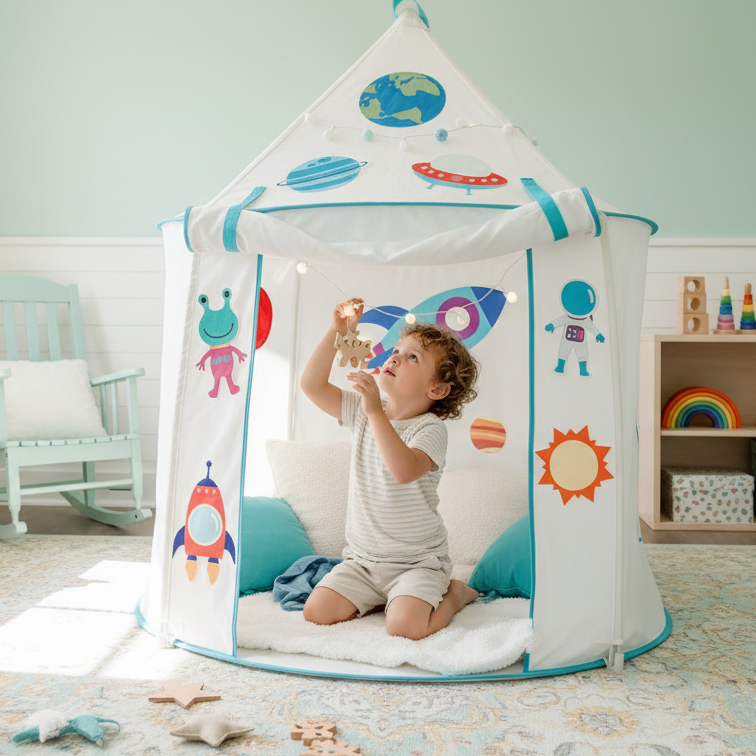
Rather than prescribing a particular way to play, its customizable imaginative play environment gives children a defined space they can reinterpret as their interests and stories change.
The tent's changeable StickeeZ felt themes allow the same physical environment to become a dinosaur world, an underwater adventure, a space mission, or whatever story the child creates around it.
What matters developmentally isn't the product itself.
It's what an open-ended environment can make possible:
A child choosing.
Changing.
Touching.
Arranging.
Imagining.
And deciding what happens next.
How to Encourage Sensory Play at Home
You don't need to prepare elaborate activities every day.
Start with what you already have.
Follow Your Child's Interests
If your child loves water, begin there.
If they collect rocks, explore rocks.
If they love vehicles, create roads from tape or cardboard.
If they're constantly climbing, think about safe opportunities for movement.
Sensory play becomes much easier when you begin with curiosity that already exists.
Offer Materials Without Explaining Everything
Adults are very good at turning play into instructions.
Try occasionally placing interesting materials nearby and seeing what your child does.
Instead of:
"First do this, then put this here."
Try:
"I wonder what you could make with these."
Or say nothing at all.
Observation can be surprisingly powerful.
Let Repetition Happen
If your child repeats the same action again and again, you don't necessarily need to introduce something new.
Repetition may be part of the exploration.
Allow the experience to unfold.
Rotate Rather Than Constantly Add
Children don't always need more toys.
Sometimes changing which materials are available can make familiar objects feel interesting again.
You might rotate:
-
Play scarves
-
Blocks
-
Figurines
-
Natural objects
-
Felt pieces
-
Art materials
-
Building materials
Novelty can come from recombining familiar materials, not only purchasing something new.
Combine Sensory Play With Storytelling
Ask open-ended questions such as:
"Who lives here?"
"What happened before we arrived?"
"Where does this road go?"
"What does your character need?"
"What should happen next?"
But don't feel compelled to question constantly.
Sometimes the best contribution an adult can make is simply being interested without directing the story.
What If My Child Doesn't Like Sensory Activities?
That's okay.
"Sensory play" should never mean forcing a child to touch something they dislike.
Children differ enormously in their sensory preferences.
One child may happily cover both hands in paint.
Another may immediately want to wash it off.
One child may seek movement constantly.
Another may prefer quieter activities.
The goal is not to make children tolerate every sensory experience.
Instead:
-
Offer choices
-
Watch their reactions
-
Allow them to stop
-
Introduce unfamiliar experiences gradually
-
Respect clear discomfort
-
Let them explore in ways that feel manageable
Sensory preferences are part of the child's experience, not an obstacle adults need to defeat.
If a child's responses to everyday sensory experiences are consistently causing significant distress or interfering with daily life, a pediatrician or appropriately qualified professional can help parents decide whether further support would be useful.
Is Sensory Play the Same as Montessori Play?
Not exactly.
Sensory exploration appears frequently in Montessori-inspired environments because hands-on learning is important within Montessori practice.
But sensory play is a broader category.
A sensory activity does not have to be Montessori.
It can be highly imaginative, messy, movement-based, nature-based, artistic, musical, or completely invented by the child.
There is considerable overlap between:
-
Sensory play
-
Montessori-inspired play
-
Open-ended play
-
Pretend play
-
Exploratory play
-
Child-led play
These aren't competing categories.
One activity may involve several at once.
What About DIR/Floortime and Child-Led Play?
Sensory play can also complement the broader idea of following a child's interests during interaction.
Approaches such as DIR/Floortime place considerable emphasis on joining children within their interests and building engagement through child-led interaction.
That doesn't mean an ordinary sensory activity at home becomes a therapy session.
For parents, the useful takeaway is simpler:
Notice what fascinates your child, enter their world with curiosity, and allow their interests to influence where the play goes next.
Sometimes connection grows not because an adult created a better activity, but because the adult became a better observer.
Five Easy Sensory Play Ideas to Try Today
You probably already have everything you need.
1. Water Transfer
Provide two containers, water, cups, and spoons.
Let your child pour, scoop, fill, and experiment.
2. Texture Hunt
Walk around the house or outdoors and look for things that feel:
-
Smooth
-
Rough
-
Soft
-
Hard
-
Bumpy
-
Cool
-
Warm
No elaborate setup required.
3. Build a Cushion Adventure
Use cushions, blankets, and pillows to create a safe path for crawling, stepping, building, or pretend play.
4. Create With Play Dough
Skip the finished model.
Offer dough and a few safe tools and see what emerges.
5. Make a Story World
Combine a few tactile, movable objects—felt shapes, figurines, blocks, scarves, or natural materials—and let your child decide what the world becomes.
This is where sensory play, symbolic play, and imaginative storytelling can begin to overlap beautifully.
Frequently Asked Questions About Sensory Play
What is the simplest definition of sensory play?
Sensory play is play that gives children opportunities to explore through their senses and movement. It may involve touch, sight, sound, smell, taste, balance, body awareness, or several sensory experiences at once.
What skills can sensory play support?
Depending on the activity, sensory play can provide opportunities to practice fine motor coordination, language, problem-solving, imaginative thinking, spatial awareness, movement, attention, and independent exploration.
Does sensory play need special equipment?
No.
Water, cardboard, blankets, household containers, natural objects, dough, fabric, music, and everyday movement can all become sensory experiences.
Is sensory play only for toddlers?
No.
Sensory exploration continues throughout childhood. The activities simply become more complex as children grow.
How long should sensory play last?
There is no ideal duration.
If a child is safely and meaningfully engaged, there is usually no reason to end an activity simply because a predetermined amount of time has passed.
Follow the child rather than the clock whenever circumstances allow.
Can sensory play be screen-free?
Absolutely.
Most traditional sensory experiences are naturally screen-free because the child is directly interacting with objects, movement, people, and the physical environment.
Sensory Play Doesn't Need to Look Impressive
Perhaps the biggest misconception about sensory play is that parents need to manufacture it.
You don't.
Children are naturally sensory beings.
They want to touch the world.
Move through it.
Listen to it.
Take things apart.
Put them back together.
Build.
Pour.
Climb.
Arrange.
Pretend.
Sensory play simply gives those instincts room to operate.
You can support it with interesting materials and thoughtful environments, but you don't need to manage every moment.
Sometimes the richest sensory experience begins with something remarkably ordinary:
A puddle.
A blanket.
A cardboard box.
A handful of leaves.
A quiet corner.
And a child wondering:
"What can I do with this?"
For families who want to extend a quiet or imaginative moment without adding another screen, ZeeZee's guided audio stories and listening experiences can also be paired with drawing, pretend play, a cozy corner, or other hands-on activities.
The goal isn't constant stimulation.
It's giving children enough time, freedom, and possibility to discover the world through their own senses—and then imagine what that world might become.





Comment (0)