

Focus vs Stimulation: What Modern Kids Are Missing
Modern childhood has changed dramatically in just one generation. Children today are growing up surrounded by screens, notifications, endless entertainment, fast-paced content, and constant stimulation. Every spare moment can now be filled instantly with music, videos, games, scrolling, or digital interaction. While technology has created convenience and opened the door to incredible learning opportunities, it has also quietly changed the way children experience attention, imagination, boredom, emotional regulation, and play.
Many parents are beginning to notice something unsettling. Children seem more distracted, less patient, more emotionally overwhelmed, and increasingly dependent on external entertainment. Teachers report shorter attention spans in classrooms. Caregivers struggle to hold a child’s focus during simple daily routines. Even activities that once naturally absorbed children for hours, such as building forts, imaginative storytelling, drawing, or outdoor play, now compete against highly stimulating digital alternatives.
The growing concern is not simply about screen time. The deeper issue is the difference between stimulation and focus.
Modern children are receiving more stimulation than any generation before them, yet many are struggling to develop deep concentration, independent thinking, patience, and imaginative engagement. This imbalance is shaping how children learn, communicate, play, and emotionally process the world around them.
Understanding this difference is essential for parents who want to raise calm, creative, emotionally resilient children in an overstimulated world.
The Difference Between Focus and Stimulation
Stimulation is immediate. It captures attention quickly through movement, sound, novelty, excitement, rewards, and rapid emotional feedback. Modern apps, games, videos, and social platforms are specifically designed to trigger continuous engagement. Bright colors, rapid scene changes, rewards, likes, swipes, and autoplay systems all encourage the brain to seek constant novelty.
Focus works differently.
Focus develops slowly. It requires patience, repetition, emotional regulation, and sustained attention. It grows when children are allowed to become deeply engaged in meaningful experiences without constant interruption. Reading a story, building something from imagination, creating pretend worlds, solving problems independently, or exploring nature all help develop focus.
The challenge is that stimulation feels exciting immediately, while focus often begins quietly.
A child scrolling through short-form videos receives instant dopamine rewards every few seconds. A child building a pretend castle out of blankets and cushions may initially feel bored before creativity begins to emerge. However, it is within that slower process that important developmental skills are formed.
Children need moments where their brains are not constantly entertained. They need opportunities to create instead of consume.
Why Overstimulation Is Becoming a Growing Problem
Today’s children rarely experience true mental stillness.
Many wake up to cartoons, travel with tablets, eat meals while watching videos, transition between activities with music or digital content, and end the day with screens before bed. Even educational content often relies on rapid stimulation to maintain engagement.
While occasional entertainment is not harmful on its own, constant stimulation changes expectations.
The brain begins to adapt to high-speed engagement. Slower activities may then feel “boring” even when they are deeply beneficial.
This can affect:
- Attention span
- Emotional regulation
- Sleep quality
- Creativity
- Problem-solving abilities
- Independent play
- Patience
- Conversation skills
- Academic concentration
- Frustration tolerance
Many children are no longer struggling because they lack intelligence. They are struggling because their nervous systems rarely experience calm.
When the brain becomes conditioned to constant input, quiet moments can feel uncomfortable. Yet quiet moments are often where creativity, reflection, imagination, and deep learning begin.
The Decline of Boredom and Why It Matters
For many adults, boredom was once a normal part of childhood.
Long car rides, waiting rooms, rainy afternoons, or quiet weekends often forced children to invent games, create stories, build imaginary worlds, or simply sit with their thoughts. These unstructured moments helped develop creativity and independent thinking.
Today, boredom is often eliminated instantly.
A child says, “I’m bored,” and a screen quickly fills the silence.
The problem is that boredom itself is not harmful. In fact, boredom can be developmentally important.
Boredom creates space for:
- Creativity
- Self-directed exploration
- Problem-solving
- Emotional processing
- Imagination
- Curiosity
- Innovation
When children are constantly entertained, they lose opportunities to develop internal engagement.
Children who always rely on external stimulation may struggle to create their own experiences independently. They may become passive consumers rather than active creators.
This is one reason why open-ended play is becoming increasingly important in modern parenting.
Imagination Requires Mental Space
Imagination does not thrive under constant stimulation.
Creative thinking often emerges during slower moments when children are free to explore ideas without structured outcomes or digital interruption.
A cardboard box becomes a spaceship.
A blanket becomes a castle.
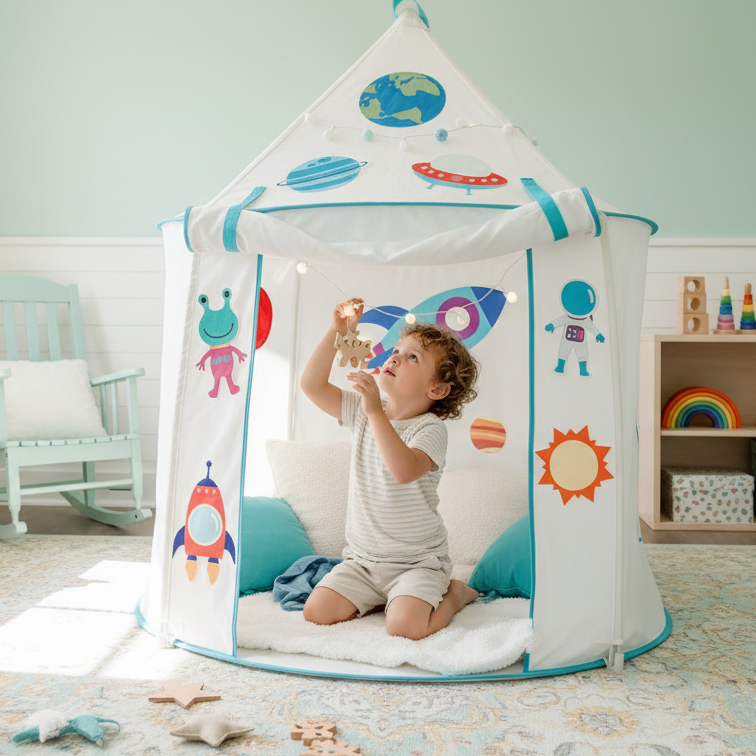
A simple play tent becomes a hidden reading nook, a jungle safari, a bakery, a pirate ship, or a secret clubhouse.
This kind of imaginative transformation is deeply valuable for child development because it strengthens:
- Language skills
- Emotional intelligence
- Narrative thinking
- Social development
- Cognitive flexibility
- Creativity
- Confidence
- Independent thinking
When children engage in imaginative play, they are not simply “playing.” They are practicing real-world cognitive and emotional skills.
The challenge is that highly stimulating entertainment leaves little room for imagination to initiate naturally.
Why invent a story when endless stories are already streaming?
Why build an imaginary world when digital games provide one instantly?
The brain gradually becomes accustomed to receiving ready-made entertainment rather than generating experiences internally.
This is why many parents are intentionally creating calmer play environments that encourage open-ended exploration instead of constant passive consumption.
Simple environments often produce deeper creativity.
At ZeeZee Adventures, many families are rediscovering the value of screen-free imaginative spaces that encourage children to slow down, create stories, and explore independent play naturally. The goal is not to reject technology completely, but to restore balance by giving imagination room to breathe.

The Nervous System and Emotional Overload
One of the most overlooked effects of overstimulation is its impact on the nervous system.
Children are still developing the ability to regulate emotions, process sensory input, and manage stress. Constant stimulation can overwhelm this process.
Fast-paced content, loud environments, multitasking, and excessive digital exposure may contribute to:
- Irritability
- Emotional outbursts
- Restlessness
- Sleep difficulties
- Anxiety-like behaviors
- Difficulty transitioning between activities
- Reduced frustration tolerance
Many parents notice that children become dysregulated after extended screen exposure. They may appear more emotional, less cooperative, or unable to settle into calm activities.
This does not necessarily mean technology itself is inherently harmful. Rather, it highlights the importance of balance and nervous system recovery.
Children need calm experiences to help regulate sensory input.
Quiet reading.
Outdoor exploration.
Creative play.
Slow routines.
Hands-on activities.
These experiences allow the nervous system to slow down instead of remaining in a constant state of stimulation.
Why Deep Play Matters More Than Ever
Not all play has the same developmental impact.
Passive entertainment keeps children occupied.
Deep play helps children grow.
Deep play occurs when children become fully absorbed in imaginative or creative experiences for extended periods of time. During this state, children develop concentration, persistence, emotional engagement, and independent thinking.
Examples of deep play include:
- Building forts
- Pretend roleplay
- Creating stories
- Constructing imaginary worlds
- Drawing for long periods
- Exploring outdoors
- Crafting
- Reading independently
- Open-ended toy play
Deep play often looks slower and quieter than highly stimulating entertainment, but it exercises important cognitive muscles.
Children practicing deep play are learning how to:
- Stay engaged
- Solve problems
- Create meaning
- Develop patience
- Navigate emotions
- Expand creativity
- Strengthen focus
One of the reasons imaginative spaces have become popular among intentional parents is that they encourage uninterrupted engagement.
A cozy tent, reading corner, or calm play area signals safety and independence. It invites children into slower, more immersive experiences that are increasingly rare in overstimulated modern environments.
Attention Is Built Through Practice
Many parents worry that their child cannot focus.
However, focus is not something children simply “have” or “lack.” It is a skill that develops through repeated practice.
The challenge is that many modern environments unintentionally train distraction instead.
Rapid content switching teaches the brain to expect novelty.
Notifications interrupt attention.
Autoplay eliminates pause.
Multitasking weakens sustained concentration.
Children who rarely practice long-form engagement may struggle when required to focus deeply in school, conversations, or independent activities.
The good news is that focus can still be strengthened.
Children build concentration through:
- Reading
- Creative play
- Art
- Puzzles
- Outdoor exploration
- Building activities
- Open-ended storytelling
- Slow hobbies
- Independent projects
Importantly, focus grows gradually.
Children often resist slower activities initially because their brains are accustomed to higher stimulation. However, once they transition into deeper engagement, many become calmer, more creative, and more emotionally regulated.
The Impact on Parent-Child Relationships
Overstimulation does not only affect children. It also impacts family connection.
When every quiet moment is filled with digital distraction, opportunities for meaningful interaction decrease.
Simple conversations.
Shared storytelling.
Reading together.
Imaginative games.
Family rituals.
These moments help children develop emotional security and communication skills.
Modern parenting often feels pressured to constantly entertain children, but children do not necessarily need more entertainment.
They often need more connection.
Children remember presence more than perfection.
They remember how a home felt.
They remember safe spaces where imagination was encouraged.
They remember moments when someone slowed down enough to truly engage with them.
Creating calmer routines can strengthen family relationships by reducing overstimulation and increasing meaningful interaction.
Reclaiming Slow Childhood
A growing number of parents are intentionally moving toward slower childhood experiences.
This does not mean abandoning technology entirely.
It means becoming more mindful about balance.
Children benefit from environments where:
- Screens are not the default solution
- Boredom is allowed occasionally
- Independent play is encouraged
- Imagination is valued
- Outdoor exploration is prioritized
- Quiet routines exist
- Creativity has room to emerge
Many families are rediscovering simple childhood experiences that were once considered ordinary.
Building forts.
Reading under blankets.
Pretend adventures.
Nature walks.
Storytelling.
Hands-on creativity.
These experiences may appear simple, but they support healthy neurological, emotional, and cognitive development.
At ZeeZee Adventures, this philosophy is reflected in the idea that children do not always need louder toys or more stimulation. Sometimes they simply need spaces where imagination can lead the experience naturally.
A child who feels safe, calm, and creatively engaged is developing far more than entertainment habits. They are building attention, confidence, emotional resilience, and independent thought.
The Long-Term Importance of Focus
Focus is becoming one of the most valuable skills of the future.
In a world built around distraction, the ability to think deeply, concentrate, regulate emotions, and engage meaningfully will become increasingly important.
Children who develop strong focus skills are often better equipped for:
- Academic learning
- Emotional regulation
- Creativity
- Communication
- Problem-solving
- Long-term goal achievement
- Healthy relationships
- Independent thinking
These skills are not built through constant stimulation.
They are built through practice, presence, and meaningful engagement.
Parents do not need to create perfect childhoods.
They simply need to create enough opportunities for children to slow down, imagine, create, and engage deeply with the world around them.
Final Thoughts
Modern children are not lacking intelligence, creativity, or potential.
What many lack is space.
Space to think.
Space to imagine.
Space to become absorbed in meaningful play.
Space to experience boredom long enough for creativity to emerge.
Space to focus without interruption.
In today’s overstimulated world, protecting those spaces may be one of the most valuable gifts parents can give.
The goal is not to eliminate technology or entertainment completely. The goal is balance.
Children deserve opportunities to experience both excitement and stillness.
Both learning and wonder.
Both connection and independence.
Because when children are given calm environments, meaningful play, and room for imagination, they do more than stay occupied.
They grow.





Comment (0)