
Montessori vs Traditional Play: What's the Difference?
Introduction
Walk into any nursery, toy shop or parenting forum, and you're likely to hear two very different opinions about children's play.
Some parents praise Montessori for its calm environments, purposeful activities and focus on independence.
Others believe traditional play offers children greater freedom, imagination and joyful exploration.
If you're trying to decide which approach is best for your child, it's easy to feel overwhelmed.
Do you need wooden Montessori toys?
Should you avoid colourful plastic toys?
Does imaginative play fit into Montessori?
Can children benefit from both approaches?
These are sensible questions, and the answer is often more balanced than many online discussions suggest.
The truth is that both Montessori play and traditional play offer valuable opportunities for learning. Each encourages different aspects of development, and neither approach needs to exclude the other.
Rather than asking which philosophy is better, it is often more helpful to ask how each one supports children's natural curiosity, confidence and creativity.
Understanding the strengths of both approaches allows parents to make thoughtful choices that reflect their child's personality, interests and stage of development.
This guide explains the similarities, differences and practical applications of Montessori and traditional play, helping you create a home where children can learn, imagine and thrive.
Quick Answer
Montessori play and traditional play both support healthy child development, but they emphasise different approaches. Montessori encourages independence, practical life skills and purposeful, hands-on learning within a carefully prepared environment. Traditional play often places greater emphasis on imagination, free exploration, social interaction and creative expression. Many families successfully combine both approaches to create a balanced play environment.
Key Takeaways
-
Montessori play encourages independence, concentration and practical life skills.
-
Traditional play often promotes imagination, flexibility and spontaneous creativity.
-
Both approaches support healthy child development in different ways.
-
Children benefit most when they experience a balance of purposeful learning and open-ended exploration.
-
Parents do not need to choose one philosophy exclusively.
Definition
What Is Montessori Play?
Montessori play is a child-led approach based on the educational philosophy developed by Dr Maria Montessori. It encourages children to learn through purposeful, hands-on experiences using carefully prepared environments that support independence, concentration and practical life skills.
What Is Traditional Play?
Traditional play refers to the broad range of unstructured and guided play experiences that have long been part of childhood. It often includes imaginative games, pretend play, building, outdoor exploration, crafts, board games and social activities. Traditional play generally encourages creativity, flexibility and joyful exploration without following a specific educational philosophy.
Understanding the Two Approaches
Although Montessori and traditional play are often presented as opposites, they share an important belief.
Children learn best through active participation.
Rather than relying solely on instruction, both approaches encourage children to explore, experiment, and discover through experience.
The difference lies in how those opportunities are presented.
Montessori carefully prepares the environment to encourage purposeful learning and independence.
Traditional play tends to allow experiences to develop more spontaneously, often following children's imagination wherever it leads.
Understanding this distinction helps parents appreciate why both approaches remain valuable today.
Expert Insight
Children benefit from a variety of meaningful play experiences.
Child development specialists generally agree that children thrive when they experience different forms of play. Practical life activities build confidence and independence, while imaginative play encourages creativity, flexible thinking, and communication. A balanced childhood often includes both.
Core Principles of Montessori Play
Montessori education is built around several guiding principles that influence the way children interact with their environment.
Independence
Children are encouraged to complete tasks for themselves whenever possible.
Purposeful Activities
Experiences are designed to teach meaningful skills rather than simply entertain.
Prepared Environment
Materials are organised to encourage exploration without overwhelming children.
Concentration
Children are given uninterrupted time to focus deeply on one activity.
Respect for the Child
Adults guide and observe rather than directing every experience.
These principles encourage children to become confident, capable learners who enjoy discovering new skills independently.
Core Principles of Traditional Play
Traditional play is typically more flexible and less structured.
Children often decide what happens as the activity develops.
One afternoon might involve pretending the sofa is a pirate ship.
The next could become an art project or an energetic game in the garden.
Traditional play often encourages:
-
Imaginative storytelling.
-
Group games.
-
Role play.
-
Creative arts.
-
Outdoor adventures.
-
Construction play.
-
Family games.
-
Social interaction.
Its greatest strength lies in allowing children to invent, adapt, and change their ideas freely.
Montessori vs Traditional Play Comparison
|
Montessori Play |
Traditional Play |
|
Child-led with carefully prepared materials. |
Often spontaneous and flexible. |
|
Focus on practical life skills and purposeful activities. |
Focus on imagination, fun and exploration. |
|
Calm, organised environments. |
Variety of play settings and materials. |
|
Encourages sustained concentration. |
Encourages creativity and social interaction. |
|
Adults observe and guide. |
Adults may participate, organise or simply join the fun. |
|
Materials often have a clear developmental purpose. |
Toys may have many different purposes depending on children's imagination. |
Neither column represents a better childhood.
They simply reflect different ways children experience learning.
Similarities Between Montessori and Traditional Play
Despite their differences, these approaches share more in common than many parents realise.
Both encourage children to:
-
Learn through experience.
-
Solve problems independently.
-
Build confidence.
-
Develop fine and gross motor skills.
-
Strengthen communication.
-
Explore their interests.
-
Become increasingly independent.
Ultimately, both recognise that play is one of childhood's most powerful learning experiences.
The methods may differ, but the underlying goal remains remarkably similar.
Which Approach Is Better?
This is perhaps the question parents ask most often.
The answer is refreshingly simple.
Neither.
Children are wonderfully individual.
Some naturally enjoy organising, sorting and completing practical tasks.
Others spend hours inventing imaginary worlds.
Many children love both.
A child might happily prepare fruit using Montessori principles before spending the afternoon pretending their garden is a dinosaur island.
One experience strengthens practical confidence.
The other expands creativity.
Neither cancels out the other.
Together, they create a richer childhood.
The Developmental Benefits of Montessori Play
One reason Montessori has remained influential for more than a century is that it focuses on developing the whole child rather than simply teaching academic skills.
Every activity is designed with intention.
Children are encouraged to participate in real life, solve problems independently and repeat tasks until they feel confident. Instead of rushing from one activity to another, Montessori values depth, concentration and mastery.
This approach supports far more than practical skills.
Children gradually develop patience, resilience, confidence and a genuine belief that they are capable of learning independently.
Perhaps most importantly, Montessori nurtures intrinsic motivation. Rather than relying on stickers, rewards or constant praise, children experience the satisfaction of succeeding because of their own effort.
That feeling often becomes one of the strongest foundations for lifelong learning.
The Developmental Benefits of Traditional Play
Traditional play offers children something equally valuable.
Freedom.
Unlike activities with a clear objective, traditional play often evolves naturally through children's imagination.
A cardboard box becomes a pirate ship.
A blanket becomes a mountain cave.
A collection of toy animals turns into an entire safari adventure.
There are no right answers.
No correct sequence.
No predetermined outcome.
Children create the experience themselves.
This freedom encourages flexible thinking, storytelling, communication and social interaction. It also helps children practise negotiation, empathy and emotional expression as they interact with siblings and friends.
Traditional play reminds us that some of childhood's richest learning experiences happen simply because children are given time to imagine.
Expert Insight
Different types of play strengthen different areas of development.
Child development specialists generally agree that children benefit from a variety of play experiences. Practical, purposeful activities help build independence and concentration, while imaginative and social play strengthen creativity, communication and emotional understanding. A balanced play environment allows children to develop a wide range of lifelong skills.
Montessori Toys vs Traditional Toys
One area that often creates confusion is the difference between Montessori toys and traditional toys.
Parents sometimes assume one category is automatically better than the other.
In reality, the value of a toy depends far more on how children use it than the material from which it is made.
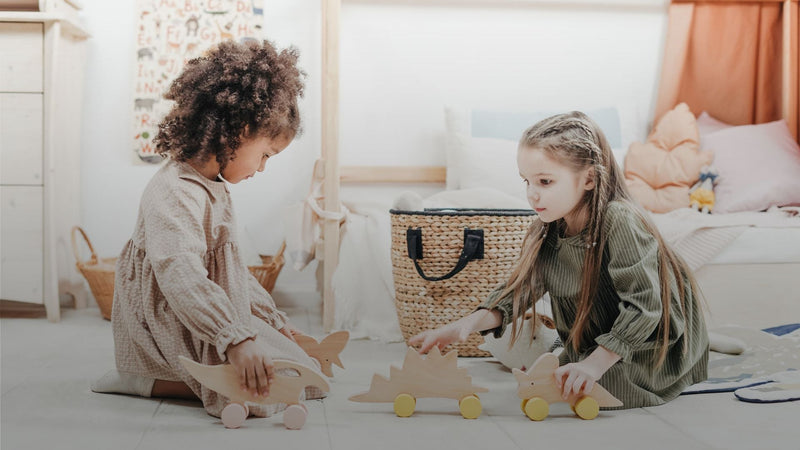
Montessori toys are usually designed with one clear developmental purpose. They often encourage children to practise a particular skill through repetition and careful observation.
Traditional toys, on the other hand, may have broader or more flexible uses. Dolls, building blocks, train sets and pretend kitchens encourage storytelling, role play and social interaction.
Both types of toys can contribute meaningfully to child development when chosen thoughtfully.
|
Montessori Toys |
Traditional Toys |
|
Often made from simple, natural materials. |
Available in many different materials and styles. |
|
Usually focus on one developmental skill. |
Often encourage multiple forms of imaginative play. |
|
Promote concentration and repetition. |
Encourage storytelling and creativity. |
|
Designed for independent exploration. |
Frequently enjoyed individually or with others. |
|
Practical and purposeful. |
Flexible and imaginative. |
Parents do not need to replace every traditional toy with Montessori materials.
A balanced toy collection often provides children with the richest opportunities for learning.
Which Children Thrive with Montessori Play?
Montessori can be particularly enjoyable for children who naturally enjoy:
-
Organising and sorting.
-
Building routines.
-
Completing practical tasks.
-
Repeating activities until they master them.
-
Working independently.
-
Exploring at their own pace.
These children often appreciate the calm, structured nature of Montessori environments.
However, this does not mean Montessori is only suitable for naturally quiet or organised children.
Many energetic children also benefit because practical activities help channel their curiosity into meaningful experiences.
Which Children Thrive with Traditional Play?
Traditional play often appeals to children who enjoy:
-
Inventing stories.
-
Dressing up.
-
Building imaginary worlds.
-
Playing with siblings or friends.
-
Acting out characters.
-
Outdoor adventures.
-
Creative arts.
These experiences encourage children to express themselves freely while developing communication and flexible thinking.
Again, there is no single personality type that fits traditional play.
Most children naturally move between structured and imaginative experiences throughout the day.
Common Myths About Montessori and Traditional Play
Many discussions online present these two approaches as complete opposites.
The reality is much more balanced.
|
Myth |
Reality |
|
Montessori children do not use their imagination. |
Montessori encourages curiosity and exploration. Many families also include rich imaginative play at home. |
|
Traditional play lacks educational value. |
Traditional play develops creativity, communication, problem-solving and emotional understanding. |
|
Montessori toys are always better. |
The best toys are those that encourage meaningful engagement and match the child's interests and stage of development. |
|
Parents must choose one philosophy. |
Most families naturally combine ideas from several educational approaches. |
|
Colourful toys prevent learning. |
Learning depends far more on how children interact with materials than their appearance alone. |
Can Montessori and Traditional Play Work Together?
Absolutely.
In fact, many child development professionals encourage families to combine the strengths of different approaches rather than following one philosophy rigidly.
Imagine a typical Saturday.
Your child helps prepare pancakes for breakfast.
Later, they water the plants and arrange flowers in a vase.
These are wonderful Montessori-inspired experiences that encourage responsibility and independence.
In the afternoon, the dining table becomes a pirate ship.
Cushions become treasure islands.
Soft toys become the crew.
Now traditional imaginative play takes over.
Both experiences are valuable.
One helps children understand the real world.
The other encourages them to imagine new possibilities.
Together, they create a wonderfully balanced childhood.
Creating a Balanced Play Environment
Parents often feel pressure to decide which educational philosophy they should follow.
Perhaps a better approach is to focus less on labels and more on what children genuinely need.
A balanced play environment might include:
-
Practical life activities such as cooking, gardening and tidying.
-
Open-ended building materials.
-
Books within easy reach.
-
Art supplies for creative expression.
-
Outdoor exploration.
-
Opportunities for imaginative storytelling.
-
Quiet spaces for independent play.
-
Family games that encourage communication and cooperation.
Children benefit most when they can move naturally between different kinds of learning throughout the day.
How ZeeZee Adventures Brings Both Approaches Together
One of the reasons ZeeZee Adventures fits naturally into modern family life is that it reflects many of the strengths found in both Montessori and traditional play.
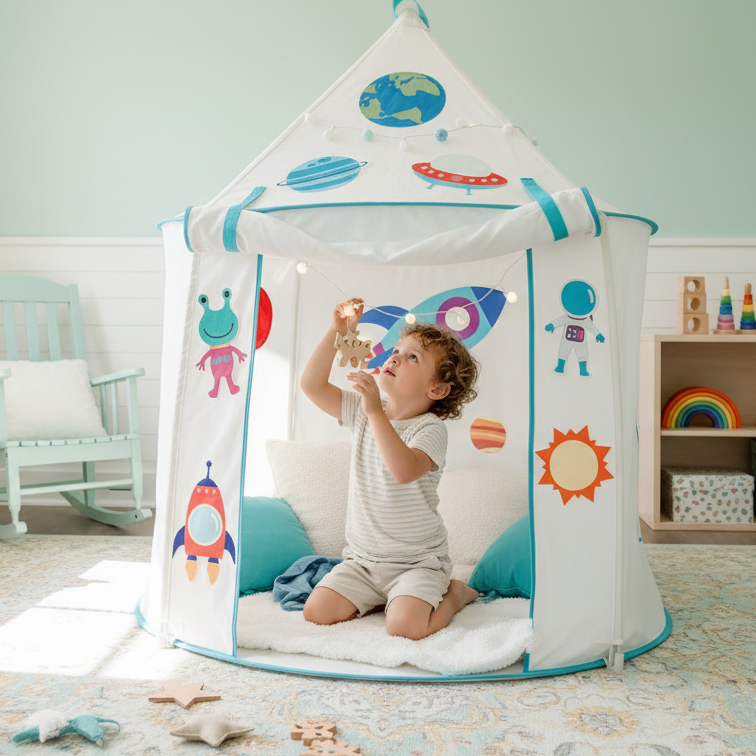
Like Montessori, the ZeeZee Adventure Tent provides a calm, thoughtfully designed environment that encourages children to explore independently. The sensory-friendly space invites quiet reading, reflection, and child-led discovery without constant adult direction. Inspired by two sisters who imagined a play tent that could evolve alongside their creativity, it encourages children to take ownership of their play experiences.
At the same time, the interchangeable StickeeZ themes embrace the spirit of traditional imaginative play. One day the tent becomes a medieval castle, the next an underwater adventure, a rainforest expedition or a space station. Instead of limiting children to a single storyline, the environment adapts to their changing interests, encouraging storytelling, creativity and open-ended exploration.
Rather than asking families to choose between Montessori and traditional play, ZeeZee Adventures supports the strengths of both by providing a space where independence, imagination and purposeful play naturally come together.
Conclusion
When parents compare Montessori play and traditional play, they are often searching for the "right" answer.
Should they replace all their toys with Montessori materials?
Should they avoid pretend play?
Should they follow one educational philosophy completely?
After exploring both approaches, a different conclusion begins to emerge.
There does not need to be a winner.
Both Montessori and traditional play help children learn, grow and develop in meaningful ways. They simply nurture different aspects of childhood.
Montessori reminds us that children are capable.
It encourages independence, concentration and practical life skills through purposeful, hands-on experiences.
Traditional play reminds us that imagination matters just as much.
It encourages storytelling, creativity, social interaction and the freedom to invent entirely new worlds.
These approaches are not competitors.
They are complementary.
A child can spend the morning helping prepare lunch, caring for plants or organising books, then spend the afternoon transforming the living room into a pirate ship or an enchanted forest.
One experience builds confidence through real-life participation.
The other builds creativity through imagination.
Together, they create a childhood rich in learning, discovery and joy.
Perhaps the most valuable lesson for parents is this.
You do not need to follow labels perfectly.
You do not need to recreate a Montessori classroom.
You do not need to reject traditional toys.
Instead, focus on creating an environment where children feel trusted, respected and inspired to explore.
Offer opportunities to participate in everyday family life.
Provide open-ended materials that encourage imagination.
Allow children time to become deeply absorbed in their own ideas.
Celebrate curiosity more than perfection.
When children are given freedom to explore, meaningful responsibilities and plenty of opportunities to imagine, they naturally develop the confidence, creativity and resilience that will serve them throughout their lives.
That is far more important than choosing one philosophy over another.
Ultimately, the best approach is the one that helps your child flourish.
Frequently Asked Questions
1. Is Montessori better than traditional play?
Neither approach is universally better. Montessori and traditional play each support different aspects of child development. Many families successfully combine both to encourage independence, creativity, confidence and joyful learning.
2. Can children enjoy both Montessori and traditional play?
Yes. A child may enjoy practical life activities inspired by Montessori while also spending hours engaged in imaginative role play, building forts or creating stories. These experiences complement one another beautifully.
3. Do I need Montessori toys to follow Montessori principles?
No. Montessori focuses on meaningful experiences rather than expensive materials. Everyday household objects and practical life activities often provide excellent learning opportunities.
4. Does Montessori discourage imagination?
Traditional Montessori classrooms often emphasise real-life experiences during the early years. However, many modern families and educators successfully combine Montessori principles with imaginative, open-ended play because both support healthy child development.
5. Which toys encourage the most creativity?
Open-ended materials such as wooden blocks, art supplies, loose parts, fabric, cardboard boxes and imaginative play environments encourage children to invent their own stories rather than simply following predetermined instructions.
6. Can traditional toys still be educational?
Absolutely. Dolls, construction toys, board games, outdoor equipment and pretend play resources all help children develop communication, creativity, social skills and problem-solving abilities.
7. How do I know which approach suits my child?
Observe how your child naturally chooses to play. Some children enjoy practical tasks and organised activities, while others thrive on imaginative storytelling. Most children enjoy a combination of both, especially when adults allow them the freedom to explore their own interests.





Comment (0)