

How to Create a Calm Corner for Quiet Play
Children's days can be full.
School, conversations, movement, toys, activities, errands, meals, and the constant stream of things happening around them can add up.
Sometimes, what a child wants after all that isn't another activity.
They may want somewhere to curl up with a book.
Somewhere to draw.
Somewhere to listen to a story.
Somewhere to play quietly with a favorite toy.
Or simply somewhere that feels a little different from the rest of the room.
That's where a calm corner can be useful.
A calm corner doesn't need to be a large room, an expensive setup, or a perfectly decorated space. It can be a small, comfortable area that gives children an option for slower, quieter play.
And importantly, it doesn't have to be a place where children are sent when they've “misbehaved.”
A calm corner works best when it is presented as an inviting choice, not a punishment or isolation space.
What Is a Calm Corner?
A calm corner is a designated area where children can engage in quieter activities or spend some unstructured time.
Depending on the child and the space available, it might include:
-
Books
-
Cushions
-
Blankets
-
Drawing materials
-
Simple puzzles
-
Building toys
-
Stuffed animals
-
Age-appropriate audio stories
-
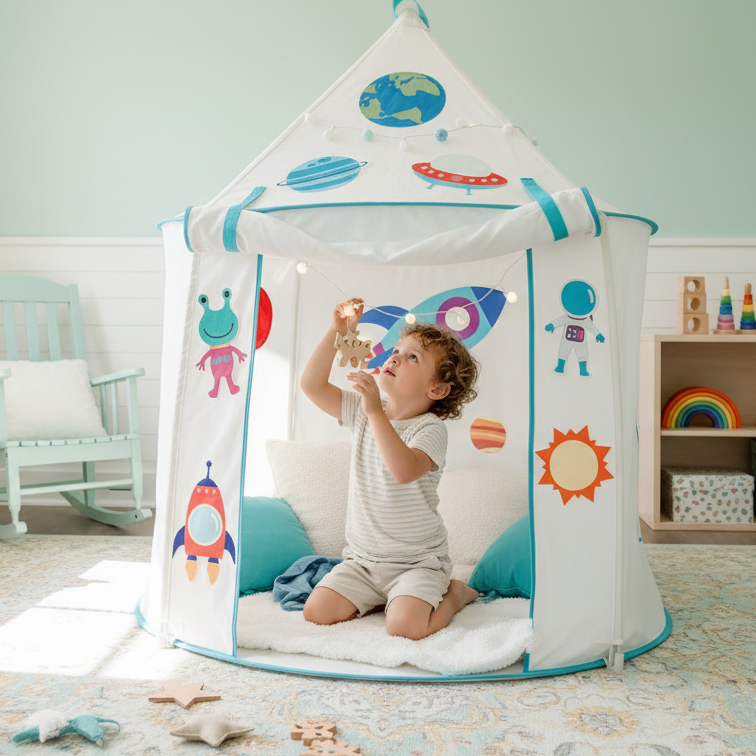
A small play tent
-
Familiar comfort items
The purpose isn't to force a child to become calm.
Instead, the environment gives them an opportunity to choose a slower activity when they want one.
Some children may use the space every day.
Others may prefer it only occasionally.
Both are perfectly reasonable.
1. Choose a Small, Low-Traffic Area
You don't need an entire room.
A corner of a bedroom, living room, playroom, or another safe area can work.
Look for somewhere that is:
-
Relatively quiet
-
Comfortable
-
Easy for your child to access
-
Away from the busiest part of the room
-
Free from obvious safety hazards
It doesn't need to be completely isolated.
In fact, younger children may prefer knowing that a parent is still nearby.
The goal is simply to create a noticeable difference in pace.
2. Make It Comfortable
Comfort is one of the simplest ways to make a space inviting.
You could add:
-
A floor cushion
-
A soft mat
-
A blanket
-
A few pillows
-
A comfortable chair
-
A small child-sized seat
You don't need to fill the space with objects.
A little empty space can be useful too.
Children may want to stretch out, sit quietly, look through a book, or create a small pretend-play world.
3. Keep the Activity Choices Simple
A calm corner doesn't need every quiet activity your child owns.
Too many choices can make the space feel cluttered and may make it harder for children to decide what to do.
Try starting with three or four options.
For example:
Reading: A small collection of favorite books.
Creating: Paper and crayons.
Building: A small container of blocks.
Pretend play: A few stuffed animals or figures.
You can rotate the choices every so often.
That allows familiar materials to feel interesting again without constantly buying something new.
4. Add a Reading Nook
Books are a natural fit for a calm corner.
You might keep a small selection of:
-
Favorite picture books
-
Storybooks
-
Wordless books
-
Nature books
-
Activity books
-
Books your child enjoys revisiting
Don't worry about making the reading corner look perfect.
The important thing is accessibility.
If your child can easily pick up a book and settle down without needing your help, the space becomes more useful for independent quiet play.
5. Give Children Something to Create
Quiet play can still be creative.
Keep a small drawing station nearby with paper and age-appropriate art materials.
Instead of giving children a specific craft to complete, try open-ended invitations:
“Draw a place you would like to explore.”
“Create a home for an imaginary creature.”
“Draw what you think is behind the clouds.”
There isn't one correct answer.
The child decides what the activity becomes.
That freedom can make the same materials useful again and again.
6. Use a Play Tent as a Calm Space
A play tent can naturally create a sense of separation without requiring a separate room.
It can become a:
-
Reading nook
-
Storytelling space
-
Pretend campsite
-
Cozy hideaway
-
Drawing space
-
Quiet play area
ZeeZee Adventures is built around the concept of an adaptable play environment. Its play tent can take on different imaginative settings through interchangeable StickeeZ themes, allowing children to reinterpret the same physical space as their interests change.
That adaptability can be useful in a calm corner because the space doesn't have to have one permanent identity.
Today it might be a reading nook.
Tomorrow it could become a quiet campsite.
Another day, it might be a small storytelling world.

7. Keep the Lighting Comfortable
Lighting can change the feeling of a space.
If possible, position the calm corner somewhere with comfortable natural light during the day.
For evening use, choose lighting that feels comfortable for the activity.
A small reading light or soft ambient light can help distinguish the corner from the brighter, busier parts of the home.
The goal isn't to make the area dark.
It's simply to create a visually comfortable environment.
8. Include Familiar Comfort Items
Children often have objects they naturally gravitate toward when they want quieter play.
It might be:
-
A favorite stuffed animal
-
A familiar blanket
-
A special book
-
A favorite pillow
-
A small collection of figures
Including a few familiar objects can make the space feel personal.
You don't need to fill the corner with toys.
A handful of things your child already enjoys may be enough.
9. Let Your Child Help Design It
A calm corner doesn't have to be entirely designed by adults.
Ask your child:
“Where would you like your quiet space?”
“What should we keep here?”
“Which books should go in it?”
“What would make this space comfortable?”
Their answers can tell you a lot about what they actually want from the space.
Maybe they want a particular blanket.
Maybe they want their stuffed animals nearby.
Maybe they want a place where they can draw.
Maybe they simply want a small space that feels like their own.
10. Keep It Open-Ended
One of the biggest mistakes with a calm corner is making it too structured.
If the space has a long list of rules and a prescribed activity schedule, it can start feeling like another task.
Instead, think of the corner as an invitation.
Your child can choose:
Read.
Draw.
Build.
Pretend.
Listen.
Rest.
Look.
Imagine.
The exact activity can change.
11. Don't Use the Calm Corner as Punishment
This is important.
A calm corner should not become:
“Go sit there because you're being difficult.”
If the space is consistently associated with punishment, children may begin to see it as somewhere they are sent when something is wrong.
Instead, introduce it positively.
You might say:
“This is your cozy space. You can come here when you want to read or play quietly.”
It can also be part of the family's normal routine.
After active play, your child might choose to spend some time there.
Before bedtime, they might look through books.
During a busy afternoon, they might retreat there with a favorite toy.
The choice matters.
12. Create a Quiet-Time Routine
A calm corner can become more useful when children know when it's available.
For example:
After lunch: quiet play.
After school: a few minutes to settle in.
Before bedtime: books or storytelling.
While a parent works: independent quiet play.
The routine doesn't have to be rigid.
Its purpose is simply to make slower moments predictable.
13. Let the Space Change With Your Child
What works for a toddler may not interest a school-age child.
A young child might want picture books, stuffed animals, and simple building toys.
An older child might prefer chapter books, drawing materials, puzzles, journaling, or a creative project.
So don't think of a calm corner as something you build once and never change.
Let it evolve.
ZeeZee Adventures' brand philosophy similarly emphasizes a play environment that grows alongside children's changing interests and imagination.
The same principle can apply to a calm corner.
The space can stay familiar while the experience changes.
14. Don't Expect Every Child to Use It the Same Way
Some children will immediately love having a cozy corner.
Others won't.
Some may use it for reading.
Others may turn it into a pretend-play space.
Some may only spend five minutes there.
Others may stay much longer.
Children have different personalities, interests, energy levels, and preferences.
The purpose isn't to make every child use a calm corner in the same way.
It's to provide another option.
15. Allow Quiet Time Without Requiring Stillness
Quiet play doesn't have to mean sitting perfectly still.
A child might:
-
Rearrange stuffed animals
-
Build something
-
Draw while talking
-
Move between books
-
Act out a quiet story
-
Lie down with a favorite toy
-
Create a small pretend world
The pace can be calmer without being completely motionless.
That's an important distinction.
A calm corner is about the type of experience, not a particular posture.
A Simple Calm Corner Formula
If you're unsure where to begin, try:
COMFORT + CHOICE + SPACE
Comfort: Add something soft and familiar.
Choice: Offer two or three quiet activities.
Space: Leave enough room for the child to use the area in their own way.
For example:
Comfort: Cushion + blanket.
Choice: Books + drawing + stuffed animals.
Space: A small corner where the child can sit, lie down, or create.
That's enough.
You don't need a complicated sensory setup or expensive furniture.
What If My Child Doesn't Want to Use the Calm Corner?
Don't force it.
If the space isn't appealing, ask why.
Maybe it's too isolated.
Maybe the activities aren't interesting.
Maybe your child wants more room.
Maybe they would rather have a tent than a chair.
Maybe they prefer listening to stories instead of reading.
Treat the space as something you can adjust.
The goal is not to make the child use the corner.
The goal is to create an environment they may choose when they want a quieter experience.
A Calm Corner Can Be More Than a Quiet Place
A thoughtfully designed calm corner can become part of a child's everyday play environment.
It can support reading in the morning, drawing in the afternoon, pretend play after school, or a quiet story before bed.
And because children change, the space can change too.
The same tent can become a reading nook today, a secret base tomorrow, and a storytelling space next week.
That's the larger idea behind adaptable play environments: the environment doesn't have to stay fixed just because the furniture does.
Children reinterpret spaces through their imagination.
And sometimes, giving them a small space where they can choose the pace of play is all they need.
Final Thought
A calm corner doesn't have to be perfect.
It doesn't need expensive décor.
It doesn't need a long list of rules.
It doesn't even need to look particularly special.
It simply needs to offer your child somewhere comfortable to slow down and choose what they want to do.
A few books.
Some paper.
A cushion.
A favorite toy.
A blanket.
Maybe a tent.
Then leave some room for imagination.
Because quiet play isn't about asking children to stop being active, curious, or imaginative.
It's about giving them another way to play.
A little slower. A little quieter. And on their own terms.
FAQ
1. What is a calm corner for kids?
A calm corner is a comfortable area where children can choose quieter activities such as reading, drawing, building, listening to stories, or independent play.
2. What should I put in a calm corner?
Start with a few comfortable and familiar items, such as cushions, a blanket, books, drawing materials, simple puzzles, building toys, stuffed animals, or other quiet-play materials your child enjoys.
3. Where should I create a calm corner?
A small, relatively quiet area of a bedroom, living room, playroom, or another safe space can work. It doesn't need to be a separate room.
4. Should a calm corner be used as a punishment?
No. A calm corner works best when presented as an inviting option for quiet play rather than a place where children are sent for misbehavior.
5. How can I make a calm corner appealing to my child?
Let your child help choose the location, books, comfort items, and activities. Keeping the space comfortable, accessible, and flexible can make it more inviting.
6. Can a play tent be used as a calm corner?
Yes. A play tent can provide a defined space for activities such as reading, storytelling, drawing, or quiet pretend play. Its purpose can also change depending on the child's interests.
7. Does a calm corner need to be completely quiet?
No. Quiet play doesn't necessarily mean silence or complete stillness. Children can talk softly, build, draw, move around, or engage in imaginative play while using the space.
8. How can I keep a calm corner interesting as my child grows?
Rotate the materials and adjust the space to match your child's changing interests and abilities. Books, creative materials, building activities, and imaginative-play themes can evolve over time.




Comment (0)