

Quiet Time Activities That Help Kids Recharge
Not every part of a child's day needs to be filled with movement, noise, or entertainment.
Sometimes, after a busy morning of school, outdoor play, social interaction, or simply a lot of stimulation, children need a different kind of experience.
Something slower.
Something familiar.
Something that gives them space to settle into their own thoughts.
Quiet time doesn't necessarily mean asking a child to sit still and do nothing. For many children, quiet play can be a gentle transition between active parts of the day. Reading, drawing, building, listening to stories, looking through books, or spending time in a cozy play space can all create opportunities to slow down.
The important thing is to think of quiet time as an opportunity, not a performance.
A child doesn't have to look perfectly calm for quiet time to be useful.
Here are some simple activities that can help create calmer moments at home.
What Is Quiet Time?
Quiet time is a period when the pace of the day slows down, and children have an opportunity to engage in calmer activities.
It isn't necessarily the same as sleep or a formal nap.
A child might spend quiet time:
-
Looking at books
-
Drawing
-
Building quietly
-
Listening to an audio story
-
Doing a simple puzzle
-
Looking through photographs
-
Playing independently
-
Sitting in a cozy space
-
Creating a story
-
Resting without a structured activity
Some children may naturally enjoy quiet activities. Others may need time and gentle guidance before they settle into them.
That's normal.
The goal isn't to force stillness.
It's to create space for a different pace of play.
1. Create a Cozy Reading Corner
A comfortable reading space can become a natural invitation to slow down.
It doesn't need to be elaborate.
A small corner with:
-
A few favorite books
-
Cushions
-
A blanket
-
Soft lighting
-
A comfortable place to sit
may be enough.
Let your child choose what they want to read.
They might look through a familiar favorite, explore picture books, or simply flip through pages.
For younger children, you can read together.
For older children, quiet reading can become a more independent part of the day.
The goal isn't to finish a certain number of pages.
It's simply to create a space where reading feels unhurried.
2. Try Quiet Drawing Prompts
Drawing can give children something to focus on without requiring a complicated craft project.
Instead of showing them exactly what to make, try an open-ended prompt.
Ask:
“Can you draw a place where you'd love to explore?”
Or:
“What do you think the moon looks like from another planet?”
Or:
“Draw a house for an imaginary animal.”
There is no correct answer.
Your child can decide what the picture becomes.
For some children, the drawing may remain a drawing.
For others, it might become the beginning of a story.
3. Listen to an Audio Story
Quiet time doesn't have to mean silence.
An audio story can give children something engaging to listen to while allowing their bodies to slow down.
They might listen while:
-
Lying on a cushion
-
Sitting inside a play tent
-
Drawing
-
Looking through a book
-
Resting under a blanket
Audio stories can also encourage children to create their own mental pictures of characters and places rather than relying entirely on visuals.
Afterward, ask:
“What was your favorite part?”
Or:
“What do you think happened next?”
That can naturally lead into storytelling or drawing.
4. Build Something Slowly
Building activities don't have to be energetic.
Give your child blocks, magnetic tiles, LEGO® pieces, or other age-appropriate construction materials and offer a simple challenge:
“Can you build a house for your favorite toy?”
Or:
“Can you make a place where three animals could live?”
Let them work at their own pace.
They might build, knock it down, change the design, and start again.
The value isn't necessarily in the finished structure.
The process gives children something to focus on while allowing their ideas to develop gradually.
5. Create a Quiet Story Space
Children often enjoy having a small space that feels separate from the rest of the room.
A play tent, blanket fort, or cozy corner can become a place for quieter activities.
It might be:
-
A reading nook
-
A storytelling space
-
A drawing studio
-
A pretend campsite
-
A place for stuffed animals
-
A quiet hideaway
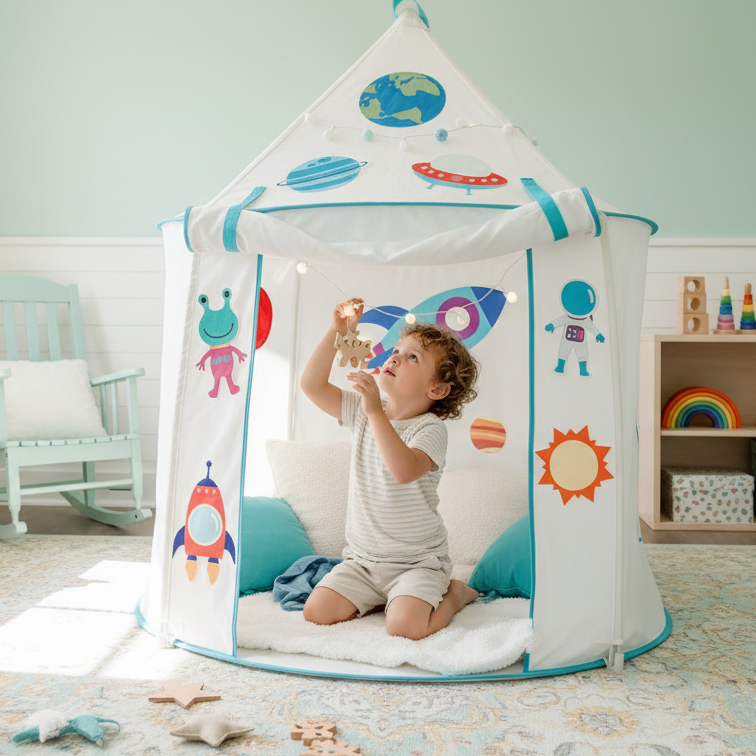
ZeeZee Adventures is designed around the idea of an adaptable play environment, with a play tent that can take on different themes and uses as children's interests change. Its changeable StickeeZ themes can transform the same space into different imaginative settings.
The space doesn't have to be permanently labeled as a “quiet corner.”
It can change depending on what your child needs and wants to do.

6. Make a “Look and Find” Book Game
Choose a picture book with detailed illustrations.
Instead of reading the entire book, ask your child to find different things on each page.
“Can you find the tiny bird?”
“Where is something red?”
“Can you find someone wearing a hat?”
This creates a simple, focused activity that can be done together.
Older children can create their own challenges for younger siblings.
7. Create a Drawing-and-Story Combination
Start with a simple drawing.
Then ask your child to tell you the story behind it.
Maybe they draw a strange-looking creature.
Ask:
“What's its name?”
“Where does it live?”
“What does it like to do?”
“Does it have any friends?”
The drawing becomes a character.
The character becomes part of a story.
And the story can eventually become another drawing.
This is a lovely example of how one quiet activity can naturally lead into another without needing much preparation.
8. Make a Simple Puzzle Station
Puzzles can be a useful quiet-time option because they give children something specific to focus on.
Choose puzzles that are appropriate for your child's age and interests.
You can make the experience more relaxed by setting up a small puzzle area rather than treating it as something they have to finish.
If they get stuck, resist the urge to immediately solve it for them.
Try:
“What piece do you think might fit here?”
or
“What do you notice about these two pieces?”
This gives them room to work through the problem themselves.
9. Look Through Family Photos
Quiet time can also be a chance to revisit memories.
Look through printed photographs or a family photo book together.
Ask questions:
“Do you remember this day?”
“Where were we?”
“What happened after this picture?”
Children often have their own memories and interpretations of family experiences.
The activity can become a conversation rather than simply looking at pictures.
10. Try Simple Nature Observation Indoors
You don't always have to go outside to encourage observation.
Place a safe houseplant near your child and invite them to look closely.
What shapes do they notice?
Are the leaves all the same?
Can they draw what they see?
If you have safe natural objects such as leaves, pinecones, or smooth stones, children can sort, draw, describe, or arrange them.
The activity is simple, but it encourages children to slow down and pay attention to details they might normally overlook.
11. Make a Quiet Pretend-Play World
Quiet play can still involve imagination.
A child can create a small pretend world using stuffed animals, dolls, blocks, or figures.
Maybe the toys are having a picnic.
Maybe they're running a tiny library.
Maybe they're camping.
Maybe they're preparing for a journey.
You don't have to direct the story.
Simply observe or occasionally ask a question.
“Where are they going?”
“What are they bringing?”
“Who is coming with them?”
Pretend play can be energetic, but it can also become wonderfully quiet when children are focused on a story.
12. Create a “Make Your Own Book” Project
Give your child several sheets of paper.
Fold them together or staple them if appropriate.
Then say:
“Let's make a book.”
Your child can decide:
-
The title
-
The characters
-
The setting
-
What happens
-
How the story ends
They can draw pictures and dictate the words to an adult if they aren't writing independently yet.
Older children can write their own stories.
Don't worry about spelling or artistic perfection.
The point is to create something that belongs to them.
13. Try a Calm Building Challenge
Give your child a small collection of materials and one simple prompt.
For example:
“Can you build the tallest tower you can?”
Or:
“Can you make a bed for your stuffed animal?”
Or:
“Can you build a tiny house?”
Then let them experiment.
They may discover that their first design doesn't work.
They may change the base.
They may try a different shape.
They may abandon the original idea completely.
That's okay.
Quiet activities don't need to be passive.
They can still involve thinking, experimenting, and making decisions.
14. Create a “What's in My Head?” Drawing Session
Give your child a blank sheet of paper and ask:
“Can you draw something you imagined today?”
It could be a dream, a character, a place, a creature, or an adventure.
There doesn't have to be a specific answer.
Some children may start drawing immediately.
Others may need more time.
Let the silence happen.
A quiet activity doesn't have to be filled with constant conversation.
15. Give Children Permission to Do Nothing
This may be the hardest quiet-time activity for adults to plan because it isn't really an activity.
Sometimes a child may simply want to lie down, look out the window, cuddle a stuffed animal, or sit in a cozy space.
That's okay.
Children don't need every moment to have an educational purpose or structured outcome.
A little unstructured time can give them room to decide what they want to do next.
And sometimes, after a few quiet minutes, an idea appears naturally.
Quiet Time Doesn't Have to Look the Same for Every Child
One child might recharge by looking through books.
Another might want to draw.
Another may quietly build with blocks.
Another might need to move for a few minutes before they're ready for something calmer.
There is no single “right” quiet-time activity.
Children have different temperaments, interests, energy levels, and preferences.
The goal is not to make every child behave quietly in the same way.
It's to give them access to different ways of slowing down.
How to Create a Better Quiet-Time Environment
The environment can make quiet activities easier to begin.
You don't need a dedicated room.
A small, predictable area can work.
Consider keeping a few calming choices within reach:
-
Books
-
Drawing materials
-
Simple puzzles
-
Building materials
-
Stuffed animals
-
Audio stories
-
Comfortable cushions
-
A blanket
-
A small play space
Try not to put everything out at once.
A smaller selection can make it easier for children to choose.
You can also rotate materials occasionally so familiar activities regain some novelty.
Quiet Time and Adaptable Play Spaces
A useful play environment doesn't have to serve only one purpose.
The same space can support active imaginative play in the morning and quieter activities later in the day.
A play tent might become a pretend spaceship during an adventure game.
Later, it can become a reading nook.
Another day, it might be a storytelling space filled with cushions and books.
That flexibility is central to the ZeeZee Adventures approach. The brand describes its play environment as something that can evolve with children's changing interests and imaginations rather than remaining fixed to one theme.
The idea is simple:
The space can change without the child needing a completely new space.
A Simple Quiet-Time Formula
When you're unsure what to offer, try:
SPACE + CHOICE + TIME
Space: Create somewhere comfortable and relatively free from distractions.
Choice: Offer two or three calm activities.
Time: Give your child enough uninterrupted time to decide what they want to do.
For example:
Space: A cozy corner with cushions.
Choice: Books, drawing, or building.
Time: Let your child explore without immediately changing the activity for them.
This approach keeps quiet time flexible rather than turning it into another scheduled task.
The Goal Isn't Perfect Calm
Quiet time isn't about making children silent, still, or perfectly regulated.
Some children will talk while they draw.
Some will move around while listening to a story.
Some will spend five minutes with one activity and then switch.
That's part of being a child.
The purpose is simply to create moments when the pace can slow down.
In a busy household, those moments can be valuable for everyone.
Sometimes the most meaningful play is loud and energetic.
Sometimes it's a child curled up with a book, drawing a world of their own, or quietly deciding what a cardboard box should become.
Both kinds of play have a place.
And sometimes, after a little quiet, children are ready to return to the world with a new idea.
FAQs
1. What are good quiet time activities for kids?
Reading, drawing, puzzles, building, storytelling, looking through books, listening to audio stories, creating a pretend-play world, and spending time in a cozy space are all options for quiet play.
2. What is quiet time for children?
Quiet time is a period when children can slow down and choose calmer activities without necessarily needing to sleep or nap. It can include reading, drawing, building, listening, resting, or independent play.
3. How can I help my child enjoy quiet time?
Create a comfortable space, offer a small selection of activities, and give your child enough uninterrupted time to choose what interests them. Some children may need a gradual transition from active play to quieter activities.
4. Does quiet time mean children have to sit still?
No. Quiet play can still involve movement, conversation, building, drawing, or pretend play. The idea is to create a slower, calmer type of activity rather than require complete stillness.
5. What are some screen-free quiet activities for kids?
Children can read books, draw, build with blocks, complete puzzles, listen to audio stories, look through family photographs, make books, or create quiet pretend-play scenarios.
6. How can I create a quiet corner for my child?
Choose a comfortable area with relatively few distractions and add a few accessible options such as books, cushions, drawing materials, puzzles, building toys, or stuffed animals. The space can be simple and doesn't need to be a separate room.
7. Can imaginative play be a quiet activity?
Yes. Imaginative play doesn't always involve running or loud activity. Children can create stories with stuffed animals, dolls, blocks, or a play tent while remaining relatively quiet and focused.
8. How long should quiet time last?
There isn't one appropriate length for every child. It can vary depending on age, temperament, daily schedule, and the child's needs. The focus can be on providing an opportunity for calmer play rather than meeting a fixed time target.






Comment (0)