
How to Create a “Yes Space” at Home (Without Constantly Saying No)
If your day sometimes feels like a running list of “no’s,” you’re not alone.
“No, don’t climb that.”
“No, that’s fragile.”
“No, that’s not for throwing.”
Of course, we set limits to keep our children safe. But when correction becomes the background noise of the day, frustration builds — for both parent and child.
What if instead of constantly managing behavior, we redesigned the environment?
This idea is often referred to as a “Yes Space” — a concept popularized in respectful parenting circles and discussed by parenting educator Janet Lansbury, who describes Yes Spaces as safe. In these prepared environments, children can explore freely without constant interruption or redirection.
What Is a Yes Space?
A Yes Space is a fully safe, enclosed play area where a child can:
-
Move freely
-
Explore independently
-
Test ideas safely
-
Engage without constant correction
A true Yes Space:
-
Is physically safe and enclosed
-
Includes open-ended materials
-
Encourages independent play
-
Reduces overstimulation
-
Minimizes repeated “no.”
When children know they can explore without interruption, something changes.
Play deepens.
Focus extends.
Confidence grows.
And the energy in the home shifts.
Why Modern Families Are Rethinking Play Spaces
Today’s childhood is full of stimulation — screens, noise, flashing toys, constant novelty.
Many single-function toys lose interest quickly once a child masters their limited use. When toys direct the storyline instead of inviting imagination, engagement shortens.
The result?
More toys.
More clutter.
Shorter attention spans.
Less sustained play.
Parents searching for how to create a Yes Space at home are often responding to this pattern.
They aren’t looking for more toys.
They’re looking for better toddler play spaces.

Designing a Yes Space in Your Home
You don’t need a dedicated playroom.
A Yes Space can be:
-
A gated section of your living room
-
A defined corner near the kitchen
-
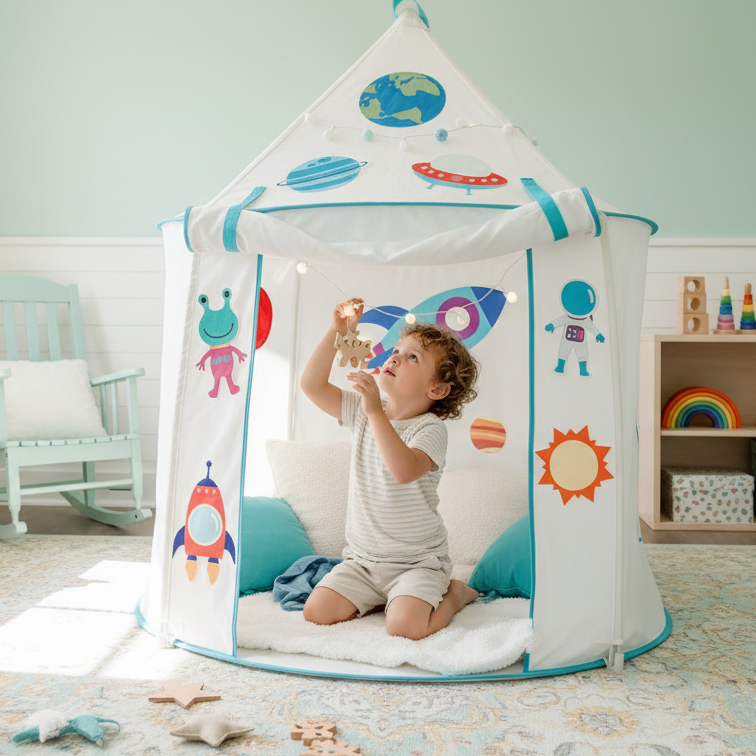
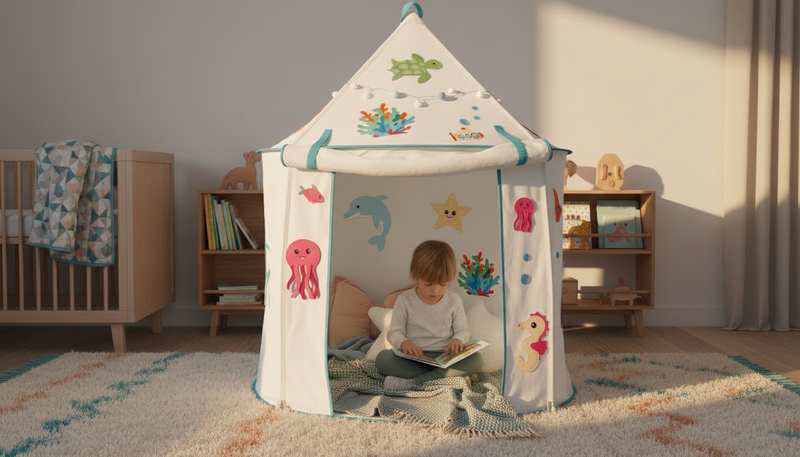
A cozy enclosed play structure
-
A calming corner for toddlers in a shared family space
The goal is simple: freedom within boundaries.
1. Enclosure Creates Security
Children relax when they understand the limits of their environment.
An enclosed space signals safety and ownership.
It allows you to step away briefly while still supporting independent play for toddlers at home.
2. Fewer, Open-Ended Materials
Simple objects often invite deeper play than complex, one-function toys.
Think:
-
Stacking materials
-
Soft dolls
-
Building pieces
-
Sensory textures
-
Balls of different sizes
Open-ended materials invite imagination instead of directing it.
3. A Flexible Play Environment
Some families choose a customizable play tent as the anchor of their space
Unlike fixed-design tents, adaptable structures allow the same environment to transform without replacing it.
With interchangeable StickeeZ themes, the same structure can evolve as interests change.
One Tent. Changeable Themes. Endless Adventures.
The structure remains familiar.
The story changes.
And that distinction matters.
When a Toy Becomes a Territory
Children regulate emotions more effectively in environments they can predict and influence. A calming corner for toddlers. A retreat during overstimulation.
A sensory-friendly play space. When a space remains consistent but flexible, it stops feeling like a toy. It becomes emotional infrastructure.
Supporting Emotional Regulation Through the Environment
A thoughtfully designed Yes Space supports:
-
Emotional regulation
-
Self-confidence
-
Focus and longer attention spans
-
Secure attachment
-
Problem-solving
Instead of constant correction, children experience trust.
Instead of restriction, they experience agency.
Frequently Asked Questions About Creating a Yes Space
What is a Yes Space for toddlers?
A Yes Space is a fully safe, enclosed play area where toddlers can explore freely without constant correction. It encourages independent play, confidence, and emotional regulation while reducing the need for repeated “no.”
How do you create a Yes Space at home?
To create a Yes Space at home:
-
Choose a physically safe and enclosed area
-
Remove breakable or unsafe items
-
Include open-ended materials
-
Add soft textures and calming elements
-
Create a defined structure that supports both play and retreat
Many families use a customizable play tent to anchor their toddler play space.
What is the difference between a Yes Space and a playroom?
A playroom may contain many toys. A Yes Space is intentionally designed to allow freedom within boundaries. It focuses on safety, autonomy, and open-ended exploration rather than quantity of toys.
Can a play tent be used as a calming corner?
Yes. An enclosed play tent can function as a calming corner for toddlers when designed thoughtfully. When paired with soft lighting and sensory-friendly elements, it becomes a safe place for emotional regulation and independent play.
Why do toddlers lose interest in toys so quickly?
Many single-function toys lose novelty once children master their limited use. Open-ended environments and adaptable play spaces tend to hold attention longer because they evolve with a child’s imagination.




Comment (0)