
Why Creative Play Is Essential for Early Childhood Development
We often talk about creativity as if it’s something a child is born with.
“She’s so creative.”
“He just doesn’t have that artistic side.”
But if you spend enough time watching children at play, something becomes clear:
Creativity isn’t a personality trait.
It’s a practice.
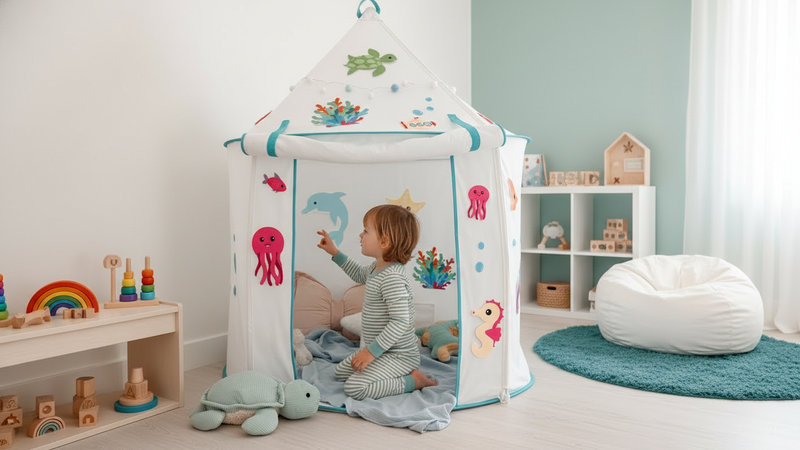
It’s built in the quiet moments when a child turns the same wooden blocks into three different worlds. It grows when a simple pile of sea animals becomes an ocean ecosystem with rules, stories, and invisible currents. It strengthens when a cardboard box becomes anything but a box.
Creativity doesn’t appear fully formed.
It develops through play.
And in today’s fast-paced, highly structured childhood, that kind of play matters more than ever.
Creativity Grows Through Experience, Not Instruction
Creative thinking doesn’t thrive on memorization or step-by-step outcomes. It develops through experience — through touching, building, rearranging, imagining, and sometimes starting over.
When children are given open-ended play opportunities, something subtle happens. They pause. They observe. Then curiosity takes over.
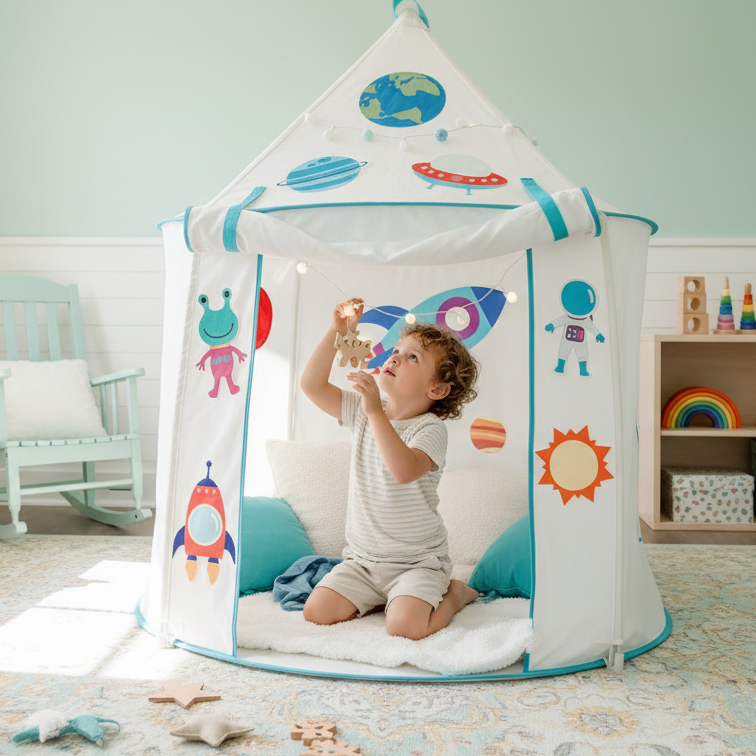
A few blocks become a city, a blanket becomes a cave, a quiet corner becomes an entire universe.
This is how children develop problem-solving skills, flexible thinking, and emotional confidence — not through repetition, but through experimentation.
Open-ended play permits them to test ideas safely.
Why Imaginative Play Supports Real Learning
There’s a powerful connection between imaginative play and early childhood development.
When a child invents an underwater world, they aren’t simply arranging toys — they’re exploring habitats, relationships, and cause-and-effect through storytelling.
When they pretend to travel through space, they begin to think about distance, movement, and possibility. They connect imagination with real-world concepts.
Imaginative play strengthens:
-
Creative thinking
-
Emotional regulation
-
Attention and focus
-
Independent problem-solving
-
Confidence in decision-making
And when learning feels self-directed, children remember it more deeply.
Play becomes meaningful, not performative.
Play Is a Child’s Natural Learning Language
To adults, play can look repetitive or simple. But beneath the surface, important developmental work is happening.
Children are:
-
Making choices
-
Testing solutions
-
Adjusting when something doesn’t work
-
Processing emotions through storytelling
In calm, thoughtfully designed play environments, children feel safe enough to explore ideas fully. They’re not rushing to the next activity. They’re immersed.
That immersion builds attention span — something many parents worry about in a screen-saturated world.
Screen-free, open-ended play supports deeper focus because it requires imagination, not passive consumption.
Creativity Strengthens With Practice
Like reading or movement, creativity improves the more it’s used.
Not through structured drills — but through repeated invitations to imagine.
Each time a child redesigns a scene, changes a storyline, or experiments with materials, they’re strengthening flexible thinking. They’re learning that ideas can evolve.
Over time, this builds creative confidence — the willingness to try something new without fear of getting it “wrong.”
And that mindset carries far beyond childhood.
How Parents Can Support Creative Development at Home
Encouraging creativity doesn’t require elaborate systems or expensive materials. Often, it starts with something simpler:
Space.
Space to explore without constant correction.
Space to rearrange and redesign.
Space to ask questions instead of receiving instructions.
Small shifts make a difference:
-
Offer open-ended materials instead of single-purpose toys
-
Ask reflective questions (“What’s happening in your story?”)
-
Reduce visual clutter to create calmer play environments
-
Celebrate effort and curiosity rather than perfection
When children feel ownership over their ideas, creativity becomes natural — not pressured.
Making Room for Imagination
Creativity isn’t reserved for a gifted few.
It’s a life skill built slowly through experience, imagination, and play.
In a world that moves quickly and constantly competes for attention, children need space to slow down. To build worlds from scratch. To test ideas without a script.
When we protect time for open-ended, screen-free play, we’re not just encouraging creativity.
We’re helping children build the confidence to think independently — a skill they’ll carry for life.





Comment (0)