

How to Design a Playroom That Reduces Tantrums and Overwhelm
Introduction: When Play Spaces Become Overwhelming
Playrooms are often designed with the best intentions.
Bright colours.
Abundant toys.
Walls filled with stimulation.
At first glance, these environments appear engaging and child-friendly. Yet many parents notice an unexpected pattern.
Children become restless.
Play feels scattered.
Tantrums emerge more frequently.
This raises an important question: can the design of a playroom itself contribute to emotional overwhelm?
Research in child development and environmental psychology suggests that it can.
Children are highly sensitive to their surroundings. The structure, colour, layout, and sensory load of a space all influence how they think, feel, and behave.
A thoughtfully designed playroom does more than provide entertainment. It creates an environment that supports emotional regulation, focus, and calm.
Understanding Why Children Become Overwhelmed
Young children are still developing the ability to regulate their emotions and filter sensory input.
Unlike adults, they cannot easily ignore background noise, visual clutter, or competing stimuli.
When a space contains too many elements demanding attention, the brain must process everything at once.
This can lead to:
- sensory overload
- reduced attention span
- irritability
- emotional outbursts
Tantrums are often not simply behavioural issues. They are frequently a response to environments that feel overwhelming or unpredictable.
The Role of Environment in Emotional Regulation
Emotional regulation is closely linked to a child’s surroundings.
Calm, structured environments support the nervous system. They allow children to feel safe, focused, and in control.
Chaotic environments, by contrast, can trigger stress responses.
Research shows that children are more likely to remain engaged and emotionally stable when their environment:
- reduces unnecessary stimulation
- provides a clear structure
- allows for predictable interactions
This makes playroom design a critical factor in daily emotional experiences.
The Problem With “More Is Better”
Many playrooms follow a common pattern: more toys, more colour, more stimulation.
While variety can be beneficial, excess often has the opposite effect.
Too many toys can lead to:
- decision fatigue
- shallow engagement
- constant switching between activities
Children may struggle to settle into play because their attention is divided.
Studies have shown that when fewer toys are available, children tend to play more deeply and creatively.
The key is not quantity, but quality and accessibility.
Creating Visual Calm Through Colour and Layout
The visual environment plays a powerful role in how children feel.
Bright, highly saturated colours can be stimulating, but when used excessively, they can contribute to sensory overload.
Calm colour palettes—such as soft blues, greens, and neutrals—help reduce visual noise.
Equally important is layout.
Clear, open spaces allow children to:
- move freely
- Focus on individual activities
- feel a sense of order
When everything is visible and organised, the environment becomes easier to process.
Zoning: Structuring the Playroom
One of the most effective strategies in playroom design is zoning.
Instead of treating the space as a single open area, it is divided into functional zones.
For example:
- a quiet reading corner
- an imaginative play area
- a creative or craft space
Each zone supports a specific type of activity.
This structure helps children understand how to use the space and reduces the cognitive effort required to choose what to do next.
The Importance of Open-Ended Play
Open-ended play materials are particularly effective in reducing overwhelm.
Unlike toys with fixed functions, they allow children to create their own experiences.
This supports:
- creativity
- problem-solving
- emotional expression
Open-ended play also tends to be slower and more immersive, which helps regulate attention and reduce overstimulation.
Designing for a Sense of Security
Children often seek spaces that feel contained and predictable.
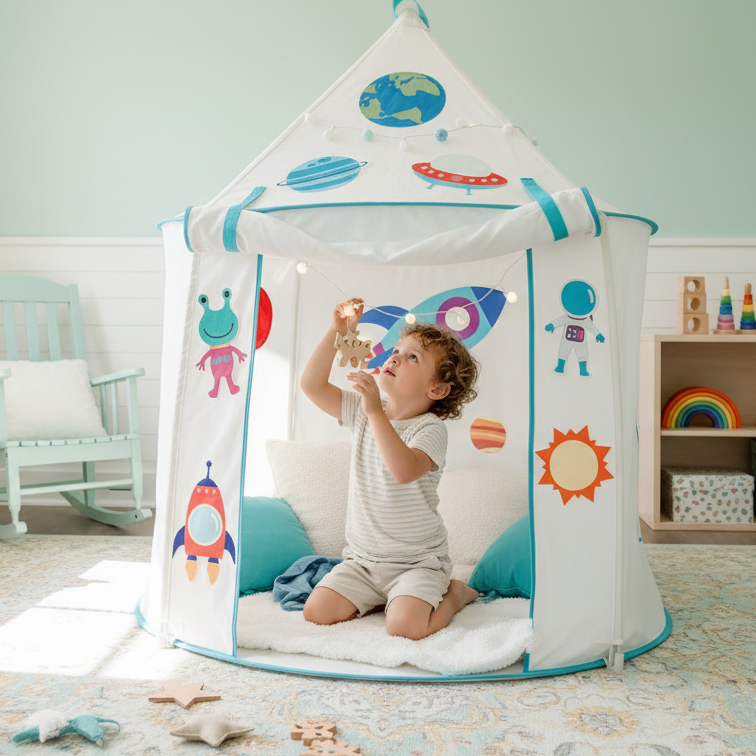
Small, enclosed or semi-enclosed areas can provide a sense of comfort.
These spaces allow children to retreat, reset, and engage in focused play.
Modern approaches to playroom design increasingly incorporate flexible, child-led environments that can be adapted over time.
For instance, concepts explored in platforms such as ZeeZee Adventures reflect this shift towards creating calm, adaptable play environments where children can shape their own experiences. Rather than overwhelming the child with constant stimulation, these spaces provide a foundation for imagination and emotional balance.
Lighting and Sensory Balance
Lighting plays a subtle but important role.
Harsh, bright lighting can increase stimulation, while softer, diffused light creates a calmer atmosphere.
Natural light is particularly beneficial, as it supports both mood and focus.
Reducing background noise and visual distractions further enhances the environment.
Together, these elements contribute to a space that feels safe and manageable.
Encouraging Independent Play
A well-designed playroom encourages independence.
When children can easily access and understand their environment, they are more likely to engage in self-directed play.
This reduces frustration and dependency, both of which can contribute to emotional outbursts.
Simple design choices—such as accessible storage and clear organisation—can make a significant difference.
The Role of Routine and Consistency
Design alone is not enough. Routine plays a complementary role.
When children know what to expect from their environment, they feel more secure.
Consistent use of playroom zones reinforces structure and predictability.
This combination of design and routine supports emotional stability.
A Different Approach to Playroom Design
Rather than asking how to make a playroom more exciting, it may be more useful to ask a different question.
How can the space support calm, focus, and creativity?
Often, the answer involves reducing rather than adding.
Less clutter.
Less noise.
Less visual overload.
More space for imagination.
Conclusion: Designing for Calm and Connection
A playroom is not just a place for toys.
It is an environment that shapes how children think, feel, and behave.
When designed thoughtfully, it can reduce overwhelm, support emotional regulation, and encourage meaningful play.
Because sometimes the most effective play spaces are not the most stimulating ones—
But the ones that feel calm enough for children to engage truly.





Comment (0)