
How to Design a Playroom That Encourages Creativity
A child walks into a perfectly decorated playroom.
There is a miniature kitchen with every accessory. A carefully themed dollhouse. Matching storage bins. Shelves filled with toys. Activities waiting on the table.
And five minutes later:
“What should I play?”
It seems contradictory. How can a room contain so much entertainment and still leave a child unsure what to do?
Because a playroom that looks creative is not necessarily a playroom that asks children to be creative.
Creativity needs something adults sometimes accidentally design out of children's environments: unfinished possibilities. A block that has not already been assigned a purpose. A piece of fabric that could become almost anything. An empty stretch of floor. A cardboard box. Materials that can be combined in ways nobody planned. A space children are allowed to change.
The goal, then, is not to design the most stimulating playroom possible. It is to create an environment that provides enough inspiration to begin while leaving enough unanswered for the child to continue.
Here is how to design a playroom that makes more room for imagination, experimentation, storytelling, problem-solving, and genuinely child-led creative play.
Quick Answer: What Makes a Playroom Creative?
A creative playroom is a flexible environment where children can access materials, combine them in different ways, change the space, invent stories, build original ideas, and play without every activity having a predetermined result.
Prioritize open-ended materials such as blocks, drawing supplies, figures, fabric, cardboard, building pieces, books, and reusable scenery. Keep choices manageable, preserve some open floor, make independent materials reachable, and resist designing every corner around one permanent theme.
Most importantly, create a room that asks:
“What could you make here?”
rather than:
“Which activity would you like to complete?”
Key Takeaways
-
Creativity is supported by opportunities to imagine, experiment, combine ideas, and make choices—not simply by owning toys marketed as “creative.”
-
Open-ended materials leave more decisions to the child than toys with highly prescribed outcomes.
-
An uncluttered room can make individual possibilities easier to notice.
-
Empty space is useful creative space.
-
Art, construction, storytelling, books, movement, and pretend play can overlap rather than living in separate activity stations.
-
Children should be allowed to alter parts of the environment instead of only occupying a room adults have finished designing.
-
Parents can support creativity by offering materials and time without continually directing what the finished play should look like.
What Does Creativity Look Like in Children's Play?
Creativity in childhood is broader than painting a picture or making a craft.
It happens when a child takes an idea and changes it.
A cardboard box becomes a veterinary clinic. Two blocks become telephones. A scarf represents lava that nobody is allowed to touch. A drawing becomes a treasure map that sends the entire family around the house.
Creative play frequently involves divergent possibilities rather than one predetermined answer.
This is one reason free and imaginative play matters. Head Start describes play as an important context through which young children explore their environment, relationships, bodies, and developing abilities. Harvard's Center on the Developing Child also notes that playful activities provide opportunities to practice abilities such as attention, working memory, and self-control.
That does not mean a particular playroom design will make a child “more creative.” Creativity develops within a much larger combination of experience, relationships, interests, temperament, learning, and opportunity.
The environment can, however, provide more opportunities for children to make creative decisions.
For a broader look at supporting those opportunities throughout everyday family life, ZeeZee Adventures' ideas for encouraging more creative play at home make a useful companion to this room-specific guide.
1. Begin With Less, Not More
The first step in designing a creative playroom may be removing something.
A wall of toys looks full of possibility to an adult, but children still have to direct attention toward one object and decide what to do with it.
A small experimental study involving 36 toddlers compared play with four toys versus sixteen toys. In the environment with fewer toys, children played with individual toys for longer and explored them in a greater variety of ways. It is a small study and does not establish an ideal number of toys for every child, but it offers useful evidence that simply increasing choice does not necessarily improve play quality.
Try storing part of the toy collection and leaving breathing room between what remains.
You do not need a rigid rotation schedule.
Watch what is being used.
Leave deeply engaging materials available. Rotate items that have become almost invisible.
The goal is not minimalism.
It is visibility of possibility.
2. Give Open-Ended Materials the Best Space
If you want more creative play, give prominent space to materials that do not finish the idea for the child.
Blocks are useful because they do not know whether they are supposed to become a tower, road, zoo, cake, robot, or castle.
Fabric has no problem becoming an ocean one minute and a superhero cape the next.
Cardboard is remarkably cooperative about almost any imaginary assignment.
Figures, reusable scenery, construction materials, clay or play dough, paper, and drawing tools can all move between activities.
This does not mean fixed-purpose toys are bad. A child can play creatively with an extremely specific toy too.
The useful question is simply:
How many decisions does this material leave to the child?
The more decisions the child gets to make, the more opportunity there is to create rather than merely follow.
3. Preserve Empty Floor Space
Parents often design playrooms by asking what should go into every corner.
Try asking what should not.
Open floor is one of the most adaptable materials in the room.
It can hold a block city, a cardboard rocket, a dance, a train route, an animal kingdom, a blanket fort, or an elaborate game that somehow requires every stuffed animal in the house.
Once floor space is permanently occupied by tables, storage units, activity centers, and bulky single-use toys, those possibilities become harder.
Empty space is not unfinished interior design.
For children, it is an invitation.
4. Put Art Materials Where Art Can Become Part of Play
Creative materials are often kept in a craft cupboard and brought out when adults announce an art activity.
There is another possibility.
Keep a small selection of developmentally appropriate drawing materials accessible enough that children can use them when their play suddenly requires something.
The dinosaur park needs tickets.
The shop needs a sign.
The explorers need a map.
The invented creature needs to be documented.
Now art is not a separate scheduled activity.
It becomes a language children can bring into whatever they are already imagining.
This is often more interesting than continually providing crafts with one prescribed finished product.
A blank sheet communicates:
You decide.
5. Put Books Close to Building and Pretend Play
Books do not have to live in a separate “quiet learning” zone.
Stories give children raw material for other stories.
A book about oceans can change what happens with blue fabric later that afternoon.
A picture of a suspension bridge may appear again in the block area.
A story about an astronaut can turn a cardboard box into a spacecraft.
Creativity does not mean inventing ideas from nowhere. Human creativity frequently involves noticing, borrowing, combining, transforming, and recombining experiences.
Keep a rotating selection of books near the places where children build and pretend.
Then allow the connection to happen naturally.
You do not need to ask for a book report afterward.
6. Create One Area With No Permanent Identity
A creative playroom benefits from at least one place that does not always represent the same thing.
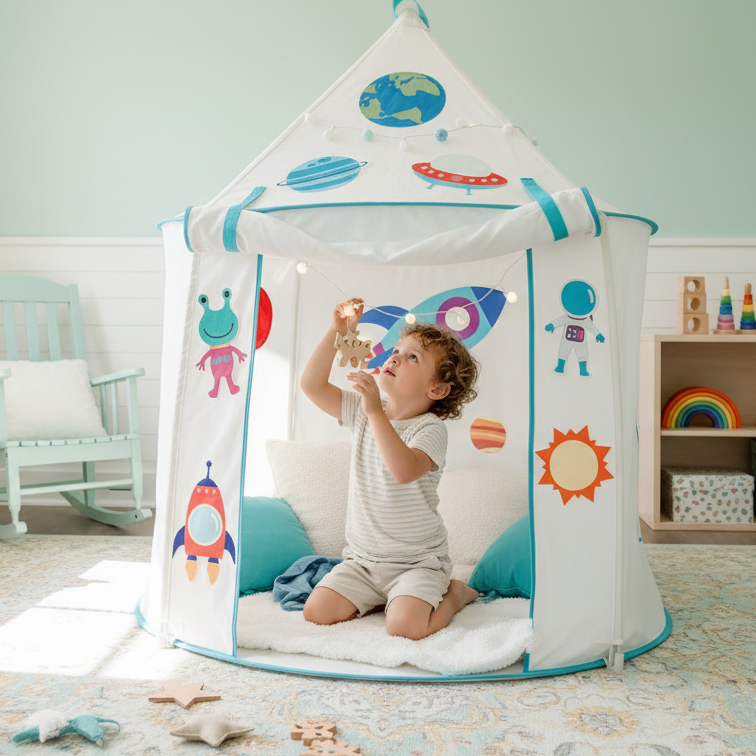
Perhaps it is a play tent.
Perhaps it is underneath a table.
Maybe it is an open corner with several cushions and pieces of fabric.
Today it becomes a restaurant.
Tomorrow it is the inside of a whale.
Later it becomes the headquarters of a rescue team responsible for a crisis adults have not been fully briefed about.
Permanent themed rooms can be visually delightful, but a flexible setting gives the child another creative decision:
Where are we today?
That question can start an entire afternoon of play.
7. Let Children Alter the Scenery
Adults usually design rooms and children use them.
A more creative arrangement allows children to design part of the environment too.
Consider a surface where artwork can change, reusable felt pieces can move, scenery can be rearranged, or cardboard backgrounds can be redrawn.
Children can then influence not only the objects inside the game but the world surrounding it.
This principle is also relevant to ZeeZee Adventures' approach to the play environment. The ZeeZee Adventures Tent uses swappable felt StickeeZ, allowing the same physical structure to shift between themes such as space, dinosaurs, oceans, and imaginative kingdoms as children's stories change.
The important creative principle is broader than the product:
Keep the structure familiar while allowing the story to change.
A felt board, children's artwork, fabric backdrop, chalk surface, or decorated cardboard wall can use the same idea.
8. Organize Materials—But Don't Organize the Imagination
Toy organization is useful until the rules become more important than the play.
Adults tend to think categorically:
Cars belong here.
Animals belong there.
Blocks belong in that basket.
A child may have other plans.
The dinosaur needs to ride in the ambulance.
The wooden blocks are now sandwiches.
A scarf has become a road.
The toy saucepan is obviously a helmet.
Let materials cross categories.
Keeping the room generally organized helps children locate and reset materials. Insisting that every category remain separate during play can limit the very combinations that often produce creative ideas.
Organize the storage.
Not the story.
9. Create Invitations Without Designing the Outcome
Parents can sometimes help play begin without controlling where it ends.
Put several animal figures beside the blocks.
Place a cardboard tube near the art supplies.
Leave a book about castles near some construction pieces.
Add an unfamiliar piece of fabric to a familiar pretend-play area.
Then stop.
There is an important difference between:
“Build a castle with these blocks.”
and:
“I wonder what you'll make.”
The first provides an outcome.
The second preserves possibility.
And if the child ignores your beautifully subtle invitation and spends twenty minutes pretending the laundry basket is a bus?
The creative play still succeeded.
10. Design for Making, Breaking, and Trying Again
Creative spaces should tolerate unsuccessful ideas.
A tower falls.
Tape does not hold.
The cardboard bends.
The bridge cannot support the animals.
The drawing looks different from what the child imagined.
These moments are part of creating.
If adults immediately repair every problem, children lose opportunities to decide what to change.
Harvard's play resources emphasize playful opportunities for children to practice attention, working memory, and self-control. Creative construction can naturally require children to remember an idea, notice feedback, alter a plan, and try another approach.
Instead of immediately saying, “Here, I'll fix it,” try:
“You're trying to keep that standing.”
Then wait.
Creativity often needs a little space after something goes wrong.
11. Allow Some Projects to Stay Unfinished
A playroom designed for creativity should not always reset to zero.
If practical, give children one place where an unfinished project can remain temporarily.
A tray.
A table corner.
A low shelf.
A section of floor.
Returning to yesterday's world lets a child ask different questions.
What was I making?
What could I add?
Do I still like that idea?
Could this become something else?
Creative work often develops through revision rather than one burst of inspiration.
Children deserve that opportunity too.
12. Make Materials Accessible Enough for Spontaneous Ideas
Creative momentum disappears quickly when every next step requires adult permission.
If your child suddenly decides their cardboard boat needs a flag, can they access paper and crayons?
If the block city needs characters, can they reach some?
If the fort needs fabric, is there a safe basket they are allowed to use?
Accessibility supports agency.
That does not mean putting every household item within reach. Materials involving scissors, small parts, art supplies, or other hazards need to match the child's age, abilities, and supervision needs.
But the materials intended for independent use should be independently usable.
Otherwise, the room quietly teaches children to wait for an adult before extending an idea.
13. Include Inspiration Without Over-Theming the Room
A creative playroom does not have to be visually blank.
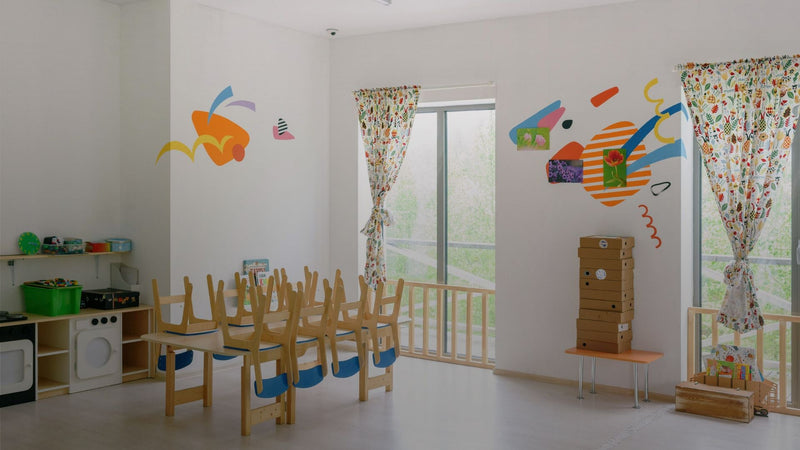
Children can enjoy color, artwork, maps, family photographs, nature displays, children's own creations, interesting books, and changing objects.
The distinction is between inspiration and instruction.
A giant permanent pirate mural can make a space feel like a pirate room.
A changing collection of child-created pictures allows the room to become almost anything.
There is no requirement to make every playroom neutral or minimalist.
Just consider whether the decoration expands possible stories or defines them too narrowly.
14. Let the Child Leave a Visual Fingerprint
One of the easiest ways to make a room feel creative is to stop making it entirely adult-designed.
Display some of your child's artwork.
Ask where a few materials should go.
Allow them to choose which books are currently visible.
Let older children help decide what should be rotated out.
Create a small area they can regularly redesign.
The room does not need to surrender completely to children's decorating decisions.
But if children are never allowed to influence the space, it sends an interesting message:
Be creative here—but please don't change anything.
A room intended for creators should show some evidence that creators live there.
15. Protect Time as Carefully as You Design Space
A beautifully designed room cannot support deep creative play if children never have enough uninterrupted time to use it.
Creativity often begins slowly.
The first few minutes may involve wandering.
Moving objects.
Saying “I'm bored.”
Trying one idea and abandoning it.
Adults can interpret that uncertainty as evidence that the child needs entertainment.
Sometimes it is simply the transition before self-directed play develops.
Do not expect every unstructured period to turn into an extraordinary imaginary world.
But whenever possible, avoid filling every hesitation with another activity suggestion.
The playroom provides the ingredients.
Time lets children decide what to cook.
Creative Playroom Design: What Helps and What Can Get in the Way?
|
Design choice |
More supportive of creative play |
More restrictive when overused |
|
Toy selection |
Versatile materials with multiple uses |
Large numbers of highly prescribed toys |
|
Floor plan |
Open space that can change |
Every area permanently assigned |
|
Art |
Accessible materials and blank paper |
Only adult-led finished crafts |
|
Pretend play |
Flexible props and scenery |
One permanently scripted world |
|
Storage |
Clear, child-friendly categories |
Rules preventing materials from mixing |
|
Decoration |
Changing inspiration and child artwork |
Themes that define every story |
|
Adult role |
Curiosity, observation, occasional prompts |
Continual instructions and corrections |
|
Project time |
Some opportunities to return later |
Every creation dismantled immediately |
The goal is not to eliminate structure. Children can enjoy puzzles, crafts, games, and highly detailed toys alongside open-ended experiences.
A creative playroom simply makes sure not everything has already been decided.
Common Playroom Design Mistakes
One common mistake is confusing visual stimulation with creativity. A room can be colorful, elaborate, and filled with activities without giving the child many meaningful choices.
Another is purchasing too much before observing how the child actually plays. A toy marketed for creativity may be less generative for your child than cardboard, figures, or a building material they repeatedly return to.
Parents can also over-direct the room. Carefully arranged activity trays can be useful, but when every play experience arrives with instructions, children receive fewer opportunities to generate their own starting point.
Finally, avoid judging the quality of creative play by the finished product.
The strangely shaped cardboard structure that collapses may have required much more experimentation than the beautiful craft completed by following twelve adult-directed steps.
Process matters.
Parent Action Checklist
Before redesigning the entire room, try these changes first:
-
Remove several rarely used toys from visible storage.
-
Preserve an open patch of floor.
-
Put safe drawing materials where children can access them.
-
Add several open-ended materials such as blocks, fabric, figures, or cardboard.
-
Place books close enough to inspire other play.
-
Create one area that can become different imaginary settings.
-
Allow children to combine toys from different storage categories.
-
Display some child-created artwork.
-
Give selected unfinished projects somewhere to remain.
-
Reduce unnecessary background screens and distractions.
-
Wait before supplying a solution when a child says, “I don't know what to do.”
-
Observe what your child repeatedly creates before buying more.
Frequently Asked Questions
What should be in a creative playroom?
A creative playroom can include blocks, figures, art materials, books, fabric, cardboard, pretend-play objects, construction materials, reusable scenery, and enough open space to combine them. The specific materials should suit the child's age, interests, and safety needs.
Do children need lots of toys to be creative?
No. More toys do not automatically produce more creative play. In one small study of 36 toddlers, children showed longer engagement with individual toys and more varied play when fewer toys were available. The finding should not be turned into a universal toy-count rule, but it suggests that reducing choice can sometimes support deeper exploration.
What colors make children more creative?
There is no established playroom color guaranteed to increase creativity. Choose a visual environment that works for your family and child rather than relying on claims that a particular color produces a developmental outcome.
Are open-ended toys better for creativity?
Open-ended materials can be particularly useful because they leave children more decisions about what an object represents and how it will be used. They do not need to replace every structured toy; the goal is to maintain a healthy amount of play where the child determines the outcome.
How do I encourage creativity without buying more toys?
Rotate existing materials, add safe household objects such as cardboard or fabric where appropriate, combine toys that are normally stored separately, provide blank paper, preserve open floor space, and allow children longer periods of child-led play. ZeeZee Adventures has a separate guide devoted specifically to encouraging creative play without buying more toys.
Does a creative playroom need to be large?
No. A small corner can support highly imaginative play when materials are flexible, and children are allowed to transform the space. ZeeZee's existing guide to creating an open-ended play space at home also emphasizes flexibility and accessibility rather than requiring a dedicated large room.
Should parents join creative play?
Sometimes. Shared play can be enjoyable and valuable, but adults do not have to enter every game. When a child is deeply engaged, simply protecting the time and allowing the child's story to remain theirs can be useful.
Don't Design the Most Creative Playroom. Design the Least Finished One.
Parents can select beautiful furniture.
Organize the shelves.
Choose thoughtful toys.
Hang artwork.
Create storage.
But there is one thing we cannot successfully design in advance:
the child's idea.
That is why the best creative playroom is not necessarily the room with the most activities.
It is the room with space left inside it.
Space for the block to become something unexpected.
Space for the child to move two unrelated objects together.
Space for an unfinished project.
Space for an idea to fail.
Space for tomorrow's story to look nothing like today's.
ZeeZee Adventures' wider philosophy of changeable imaginative environments follows that same principle: familiar play structures can remain open to new stories rather than requiring the child's imagination to stay inside one permanent theme. The current StickeeZ system, for example, lets families swap felt themes while keeping the underlying play environment familiar.
But the principle begins long before any product.
A cardboard box can do it.
A blanket can do it.
An empty corner can do it.
For families who want to take this idea further, how to create an open-ended play space at home is the natural next ZeeZee resource.
You do not need to design your child's imagination.
Just leave enough room for it to arrive.
Author Bio
The ZeeZee Play Experts share research-informed ideas about imaginative play, creativity, independent play, sensory exploration, and screen-free childhood. ZeeZee Adventures' educational resources help families create environments that give children more opportunities to invent, explore, and direct their own play.




Comment (0)