
Small Playroom Ideas for Modern Families
A playroom sounds wonderful until you look around your home and realize there is no spare room waiting to become one.
For many modern families, children's play happens in spaces that already have another job. The living room is also the playroom. The dining area becomes an art table after breakfast. A bedroom needs to hold clothes, books, toys, and somewhere to build. In an apartment, the “playroom” may be one wall, one corner, or a basket that comes out in the afternoon and disappears before dinner.
That does not make the space inadequate.
Children do not need a large dedicated room to build, pretend, draw, move, read, and develop their own play ideas. What matters more is whether the environment makes those experiences reasonably easy to begin.
A thoughtfully designed small play space can give children materials they can reach, enough room to manipulate them, permission to transform part of their environment, and a simple way to reset the space when family life needs the room back.
For modern families, the goal is therefore not to create a miniature preschool inside the house.
It is to make less space work harder without filling every available inch with toys.
Quick Answer: How Do You Create a Playroom in a Small Space?
To create a playroom in a small home, define a compact play zone, keep only a manageable selection of toys accessible, use vertical and concealed storage, choose open-ended materials with multiple uses, preserve some clear floor space, and make frequently used items easy for children to reach independently.
The play area does not need to remain permanently set up. Portable baskets, rolling storage, foldable materials, temporary forts, and transformable play environments can allow the same room to serve children during play and the rest of the family at other times.
The best small playroom is not necessarily the one that stores the most toys.
It is the one that supports the most possibilities per square foot.
Why Small Playrooms Can Work Surprisingly Well
Parents sometimes assume that more space automatically creates better play.
Space certainly helps with certain kinds of movement and large construction, but size alone does not determine whether children become absorbed in play. A large room filled with competing materials can still make it difficult to know where to begin, while a smaller environment with accessible, flexible materials can offer a clearer starting point.
The broader developmental value comes from play itself. The American Academy of Pediatrics describes play as an important context for children's cognitive, language, social-emotional, and executive-function development, and notes that less-directive play allows children greater opportunities to explore and create.
For toddlers specifically, current CDC parenting guidance also encourages free play and opportunities for active movement as part of everyday development.
So rather than asking, “Is our home large enough for a proper playroom?” a more useful question is:
“Can my child easily begin meaningful play with the space we already have?”
That question opens many more possibilities.
1. Stop Thinking in Rooms and Start Thinking in Zones
The word playroom can make parents imagine four dedicated walls.
A play zone is more realistic.
It might occupy one side of the living room, the end of a hallway, a bedroom corner, a section beneath a loft bed, or a small patch beside the dining area.
Defining the space visually can help without building permanent walls. A washable rug, floor mat, low shelf, basket, or piece of furniture may be enough to communicate where play materials generally belong.
The advantage is flexibility.
The family does not lose an entire room, and the child still gains somewhere that feels recognizably available for play.
For families thinking more broadly about how environments influence self-directed activity, ZeeZee Adventures' ideas for designing a home that encourages independent play make a useful companion resource.
2. Preserve Floor Space Before Adding Furniture
In a small room, every new piece of furniture feels as though it should solve a storage problem.
But children also need somewhere to actually play.
A large cabinet may hold dozens of toys while simultaneously removing the floor area needed to build a block city, arrange animals, stretch out with drawing materials, or construct a fort.
Before adding another storage unit, protect some open floor.
This may feel counterintuitive because empty space appears “unused.” For children, it is often highly usable.
The same patch of floor can become a road system in the morning, a dance floor after lunch, and an imaginary campsite in the afternoon.
That flexibility is especially valuable when square footage is limited.
3. Use Vertical Space for Storage, Not for Play Everything
Walls are useful when floors are scarce.
Higher shelving can hold adult-access materials, toy rotations, extra craft supplies, or items that require supervision. Lower shelves can contain the smaller selection children are allowed to use independently.
The important distinction is accessibility.
Not everything needs to be within reach.
But the materials you expect children to use independently should not require adult assistance every time.
This creates a useful two-level system:
child-accessible play materials below; adult-managed storage above.
It lets small rooms hold more without placing the entire collection in the child's visual field at once.
4. Choose Toys by Play Value, Not Storage Quantity
Small spaces make one question particularly useful:
How many different kinds of play can this object support?
Blocks perform well because they can become buildings, roads, furniture, food, walls, or landscapes.
Fabric can become dress-up clothing, water, a roof, scenery, or a blanket.
Figures can move between construction play and storytelling.
Cardboard can become almost anything.
The AAP's guidance on toys emphasizes traditional, developmentally appropriate toys that support imagination, language, problem-solving, creativity, and interaction rather than assuming that additional electronic features create greater developmental value.
For a small home, open-ended materials have an additional practical advantage:
One object can do the work of several highly specific toys.
5. Rotate Instead of Displaying Everything
You do not have to organize every toy your child owns into the play area.
Keep part of the collection elsewhere.
When several materials have lost their novelty or are rarely touched, replace one or two with something stored away.
Toy rotation does not require a color-coded calendar or Sunday evening ritual.
Let actual play guide it.
If the train set is being used every day, leave it.
If three baskets have not been touched for weeks, that may be a reasonable place to simplify.
A small play area becomes much easier to manage when storage is not expected to simultaneously function as an exhibition of every object the child has ever received.
6. Make Storage Part of the Reset
For multipurpose rooms, cleanup matters.
A play space that takes forty minutes to restore every evening will eventually become exhausting, no matter how beautiful it looks.
Use large, understandable categories instead of complex systems.
Blocks.
Figures.
Art.
Books.
Dress-up.
Cars.
The categories should make sense to the family, not to Instagram.
A few baskets or bins that can slide into a cabinet, underneath a bench, or against a wall allow the room to transition quickly.
Young children will still need help resetting the environment. Independence develops gradually. But when the system itself is understandable, they can increasingly participate.
7. Use Furniture That Can Serve More Than One Person
In small homes, dedicated children's furniture sometimes occupies valuable space long after the activity ends.
Where practical, think multipurpose.
A sturdy low bench may provide seating and storage.
A family table can become an art surface with a protective mat.
A pouf can be adult seating, child seating, a pretend mountain, or part of a fort.
A bookcase can separate a play zone while also serving the entire room.
The goal is not to eliminate child-sized design. It is to be selective about which pieces genuinely improve children's independence or comfort enough to justify permanent floor space.
Modern-family design works best when children's needs are integrated into family life rather than requiring the rest of the home to disappear.
8. Create One Portable Play Basket
Not every play experience needs permanent square footage.
A portable basket can create a temporary activity zone anywhere.
One basket might contain several figures, blocks, fabric pieces, and vehicles. Another might hold paper and drawing materials. A third could contain pretend-play objects.
Bring one out.
Put the others away.
The child gains a manageable set of possibilities without an entire room of visual competition.
This also makes it possible for play to move.
A child can build near a parent preparing dinner, create beside a sibling doing homework, or relocate to the bedroom when the living room is needed for guests.
A modern play space can be mobile.
9. Build a Fold-Away Art Area
Families do not need a dedicated art studio to make creativity accessible.
A small caddy containing washable crayons, pencils, paper, and a few age-appropriate materials can turn the dining table into an art station within seconds.
When the activity ends, the entire setup disappears.
This has another advantage: art can naturally become part of other play instead of remaining a separate “activity.”
A child might draw a treasure map and then use it in pretend play.
Create tickets for an imaginary train.
Write a menu for a restaurant.
Design planets for a cardboard spaceship.
The materials take very little space while extending other forms of play.
10. Give Children One Place They Are Allowed to Transform
Small homes often need to stay orderly because everyone can see almost everything.
But children also need some room to change their environment.
Consider creating one flexible place where transformation is allowed.
It might be:
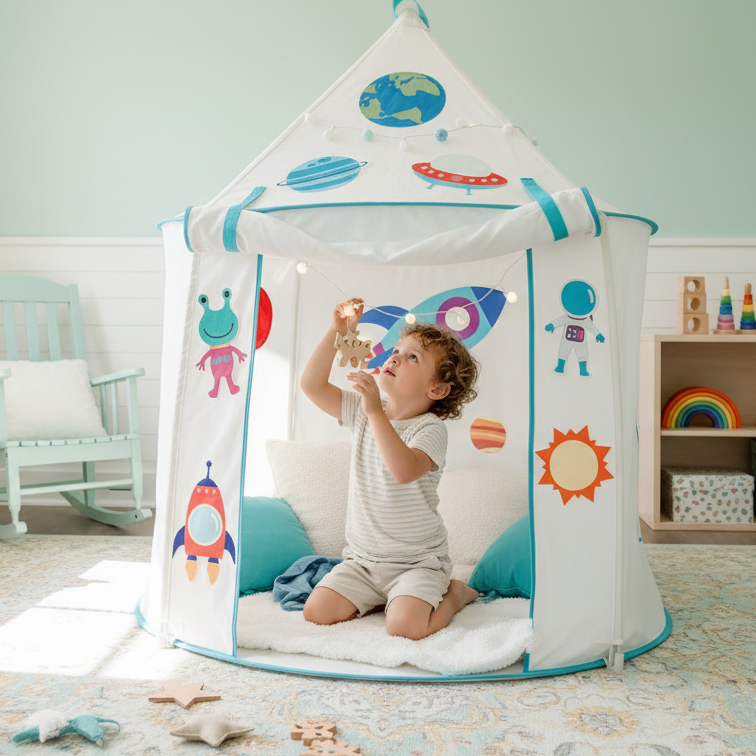
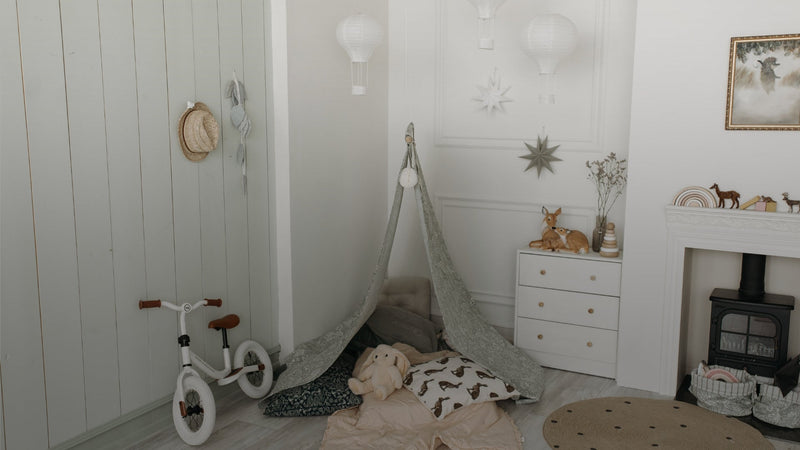
a play tent,
a section underneath a table,
two chairs and a blanket,
a foldable cardboard structure,
or one small corner with movable scenery.
Today it becomes a shop.
Tomorrow it becomes a spaceship.
Then a library.
Then something with rules no adult fully understands.
That ability to reinterpret a familiar environment can make a small play area feel larger because the physical footprint remains the same while the imaginary possibilities keep changing.
11. Let Changeable Scenery Do the Work of Multiple Themes
This is particularly useful in small homes.
Buying a dinosaur play structure, space play structure, castle, shop, and ocean-themed setup would require considerable storage.
A changeable surface can provide multiple stories without multiple large objects.
That idea connects naturally with ZeeZee Adventures. The ZeeZee Adventures Tent uses interchangeable StickeeZ felt themes so the same physical play space can shift between imaginative worlds instead of requiring families to replace the entire environment as children's interests change. ZeeZee's current site also positions changeable environments within its broader independent and imaginative-play content.
The useful principle applies whether or not a family uses a dedicated play tent:
When space is limited, change the story rather than the footprint.
A felt board, cardboard backdrop, fabric, removable scenery, or a child's own artwork can do something similar.

12. Make Books Visible Without Building a Library Wall
Books deserve a place in the play area, but a small room does not require hundreds displayed simultaneously.
A narrow front-facing ledge, small basket, or short shelf can hold a rotating selection.
Change books according to interest rather than filling the wall.
A construction book may inspire building.
A dinosaur story enters pretend play.
A book about oceans suddenly changes the blue blanket into the Pacific.
Stories can extend play without requiring another category of bulky toys.
The physical footprint is tiny.
The imaginary footprint is enormous.
13. Use Screens Intentionally Rather Than Letting Them Become Background Furniture
Modern family rooms often contain televisions because adults use the space too.
That does not automatically make them poor play environments.
The more practical question is whether a screen is being intentionally used or simply running in the background while the child is trying to do something else.
When nobody is watching, turning it off can remove a competing source of movement and sound.
That does not require turning the entire home into a rigid screen-free zone.
It simply creates clearer boundaries between screen time and play time.
A shared room can serve both.
It does not need to serve both simultaneously every minute.
14. Design for Siblings Without Duplicating Everything
Small homes become particularly complicated when siblings share the play area.
The solution does not have to be buying two of everything.
Instead, think about whether the space allows different kinds of engagement to coexist.
One child may be building on the floor while another draws at the table.
A basket of common open-ended materials can support shared play when they want to collaborate.
A smaller personal basket or shelf can protect a few individual projects or possessions.
Children will still disagree.
No storage system has yet eliminated sibling conflict.
But giving the room multiple possible ways to be used can prevent every activity from requiring the exact same patch of space.
15. Let Some Play Stay Unfinished
Small-space families understandably want to reset rooms frequently.
But if possible, identify one small place where a project can survive.
A tray.
A shelf.
A section of a low table.
A cardboard base that can be lifted and moved.
A child who spends thirty minutes building a world may want to continue tomorrow.
Allowing selected creations to remain gives children the opportunity to return to an existing idea instead of constantly beginning again.
The trick in a small home is making unfinished play movable.
A tray can slide under a bed.
A baseboard can move onto a shelf.
A small construction can sit on top of a cabinet.
You do not need to preserve everything.
Just enough to communicate:
Some ideas are worth coming back to.
16. Create a Quiet Option Without Creating Another Room
Children sometimes want a smaller, quieter place even inside an already small home.
That does not require a second room.
A floor cushion beside a bookshelf, a play tent, a chair facing away from the busiest part of the room, or a temporary blanket space may provide a different experience without consuming much space.
Keep it flexible rather than labeling it as somewhere a child must go to “calm down.”
A child may use the same area for books, pretend play, audio stories, drawing, or simply sitting alone for a few minutes.
Modern small-space design works best when each zone supports several possibilities.
17. Remember That a Small Playroom Should Still Look Like Your Home
Parents sometimes feel caught between two aesthetics.
Either the house looks adult and children seem unwelcome, or every shared space becomes visually dominated by children's products.
There is a middle ground.
Choose storage, mats, baskets, and furniture that work with the larger room when that matters to you. Keep highly visual children's materials accessible in a defined area rather than across every surface. Use closed storage for rotation items.
But do not optimize aesthetics so aggressively that the child becomes afraid to touch or change anything.
A family home is allowed to show evidence of childhood.
The objective is not an untouched showroom.
It is a room adults enjoy living in, and children understand they are welcome to use.
Small Playroom Ideas for Apartments
Apartment families often benefit most from portability.
A rolling cart can disappear into a closet.
A basket can move between rooms.
A foldable mat creates temporary floor definition.
Vertical shelving protects floor space.
A lightweight play environment can be set up and changed without permanent remodeling.
Most importantly, resist treating every empty wall as a storage opportunity.
Children need negative space too.
If the apartment offers only one large common room, creating a child-accessible zone within that room may work better than attempting to squeeze all play into the bedroom.
Children often want to play near family activity anyway.
The playroom does not have to be isolated to be legitimate.
Small Playroom Ideas for Shared Bedrooms
Bedrooms require additional restraint because they also need to support sleep, dressing, and storage.
Try keeping the highest-energy or largest play materials elsewhere when possible and using the bedroom for books, drawing, figures, construction, or quieter pretend play.
Under-bed storage can hold toy rotations.
A small shelf can provide child access without overwhelming the room.
A portable building tray can allow projects to move when bedtime approaches.
The purpose is not to maximize the number of activities the bedroom can support.
It is to preserve enough simplicity that the room can still perform its primary functions.
What Modern Families Should Avoid in a Small Playroom
The first mistake is trying to fit a large-house playroom into a small-house footprint.
More shelving is not always the solution.
Another is buying highly specific large toys without considering how frequently they will be used relative to the floor space they permanently occupy.
Parents may also create elaborate activity stations that look wonderful but require constant adult resetting.
And perhaps the most common mistake is assuming organization means every object deserves a permanent place in the visible play area.
Some things can live elsewhere.
Some can be donated.
Some can rotate.
Some activities can exist temporarily.
A small playroom becomes much easier when you stop asking it to store the entirety of childhood at once.
Small Playroom vs. Large Playroom: What Actually Matters?
|
Design question |
Small playroom |
Larger playroom |
|
Toy selection |
More selective |
Can accommodate more |
|
Storage strategy |
Vertical, concealed, rotating |
More permanent storage possible |
|
Floor space |
Must be protected deliberately |
Easier to create multiple zones |
|
Furniture |
Multipurpose is especially valuable |
More dedicated furniture possible |
|
Play zones |
Often temporary or overlapping |
Can be more permanently defined |
|
Imaginative space |
Transformable environment |
Multiple dedicated environments possible |
|
Cleanup |
Quick reset is essential |
Can tolerate more unfinished play |
|
Best principle |
Possibilities per square foot |
Purposeful use of available space |
Neither is inherently better.
A large playroom can be poorly designed.
A tiny play corner can become deeply meaningful.
A Small-Playroom Checklist for Modern Families
-
Define a play zone instead of waiting for a spare room.
-
Protect useful floor space before adding storage.
-
Keep independent materials at child height.
-
Store rotation and supervised materials higher or elsewhere.
-
Prioritize toys that support multiple kinds of play.
-
Display fewer items at once.
-
Use baskets or containers that make resetting quick.
-
Consider portable or multipurpose furniture and materials.
-
Create at least one space the child can transform.
-
Allow selected projects to remain unfinished.
-
Integrate books and art without creating bulky stations.
-
Turn off background screens when nobody is using them.
-
Let the room still feel like part of your home.
-
Keep enough flexibility for the space to evolve as your child grows.
Frequently Asked Questions
How do you make a playroom in a small house?
You do not need a dedicated room. Define a child-accessible play zone within a bedroom, living room, dining area, or other shared space. Keep a smaller number of open-ended materials available and use portable or vertical storage for everything else.
What should be in a small playroom?
Prioritize materials that can support multiple types of play, such as blocks, books, art supplies, figures, fabric, pretend-play pieces, and age-appropriate construction materials. Include some open floor and accessible storage rather than filling the entire area with toys.
How do I make a small playroom look less cluttered?
Display fewer materials, rotate toys, use larger storage categories, place excess supplies in concealed or higher storage, and leave deliberate visual space between objects.
Can I create a playroom in my living room?
Yes. A section of a living room can function as a child-accessible play zone while the rest remains shared family space. Portable baskets, defined flooring, low storage, and flexible play materials can make transitions easier.
How can I make a small playroom encourage independent play?
Put developmentally appropriate materials within reach, simplify the number of choices, preserve space for building, and choose toys that children can use without constant adult setup or instruction. Play itself provides opportunities to practice attention, planning, creativity, and problem-solving.
Should a small playroom have lots of storage?
It needs enough storage to function, but maximizing storage can unintentionally reduce usable play space. Prioritize floor area, accessible everyday materials, and off-site or vertical storage for things that do not need to remain visible.
Is a play tent practical in a small room?
It can be if its footprint works with the room and the child uses it for several kinds of play. In a small home, any larger play object should ideally justify its footprint through repeated or flexible use rather than serving only one narrow activity.
How do you organize toys when siblings share a small playroom?
Use broad shared categories for common materials, provide small personal areas where appropriate, and design the room so different activities can happen in parallel rather than requiring every child to use the same surface.
A Small Home Does Not Mean a Small Childhood
Children are remarkably good at expanding a space through imagination.
Adults see six square feet between the sofa and the bookshelf.
A child sees a campsite.
A veterinary office.
A spaceship.
A restaurant.
An underwater research station.
The design challenge is not to make the room physically enormous.
It is to avoid filling it so completely that there is nowhere left for those transformations to happen.
Modern families often need rooms to work harder than they once did.
The living room may have to entertain adults, welcome visitors, store children's materials, host family movie night, and become an imaginary kingdom before breakfast.
That is not a design failure.
It simply requires flexibility.
Choose fewer objects with more possibilities.
Store what does not need to be visible.
Protect some open floor.
Let play move.
Allow the environment to transform.
And remember that the child's imagination does not know the square footage of your home.
For more ideas specifically focused on helping children use that environment with increasing ownership, ZeeZee Adventures' 15 playroom ideas that inspire independent play are the natural next resource.
A small playroom does not need to contain everything.
It needs to leave room for something to happen.
Author Bio
The ZeeZee Play Experts share research-informed ideas about independent play, imaginative childhood, sensory exploration, creativity, and screen-free family life. ZeeZee Adventures' educational resources help parents create flexible environments that give children's ideas more room to grow—even when physical space is limited.





Comment (0)