
Playroom Organization Ideas That Kids Can Maintain
A playroom can look beautifully organized at 8:00 a.m. and completely unrecognizable by lunchtime.
Blocks migrate into the pretend kitchen. Stuffed animals appear underneath furniture. Art supplies lose their lids. Pieces from three different sets somehow become essential to one enormous imaginary world.
Then comes the familiar request:
“Okay, everyone. Time to clean up.”
And suddenly nobody remembers where anything belongs.
This is where many playroom organization systems fail. They are designed beautifully for adults, but they require too many decisions, too many categories, or too much precision for children to realistically maintain.
A child-friendly organization system works differently.
It gives toys obvious homes. It keeps everyday materials within reach. It uses categories children can understand. It makes returning an object almost as easy as taking it out. And it recognizes that cleanup skills develop gradually rather than appearing because a parent bought matching baskets.
The goal is not a playroom that stays perfectly tidy.
It is a playroom children can increasingly help reset themselves.
Quick Answer: How Do You Organize a Playroom So Kids Can Keep It Tidy?
To create a playroom children can help maintain, use a small number of broad toy categories, keep everyday storage at child height, label bins with pictures and words, avoid overfilling containers, reduce the number of toys available at once, and make cleanup part of a predictable routine.
The organization system should match the child's developmental abilities. Young children will still need adult help, but the room can be designed so they gradually understand what goes where and what happens when play ends.
CDC developmental guidance reflects this gradual progression. By around 30 months, following a simple routine such as helping pick up toys is included among common developmental milestones, while CDC guidance for older preschoolers encourages participation in simple household chores as independence develops. Milestones describe what most children can do by a particular age; they are not deadlines or performance standards for individual children.
The Best Playroom Organization System Is the One Children Can Understand
Adults can manage surprisingly complicated storage systems.
We can remember that wooden woodland animals belong in one basket while farm animals belong in another. Magnetic construction pieces belong in a divided drawer. Doll accessories are separated into clothing, food, furniture, and transportation.
A four-year-old may see:
animals, building things, doll stuff.
That simpler classification is often more useful.
Playroom organization becomes easier for children when the number of decisions required during cleanup decreases. Instead of asking a child to identify exactly which subcategory an object belongs to, broad storage allows them to recognize the general home quickly.
Early-childhood environments use a similar principle. NAEYC describes organized spaces as environments that can invite children to explore and choose activities, while its guidance on accessible environments emphasizes looking at the room from the child's perspective and considering what children can actually reach and use.
For families thinking about organization as part of a larger independence strategy, ZeeZee Adventures' 15 playroom ideas that inspire independent play is a useful companion resource.

Start With Fewer Categories
One of the quickest ways to make a playroom difficult for children to maintain is creating too many categories.
Adults often organize according to inventory.
Children benefit from organizing according to recognition.
Instead of separate containers for wooden blocks, foam blocks, magnetic pieces, and architectural blocks, perhaps the room simply needs Building.
Instead of several tiny containers for pretend foods, dishes, cooking utensils, and restaurant accessories, perhaps Pretend Kitchen is enough.
You can always create smaller categories later if your child naturally understands and uses them.
Start broad.
If cleanup becomes easy, refine only where refinement solves a real problem.
Use Containers That Are Easy to Get Into—and Out Of
The perfect storage container is not very useful if your child cannot operate it.
Heavy lids, complicated latches, deep drawers, containers stacked four high, and baskets squeezed tightly onto shelves all add friction.
If a child needs adult help simply to return an object, the organization system has made the adult part of every cleanup.
For frequently used materials, consider open baskets, lightweight bins, low drawers, or other containers your child can reasonably manage.
This does not mean everything belongs within reach. Art materials requiring supervision, choking hazards for younger siblings, and other age-inappropriate items should remain appropriately stored.
The key is more specific:
Anything you expect a child to maintain independently should be reasonably accessible to that child.
Put Everyday Storage at Child Height
Try looking at the playroom from three feet above the floor.
What can your child actually see?
NAEYC specifically recommends considering children's physical perspective when planning accessible environments—what catches their eye, what they can reach, and which materials are available to them.
This can reveal a strange mismatch in many homes.
The toys are technically “children's toys,” but their organization was designed at adult height.
Keep the small selection intended for everyday independent play low enough for the child to access and reset. Higher storage can hold rotation toys, extra supplies, activities requiring adult supervision, or less frequently used materials.
That naturally separates the room into two systems:
child-managed below, adult-managed above.
Add Picture Labels Before Expecting Children to Read Labels
A beautifully printed label saying CONSTRUCTION MATERIALS is not terribly helpful to a three-year-old who cannot read it.
Pictures make the storage system visible before literacy develops.
A photograph of the actual blocks can go on the block basket. A picture of toy animals goes where animals belong. Art supplies can have their own image.
NAEYC describes using photos of toys and classroom materials on the shelves where they belong as one type of visual support that can help children complete cleanup more independently.
Using both the photograph and the written word can work well because the label remains useful as children's print awareness grows.
The goal is not to create a Pinterest-worthy labeling system.
It is to answer the child's practical question:
“Where does this go?”
without requiring an adult to answer every time.
Don't Fill Bins to the Top
If putting a toy away requires solving a three-dimensional puzzle, the bin is too full.
Containers work best when there is room to drop objects back inside without carefully arranging every piece.
This is an easy detail to overlook because adults tend to choose storage based on how much it can hold.
For child-maintainable organization, consider how easy the container is to reset.
A basket holding twelve stuffed animals may work.
A basket containing twenty-eight stuffed animals that must be compressed beneath a lid probably does not.
The same rule applies to shelves.
Children are more likely to understand where materials belong when those materials have an obvious physical home rather than being wedged wherever space remains.
Reduce the Number of Toys Available at Once
Sometimes the organization problem is actually a quantity problem.
There is no container system capable of making an unlimited toy collection easy for a young child to manage.
Consider keeping part of the collection outside the main play area and rotating materials according to interest.
This does not require an elaborate weekly schedule.
If something is being used deeply, leave it.
If a basket has not attracted attention for weeks, store it temporarily and bring something else back.
Reducing the number of visible materials can also make each option easier to notice. NAEYC guidance on learning environments emphasizes organized, accessible materials and notes the value of rotating materials as children's interests and abilities change.
Organization becomes much easier when the room is not expected to display everything the child owns simultaneously.
Give Every Large Toy a “Parking Spot”
Some toys do not belong in bins.
Dollhouses.
Large trucks.
Play kitchens.
Push toys.
Play tents.
Oversized building projects.
Give these objects a visible home base.
You might call it a parking spot with younger children:
“The fire truck parks here.”
“The stroller sleeps beside the kitchen.”
This turns abstract organization rules into something connected to play.
It also prevents larger objects from becoming permanent obstacles simply because nobody knows where they are supposed to go.
Keep Sets Together—But Don't Police Play
Organization should make materials easy to find.
It should not prevent children from combining them.
NAEYC has described cross-area play as play in which children move materials beyond their originally defined centers, allowing them to combine resources in different ways.
That distinction works beautifully at home.
The animals may have a storage home.
The blocks have another.
The vehicles have another.
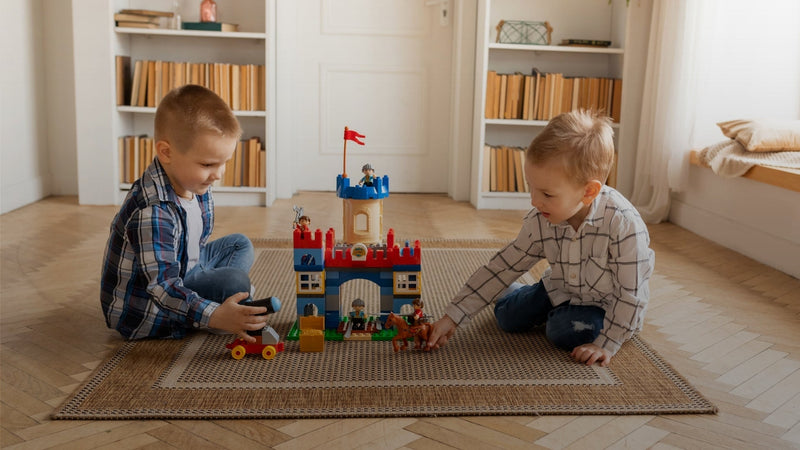
During play, however, the dinosaur is perfectly welcome to drive the ambulance across a block bridge toward the pretend kitchen.
Organize after the story.
Do not organize the imagination while it is happening.
Use a “Project Parking” Area
Not everything should be cleaned up.
A child may spend thirty minutes building a city and want to continue tomorrow. If every cleanup means destroying every creation, resetting the playroom can begin to feel like losing something rather than caring for the space.
Create one designated place for unfinished work.
A tray can hold a construction.
A small shelf can keep an art project.
A low table might have a “still working” corner.
The space should be limited. Otherwise every abandoned object suddenly becomes an important ongoing project.
But preserving selected work communicates something valuable:
Cleaning up doesn't mean every idea has to disappear.
Make Transformable Play Easy to Reset
Open-ended imaginative spaces create a particular organizational challenge because materials naturally move around.
Fabric becomes scenery.
Felt pieces become characters.
Blocks enter the story.
Books become pretend menus.
Rather than trying to prevent this movement, give the main ingredients obvious homes once the story ends.
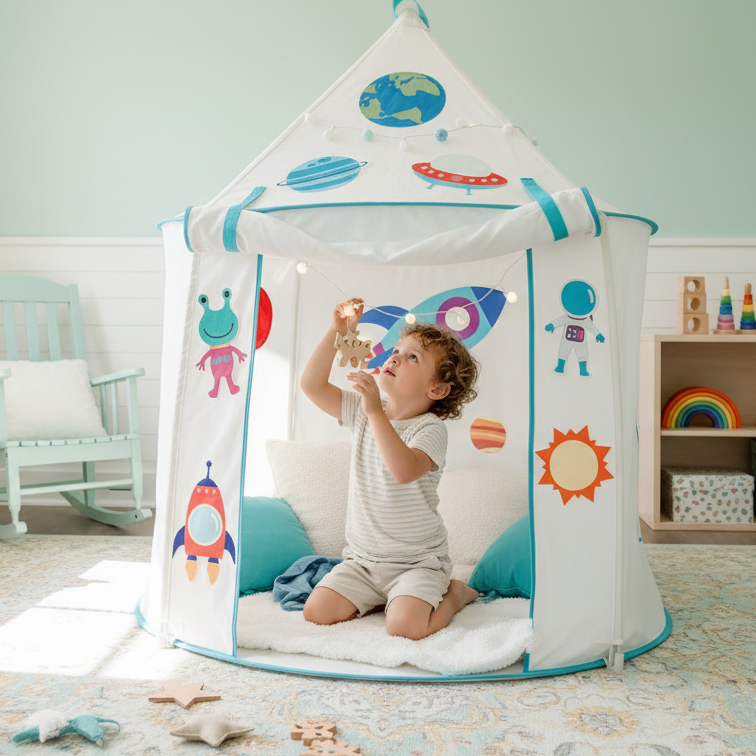
This principle fits naturally with ZeeZee Adventures' changeable play environment. StickeeZ pieces can be rearranged across the tent as children's stories change, while themes remain reusable rather than requiring an entirely separate fixed play structure for every imaginary world. ZeeZee's current product materials describe the system around swappable felt themes and child-led transformation of the same familiar environment.
The organizational lesson applies far beyond the tent:
Let play become complicated. Make the reset simple.
A basket for fabric.
A basket for figures.
A home for blocks.
The story can be wildly imaginative while the storage remains almost boring.
That is often exactly what children need.
Make Cleanup a Routine Rather Than a Surprise
Children may resist transitions even when they understand what cleanup means.
Predictability can help.
CDC guidance for toddler and preschool parenting specifically includes cleanup among routines families may establish, while NAEYC recommends predictable transition signals such as a familiar cleanup song, timer, or visual cue.
Instead of suddenly announcing:
“Clean everything right now!”
try creating a recognizable sequence.
Perhaps the child gets a short warning.
Then the same cleanup song begins.
Blocks go home first.
Books return next.
Then the child chooses the last thing to put away.
The precise routine matters less than consistency.
Over time, the environment itself begins supplying part of the instruction.
Give One Cleanup Direction at a Time
“Clean your playroom” is a surprisingly large request.
Even adults can become overwhelmed when faced with an entire messy room.
Young children may respond better to a visible, concrete starting point.
“Let's put the blocks in their basket.”
Then:
“Now let's find the animals.”
This is different from completing the entire cleanup for them.
You are reducing the organizational demand while allowing the child to perform the task.
As skills develop, fewer prompts may be needed.
The long-term goal is not instant independence.
It is gradual transfer of responsibility.
Let the Child Help Decide Where Things Live
If your child repeatedly returns the cars to a particular basket—even though your elaborate system says that basket belongs to something else—consider whether the child has discovered the more intuitive organization.
Children are more likely to remember systems that make sense from their perspective.
Ask:
“Where should the dress-up clothes live?”
“Which basket would make it easiest to find the animals?”
“Should the drawing things stay near this table?”
Older preschoolers and school-age children can increasingly participate in these decisions.
Organization then becomes something the family develops together rather than a system adults impose and children repeatedly misunderstand.
Build the System Around How the Child Actually Plays
Watch the traffic patterns.
If books constantly migrate beside the play tent, perhaps a small book basket belongs there.
If art materials repeatedly end up beside the blocks because children make signs and maps, maybe those materials should live closer together.
If stuffed animals are carried into the cozy corner every day, their storage might belong nearby.
Early-childhood guidance emphasizes observing how children use environments and then adjusting materials and experiences accordingly.
Your child is already showing you how the room wants to be organized.
The question is whether the storage system listens.
Don't Expect Adult-Level Tidiness
A playroom children can maintain will probably not look exactly like one organized entirely by adults.
The books may not face the same direction.
Blocks may be dropped rather than arranged.
Dress-up clothes may be in the correct basket but definitely not folded.
That is okay.
If adults redo everything after children finish, we can unintentionally communicate that their contribution did not count.
Decide what actually matters.
Perhaps the goal is:
materials are off the floor,
similar things are together,
the room can be used again tomorrow.
Not:
every shelf looks professionally styled.
A system children participate in imperfectly may be more useful than a perfect system only adults can maintain.
What Can Kids Realistically Help With by Age?
Children's abilities vary considerably, so age guidelines should be treated as approximate rather than as expectations every child must meet.
At around two, cleanup may mean putting a few familiar objects into one obvious basket with an adult nearby. CDC guidance specifically suggests letting two-year-olds help with simple chores such as putting toys or laundry into a basket.
By around 30 months, following simple routines such as helping pick up toys appears among CDC developmental milestones.
Preschoolers can gradually take on more steps. CDC guidance for four-year-olds suggests involving children in simple household chores as one way of encouraging independence, while simple chores are also included in the developmental guidance for five-year-olds.
The useful principle is not:
“My four-year-old should clean the playroom independently.”
It is:
“What part of this routine can my child reasonably own now?”
Then build from there.
Common Playroom Organization Mistakes
One common mistake is using too many tiny bins. They may look beautifully organized, but children have to remember too many distinctions.
Another is buying storage before reducing the amount being stored. Sometimes the room needs fewer objects, not another cabinet.
Parents may also create systems based entirely on aesthetics. Hidden storage can make a room look calm, but if children cannot tell where anything belongs, adults remain responsible for the reset.
And perhaps the biggest mistake is expecting organization to prevent mess.
A deeply used playroom will get messy.
Blocks will travel.
Characters will cross categories.
Fabric will become scenery.
That is not evidence that the organization failed.
The real test comes afterward:
Can the room reasonably find its way back?
Playroom Organization: Adult System vs. Child-Maintainable System
|
Instead of… |
Try… |
|
Many highly specific categories |
A few broad categories |
|
Text-only labels |
Pictures plus simple words |
|
Heavy containers with lids |
Easy-open baskets or bins |
|
Storage mostly at adult height |
Everyday materials at child height |
|
Containers packed completely full |
Containers with reset space |
|
Every toy visible |
A manageable selection plus rotation |
|
“Clean the whole room” |
One concrete category at a time |
|
Destroying every project |
One limited project-parking space |
|
Organizing during play |
Combining freely, sorting afterward |
|
Adult-perfect shelves |
A reset standard children can participate in |
A Child-Maintainable Playroom Checklist
Before purchasing more organizers, check whether your current system passes these tests:
-
My child can reach the materials I expect them to use independently.
-
Most toys belong to obvious, broad categories.
-
Young children can use pictures to identify where things belong.
-
Containers are easy to open and carry.
-
Bins are not packed so tightly that toys are difficult to return.
-
Not every toy we own is displayed simultaneously.
-
Large toys have an obvious parking spot.
-
There is somewhere limited for unfinished projects.
-
Children are allowed to combine materials during play.
-
Cleanup happens through a reasonably predictable routine.
-
I give manageable directions rather than “clean everything.”
-
My standard for child cleanup is age-appropriate rather than adult-perfect.
Frequently Asked Questions
How should I organize a playroom for toddlers?
Use a small number of broad categories, open containers, child-height storage, and picture labels. Keep the number of available materials manageable and expect cleanup to remain highly supported by an adult. CDC guidance suggests that by around age two, children can begin helping with simple tasks such as putting toys into a basket.
Do picture labels help children clean up?
They can make storage locations easier to understand before children can read. NAEYC describes classroom use of photos showing where toys and materials belong as a visual support for more independent cleanup.
Should every toy have its own bin?
Usually not. Broad categories such as blocks, animals, vehicles, art, and dress-up are often easier for young children to understand than many highly specific subcategories.
How many toys should be kept out?
There is no universal ideal number. Keep enough variety to support meaningful play without requiring every toy the child owns to remain visible. Rotate according to actual interest rather than following a rigid schedule.
How do I teach my child to clean up toys?
Begin with predictable routines and concrete tasks. Instead of saying “clean everything,” start with something visible such as “put the blocks into this basket.” Songs, visual cues, and predictable transition routines can also support cleanup.
What if my child refuses to clean up?
Age, fatigue, transitions, task difficulty, and expectations all matter. Check whether the request is developmentally realistic and whether the organization system is understandable before treating cleanup solely as a behavior problem.
Should I let children mix toys from different bins?
Yes, when it is safe and manageable. Combining materials can support imaginative play. Storage categories can provide homes for objects after play without determining which objects children are allowed to use together during play. NAEYC describes this kind of movement between play areas as cross-area play.
How do I organize a small playroom?
Prioritize a manageable selection of versatile materials, use vertical storage for adult-managed items, preserve floor space, and choose containers that can quickly reset the room. ZeeZee Adventures' small playroom ideas for modern families explore this small-space challenge in more detail.
The Goal Isn't a Playroom That Never Gets Messy
A child-maintained playroom should get messy.
That is what happens when things are being used.
The blocks leave the block shelf because somebody needs a bridge.
The stuffed animals move because there is apparently an emergency at the pretend hospital.
Fabric leaves its basket because the floor has become an ocean.
The goal of organization is not to stop those things from happening.
It is to make sure the child has some idea of how the pieces can eventually find their way home.
A good system quietly teaches:
I can find what I need.
I know where this belongs.
I can help take care of this space.
Those skills do not appear overnight.
At first, the parent does most of the work.
Then perhaps the child carries the blocks.
Later they recognize the labels.
Eventually they may begin resetting familiar areas with fewer reminders.
That gradual participation matters far more than whether the baskets line up perfectly afterward.
So before buying another organizer, look at the playroom from your child's height.
Can they see what belongs where?
Can they reach it?
Can they return it without solving a puzzle?
If not, simplify.
The most successful playroom organization system is not the one children are least likely to mess up.
It is the one they can increasingly help put back together.
Author Bio
The ZeeZee Play Experts share research-informed ideas about independent play, imaginative childhood, sensory exploration, creativity, and screen-free family life. ZeeZee Adventures' educational resources help parents create environments that give children increasing ownership of how they play and how they care for their spaces.




Comment (0)