
The Science Behind Imagination and Early Childhood Development
Quick Answer
Imagination is far more than make-believe. Research shows that imaginative play supports healthy brain development by strengthening executive functioning, language, creativity, emotional regulation, problem-solving, and social skills. When children imagine, they're not escaping reality—they're practicing the cognitive and emotional abilities they'll use throughout life.
Key Takeaways
-
Imagination is a fundamental part of healthy early childhood development.
-
Pretend play strengthens multiple areas of the developing brain simultaneously.
-
Imaginative play supports language, creativity, emotional regulation, and executive functioning.
-
Children learn by creating experiences, not simply by memorizing information.
-
Everyday pretend play helps build skills that extend well beyond childhood.
Introduction
To an adult, a cardboard box is just a cardboard box.
To a child, it might be:
A pirate ship sailing across dangerous seas.
A spaceship heading toward a newly discovered planet.
A dragon's cave filled with glowing treasure.
A bakery selling rainbow cupcakes.
Or a tiny home for an entire family of dinosaurs.
Nothing about the box has changed.
Only the child's imagination has.
And yet, something extraordinary is happening inside their brain.
While adults see fantasy, children's brains are doing remarkably real work.
They're solving problems.
Planning stories.
Practicing conversations.
Testing ideas.
Managing emotions.
Making predictions.
Creating solutions.
Every imaginary adventure activates networks in the brain that help children understand both the world around them and their place within it.
This is why child development experts increasingly describe imaginative play as one of childhood's most powerful learning experiences.
It isn't a break from learning.
It is learning.
For decades, researchers in neuroscience, psychology, occupational therapy, and early childhood education have explored how imagination shapes development.
Their findings consistently point in the same direction.
Children who regularly engage in imaginative play aren't simply entertaining themselves.
They're building the foundation for skills they'll rely on throughout school, relationships, work, and everyday life.
The remarkable part is that children don't realize any of this.
They're simply playing.
And that's exactly what makes it so effective.
As a pediatric occupational therapist, I've often watched children transform ordinary objects into extraordinary adventures.
One child uses a wooden spoon as a magic wand.
Another turns couch cushions into mountain peaks.
A preschooler carefully bandages a stuffed bear while explaining that it needs "extra hugs to heal."
These moments may appear simple.
But beneath every pretend story, the brain is making millions of new connections.
Connections that support thinking.
Learning.
Communication.
Confidence.
Creativity.
And emotional resilience.
Understanding the science behind imagination helps us appreciate something important.
Pretend play isn't something children eventually outgrow.
It's one of the primary ways they grow.
What Is Imagination?
Imagination is the ability to create ideas, stories, images, or possibilities that aren't immediately present.
It's the remarkable skill that allows children to think beyond what they can see, hear, or touch.
A toddler pretends a banana is a telephone.
A preschooler becomes a veterinarian caring for an injured tiger.
A six-year-old invents an entire planet where clouds are made of marshmallows and dragons deliver the mail.
None of these scenarios are real.
Yet every one of them requires incredibly sophisticated thinking.
Children must imagine situations that don't exist, remember details, create relationships between ideas, predict what might happen next, and adapt the story as it unfolds.
In developmental psychology, this ability is known as symbolic thinking.
Symbolic thinking allows one object, action, or idea to represent something else.
A stick becomes a fishing rod.
A blanket becomes an ocean.
A cardboard box becomes a spaceship.
This ability may seem playful on the surface, but it's actually one of the most significant milestones in early childhood development.
Without symbolic thinking, many later skills would be difficult to develop.
Reading requires children to understand that letters represent sounds.
Writing requires symbols to represent ideas.
Mathematics relies on numbers representing quantities.
Maps represent real places.
Words represent thoughts.
Long before children master these academic skills, they begin practicing symbolic thinking through imaginative play.
Every pretend adventure becomes a rehearsal for future learning.
Why Imagination Is More Than "Make-Believe"
Adults sometimes describe pretend play as "just imagination."
But neuroscience tells a different story.
During imaginative play, children aren't switching off their brains.
They're activating many of the same neural systems they use during real-life experiences.
When a child pretends to cook dinner, they're planning steps, organizing materials, remembering sequences, communicating with imaginary guests, and solving pretend problems.
When children imagine rescuing a lost puppy, they're considering emotions, making decisions, adapting to new situations, and practicing empathy.
The brain doesn't treat these experiences as meaningless fantasy.
Instead, it uses them as opportunities to rehearse important life skills in a safe environment.
Think of imagination as a flight simulator.
Pilots practice difficult situations before encountering them in real life.
Children do something remarkably similar through pretend play.
They practice friendship before navigating complex social relationships.
They solve imaginary problems before facing real ones.
They experience bravery before confronting genuine fears.
They learn compassion before someone truly needs it.
Imagination allows children to experiment without real-world consequences.
If the dragon wins today, tomorrow's story can be different.
If the bridge collapses, they simply rebuild it.
Mistakes become part of the adventure rather than something to avoid.
That freedom encourages exploration, resilience, and creative thinking in ways few structured activities can match.
Expert Insight
Pediatric occupational therapists often describe imaginative play as a "whole-brain activity" because it integrates cognitive, emotional, social, sensory, and motor skills at the same time. Rather than practicing one developmental skill in isolation, children strengthen multiple areas of development simultaneously as they invent stories, solve problems, communicate ideas, and adapt to changing scenarios.
The Science of Brain Development During Play
A child's brain develops at an extraordinary pace during the early years of life.
By the time children begin school, billions of neural connections have already formed through everyday experiences.
Every conversation.
Every movement.
Every challenge.
Every playful interaction helps shape those growing neural pathways.
Imaginative play is especially powerful because it activates multiple brain systems simultaneously.
Unlike passive entertainment, pretend play requires children to actively create, remember, predict, organize, communicate, and adapt—all within a single activity.
Imagine a child pretending to run a veterinary clinic.
At first glance, they're simply caring for stuffed animals.
But inside the brain, an incredible amount of work is taking place.
They're remembering what veterinarians do.
Planning the next step in the examination.
Using language to explain treatments.
Considering how the "patient" might feel.
Deciding which tools are needed.
Changing the story when a new pretend emergency arrives.
Managing excitement when the play becomes dramatic.
All of these processes involve different areas of the brain working together.
Repeated experiences like these strengthen the neural networks that support learning, emotional regulation, attention, flexibility, and decision-making.
This is one reason researchers often describe play as the natural architecture of childhood development.
Children aren't only preparing for school.
They're building the brain that will help them learn throughout their entire lives.
A Brain Built Through Experience
One of the most remarkable discoveries in developmental neuroscience is that children's brains are shaped by what they do repeatedly.
Neural pathways strengthen through use.
The more children practice thinking creatively, solving problems, communicating ideas, and adapting to new situations, the more efficient those brain networks become.
Imaginative play provides repeated opportunities to practice all of these skills naturally.
Not because someone assigned them as lessons.
But because the story demands them.
Every adventure becomes another opportunity for the brain to grow.
And unlike worksheets or memorization, children return to imaginative play willingly.
They practice these essential skills because they're having fun—not because they're told to.
How Imagination Builds the Brain
Every time a child invents a story, pretends to be someone else, or transforms an ordinary object into something extraordinary, they're exercising far more than creativity.
They're strengthening the brain's ability to think, adapt, remember, communicate, and solve problems.
Unlike activities that focus on a single skill, imaginative play activates multiple areas of development simultaneously. A child pretending to run a bakery isn't only "playing shop." They're planning, organizing, negotiating, remembering, calculating, communicating, and making decisions—all within one playful experience.
Let's explore the remarkable developmental skills imagination helps build.
1. Executive Function: The Brain's Control Center
One of the greatest benefits of imaginative play is how it strengthens executive functioning—the set of mental skills that help children plan, focus, remember instructions, regulate behavior, and manage multiple tasks.
Think of executive function as the brain's air traffic controller.
It helps children decide:
-
What should I do first?
-
What happens next?
-
How do I solve this problem?
-
Should I change my plan?
-
What should I remember?
These are incredibly complex skills, yet children practice them naturally during pretend play.
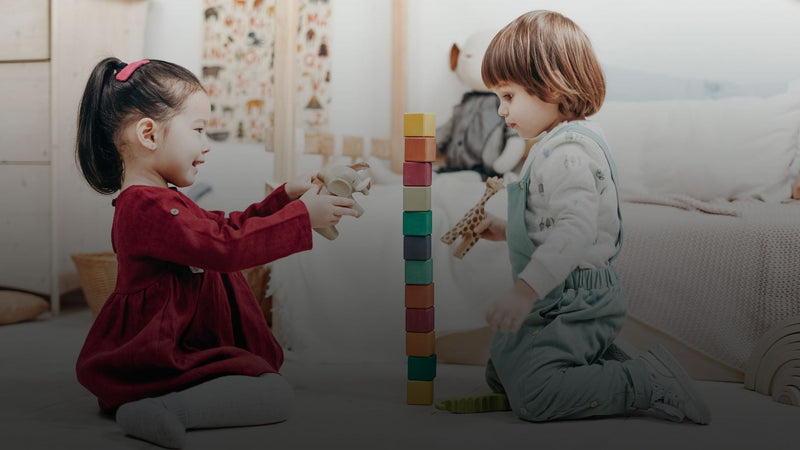
Imagine two children pretending to run a restaurant.
One becomes the chef.
The other greets customers.
Soon they realize they've forgotten to "cook" the food.
Now they must reorganize their plan.
Perhaps the chef prepares imaginary pizza while the server keeps the customers entertained.
Without realizing it, they're practicing planning, working memory, attention, flexibility, and self-control.
These same executive function skills later support:
-
Following classroom instructions
-
Completing homework
-
Managing time
-
Organizing projects
-
Making thoughtful decisions
-
Regulating emotions
Pretend play provides repeated opportunities to strengthen these abilities in an enjoyable, low-pressure environment.
Why It Matters
Children don't develop executive function by memorizing instructions alone.
They develop it by making meaningful decisions.
Imagination gives them countless opportunities to do exactly that.
2. Cognitive Flexibility: Learning to Think in New Ways
Life rarely goes exactly as planned.
Being able to adapt is one of the most valuable skills children can develop.
This ability is called cognitive flexibility.
It refers to the brain's capacity to adjust thinking when situations change, consider different perspectives, and generate multiple solutions to a problem.
Pretend play constantly exercises this skill.
Imagine a child building a zoo.
Halfway through the game, they decide the animals have escaped.
Now the entire story changes.
The zoo becomes a rescue mission.
The veterinarian suddenly becomes a helicopter pilot.
The elephant becomes the hero.
Every unexpected twist requires the child to rethink the story and create new solutions.
Rather than seeing change as a problem, imaginative play teaches children that change can become part of the adventure.
This flexible thinking later supports:
-
Adapting to new school routines
-
Solving unfamiliar problems
-
Managing unexpected challenges
-
Considering different viewpoints
-
Thinking creatively in academic subjects
Why It Matters
Children who regularly practice flexible thinking are often more comfortable adapting when real-life situations don't go according to plan.
Expert Insight
Developmental research consistently shows that children learn more effectively when they generate solutions rather than simply receiving them. Imaginative play encourages flexible thinking because stories constantly evolve, requiring children to adapt, revise, and invent new possibilities instead of relying on one "correct" answer.
3. Problem-Solving: Every Story Needs a Challenge
Every memorable adventure includes a problem.
The dragon blocks the bridge.
The spaceship runs out of fuel.
The bakery loses its recipe.
The dinosaur catches a cold.
Children instinctively create challenges because problems make stories interesting.
And every challenge becomes an opportunity to think critically.
Unlike worksheets that often have one correct answer, pretend play offers endless possibilities.
Should the pirate build a new boat?
Ask the dolphin for help?
Invent a flying submarine?
Children evaluate ideas, test solutions, adjust their plans, and continue experimenting until the story moves forward.
This process develops:
-
Logical thinking
-
Creativity
-
Decision-making
-
Cause-and-effect reasoning
-
Persistence
Importantly, mistakes aren't failures during pretend play.
They're simply plot twists.
That encourages children to keep trying instead of giving up.
Why It Matters
Children who experience safe opportunities to solve problems during play become more confident tackling challenges outside of play.
4. Language Development: Stories Build Communication
Imagination and language grow together.
The richer a child's pretend world becomes, the richer their communication often becomes as well.
During imaginative play, children naturally practice:
-
New vocabulary
-
Conversation
-
Storytelling
-
Listening
-
Explaining ideas
-
Asking questions
-
Describing events
Imagine a child pretending to be a veterinarian.
They may say:
"Your puppy has a sore paw."
"I'll need to check its heartbeat."
"Don't worry—it just needs some medicine and a nap."
These conversations help children organize thoughts into meaningful sequences while expanding vocabulary they may have heard in books or everyday life.
When children play with siblings, friends, or parents, language becomes even more dynamic.
They negotiate roles.
Explain rules.
Resolve disagreements.
Develop characters.
Build increasingly complex narratives.
Every conversation strengthens communication skills that later support reading comprehension, writing, and classroom participation.
Why It Matters
Language isn't only learned through formal instruction.
It's also developed through meaningful conversations, storytelling, and imaginative experiences.
5. Memory: Building Stronger Connections
Imagination depends on memory.
Children constantly draw from previous experiences to create new stories.
A child who recently visited the doctor may pretend to run a hospital.
A child fascinated by dinosaurs might create an entire prehistoric adventure.
A family trip to the beach may inspire weeks of underwater explorations.
Each pretend scenario requires children to recall information and combine it in new ways.
This strengthens working memory—the ability to hold and manipulate information while completing a task.
For example, during a pretend grocery store game, children might remember:
-
Shopping lists
-
Customer orders
-
Prices
-
Store rules
-
Character roles
They must keep all of this information organized while the story continues to evolve.
Why It Matters
Working memory supports learning across every subject, from reading and mathematics to following multi-step instructions and completing everyday tasks.
6. Creativity: Learning That There Can Be More Than One Answer
Perhaps the most obvious benefit of imagination is creativity.
But creativity isn't simply about drawing beautiful pictures or inventing funny stories.
It's about learning to generate possibilities.
Children who engage in imaginative play regularly begin asking questions like:
-
What else could this become?
-
Is there another way?
-
What if I tried something different?
-
What happens if I change the story?
These questions encourage divergent thinking—the ability to produce multiple ideas rather than searching for one correct answer.
A cardboard box becomes:
-
A castle
-
A rocket
-
A washing machine
-
A dragon cave
-
A race car
-
A bakery
The object never changes.
Only the thinking does.
This flexible creativity becomes increasingly valuable as children encounter more complex academic, social, and real-world challenges.
Why It Matters
Creative thinking helps children innovate, adapt, and approach unfamiliar situations with confidence instead of fear.
7. Decision-Making: Becoming the Author of the Adventure
Every pretend story is filled with choices.
Who is the hero?
Where does the journey begin?
What happens if the bridge breaks?
Who needs help?
Should the treasure be shared?
Children make hundreds of decisions during imaginative play.
Most are small.
Some completely transform the story.
Each decision strengthens independence because children experience the consequences of their choices in a safe environment.
If one idea doesn't work, they simply invent another.
This encourages thoughtful experimentation rather than fear of making mistakes.
Over time, children become more comfortable evaluating options, considering outcomes, and trusting their own judgment.
Why It Matters
Decision-making is a lifelong skill.
Pretend play allows children to practice making choices every day, without the pressure of real-world consequences.
One Adventure, Countless Developmental Benefits
One of the most remarkable aspects of imaginative play is that these developmental skills rarely occur in isolation.
Imagine a child pretending to lead a rescue mission.
They must:
-
Remember the story (memory)
-
Organize a plan (executive function)
-
Adapt when something unexpected happens (cognitive flexibility)
-
Solve problems along the way (critical thinking)
-
Explain ideas to imaginary teammates (language)
-
Invent creative solutions (creativity)
-
Decide what happens next (decision-making)
All of this unfolds during what appears to be "just playing."
From the outside, it may look like simple fun.
Inside the brain, however, countless neural connections are forming—connections that support learning, resilience, communication, and lifelong curiosity.
8. Emotional Development: Understanding Feelings Through Imagination
Children don't always have the words to explain how they feel.
Big emotions like fear, disappointment, excitement, jealousy, frustration, or worry can be difficult to understand—even for adults.
Imaginative play gives children a safe place to explore these emotions without experiencing real-world consequences.
A child whose stuffed bear is "scared of thunderstorms" may actually be working through their own fear of loud noises.
A superhero who feels nervous before saving the day may reflect a child preparing for their first day of school.
A dinosaur who gets left out by friends might be helping a child process a recent disagreement on the playground.
From the outside, these stories appear fictional.
From the inside, they're emotionally meaningful.
Children often project their feelings onto characters because it's easier to talk about what the dragon is feeling than what they're feeling themselves.
This emotional distance makes difficult experiences feel safer to explore.
As stories unfold, children naturally experiment with solutions.
How does the frightened puppy feel better?
What helps the lonely astronaut make a new friend?
How can the angry dragon calm down?
Every answer they create strengthens emotional understanding.
Why It Matters
Pretend play helps children recognize emotions, express feelings safely, and discover healthy ways to cope with everyday challenges.
9. Empathy: Seeing the World Through Someone Else's Eyes
One of imagination's greatest gifts is that it allows children to step into another person's world.
Today they're a firefighter.
Tomorrow they're a baby bird learning to fly.
Next week they're a doctor caring for an injured dinosaur.
Every new role requires children to ask an important question:
"How would someone else feel?"
This is the beginning of empathy.
When children pretend to comfort a sick teddy bear, rescue a frightened kitten, or help an imaginary friend solve a problem, they're practicing perspective-taking.
They begin considering:
-
What does this character need?
-
Why are they upset?
-
How can I help?
-
What would make them feel safe?
These questions strengthen social understanding long before children can fully explain empathy in words.
Role-play also encourages children to recognize that different people have different experiences, thoughts, and feelings.
This ability becomes increasingly important as children learn to cooperate with classmates, resolve disagreements, and build meaningful friendships.
Why It Matters
Empathy supports kindness, cooperation, emotional intelligence, and healthy relationships throughout life.
Expert Insight
Developmental psychologists describe pretend play as one of the earliest opportunities children have to practice perspective-taking. By imagining another person's thoughts, emotions, and motivations, children strengthen the social understanding needed for collaboration, communication, and emotional intelligence.
10. Self-Regulation: Practicing Calm in a Safe Environment
Learning to manage emotions and behavior is one of childhood's biggest developmental tasks.
Children aren't born knowing how to stay calm when they're frustrated or disappointed.
They learn through repeated experiences.
Imaginative play creates countless opportunities to practice self-regulation naturally.
Imagine a child pretending to be a firefighter.
The pretend fire spreads.
The rescue becomes urgent.
Characters need help.
The child feels excitement—but they must also stay focused enough to continue the story.
Or imagine siblings pretending to run a restaurant.
One wants to be the chef.
The other wants the same role.
Now they must negotiate, compromise, and manage disappointment before the game can continue.
These everyday play moments require children to:
-
Wait their turn.
-
Control impulses.
-
Shift attention.
-
Adjust expectations.
-
Recover from setbacks.
Unlike real-life stressful situations, pretend play allows children to rehearse these skills in a safe, low-pressure environment where mistakes simply become part of the adventure.
Why It Matters
Children who regularly practice self-regulation during play are better prepared to manage emotions, transitions, and social challenges in everyday life.
11. Social Development: Learning How Relationships Work
Imaginative play is often children's first introduction to teamwork.
Whether they're pretending with siblings, classmates, friends, or parents, they quickly discover that shared stories require cooperation.
Someone becomes the astronaut.
Someone drives the train.
Someone cares for the baby dragon.
Someone owns the bakery.
These roles don't simply appear.
Children negotiate them.
They explain ideas.
Listen to others.
Adapt when plans change.
Resolve disagreements.
Invite new characters into the story.
Through these playful interactions, children begin learning essential social skills, including:
-
Taking turns
-
Sharing leadership
-
Listening actively
-
Compromising
-
Respecting different ideas
-
Working toward common goals
Unlike structured games with fixed rules, imaginative play allows children to create the rules together.
That collaborative decision-making strengthens communication while helping children understand that successful relationships depend on flexibility and cooperation.
Why It Matters
Social competence develops through meaningful interactions—not simply by being around other children.
Pretend play provides those interactions every day.
12. Resilience: Discovering That Problems Can Be Solved
Every great story includes obstacles.
The bridge collapses.
The dragon steals the treasure.
The spaceship loses power.
The bakery runs out of flour.
Children naturally invent problems because challenges make stories exciting.
More importantly, they also invent solutions.
Sometimes the first idea doesn't work.
So they try another.
And another.
Because nothing is permanent in imagination.
Failure isn't failure.
It's simply a new chapter.
This mindset encourages resilience.
Children learn that setbacks aren't reasons to stop.
They're invitations to think differently.
Unlike real-world failures, pretend challenges carry very little risk.
That safety allows children to experiment freely.
The confidence they build during imaginary adventures often transfers into real-life situations.
Instead of becoming discouraged when faced with a difficult puzzle or classroom assignment, children who've practiced problem-solving through play are more likely to think:
"Maybe I just need another idea."
Why It Matters
Resilience grows when children experience manageable challenges and discover that persistence often leads to new solutions.
What Research Says About Imagination
For many years, researchers viewed play as a pleasant break from learning.
Today, the evidence tells a different story.
Research across neuroscience, psychology, occupational therapy, and early childhood education consistently shows that imaginative play supports multiple areas of development simultaneously.
Studies have linked rich pretend play experiences with improvements in:
-
Executive functioning
-
Language development
-
Self-regulation
-
Creativity
-
Cognitive flexibility
-
Social competence
-
Emotional understanding
-
Problem-solving
-
Narrative skills
Researchers also suggest that children who regularly engage in child-led imaginative play are often better prepared for the increasingly complex demands of school and everyday life.
Importantly, these benefits don't come from adults directing every activity.
They emerge when children have opportunities to create stories, experiment with ideas, solve problems, and follow their own curiosity.
This is one reason organizations focused on early childhood development continue to emphasize the importance of protecting play as an essential part of healthy development rather than treating it as an optional extra.
Why Imagination Matters More Than Ever
Today's children are growing up in a world unlike any previous generation.
Schedules are fuller.
Screens are more accessible.
Entertainment is available instantly.
Many activities provide ready-made stories, characters, and outcomes.
While technology certainly has its place, it can reduce opportunities for children to invent ideas entirely on their own.
Imagination asks something different.
It invites children to become creators instead of consumers.
To ask questions instead of waiting for answers.
To build worlds rather than simply watching them.
To solve problems instead of following instructions.
These experiences strengthen skills that artificial intelligence, automation, and rapidly changing technologies cannot replace—curiosity, adaptability, creativity, empathy, and innovative thinking.
In many ways, imagination has become one of the most future-ready skills children can develop.
Creating Spaces Where Imagination Can Thrive
While imagination comes from within, the environment around a child can either encourage it or limit it.
Children don't need rooms filled with expensive toys.
They need spaces that invite possibility.
A few open-ended materials.
Time without interruptions.
Freedom to experiment.
Permission to follow their own ideas.
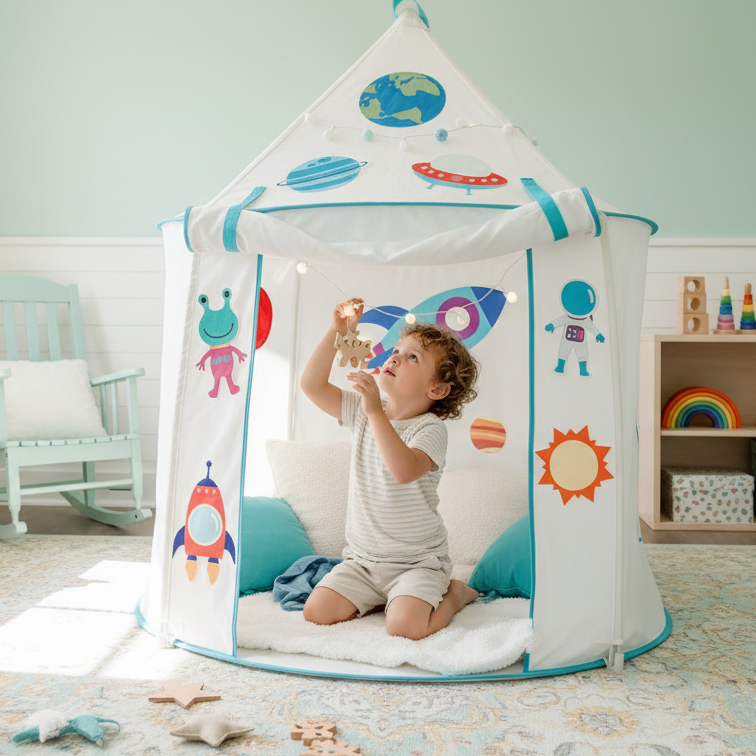
This philosophy is central to ZeeZee Adventures. Rather than offering a toy with a single storyline, the adaptable play environment encourages children to become the storytellers. Interchangeable StickeeZ themes—from outer space and dinosaurs to magical kingdoms and ocean adventures—allow the same familiar play space to evolve alongside a child's changing interests. Combined with everyday objects like blankets, cardboard boxes, flashlights, or stuffed animals, these flexible environments encourage children to imagine, explore, and create without predetermined outcomes.
After all, the most powerful part of imaginative play isn't the props.
It's the child who decides what those props become.
Myth vs. Fact
|
Myth |
Fact |
|
Imagination is just entertainment. |
Research shows that imagination strengthens cognitive, emotional, social, and language development while supporting healthy brain growth. |
|
Pretend play isn't as educational as academic activities. |
Imaginative play develops executive functioning, creativity, problem-solving, communication, and self-regulation—all essential for lifelong learning. |
|
Children who pretend a lot have trouble separating fantasy from reality. |
Healthy imaginative play actually helps children understand the difference between real and pretend while practicing flexible thinking. |
|
Expensive toys create better imagination. |
Children often create the richest stories using simple, open-ended materials because they decide what each object becomes. |
|
Adults should lead pretend play to make it educational. |
Child-led play encourages deeper learning because children generate ideas, solve problems, and direct their own experiences. |
Action Checklist
Use these simple strategies to help imagination become part of everyday life.
✅ Protect daily time for unstructured play.
✅ Keep a variety of open-ended materials available.
✅ Allow boredom to become an opportunity for creativity.
✅ Ask open-ended questions instead of giving instructions.
✅ Follow your child's ideas—even when they seem unusual.
✅ Encourage storytelling during everyday routines.
✅ Read books together and invite children to imagine different endings.
✅ Join pretend play as a supporting character rather than the leader.
✅ Celebrate curiosity, creativity, and persistence instead of perfect results.
✅ Remember that the goal isn't to create better stories—it's to help your child trust their own imagination.
Frequently Asked Questions
At what age does imagination begin?
Imagination begins surprisingly early.
Around 18 to 24 months, many toddlers start engaging in simple pretend play, such as pretending to drink from an empty cup or feeding a stuffed animal.
Between ages three and five, imagination often expands dramatically as children invent characters, create elaborate stories, and explore fantasy worlds.
Does imaginative play really help brain development?
Yes.
Research in developmental psychology and neuroscience suggests that imaginative play strengthens neural connections involved in executive functioning, language, emotional regulation, memory, creativity, and problem-solving.
Rather than being separate from learning, imaginative play is one of the ways young brains learn best.
How much imaginative play should children have each day?
There is no universal recommendation because every child is different.
However, most child development experts encourage regular opportunities for uninterrupted, child-led play.
Even twenty to thirty minutes of unstructured imaginative play each day can provide valuable developmental benefits when children are free to lead the experience.
What if my child prefers realistic play instead of fantasy?
That's perfectly normal.
Not every child pretends to be superheroes or dragons.
Some children enjoy realistic role-play, such as running a grocery store, caring for dolls, building cities, or pretending to cook meals.
These activities still develop many of the same cognitive, emotional, and social skills.
Can screens replace imaginative play?
Digital experiences can certainly entertain and even educate children in some contexts.
However, they often provide ready-made characters, stories, and outcomes.
Imaginative play is different because children become the creators.
They invent the characters.
Solve the problems.
Build the worlds.
This active process strengthens creativity and executive functioning in ways passive entertainment cannot fully replicate.
How can I encourage imagination without buying more toys?
The best imaginative play often begins with ordinary household items.
Blankets.
Cardboard boxes.
Scarves.
Wooden spoons.
Building blocks.
Flashlights.
Stuffed animals.
Children don't need more toys.
They need materials that can become anything their imagination decides.
Final Thoughts
The science is remarkably consistent.
Imagination isn't a distraction from learning.
It's one of the ways learning happens.
Every pretend adventure asks children to think beyond what they already know.
To create.
To question.
To adapt.
To communicate.
To solve problems.
To understand emotions.
To see the world through someone else's eyes.
While adults often focus on the visible outcome—a cardboard spaceship, a dragon's castle, or an imaginary bakery—the most important work is happening beneath the surface.
Neural connections are strengthening.
Language is expanding.
Confidence is growing.
Resilience is taking shape.
These invisible developments become the foundation for future learning, relationships, and lifelong curiosity.
As parents and caregivers, we don't need to create extraordinary experiences every day.
More often, we simply need to protect the ordinary moments where extraordinary imagination can emerge.
A quiet afternoon.
A few open-ended materials.
Time without constant interruption.
Permission to wonder.
When children are given the freedom to imagine, they aren't simply pretending.
They're practicing the skills they'll use to navigate a world that constantly asks them to think creatively, collaborate with others, solve new problems, and adapt to change.
The stories they invent today become the thinking habits they rely on tomorrow.
And perhaps that's the greatest lesson science teaches us about imagination.
It isn't preparing children for one moment in the future.
It's shaping the way they learn, grow, and understand the world every single day.





Comment (0)