
How to Encourage Storytelling Through Everyday Play
Introduction: Why Storytelling Matters More Than Ever
Storytelling is one of the oldest and most powerful forms of human expression. Long before formal education systems existed, stories were how knowledge, culture, and values were passed from one generation to the next. For children, storytelling is not merely a creative activity—it is a fundamental part of cognitive, emotional, and social development.
In early childhood, storytelling often emerges naturally through play. A simple object becomes a character. A quiet corner becomes a world. A routine moment transforms into an unfolding narrative. These small acts of imagination are not trivial; they are the building blocks of language, empathy, and problem-solving.
Yet in modern environments filled with structured toys, digital entertainment, and constant stimulation, opportunities for natural storytelling can become limited. Encouraging storytelling today requires intentionality—not through instruction, but through the thoughtful design of play experiences.
The Developmental Power of Storytelling in Childhood
Storytelling is deeply connected to multiple areas of development. When children create and narrate stories, they are simultaneously engaging several cognitive and emotional processes.
From a cognitive perspective, storytelling enhances language acquisition. Children learn to organise thoughts, sequence events, and expand vocabulary. Narrative thinking also supports memory development, as children begin to understand cause-and-effect relationships.
Emotionally, storytelling provides a safe space for expression. Children often process feelings through imagined characters and scenarios. A story about a lost toy may reflect anxiety, while a heroic narrative may express confidence or aspiration.
Socially, storytelling builds empathy. When children create characters, they begin to consider perspectives beyond their own. This ability to understand others is foundational to emotional intelligence.
Why Everyday Play Is the Best Medium for Storytelling
Storytelling does not require structured lessons or formal prompts. In fact, it thrives most naturally in unstructured, everyday play.
When children are given freedom within their environment, they begin to assign meaning to objects and situations. A chair becomes a mountain. A blanket becomes a river. A quiet space becomes a secret world.
This kind of symbolic play is critical. It allows children to transform reality, experiment with ideas, and build narratives that evolve over time.
Importantly, everyday play removes pressure. Unlike formal storytelling activities, it does not demand performance or correctness. Children are free to explore ideas without judgement, which often leads to richer and more sustained narratives.
The Role of Environment in Encouraging Storytelling
The physical environment plays a crucial role in shaping how children engage in storytelling.
Highly stimulating environments—filled with noise, bright colours, and numerous toys—can fragment attention. In such spaces, children often move quickly between activities without fully engaging in narrative play.
In contrast, calmer and more intentional environments support deeper focus. When visual and sensory distractions are reduced, children are more likely to immerse themselves in imaginative experiences.
Spaces that encourage storytelling often include:
- Defined play zones that create a sense of place
- Soft lighting that promotes calmness
- Open-ended materials that invite interpretation
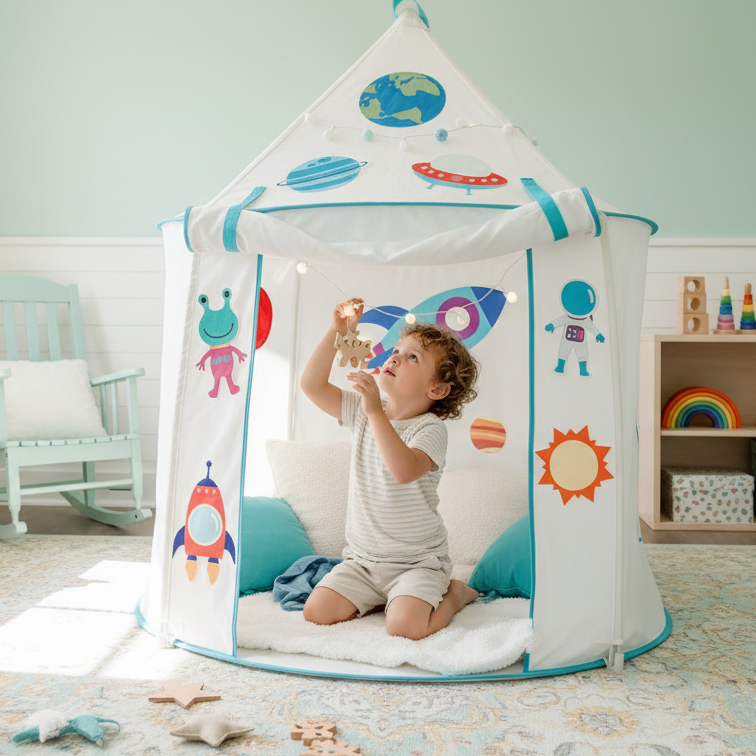
- Comfortable, enclosed areas that feel safe and private
These elements work together to create an environment where stories can unfold naturally.
For instance, many families now incorporate adaptable play environments such as ZeeZee Adventures into their homes. These types of flexible spaces provide children with a consistent yet transformable setting—one that can become a castle, a reading nook, or an exploratory cave depending on the story being created.
Open-Ended Materials: The Foundation of Narrative Play
The type of materials children interact with significantly influences their ability to create stories.
Open-ended materials are particularly effective because they do not prescribe a specific use. Instead, they act as prompts for imagination.
Examples include:
- Building blocks
- Fabric pieces
- Figurines or dolls
- Natural objects such as stones or wood
- Simple play structures
Unlike toys with fixed functions, these materials allow for continuous reinterpretation. A single object can take on multiple roles within different narratives.
This flexibility is essential for sustaining storytelling over time. When a toy dictates how it should be used, the narrative quickly reaches its limits. When a toy invites interpretation, the story can evolve indefinitely.
The Importance of Time and Space in Story Development
One of the most overlooked aspects of storytelling is time. Children require uninterrupted periods to develop narratives fully.
In environments where play is frequently interrupted—by schedules, screens, or structured activities—stories often remain incomplete. Children may begin imaginative play but abandon it before it has the opportunity to deepen.
Providing extended periods of unstructured time allows stories to develop complexity. Characters gain depth. Plots evolve. New ideas emerge.
Similarly, having a consistent play space supports continuity. When children return to the same environment, they can pick up where they left off, extending narratives over days or even weeks.
The Role of Parents in Supporting Storytelling
Parents play an important role in encouraging storytelling, but their involvement should be carefully balanced.
Rather than directing play, parents can support storytelling by:
- Observing without interrupting
- Asking open-ended questions
- Introducing gentle prompts when needed
- Providing materials without prescribing their use
For example, instead of saying, “Let’s play this game,” a parent might ask, “What is happening in your story?” This approach invites children to take ownership of their narrative.
It is also important to avoid over-correction. Storytelling is not about accuracy; it is about expression. Allowing children to experiment freely encourages confidence and creativity.
Storytelling Through Everyday Moments
Storytelling does not need to be confined to designated playtime. It can emerge throughout the day in simple, everyday interactions.
A walk in the park can become an adventure story.
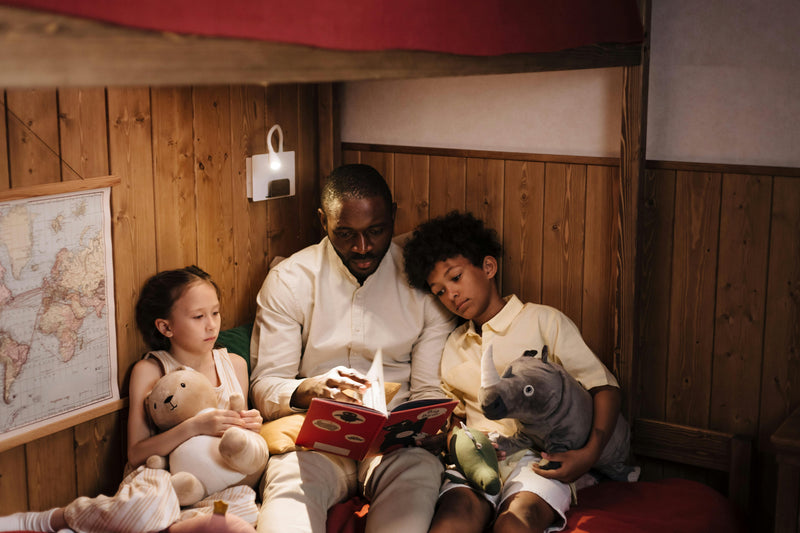
A bedtime routine can evolve into a narrative ritual.
Even daily tasks can be framed within imaginative contexts.
These moments reinforce the idea that storytelling is not an isolated activity—it is a way of seeing and interpreting the world.
Creating a Home That Nurtures Storytelling
Designing a home environment that supports storytelling does not require significant changes. Small adjustments can have a meaningful impact.
Consider:
- Reducing visual clutter to minimise distraction
- Creating a dedicated imaginative play space
- Rotating materials to maintain novelty
- Incorporating flexible elements that can be reconfigured
The goal is not to create a perfect playroom, but to create conditions where imagination can thrive.
Long-Term Benefits of Storytelling Through Play
The benefits of storytelling extend far beyond childhood.
Children who engage in narrative play often develop:
- Strong communication skills
- Creative thinking abilities
- Emotional resilience
- Problem-solving capabilities
These skills remain relevant throughout life, influencing academic performance, relationships, and personal growth.
Conclusion: Letting Stories Grow Naturally
Encouraging storytelling does not require complex strategies or expensive tools. It requires space, time, and thoughtful environments.
When children are given the freedom to imagine, they naturally begin to create stories. These stories may be simple at first, but over time they become richer and more meaningful.
In a world that often prioritises speed and structure, storytelling offers something different—a slower, deeper form of engagement.
And in that space, children do more than play.
They learn to think, to feel, and to understand the world around them.





Comment (0)