

How to Keep Kids Active Indoors Without Screens
When the weather keeps everyone inside, one of the hardest parts of the day can be hearing:
“I’m bored.”
If the usual answer is a tablet, television, or phone, you’re certainly not alone. Screens can be an easy way to fill an afternoon, especially when parents are working, cooking, or simply trying to get through a busy day.
But keeping children active indoors doesn't have to mean turning your home into a gym—or creating a new activity every 20 minutes.
Movement can become part of imaginative play.
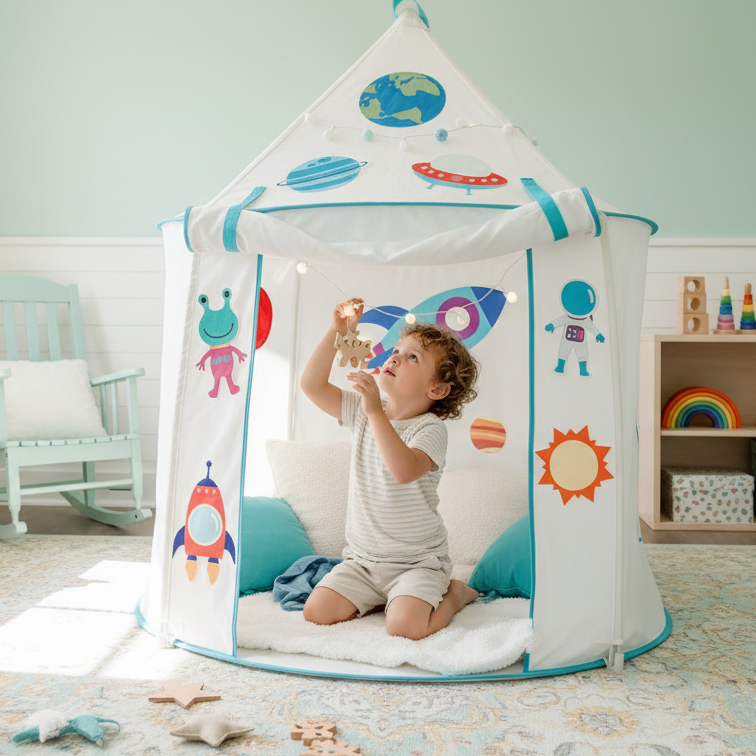
A living room can become an obstacle course. Cushions can become stepping stones. A blanket fort can become a jungle base. A play tent can become a spaceship that needs to be explored.
The goal isn't to eliminate screens completely.
It's to give children other things that are interesting enough to make them want to move, imagine, explore, and play.
Here are practical ways to make that happen.
Why Indoor Movement Matters
Children naturally move throughout the day when they have opportunities to play, explore, and interact with their environment.
But indoors, movement can become harder to initiate.
There may be less space. The weather may prevent outdoor play. Toys can encourage sitting. And screens provide an instantly engaging alternative.
That doesn't mean every indoor moment needs to be physically active.
Children also need quiet play, reading, drawing, rest, and opportunities to simply do nothing.
Instead, think about creating a variety of movement opportunities throughout the day.
A few minutes of dancing.
A building challenge.
An imaginative game.
A treasure hunt.
A short movement break between quieter activities.
Small moments can add up without making the day feel like a structured exercise program.
1. Turn the Living Room Into an Obstacle Course
You don't need specialized equipment.
Use safe, stable household objects to create a simple course:
-
Walk around cushions
-
Crawl under a table
-
Step over pillows
-
Follow a line of tape
-
Toss a soft ball into a basket
-
Balance along a clearly defined path
-
Finish with five jumping jacks or a silly dance
Keep the setup appropriate for your child's age and your available space, and avoid unstable furniture or anything that could cause a fall.
Then let your child redesign the course.
The first version might be a jungle expedition.
The next could be superhero training.
The one after that might be an astronaut mission.
The physical activity stays similar, but the story keeps it fresh.
2. Play “The Floor Is Lava”
It's an old favorite because it turns ordinary furniture and floor space into an imaginary world.
Tell your child the floor has suddenly become lava.
Now they have to move from one safe place to another without touching it.
Cushions can become islands.
A rug can become a bridge.
A chair can become a mountain.
You can make the challenge easier or harder depending on your child's age and abilities.
And once your child understands the game, let them create the next version.
“Where is the lava coming from?”
“Where is the safe zone?”
“What happens if the bridge disappears?”
Now the game includes movement, imagination, and problem-solving.
3. Turn Dance Into a Game
Put on music and give children a simple challenge.
When the music plays, move.
When it stops, freeze.
Then add different movement ideas:
-
Dance like a robot
-
Move like a dinosaur
-
Walk like a giant
-
Hop like a frog
-
Float like you're underwater
-
Move in slow motion
You can also let your child become the “dance leader.”
They choose the movement.
Everyone else follows.
There doesn't need to be a perfect dance routine.
The point is simply to make movement playful.
4. Create an Indoor Treasure Hunt
Treasure hunts can get children moving without feeling like an exercise activity.
Hide clues around the house and make each clue lead to the next.
For younger children, use simple directions:
“Look somewhere soft.”
“Find something blue.”
“Your next clue is near something you use every day.”
For older children, create riddles or simple puzzles.
You can add movement challenges along the way:
“Before finding the next clue, hop like a rabbit to the kitchen.”
Or:
“Walk backward to the next room.”
The physical movement becomes part of the story rather than a separate task.
5. Build a “Rescue Mission”
Children often become more interested in movement when there's a reason for it.
Place a stuffed animal at the other side of the room.
Then announce:
“The bear needs rescuing!”
Now your child has to cross the imaginary jungle, climb over the mountains, cross the river, and bring the bear back safely.
You can create the environment using blankets, cushions, cardboard boxes, and other safe materials.
This is especially useful when your child isn't interested in simply being told to “exercise.”
They aren't exercising.
They're completing a mission.
6. Have an Animal Movement Challenge
Pick an animal and move like it.
How does a penguin walk?
How does a frog jump?
How does a crab move?
How does a bear walk?
How does a snake travel?
Let your child choose the next animal.
You can even turn it into a guessing game.
One person moves.
Everyone else tries to guess the animal.
It's simple, requires very little preparation, and can be adapted for different ages.
7. Build, Move, Rebuild
Movement doesn't always have to be separate from creative play.
Try combining the two.
Give your child a building challenge:
“Can you build a house for your stuffed animal?”
But there's a catch.
The building materials are across the room.
Your child has to carry one item at a time to the building area.
Now they're walking, carrying, bending, reaching, building, and solving problems without the activity feeling like a workout.
When the structure is finished, knock it down and create something new.
8. Make a Superhero Training Course
Create several simple stations around the room.
For example:
Station 1: Jump over a pillow.
Station 2: Crawl through a blanket tunnel.
Station 3: Toss a soft ball at a target.
Station 4: Balance along a tape line.
Station 5: Run to the “rescue zone.”
Give your child a superhero mission to complete.
You can even let them invent their superhero name, special power, and mission.
The more children participate in creating the game, the less it feels like an adult-designed exercise routine.
9. Try “Move Like the Story”
Read or tell a simple story and let movement become part of it.
If the character walks through a forest, everyone walks.
If they climb a mountain, everyone climbs in place.
If they cross a river, everyone pretends to swim.
If a storm arrives, everyone crouches and hides.
If the character discovers a magical creature, everyone chooses how that creature moves.
This can be especially engaging for younger children because the movement has a purpose within the story.
10. Use a Play Tent as an Activity Base
A play tent can become a useful anchor for active indoor play.
It could be:
-
An explorer's base
-
A spaceship
-
A rescue station
-
A camping site
-
A dinosaur research center
-
A superhero headquarters
Children can move between the tent and other parts of the room as the story develops.
ZeeZee Adventures takes an adaptable approach to this kind of play environment. Its tent can be paired with changeable StickeeZ themes, allowing the same physical space to support different imaginative settings as children's interests change.
The important part is not the tent itself.
It's the possibility of giving movement a reason and a story.

11. Create a “Can You…?” Movement Game
Make a list of simple challenges:
Can you…
-
Jump five times?
-
Walk like a penguin?
-
Crawl across the room?
-
Balance on one foot?
-
Spin once and freeze?
-
Reach as high as you can?
-
Make up a new movement?
Let your child add challenges too.
This keeps the activity flexible and gives them some control over what happens next.
12. Turn Chores Into Movement
Not every active moment needs to be called a game.
Age-appropriate household tasks can naturally involve movement.
Children might:
-
Carry lightweight items
-
Put toys away
-
Help set the table
-
Sort laundry
-
Water plants
-
Help tidy a play area
The goal isn't to turn chores into exercise.
It's simply to recognize that movement can happen throughout an ordinary day.
13. Create an Indoor Adventure
Sometimes the best way to encourage movement is to stop talking about movement altogether.
Create an adventure.
Maybe your child is an explorer trying to reach a hidden island.
Maybe they're astronauts collecting samples from different planets.
Maybe they're rescuers searching for lost animals.
Maybe they're traveling through an imaginary jungle.
Give them a few physical challenges along the way.
Cross the river.
Climb the mountain.
Find the hidden object.
Return to base.
Now walking, crawling, balancing, jumping, and reaching all become part of the story.
This is where imaginative play can make indoor movement feel much more natural.
How to Keep Indoor Active Play From Becoming Repetitive
The same obstacle course can become boring if it never changes.
But you don't always need a new activity.
Try changing one element.
Change the setting
Jungle → Space → Ocean → Castle
Change the character
Explorer → Astronaut → Dinosaur → Superhero
Change the mission
Find an animal → Rescue someone → Find treasure → Repair the spaceship
Change the movement
Hop → Crawl → Balance → Dance
A familiar game can suddenly feel new when its context changes.
This is one reason adaptable play environments can be valuable. Children can revisit the same physical space while imagining something completely different.
Don't Make Every Indoor Moment About Being Active
Keeping kids active indoors doesn't mean keeping them moving constantly.
Children need different kinds of experiences throughout the day.
There will be energetic play.
There will be quiet play.
There will be reading.
There will be drawing.
There will be moments when your child simply lies on the floor and does nothing.
That's okay.
The goal is not to replace every screen moment with structured activity.
Instead, create an environment where movement, creativity, quiet time, and independent play can naturally coexist.
A child might spend twenty minutes racing through an imaginary obstacle course and then retreat into a tent with a book.
Both experiences have a place.
The Bigger Idea: Make Play Worth Moving For
If a child doesn't want to leave the screen to do jumping jacks, the answer may not be a better exercise instruction.
Maybe the movement needs a reason.
“Can you jump across the lava?”
feels different from:
“Do ten jumps.”
“Can you crawl through the jungle to rescue the puppy?”
feels different from:
“Go crawl around for five minutes.”
The physical movement is similar.
The experience isn't.
Children often engage differently when movement is connected to imagination, curiosity, storytelling, or a challenge they can help shape.
That doesn't mean every child will enjoy the same games. Children have different personalities, interests, energy levels, and physical abilities.
The best approach is to offer choices and notice what your child naturally enjoys.
A Simple Screen-Free Movement Formula
When you need an easy idea, try:
MOVE + IMAGINE + CHOOSE
Move: Add a simple physical action.
Imagine: Give it a story or setting.
Choose: Let your child decide what happens next.
For example:
Move: Crawl across the room.
Imagine: You're exploring a jungle.
Choose: “Which animal do we find next?”
That's enough to start.
The rest can come from your child's imagination.
FAQs
1. How can I keep my kids active indoors without screens?
Try turning everyday indoor spaces into opportunities for movement and imaginative play. Indoor obstacle courses, treasure hunts, dance games, animal movement games, rescue missions, and pretend adventures can encourage children to move while keeping play engaging.
2. What are some screen-free indoor activities for kids?
Some options include indoor treasure hunts, obstacle courses, dance games, “the floor is lava,” animal movement challenges, superhero training courses, building activities, and imaginative adventure games.
3. How can I make indoor exercise fun for kids?
Connect movement to a story or challenge instead of presenting it simply as exercise. For example, children can jump across imaginary lava, crawl through a jungle, or complete a superhero rescue mission.
4. How do I encourage my child to move more indoors?
Give children opportunities to choose how they want to move and make the activity playful. Simple materials such as cushions, blankets, cardboard boxes, and soft toys can become part of movement-based imaginative games.
5. What can kids do indoors when they are bored?
Children can create an obstacle course, organize a treasure hunt, build an imaginary world, play an animal movement game, create a rescue mission, dance, or turn a play space into an adventure setting.
6. Can imaginative play help keep kids active indoors?
Imaginative play can naturally incorporate movement. When children pretend to be explorers, astronauts, superheroes, or animals, actions such as crawling, jumping, balancing, walking, and reaching can become part of the story.
7. Does indoor play always need to be physically active?
No. Children benefit from a variety of experiences, including active play, quiet play, reading, creative activities, and rest. The goal is to create opportunities for movement rather than making every indoor moment physically demanding.
8. How can I make the same indoor game interesting again?
Change the story, setting, character, or challenge. For example, the same obstacle course can become a jungle expedition one day, a space mission the next, and a superhero training course later. This allows familiar play materials to support new experiences.
Let the Adventure Do the Work
Keeping children active indoors doesn't have to mean planning an elaborate schedule of physical activities.
Sometimes it starts with changing the way we frame play.
A cushion isn't just a cushion.
It's an island.
A blanket isn't just a blanket.
It's a river.
A play tent isn't just a tent.
It's a base camp.
And a rainy afternoon isn't necessarily a day when play has to stop.
It can be an opportunity to create a world inside the home.
ZeeZee Adventures is built around the broader idea that a child's play environment can evolve with their imagination rather than remaining fixed to one theme.
So the next time you're looking for a way to get kids moving without immediately reaching for a screen, try starting with a story.
Ask:
“Where are we going?”
Then let your child decide how to get there.
The movement might take care of itself.





Comment (0)