

Minimalism in Play: How Less Can Lead to More Creativity and Focus
In today’s world, children are surrounded by more than ever before—more toys, more screens, more noise, more stimulation.
At first glance, it feels like abundance should be a good thing.
But when everything is available, something important often gets lost:
Attention.
Depth.
Imagination.
Minimalism in play isn’t about taking things away from children.
It’s about giving them back something far more valuable—space to think, create, and focus.

The Problem with “Too Much”
Walk into most play areas today, and you’ll see overflowing toy bins, bright lights, constant sounds, and endless options.
It looks exciting.
But for a child’s brain, it can be overwhelming.
When there are too many choices:
-
attention becomes scattered
-
engagement becomes shallow
-
play becomes short-lived
Children jump from one toy to another—not because they’re curious, but because nothing holds their focus long enough.
More options don’t always mean better play.
Often, they mean distracted play.
Why Less Actually Works Better
When you reduce the number of toys and distractions, something interesting happens.
Children slow down.
They begin to:
-
Explore more deeply
-
Engage for longer periods
-
Use imagination to fill gaps
Instead of relying on the toy to entertain them, they start creating their own experience.
A simple object becomes multiple things.
A quiet space becomes a world.
This is where real creativity begins.
Minimalist Toys vs. “Ready-Made Entertainment”
Not all toys are equal.
Some toys do everything for the child—lights, sounds, instructions, outcomes.
Others do almost nothing.
And that’s exactly why they’re powerful.
Minimalist toys:
-
don’t dictate how to play
-
allow multiple interpretations
-
grow with the child’s imagination
Think of:
-
blocks
-
soft toys
-
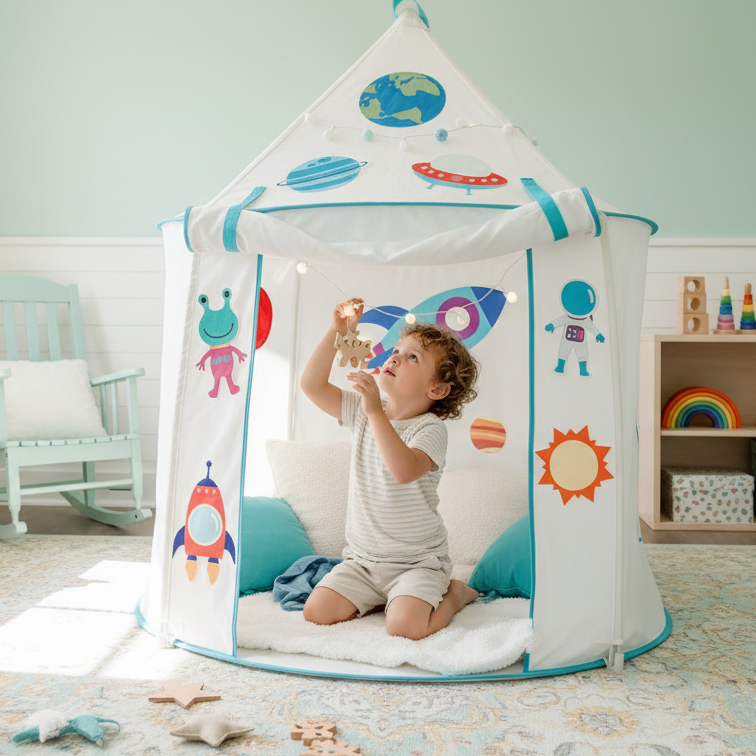
open-ended play tents
-
cushions and blankets
These aren’t just toys.
They are tools for thinking.
The less a toy does, the more a child has to do.

Focus Comes from Clarity, Not Stimulation
Focus isn’t something children are born lacking.
It’s something that gets disrupted.
Constant stimulation trains the brain to expect quick rewards and frequent changes.
Minimal environments do the opposite.
They:
-
Reduce mental noise
-
Create calm
-
Support longer attention spans
When a child plays in a clean, defined space without constant interruptions, they naturally settle into deeper engagement.
Focus becomes effortless—not forced.
The Role of Defined Play Spaces
A child doesn’t just need fewer things.
They need clearer boundaries.
A well-defined play space—like a cozy corner or a dedicated play tent—acts as a signal:
“This is your world.”
Inside that space:
-
Distractions are limited
-
Imagination expands
-
The child feels a sense of control
This sense of ownership is powerful.
It allows children to fully immerse themselves in play without constantly shifting attention.
The Emotional Side of Minimalism
Minimalism isn’t just about creativity and focus.
It also impacts how children feel.
Cluttered environments can create:
-
restlessness
-
irritability
-
overstimulation
Simplified spaces, on the other hand, promote:
-
calmness
-
security
-
emotional regulation
When the environment feels peaceful, the mind follows.
And a calm mind is far more capable of learning, creating, and adapting.
Practical Ways to Simplify Play
You don’t need a complete overhaul.
Small shifts make a big difference.
1. Rotate Toys Instead of Displaying Everything
Keep a few toys accessible and store the rest.
Reintroduce them over time to keep play fresh.
2. Choose Open-Ended Over Electronic
Prioritize toys that require imagination, not instruction.
3. Declutter the Play Area
Clear space visually and physically.
Less clutter = more focus.
4. Create a Dedicated Play Zone
Even a small corner can become a powerful imaginative space.
5. Allow Quiet Play Time
Not every moment needs stimulation.
Silence is where creativity often begins.
The “Less is More” Shift in Parenting
Across parenting and education, there’s a growing realization:
Children don’t need more input.
They need more room to process.
Minimalism supports:
-
independent thinking
-
deeper engagement
-
stronger emotional balance
It’s not about limiting a child’s world.
It’s about removing the noise so they can actually experience it.
Final Thought
We often try to give children everything.
But what they truly need isn’t more things.
It’s more space.
Space to imagine.
Space to focus.
Space to become who they are.
Because when you remove the excess,
you don’t take something away—
you make something meaningful possible.





Comment (0)