
Montessori-Inspired Playroom Ideas You'll Love
There is something instantly appealing about a Montessori-inspired playroom.
The shelves are low. The materials are easy to see. There is room to move. Nothing seems to be shouting for attention. Instead of overflowing baskets and flashing toys, the room seems to quietly tell the child:
You can do this yourself.
That sense of independence is more important than the aesthetic.
Montessori-inspired spaces have become popular in family homes partly because many of their core ideas are remarkably practical: put useful things where children can reach them, create order they can understand, offer a manageable selection of purposeful materials, and design the environment around the child's size rather than the adult's convenience.
But parents do not need to turn their living room into a formal Montessori classroom to borrow those principles.
Authentic Montessori education includes specially designed learning materials, trained Montessori educators, carefully sequenced presentations, and a prepared classroom environment. At home, “Montessori-inspired” is a more accurate description when families adapt selected principles to everyday play. The American Montessori Society describes prepared Montessori environments as intentionally arranged, child-accessible spaces containing appropriately sized furniture and carefully selected materials, while the Association Montessori Internationale similarly emphasizes accessibility, free choice, order, and hands-on activity.
The goal at home is not perfection.
It is creating a space where children can increasingly choose, begin, explore, and put things back with less adult intervention.
Quick Answer: What Makes a Playroom Montessori-Inspired?
A Montessori-inspired playroom usually emphasizes independence, accessibility, order, simplicity, hands-on activity, and respect for the child's developmental abilities. Materials are kept within reach when safe, furniture may be sized for children, choices are intentionally limited rather than overwhelming, and the room is arranged so children can begin meaningful activities without constantly depending on an adult.
The room does not have to contain only wooden toys, use neutral colors, or purchase official Montessori materials to benefit from these ideas.
What matters more is the question behind the design:
Can my child participate in this space with increasing independence?
Key Takeaways
A Montessori-inspired home playroom can borrow from the prepared-environment principle without attempting to reproduce a Montessori classroom. Low accessible shelving, manageable choices, child-sized tools, defined homes for materials, opportunities for movement, and practical routines can all make children's everyday environments easier to use independently. AMS specifically identifies child-sized furniture, reachable shelving, and opportunities for children to choose and complete activities themselves as characteristic features of Montessori environments for younger children.
At the same time, Montessori-inspired should not become another decorating trend where beige toys and beautiful shelves matter more than the child. The central idea is functional independence, not a particular Instagram aesthetic.
Start With the Montessori Idea of a “Prepared Environment”
One of the most useful Montessori concepts for parents is the prepared environment.
Rather than repeatedly telling a child what to do, adults arrange the environment so appropriate action becomes easier.
A child who can reach their books does not need to ask for one.
A child whose art materials have an understandable home can begin drawing without waiting for a setup.
A child with an appropriately sized table can sit and work without climbing onto furniture designed entirely for adults.
AMI describes the prepared environment as one in which order, simplicity, and accessibility help children move toward purposeful activity with less dependence on adult intervention.
That idea changes the way we approach playroom design.
Instead of asking:
“How can I fit more toys in here?”
ask:
“How can I make it easier for my child to use what is already here?”
1. Bring the Most Useful Materials Down to Child Height
Low shelving is probably the most recognizable feature of Montessori-inspired spaces, but its purpose is practical rather than decorative.
Children should be able to see and access at least some materials without asking an adult to retrieve them.
AMS describes reachable shelves and child-sized furniture as standard characteristics of Montessori early-childhood environments because they give children greater opportunities to make choices and complete activities independently.
At home, that might mean keeping books, blocks, puzzles, drawing supplies, or familiar pretend-play materials on one low shelf.
Items requiring supervision can remain higher.
The goal is not unrestricted access.
It is intentional independence.
2. Display Less at One Time
Montessori-inspired shelves tend to feel calmer because they do not attempt to display every possession simultaneously.
Each material has room around it.
A child can actually see what is available.
You can borrow this principle without owning formal Montessori materials. Instead of filling a shelf with twenty-five toys, choose several activities your child currently uses and store the rest elsewhere.
Rotate occasionally according to interest.
You do not need a weekly rotation spreadsheet.
If the blocks continue attracting deep play, leave them.
If something has become invisible for several weeks, swap it.
The purpose of simplicity is not to create a minimalist home.
It is to make choice manageable.
3. Give Everything an Obvious Home
Order is another important Montessori principle.
But order for children should be understandable, not obsessive.
A puzzle returns to the same place.
Books have a clear shelf.
Drawing tools belong in one container.
Blocks have a basket or defined area.
When objects have predictable homes, children can gradually participate in both choosing and returning materials.
AMI describes order and accessibility as important features of a prepared environment precisely because they reduce the need for constant adult direction.
This does not mean stopping imaginative play because the toy dinosaur wandered into the block area.
Let play become complicated.
Restore the order afterward.
4. Add Child-Sized Furniture Where It Actually Helps
A miniature version of every piece of furniture is unnecessary.
But child-sized furniture can be useful when it allows children to perform an everyday activity more comfortably and independently.
A low table and chair can provide somewhere to draw, complete a puzzle, look at objects, or work with play materials.
A reachable hook can let a child hang a dress-up item.
A small bookshelf can make choosing and replacing books easier.
AMS specifically identifies child-sized furniture and tools as features that allow young children to make choices and carry out tasks with increasing independence.
Before buying something, ask whether it changes what your child can actually do.
If the answer is no, the room may not need it.
5. Make Books Easy to Choose
Instead of packing books tightly onto an adult-height shelf, make a smaller selection visible and reachable.
A low basket works.
A short shelf works.
A narrow front-facing display can work.
Rotate books as interests change.
The purpose is not to create a perfectly styled Montessori reading corner. It is to allow the child to choose a book, use it, and increasingly return it themselves.
A comfortable place nearby—a cushion, small chair, rug, or cozy play space—can make reading feel naturally connected to the rest of the room.
6. Include Real-Life Activities, Not Only Toys
Montessori education places considerable emphasis on practical life—meaningful activities connected to caring for oneself, others, and the environment.
At home, that principle might influence the playroom in very simple ways.
Perhaps your child has a small cloth available for wiping their table.
Maybe they help water a plant.
Art supplies are stored in a way they can help reset.
A basket makes it possible to carry materials from one area to another.
The point is not to turn playtime into chores.
It is recognizing that young children often find genuine participation interesting.
AMS describes Montessori environments for younger children as including child-accessible tools and opportunities to carry out everyday activities independently.
Sometimes the most Montessori-inspired item in the room is not a toy at all.
7. Leave Enough Floor for Movement
A Montessori-inspired playroom should not be so efficiently furnished that children have nowhere left to move.
Open floor gives children room to carry materials, work on a rug, build, construct, and physically navigate the environment.
AMI's description of Montessori environments includes a variety of spaces where children can work individually or with others, while AMS emphasizes giving children sufficient space to engage without unnecessary interference.
That means empty space is functional.
You do not have to fill it.
8. Use Trays or Baskets to Make Activities Understandable
A tray can turn several loose materials into one manageable activity.
For example, paper and several drawing tools can stay together.
Puzzle pieces remain with their puzzle.
A small collection of sorting objects can stay contained.
A basket might hold several objects related to one kind of play.
This makes it easier for a child to understand where an activity begins and how it can eventually be returned.
But avoid turning every play experience into a carefully curated Montessori tray.
Home is still home.
Blocks can live in a basket.
Pretend-play materials can mix.
Art can become spontaneous.
The prepared environment should support children's activity, not become another system children are afraid to disturb.
9. Choose Hands-On Materials That Ask the Child to Participate
Montessori environments emphasize active engagement rather than passive entertainment. AMI describes children working hands-on with materials and making choices within the environment, while the AAP broadly emphasizes active play as a context for creativity, problem-solving, language, and developmental learning.
At home, that might mean prioritizing materials children physically manipulate.
Blocks.
Puzzles.
Art materials.
Objects for sorting or matching.
Clay or play dough.
Books.
Simple construction materials.
Pretend-play objects.
Nature collections.
Not everything has to be wooden.
Not everything has to be marketed as Montessori.
A plastic cup a child can independently use may align more closely with the practical philosophy than an expensive wooden toy that mostly sits untouched.
10. Create a Quiet Place Without Making It Mandatory
Montessori early-childhood classrooms can include comfortable spaces for quiet reading alongside more active work areas.
At home, a small optional retreat can be similarly useful.
It might be a cushion beside the bookshelf.
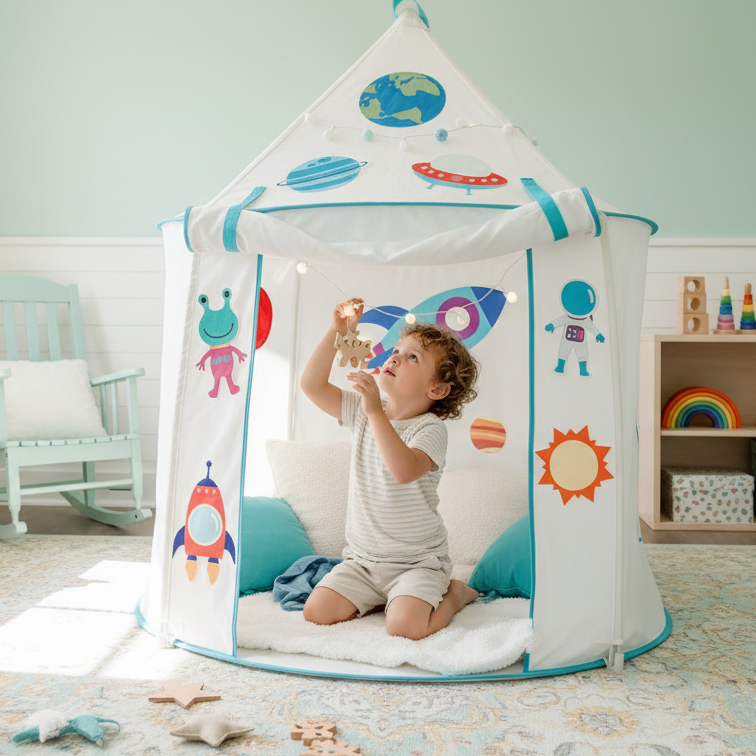
A small play tent.
A corner with a rug and several books.
The important word is optional.
Do not assume every child needs an enclosed “calm-down” space or that the area will regulate emotions in a particular way. Children have different preferences.
Simply make another kind of participation available.
The same child may build energetically on the floor one morning and choose the quieter corner that afternoon.
11. Make the Environment Changeable Without Making It Chaotic
This is where Montessori-inspired design can meet imaginative play particularly well.
Traditional Montessori classroom materials are not the same thing as open-ended pretend-play materials, and parents should not collapse the two approaches into one. But a home does not have to adhere rigidly to one educational philosophy.
Families can maintain an orderly, child-accessible environment while also giving children opportunities to transform parts of it imaginatively.
A basket of fabric can become scenery.
A defined corner becomes a shop.
Reusable felt elements can change a familiar play surface.
A play structure can become different imaginary worlds while retaining the same physical home in the room.
This is where ZeeZee Adventures can fit contextually rather than being presented as a Montessori material. The ZeeZee Adventures Tent is a changeable imaginative environment using interchangeable StickeeZ themes, allowing children to modify the setting without replacing the underlying play space. ZeeZee should therefore be understood as compatible with some Montessori-inspired home principles—such as accessible, child-directed engagement and a reusable environment—not as an authentic Montessori classroom material.
That distinction keeps the educational connection accurate.

12. Think “Freedom Within Limits”
Montessori independence is not the same as children having unrestricted access to everything.
The environment is intentionally prepared.
Adults decide what is safe and developmentally appropriate to make available.
Then children have meaningful choice within that environment.
At home, you might make six activities accessible rather than sixty.
The child decides which one to use.
Art materials intended for independent use stay within reach.
Permanent markers do not.
The child can rearrange blocks freely.
The bookshelf does not need to become climbing equipment.
This combination of autonomy and structure is more useful than either total adult control or total environmental freedom.
13. Let Children Participate in Resetting the Room
A Montessori-inspired environment works best when children gradually become participants in caring for it.
That expectation must remain developmentally realistic.
A toddler may place blocks into a basket alongside you.
A preschooler might return a puzzle to its shelf.
An older child can take more responsibility for restoring materials.
The goal is not perfect cleanup.
It is helping children recognize that the room belongs to them not only when they use it, but also when they care for it.
This is another reason simple organization helps.
Children cannot independently reset a system only adults understand.
14. Resist the “All Wooden, All Beige” Version of Montessori
A Montessori-inspired playroom does not need to be colorless.
Authentic Montessori environments themselves contain visually distinctive, purposeful materials; AMS describes classroom materials as carefully selected and aesthetically arranged, not universally beige.
Your child's artwork can be colorful.
Books can be colorful.
Blocks can be colorful.
Their favorite objects can be colorful.
The relevant question is not:
“Does this look Montessori enough?”
It is:
“Is this environment orderly, accessible, purposeful, and appropriate for the child using it?”
A home designed entirely around an adult's preferred aesthetic can accidentally become less child-centered, even when the aesthetic is inspired by Montessori.
15. Follow the Child Before Following Pinterest
This may be the most Montessori-inspired principle of all.
Observe.
What does your child repeatedly choose?
What do they ignore?
What activity have they outgrown?
What keeps appearing in their play?
Where do they naturally sit?
What can they already do without assistance?
Montessori education places close observation at the heart of how adults prepare and adapt environments around children's developmental needs. The environment is not intended to remain frozen while the child changes.
Your home playroom can evolve the same way.
If your child is deeply engaged with construction, give construction more room.
If they suddenly become interested in drawing, make drawing easier to access.
If several materials are gathering dust, store them.
Prepare the environment for the child who actually lives in your home.
Not the child in the photograph that inspired it.
Montessori-Inspired Does Not Mean “Official Montessori”
This distinction is worth making clearly.
A genuine Montessori classroom involves much more than low shelves and wooden toys. AMS identifies core components including trained Montessori teachers, multi-age classrooms, Montessori materials, child-directed work, and uninterrupted work periods.
At home, most parents are not trying to reproduce that educational system.
Nor do they need to.
You can borrow ideas such as:
-
child accessibility,
-
manageable choice,
-
environmental order,
-
practical independence,
-
hands-on participation,
-
child-sized tools,
-
observation,
-
and respect for concentration,
while still having pretend play, open-ended toys, favorite character toys, colorful books, stuffed animals, and the normal beautiful chaos of family life.
That is why Montessori-inspired is such a useful phrase.
It makes room for adaptation.
Montessori-Inspired Playroom vs. Conventional Toy-Filled Playroom
|
Design question |
Montessori-inspired approach |
Common toy-storage approach |
|
Accessibility |
Selected materials at child height |
Toys may require adult retrieval |
|
Quantity displayed |
Smaller curated selection |
Most toys displayed together |
|
Organization |
Clear, predictable homes |
Storage primarily maximizes capacity |
|
Furniture |
Child-sized where useful |
Mostly adult-sized |
|
Independence |
Environment supports self-starting |
Adult often sets up activities |
|
Materials |
Hands-on and purposeful |
May include more passive entertainment |
|
Reset |
Child increasingly participates |
Adult often manages most organization |
|
Design priority |
Function for the child |
Storage or adult aesthetic |
Neither column needs to describe every home.
The table simply illustrates the shift in design thinking.
Common Montessori Playroom Mistakes
The first mistake is buying the aesthetic before understanding the philosophy.
A room full of expensive wooden toys is not automatically Montessori-inspired if children cannot reach them, do not know how to use the environment independently, or are not allowed to influence what happens there.
Another mistake is putting too much on the shelves.
Accessibility only works when choices remain understandable.
Parents may also become overly rigid about how materials must be used. Authentic Montessori materials have intended presentations and purposes, but a family playroom will often contain many non-Montessori materials too. Children should still have room for pretend play and creative combinations.
Finally, avoid turning independence into pressure.
AMI itself emphasizes that young children need both connection and growing independence; independence develops within relationships rather than replacing them.
A child asking you to play does not mean the Montessori-inspired environment has failed.
A Simple Montessori-Inspired Playroom Checklist
-
Put a manageable selection of safe materials within the child's reach.
-
Leave visual space between activities.
-
Give frequently used objects predictable homes.
-
Use child-sized furniture only where it increases genuine independence.
-
Keep several books accessible.
-
Include hands-on materials the child can manipulate.
-
Protect some open floor space.
-
Add practical opportunities for children to care for their environment.
-
Create an optional quieter area.
-
Keep adult-supervised materials appropriately separate.
-
Let children help reset familiar activities.
-
Rotate according to interest rather than a rigid timetable.
-
Allow the room to evolve as developmental needs change.
-
Prioritize your child's actual engagement over Montessori aesthetics.
Frequently Asked Questions
What should be in a Montessori-inspired playroom?
A Montessori-inspired home playroom can include low, accessible shelves, a small number of hands-on activities, books, child-sized furniture where useful, practical-life materials, open floor space, and clear storage children can gradually learn to use. Authentic Montessori classrooms also contain specialized Montessori materials, but families do not need to reproduce the classroom to borrow selected environmental principles.
Do Montessori playrooms need wooden toys?
No. Montessori is not defined by a wooden-toy aesthetic. The more important principles involve purposeful hands-on activity, accessibility, developmentally appropriate materials, independence, and an intentionally prepared environment.
How many toys should be on a Montessori shelf?
There is no universal number that applies to every home and child. Keep enough variety for meaningful choice without filling the shelf so completely that individual activities become difficult to notice. Observation of the child's interests is more useful than following a fixed toy count.
Are open-ended toys Montessori?
Not automatically. Authentic Montessori materials are specifically designed and often have defined purposes and presentations. Open-ended materials belong to a somewhat different play tradition, although families can include both in a Montessori-inspired home environment.
Can pretend play be included in a Montessori-inspired playroom?
Families can absolutely include pretend play in a Montessori-inspired home. A home environment does not have to reproduce a formal Montessori classroom, and broader child-development guidance recognizes pretend play as a valuable form of childhood play.
How can I make my existing playroom more Montessori-inspired?
Begin without buying anything. Reduce what is displayed, lower several commonly used materials to child height, create obvious homes for them, keep books accessible, preserve open floor space, and watch which activities your child chooses independently.
Is a play tent Montessori?
A play tent is not an authentic Montessori material simply because it is child-sized or screen-free. It can, however, fit within a Montessori-inspired home when used as an accessible environment for child-directed activity alongside other forms of play. ZeeZee's changeable Tent, for example, is better described as an imaginative-play environment than as a Montessori material.
Does a Montessori-inspired playroom encourage independence?
It can create more opportunities for independence by making appropriate materials reachable and arranging the environment so children can perform some activities with less adult assistance. Both AMI and AMS explicitly connect the prepared environment and child-sized design with growing independence.
The Most Montessori-Inspired Thing You Can Do Is Observe
It is easy to believe that creating a Montessori-inspired playroom begins with shopping.
A low shelf.
Wooden toys.
A tiny table.
Matching baskets.
But perhaps the better beginning is quieter.
Sit on the floor.
Look around from your child's height.
What can they reach?
What can they not?
What do they choose without being prompted?
What do they abandon?
Where do they concentrate?
What do they repeatedly ask you to help with that the environment could perhaps make easier?
Then change one thing.
Move the books lower.
Remove half the toys from one crowded shelf.
Put drawing materials somewhere accessible.
Give the blocks more floor space.
Add one simple place children can help return materials when they finish.
That is the deeper value of Montessori-inspired design.
The environment begins doing a little less for the adult's eye and a little more for the child's independence.
For families who want to explore the philosophy itself more deeply, ZeeZee Adventures' What Is Montessori Play? Everything Parents Should Know provides the broader educational foundation, while How Montessori Play Encourages Independence is a natural next read for understanding why accessibility and child-sized design matter. ZeeZee's current Montessori content cluster includes both resources alongside practical at-home Montessori play ideas.
You do not need a perfect Montessori playroom.
You need a space that quietly tells your child:
I thought about what you can do here.
Author Bio
The ZeeZee Play Experts share research-informed ideas about Montessori-inspired play, independent play, imagination, sensory exploration, and screen-free childhood. ZeeZee Adventures' educational resources help families translate child-development and play principles into realistic home environments without turning childhood into another optimization project.





Comment (0)