
30 Sensory Play Activities for Every Age
Sensory play has somehow developed a reputation for requiring elaborate bins, carefully dyed rice, special tools, and an afternoon of preparation.
In reality, some of the richest sensory experiences in childhood are much simpler.
A baby pats bath water and watches it ripple. A toddler carries a couch cushion across the room. A preschooler presses play dough into an imaginary birthday cake. A seven-year-old builds a fort from blankets, while an older child kneads bread dough, works with clay, gardens, paints, or constructs something from cardboard.
All of these experiences invite children to learn through their bodies and senses.
Sensory play does not need to be a separate event parents schedule into the day. It can happen naturally through touching, moving, listening, building, pouring, carrying, creating, exploring, and pretending.
This guide offers 30 sensory play activities for babies, toddlers, preschoolers, school-age children, and older kids, with an emphasis on activities that are practical, open-ended, and easy to adapt to real family life.
Quick Answer: What Are Good Sensory Play Activities for Kids?
Good sensory play activities allow children to meaningfully explore through touch, sight, sound, smell, taste, movement, balance, or awareness of their bodies in space. Water play, play dough, outdoor exploration, music and movement, fort building, cooking, gardening, art, felt play, clay, and construction activities can all provide sensory-rich experiences.
The activity itself matters less than whether the child has opportunities to explore, make choices, repeat actions, notice differences, and interact actively with the environment.
What Is Sensory Play?
In everyday parenting and early-childhood contexts, sensory play generally refers to play in which children actively explore information through their senses and movement.
Parents often think first about the familiar five senses—touch, sight, hearing, smell, and taste—but children also process information related to movement, balance, and where their bodies are in space. These experiences are often discussed in relation to the vestibular and proprioceptive sensory systems.
That is why sensory play can include much more than a tub filled with textured materials. Climbing, pushing, pulling, carrying, jumping, pouring water, listening to sounds, kneading dough, digging in soil, building with cushions, and moving to music can all be sensory-rich experiences.
If you want a deeper introduction before choosing activities, ZeeZee Adventures' how sensory play supports exploration article can serve as the educational companion to this guide.
Internal link: “What Is Sensory Play and Why Is It Important?”
What Does the Developmental Science Tell Us?
Play is not simply downtime between more important learning activities. The American Academy of Pediatrics describes play as an important context for children's cognitive, language, social-emotional, and self-regulatory development, while current CDC guidance continues to encourage young children to explore, move, manipulate objects, play with materials such as play dough, and try new things.
That does not mean every sensory activity automatically produces a particular developmental outcome. A water table is not a treatment, and squeezing dough does not guarantee a specific skill. A more accurate way to think about these activities is that they create opportunities for practice. A child pouring water experiments with cause and effect. A child pinching dough uses hand and finger muscles. A child building a fort practices planning, movement, and problem-solving. A child creating a pretend world combines sensory information with language and imagination.
It is also important to distinguish ordinary sensory play from clinical sensory integration intervention. The American Occupational Therapy Association describes sensory interventions as individualized services developed around assessment and participation needs. Home sensory activities should therefore be treated as ordinary play opportunities—not as a substitute for professional evaluation or therapy.
A Quick Age Guide
|
Age |
Sensory play often emphasizes |
Examples |
|
0–12 months |
noticing, reaching, touching, movement |
textures, water, mirrors, sounds |
|
1–3 years |
repetition, carrying, pouring, pushing |
water transfer, dough, cushions |
|
3–5 years |
sensory exploration + pretend play |
story worlds, ice, cardboard |
|
5–8 years |
building, experimenting, transforming |
forts, nature sorting, sound play |
|
8+ years |
creating, designing, making |
cooking, gardening, clay, construction |
These age ranges are flexible. Children develop at different rates, and interests matter just as much as birthdays.
Sensory Play for Babies: 0–12 Months
For babies, the world itself is the sensory activity. They do not need constant novelty. A familiar object experienced from a slightly different position, texture, sound, or movement can already be interesting. At this stage, simplicity and safety matter more than elaborate setups.
Begin with 1. fabric exploration by offering large pieces of baby-safe cotton, muslin, fleece, or terry cloth to touch and grasp. 2. Textured tummy time can introduce subtle differences by using a smooth play mat, soft blanket, or textured towel beneath supervised floor play. During 3. water splash play, babies can pat and watch shallow bath water while a caregiver maintains constant hands-on supervision.
You can also try 4. gentle sound exploration using a baby-safe rattle, crinkle fabric, or your own clapping; pause between sounds so the baby has time to notice them. 5. Mirror play gives babies an opportunity to watch faces, expressions, light, and movement. Finally, 6. outdoor observation may be as simple as sitting safely outside and noticing moving leaves, birds, breeze, shadows, and changing light.
None of these requires a “sensory kit.” At this age, the adult's calm presence and a safe environment are part of the experience.
Sensory Play for Toddlers: Ages 1–3
Toddler sensory play is often built around repetition. Adults may think, “You've already poured that,” while the toddler is still investigating what happens each time. CDC guidance specifically encourages toddlers to explore, move, climb, and try new things as their independence grows.
Start with 7. water transfer play using a small amount of water and child-safe cups for pouring and scooping. 8. Play dough exploration invites squishing, rolling, pressing, and pinching; the CDC specifically recommends play dough as one playful way to exercise hand and finger muscles. 9. Cushion pushing and carrying turns ordinary household items into opportunities for whole-body movement.
Outside, 10. A texture walk can involve noticing grass, bark, smooth stones, or dry leaves without turning the experience into a quiz. 11. Large felt-piece play allows children to touch, move, group, and rearrange tactile pieces before formal pretend stories even emerge. 12. Music and movement give toddlers room to stomp, sway, bounce, clap, or move at their own pace.
The goal is not to make toddlers perform the activity “correctly.” Their repetition, experimentation, and unexpected uses of the materials are often the most meaningful part.
Sensory Play for Preschoolers: Ages 3–5
Around the preschool years, sensory exploration increasingly overlaps with symbolic and imaginative play. A lump of dough stops being only a material to squeeze and becomes a pizza, birthday cake, pet, mountain, or something adults would never have predicted.
That transition is one reason open-ended sensory materials can remain interesting for longer periods: children are not limited to one prescribed outcome.
Try 13. a play dough bakery, where the adult introduces the possibility of a bakery and lets the child invent what happens next. With 14. a dinosaur dig, sand or another age-appropriate digging material can become a landscape for larger toy dinosaurs. 15. Ice exploration lets children observe temperature and melting while experimenting with spoons or different amounts of water.
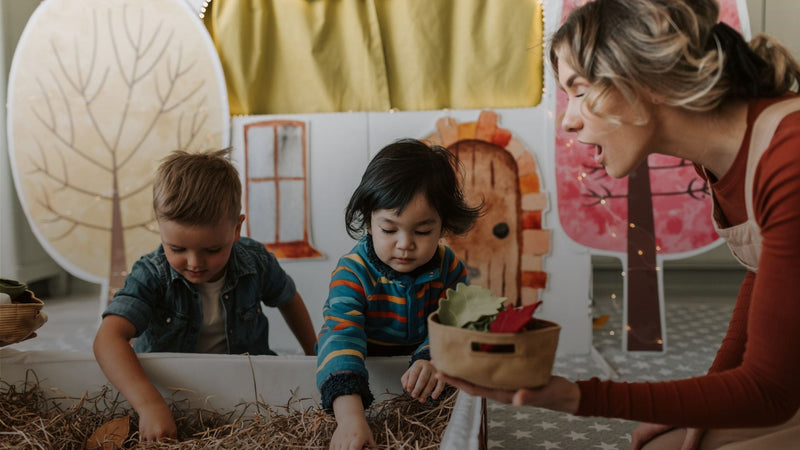
For 16. cardboard construction, provide a clean box and safe drawing or decorating materials without deciding whether it must become a rocket, shop, cave, or car. 17. A sound-guessing game can use familiar noises such as paper crinkling, keys jingling, water pouring, or blocks tapping. And with 18. a sensory story world, combine several open-ended objects—perhaps blocks, fabric, larger felt pieces, and toy figures—then ask one simple question: “Who lives here?”
That final activity is especially useful because it shows how tactile exploration can move naturally into language, symbolic play, and storytelling.
Sensory Play for Ages 5–8
School-age children still benefit from tactile, movement-based, and hands-on experiences; they simply use them in increasingly sophisticated ways. The emphasis often moves from simple exploration toward building, planning, testing ideas, and transforming environments.
For 19. a barefoot texture path, place safe surfaces such as towels, foam, soft blankets, carpet squares, or grass in sequence and invite the child to compare what they feel. 20. Homemade sound experiments can involve safe household materials, with the child investigating what makes sounds louder, softer, higher, or lower. 21. Fort building combines carrying, balancing, planning, problem-solving, and imaginative play in one familiar activity.
With 22. nature collecting and sorting, children can organize permitted fallen objects according to texture, shape, weight, or their own invented categories. 23. A mystery touch bag encourages children to describe an unseen safe object before identifying it: rough, flexible, round, smooth, heavy?
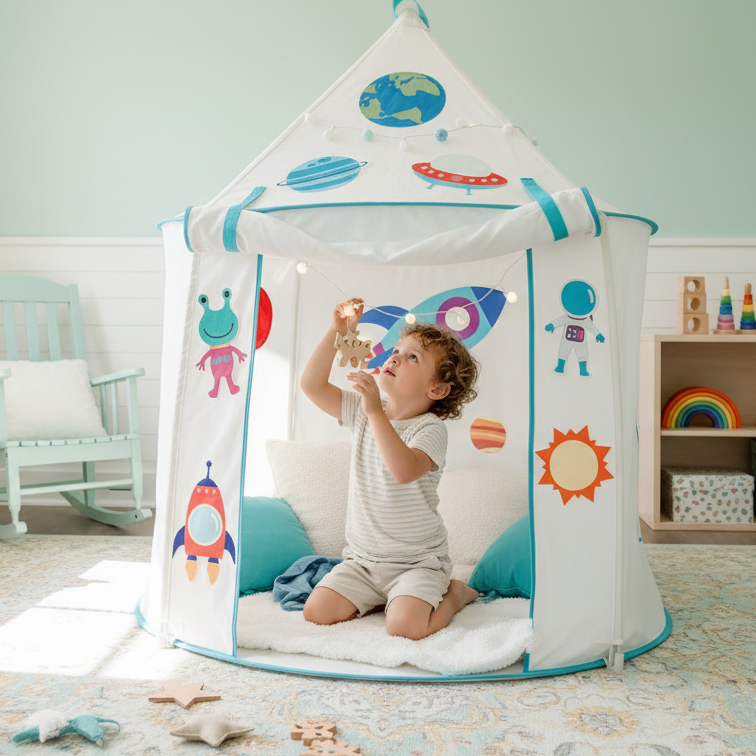
Finally, 24. a transformable pretend-play space gives children somewhere they can reinterpret again and again. A blanket fort may become a submarine today and a veterinary clinic tomorrow.
This environment-first idea also influences ZeeZee Adventures. Its customizable play environment uses changeable felt StickeeZ themes so the same familiar space can be reimagined as children's stories and interests change. The useful principle extends well beyond the product: rather than designing every story for children, give them an environment they are allowed to transform.
Sensory Play for Older Children: Ages 8+
Older children rarely describe what they are doing as sensory play, yet many of their richest hobbies remain intensely sensory.
Cooking, gardening, painting, building, sculpting, music, sewing, crafts, and outdoor exploration all require children to notice how materials feel, move, change, sound, smell, or respond.
25. Cooking or baking together combines measuring, pouring, stirring, kneading, smell, texture, and taste. 26. Gardening invites digging, carrying, watering, touching soil, noticing plants, and observing gradual change. 27. Clay sculpting offers resistance, pressure, texture, and creative problem-solving without requiring a predetermined finished object.
For 28. practical construction, give the child a real problem: could they create a cardboard book stand, storage container, marble course, or model? 29. Drawing while listening pairs auditory imagination with hands-on art; children can draw what they pictured rather than simply reproducing an existing image. ZeeZee Adventures' guided audio stories and listening experiences can be used this way as a screen-free prompt for drawing or imaginative storytelling.
Finally, 30. designing their own creative space gives older children some control over lighting, materials, seating, sound, books, art supplies, or how much visual clutter feels comfortable. Rather than adults assuming what a child should prefer, the child gets to notice and communicate what helps them engage.
Expert Insight: Follow Sensory Preferences, Not Sensory Trends
One of the most important principles in sensory play is that children do not experience sensory input identically.
A child who loves finger paint may dislike sand. A child who seeks vigorous movement may have little interest in messy materials. Another child may enjoy quiet drawing, soft fabrics, construction, or music.
Sensory play should therefore be an invitation, not a test.
If your child clearly dislikes a texture, sound, smell, or movement, forcing repeated exposure simply because an activity is labeled “sensory” is unnecessary. Offer choices, allow observation before participation, and let children stop.
If sensory responses repeatedly interfere with ordinary participation in activities such as dressing, eating, school, play, or family routines, that is different from a simple preference. A pediatrician or occupational therapy professional can help determine whether assessment is appropriate. AOTA specifically emphasizes individualized assessment before sensory-based clinical intervention.
Sensory Play Safety: Simple Is Often Safer
Some popular sensory activities deserve extra caution. Small loose materials can create choking hazards for children under three; U.S. safety rules specifically restrict small parts in products intended for this age group.
This guide also intentionally excludes water beads. The American Academy of Pediatrics warns that expandable water beads can be swallowed, inhaled, or placed in ears and may cause serious injury; its guidance says the safest choice for homes with young children is not to keep them there.
Water play should always be closely supervised. Even shallow water deserves active adult attention, particularly with babies and toddlers.
Common Sensory Play Mistakes Parents Can Skip
The first common mistake is assuming sensory play must be messy. Movement, music, building, felt, drawing, nature, cooking, and storytelling can all provide sensory experiences without covering the floor in a filler material.
Another is offering too much at once. Five bins, twenty tools, and twelve instructions do not necessarily create deeper engagement. Sometimes a bowl of water and two cups are enough.
Parents can also accidentally over-direct the experience. When every step has instructions and a predetermined final result, the child has fewer opportunities to experiment. Structured crafts can be enjoyable, but they are not the only way children learn.
Finally, avoid judging success by how long an activity lasts. A child may explore something for six minutes one day and forty minutes another. Engagement varies with age, temperament, energy, environment, and interest.
A Simple Parent Action Checklist
-
Choose an activity appropriate for your child's age and abilities.
-
Remove choking, ingestion, water, heat, or sharp-object hazards.
-
Offer only a manageable number of materials.
-
Let your child explore before giving instructions.
-
Watch what they repeatedly seek out or avoid.
-
Allow the activity to change into something you did not plan.
Frequently Asked Questions
What is the easiest sensory activity for kids?
Water transfer is one of the simplest for children old enough to use it safely. A small amount of water with cups or spoons provides opportunities for touching, pouring, comparing, and experimenting. Close supervision is essential around water.
Does sensory play have to involve a sensory bin?
No. Sensory bins are only one format. Movement, nature, music, cooking, building, drawing, fabric, clay, gardening, and pretend play can all be sensory-rich.
What are good sensory activities for toddlers?
Simple toddler activities include water pouring, play dough, carrying cushions, outdoor texture exploration, large felt pieces, and music with movement. The best choice depends on the child's interests and safety needs.
Is sensory play only for young children?
No. It changes with age. Older children often experience sensory-rich play through cooking, gardening, art, clay, construction, music, crafts, and outdoor activity.
Is sensory play the same as sensory therapy?
No. Ordinary sensory play at home is general childhood play. Clinical sensory integration or sensory-based occupational therapy involves professional assessment and individualized intervention.
Start With What You Already Have
Parents do not need thirty new activities.
This article contains thirty possibilities because children and families are different, not because anyone should work through the list.
A child may spend an entire week rebuilding the same fort. Another may want to pour water every afternoon. Someone else may become absorbed in clay, baking, drawing, or listening to a story while inventing an imaginary world.
That repetition is not a failure of creativity.
Often, it is exactly how exploration deepens.
The best place to begin is usually with something ordinary, safe, and already available—and enough unhurried time for the child to discover what they can do with it.
Author Bio
The ZeeZee Play Experts share research-informed ideas about imaginative play, independent play, sensory exploration, screen-free childhood, and environments that give children more room to create their own stories. ZeeZee Adventures' educational content is designed to help parents understand the developmental ideas behind play while offering practical strategies that can work in everyday family life.





Comment (0)