
The Benefits of Sensory Play for Brain Development
A toddler pours water from one cup into another. Again. And again.
A preschooler presses play dough flat, rolls it into a ball, pulls it apart, and starts over.
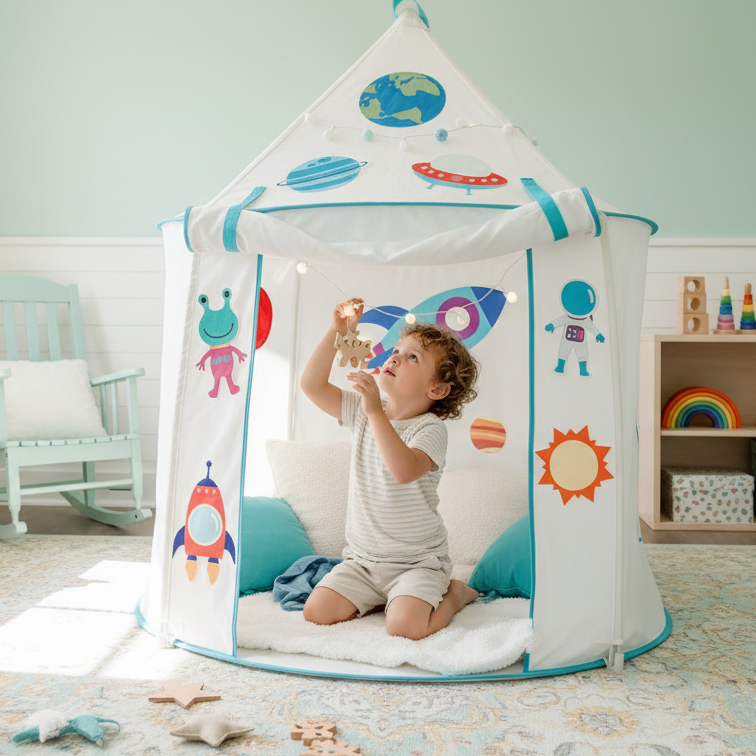
Another child carries cushions across the room to construct a fort, crawls inside, changes the entrance, invents a story, knocks half of it down, and rebuilds it.
From the outside, these moments can look wonderfully ordinary.
Inside a developing child, however, something much more complex is happening. The brain is constantly receiving information from the senses, combining it with movement, attention, memory, language, emotion, and previous experience, and deciding what to do next.
This is one reason sensory-rich play can be such a meaningful part of childhood.
Sensory play is not a shortcut to a “smarter brain,” nor does one sensory activity directly build a specific part of the brain. Development is much more complex than that. But rich, age-appropriate experiences give children repeated opportunities to practice emerging abilities such as noticing patterns, coordinating movement, solving problems, learning words, directing attention, remembering what happened, adapting when something changes, and interacting with other people.
The American Academy of Pediatrics describes developmentally appropriate play as an important context for supporting cognitive, language, social-emotional, self-regulation, and executive-function development. Harvard's Center on the Developing Child similarly emphasizes that early experiences and responsive relationships shape developing brain architecture over time.
Quick Answer: How Does Sensory Play Support Brain Development?
Sensory play gives children opportunities to receive, organize, and respond to information from their bodies and environment while they move, communicate, experiment, and solve problems. These experiences can support the development and practice of skills related to sensory processing, motor coordination, attention, language, memory, executive function, and problem-solving.
The important distinction is that sensory play does not work because a particular texture or activity magically “stimulates the brain.” It is valuable because the child is actively participating—touching, moving, predicting, adjusting, communicating, remembering, and making choices.
Research on child development increasingly reinforces this broader view: sensory and motor experiences are intertwined with how children gain opportunities to interact with and learn about the world.
Key Takeaways
Sensory-rich play can give developing brains repeated practice processing information, coordinating perception with action, using language in meaningful contexts, sustaining attention, remembering patterns, and adapting to new information. Multisensory experiences may also help children connect information across senses; research with infants, for example, has found that multisensory information can support aspects of word learning.
At the same time, parents should be cautious about exaggerated claims. There is no single sensory activity proven to “activate more of the brain,” guarantee intelligence, prevent developmental difficulties, or produce emotional regulation on demand. Ordinary sensory play is also different from occupational therapy or Ayres Sensory Integration®, which involves professional reasoning, assessment, and individualized intervention.
What Is Sensory Play?
Sensory play is best understood as active play that allows children to explore information through their senses, movement, and bodies.
The most familiar senses are sight, hearing, touch, smell, and taste. But children also use information related to movement and balance as well as feedback from muscles and joints about body position and force.
That is why sensory play can look surprisingly ordinary.
It might involve digging through sand, kneading dough, listening to different sounds, carrying cushions, crawling through a fort, moving to music, building with blocks, touching felt, pouring water, watching shadows, gardening, cooking, or walking barefoot across grass.
What makes these experiences sensory is not the product being used. It is the child's interaction with information coming from the environment and their own body.
If you want a fuller introduction before exploring the neuroscience, ZeeZee Adventures' guide to what sensory play is and why it matters is the most useful companion to this article.
Why the Developing Brain Needs Experience
A child's brain develops through an ongoing interaction between biology and experience.
In the early years, neural connections are formed, strengthened, reorganized, and refined as children interact with caregivers and the world around them. Harvard's Center on the Developing Child describes brain architecture as developing over time, with early experiences and responsive relationships influencing the foundation upon which increasingly complex skills are built.
This does not mean parents need to maximize stimulation.
More input is not automatically better input.
A constantly flashing, noisy, highly stimulating environment is not synonymous with rich development. What matters much more is having developmentally appropriate opportunities to engage, explore, repeat, interact, and respond.
That distinction is important because “brain development” is sometimes used in children's marketing as though the brain needs to be continuously stimulated.
Children do not need adults to engineer every second.
They need meaningful experiences.
They also need relationships.
Harvard describes responsive “serve and return” interactions—when a young child gestures, vocalizes, looks, or shows interest and an adult responds—as an important influence on developing neural connections associated with communication and social development.
Sensory play can create many natural opportunities for those exchanges.
A baby splashes.
The parent says, “You made the water move!”
The baby splashes again.
A toddler touches something cold.
The caregiver notices and gives the sensation language.
A preschooler builds something.
The adult waits for the child's idea before entering the story.
The developmental value is not simply in the sensory material.
It is in the whole experience.
1. Sensory Play Helps Children Practice Integrating Information
The brain rarely experiences the world through one sense at a time.
Imagine eating an apple.
A child sees its color and shape, feels its smooth surface and weight, hears the crunch, smells it, tastes it, and coordinates the movements required to hold and bite it.
The brain has to combine these streams of information into a useful understanding of one object and experience.
Researchers refer to this process broadly as multisensory integration. Research shows that children's ability to integrate sensory information continues developing with experience and maturation rather than appearing fully formed at birth.
Sensory-rich play offers everyday practice with these kinds of relationships.
A child rolling a ball sees where it moves, hears it hit the floor, feels how much force they used, and changes their next movement accordingly.
A child building with blocks sees the structure leaning, feels the position of the block in their hand, adjusts the placement, and watches what happens next.
This is not a special “brain exercise.”
It is ordinary learning through perception and action.
2. Sensory and Motor Development Work Together
Children do not learn about the world while remaining physically separate from it.
Movement changes what they can discover.
When babies gain the ability to reach, crawl, cruise, and walk, they gain entirely new opportunities to investigate objects, spaces, distances, surfaces, and people. A recent review of sensory and motor experience in cognitive development highlights how motor development can change children's learning opportunities by altering how they interact with the environment.
That relationship continues beyond infancy.
Consider a child building a fort.
They have to judge whether a cushion is heavy enough to stay upright.
They need to coordinate both hands.
They move around the structure to see it from another angle.
They crawl through a gap and discover that it is too narrow.
Then they change the design.
The child's sensory and motor systems are working together with planning and problem-solving.
This is why movement belongs in conversations about sensory play just as much as textured materials do.
3. Sensory Play Can Create Rich Conditions for Language Learning
Language becomes especially meaningful when words are attached to something children can experience.
Consider the difference between memorizing the word “rough” from a picture and feeling rough tree bark while hearing an adult say:
“That bark feels rough.”
Now the word is connected with a physical experience.
Sensory play naturally creates vocabulary around texture, movement, size, sound, temperature, force, position, shape, action, and cause and effect.
Research with infants also suggests that multisensory information can contribute to word learning. In experimental work on object-related words, infants' word recognition and learning benefited when semantic information was associated with multiple senses.
Parents do not need to narrate every second of play to take advantage of this.
In fact, constant questioning can interrupt engagement.
Try commenting naturally instead.
“The dough got flatter when you pushed hard.”
“That block sounds different on the carpet.”
“You found the smooth one.”
Then leave space for the child to respond, repeat, or continue.
Language grows inside interaction.
4. Sensory Play Gives Executive Functions Something to Practice
Executive functions include mental skills that help us hold information in mind, focus attention, manage impulses, switch strategies, and work toward goals.
Children are not born with fully developed executive-function abilities. These skills develop gradually through childhood and adolescence, supported by experience and relationships. Harvard's Center on the Developing Child describes play and age-appropriate games as opportunities for children to practice attention, working memory, and basic self-control.
Sensory play can create situations where those skills are naturally useful.
A child building a bridge needs to remember what they are trying to accomplish.
When it collapses, they may need to resist immediately abandoning the idea.
They look again.
Change the base.
Try another block.
During pretend sensory play, the demands become even richer.
“The blue fabric is the ocean.”
Now the child has to keep that imaginary rule in mind while continuing the story.
“The dinosaur can't cross until we build a bridge.”
Now working memory, planning, flexible thinking, and imagination are overlapping inside one playful experience.
This is why child-led play can be so cognitively rich without looking academic.
5. Repetition Helps Children Refine Expectations
Adults sometimes mistake repetition for stagnation.
A child transfers the same objects from one container to another again and again.
They pour water repeatedly.
Build the tower.
Knock it down.
Build it again.
From the child's perspective, repetition allows the experience to become increasingly predictable.
How much force does this require?
What happens if I tilt it differently?
Will it fall the same way?
What if I use the larger block?
The child forms expectations and compares the result with what actually happened.
Learning often depends on this relationship between prediction, feedback, and adjustment.
This is one reason parents do not need to introduce a new sensory activity every time a child becomes familiar with an old one.
Familiarity creates possibilities too.
6. Hands-On Exploration Can Support Problem-Solving
Sensory play is full of small problems that adults did not have to invent.
The dough is too sticky.
The tower will not stay upright.
The cushion will not fit through the doorway.
The object sinks.
The cardboard keeps bending.
The child has to decide what to try next.
Open-ended play is particularly useful here because there may not be one predetermined correct answer.
A child can experiment.
Fail safely.
Adjust.
Try a different idea.
The AAP emphasizes that play can support cognitive and self-regulatory skills and create opportunities for children to explore creativity, problem-solving, and flexible thinking.
The adult's instinct may be to solve the problem immediately.
Sometimes a more useful response is:
“You're trying to make that stand up.”
Then wait.
A little productive uncertainty gives the child something to think about.
7. Sensory Play Can Support Attention—But Not Because More Stimulation Is Better
Attention is another area where sensory-play claims can become exaggerated.
A sensory bin does not automatically lengthen a child's attention span.
Nor will one specific texture “teach focus.”
What open-ended sensory play can do is give children opportunities to stay with an experience they find meaningful.
That distinction matters.
Attention is easier to practice when the child has some ownership of the task.
A child who decides to build a dinosaur habitat may remain engaged because they care about completing their own idea, not because sand itself has a mysterious attention-enhancing property.
Harvard's brain-building-through-play resources specifically describe playful games and activities as opportunities to practice focusing attention and other executive-function skills.
Parents can support this by reducing unnecessary interruption.
If your child is concentrating deeply, you do not always need to add a question, suggestion, teaching point, or new material.
Sometimes maintaining attention requires adults to protect it.
8. Sensory Play Can Become Imaginative Play
A particularly important shift happens when physical materials begin representing things that are not actually there.
The scarf becomes an ocean.
The cardboard box becomes a rocket.
The felt shape becomes a dragon.
The cushions become mountains.
Now sensory exploration is becoming symbolic play.
The child is no longer responding only to what an object physically is.
They are holding another possibility in mind.
This requires imagination, memory, flexible thinking, language, and the ability to create and maintain a pretend scenario.
It is also where children's stories become increasingly personal.
Two children can receive the same materials and create entirely different worlds.
That difference matters because child-led sensory play does not simply provide stimulation.
It gives children material for ideas.
The Power of the Play Environment
Parents often ask which sensory toy they should buy.
A more useful question can be:
What kind of environment gives my child room to explore?
An effective play environment does not necessarily contain more things.
Often it contains materials children can manipulate in multiple ways, enough physical room to act on their ideas, and fewer interruptions telling them what should happen next.
This is also where ZeeZee Adventures connects naturally with the developmental idea. ZeeZee's customizable play environment uses interchangeable StickeeZ felt scenes so children can change and reinterpret the same physical play space as their stories evolve. The current ZeeZee system is designed around changeable themes and open-ended imaginative use rather than prescribing a single fixed storyline. The important developmental principle is not that children need a particular tent.
It is that environments can leave room for agency.
A child can change something.
Move something.
Choose something.
Reinterpret something.
That can happen in a ZeeZee tent, a blanket fort, a cardboard box, a play corner, or underneath the dining table.
The environment is most useful when it supports the child's ideas rather than replacing them.
Does Sensory Play Build Neural Connections?
This question appears frequently in parenting content, and the answer needs some nuance.
Children's brains are constantly forming and reorganizing neural connections as part of development. Early experiences, biological factors, and responsive relationships all influence this process. Harvard notes that the early years are a particularly active period of neural connection formation.
It would be misleading, however, to take that fact and conclude that every sensory activity “builds neural pathways” in a unique or superior way.
Almost everything a child experiences involves neural activity.
The evidence-based reason to value sensory play is not a catchy claim about making more connections.
It is that developmentally appropriate, active play provides rich opportunities for children to practice coordinating perception, action, attention, communication, memory, decision-making, and social interaction.
That is both more accurate and more useful for parents.
Sensory Play Is Not the Same as Sensory Integration Therapy
This distinction is especially important when discussing brain development.
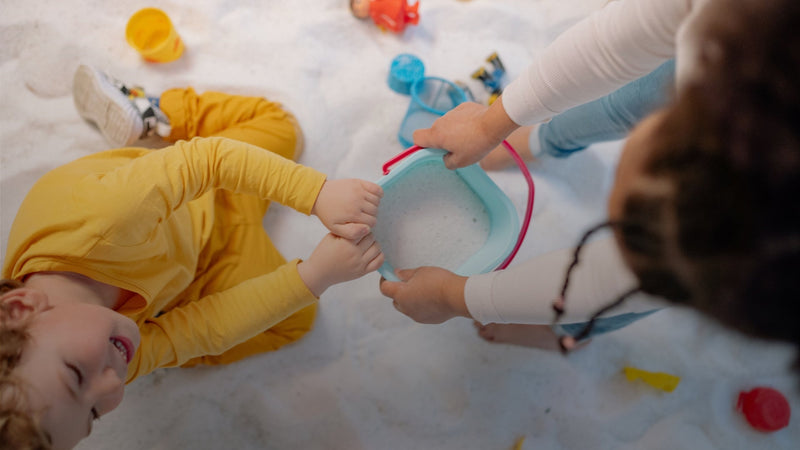
Ordinary sensory play—water, movement, dough, blocks, music, felt, outdoor exploration—is part of everyday childhood.
Occupational therapy involving sensory integration is something different.
The American Occupational Therapy Association identifies sensory integration and processing as areas of professional occupational therapy practice and provides formal resources around assessment and intervention for children and youth.
That means a parent should not interpret a sensory-play article as a treatment plan.
If a child's responses to everyday sensory experiences are causing significant distress or consistently interfering with eating, dressing, sleep, school, play, or participation in family life, concerns are better discussed with a pediatrician or appropriately qualified occupational therapy professional.
What Parents Can Do to Support Brain-Building Play
Parents do not need to engineer a “brain-boosting” sensory schedule.
A better approach is to create regular opportunities for active exploration and then pay attention to what the child does with them.
Offer materials that can change: blocks, dough, fabrics, water, cardboard, large felt pieces, natural materials, drawing supplies, or age-appropriate building objects. Include opportunities for whole-body movement as well as quiet tactile exploration.
Then resist filling every moment with instruction.
Notice what your child repeats.
Add language when it feels natural.
Let a problem remain unsolved for a little while.
Respond when the child invites you into the experience.
And follow the child's preferences rather than assuming every child needs the same amount or type of sensory input.
That last point is essential.
One child may love messy materials.
Another may prefer building.
One may seek vigorous movement.
Another may become absorbed in quiet tactile or visual activities.
There is no universal “best” sensory experience.
Common Myths About Sensory Play and the Brain
One common myth is that more sensory stimulation automatically produces more brain development. Children need meaningful, tolerable experiences—not nonstop stimulation.
Another is that messy play is somehow neurologically superior to other forms of sensory play. There is no reason to assume rice, slime, or finger paint is inherently more “brain building” than construction, movement, music, gardening, cooking, or imaginative tactile play.
Parents may also encounter claims that sensory activities regulate every child's nervous system. Children's responses differ, and a sensory experience one child enjoys may be unpleasant or distracting to another.
Finally, sensory play should not be marketed as preventing or treating ADHD, autism, anxiety, sensory processing difficulties, developmental delays, or other health and developmental conditions. Those claims go far beyond what ordinary play activities can support.
Sensory Experience and Brain Development: A Practical View
|
Sensory-play experience |
What the child may practice |
|
Pouring and transferring |
prediction, hand-eye coordination, cause and effect |
|
Building and stacking |
spatial reasoning, planning, motor coordination |
|
Dough and tactile materials |
hand use, experimentation, descriptive language |
|
Music and movement |
rhythm, movement coordination, listening |
|
Pretend sensory worlds |
symbolic thinking, language, working memory |
|
Outdoor exploration |
multisensory observation, movement, curiosity |
|
Fort or environment building |
planning, spatial thinking, problem-solving |
|
Shared sensory play with an adult |
language, turn-taking, responsive interaction |
This table describes opportunities for practice, not guaranteed developmental outcomes.
Parent Action Checklist
-
Offer developmentally appropriate opportunities to touch, move, build, listen, create, and explore.
-
Include both whole-body movement and quieter hands-on activities.
-
Keep materials simple enough that the child can change how they are used.
-
Let repetition happen instead of continually introducing novelty.
-
Describe what the child is experiencing without turning every moment into a quiz.
-
Leave some problems unsolved long enough for the child to experiment.
-
Join the child's story when invited rather than automatically directing it.
-
Respect clear sensory preferences and discomfort.
-
Avoid products or activities that promise to “rewire,” “treat,” or guarantee developmental outcomes.
-
Seek professional guidance when sensory responses substantially interfere with everyday participation.
Frequently Asked Questions
Is sensory play good for brain development?
Sensory-rich play can support healthy development by giving children opportunities to process sensory information while practicing movement, language, attention, memory, problem-solving, and social interaction. Play more broadly is recognized by the American Academy of Pediatrics as important for cognitive, language, social-emotional, and self-regulatory development.
Does sensory play create new neural connections?
Neural connections form and reorganize throughout development in response to a complex combination of biology, experiences, and relationships. It is therefore oversimplified to claim that a particular sensory activity uniquely creates neural connections. Sensory play is better understood as one form of meaningful experience through which children practice developing skills.
How does sensory play help cognitive development?
Sensory play can create opportunities for children to compare information, predict outcomes, remember what happened previously, change strategies, solve problems, and use symbolic thinking. The exact experience and developmental demands vary depending on the activity and the child.
Can sensory play support language development?
Sensory experiences give words concrete meaning. Children can connect language such as rough, smooth, heavy, cold, fast, behind, underneath, squeeze, and pour with real experiences. Experimental research also suggests that multisensory information can support aspects of infant word learning.
Is sensory play good for attention?
Sensory play can give children opportunities to practice sustained engagement, particularly when the activity is interesting and child-directed. It should not be assumed, however, that a particular sensory activity automatically improves attention.
Does sensory play improve executive function?
Play provides opportunities to practice executive-function skills such as working memory, attention, flexible thinking, and self-control. Harvard's Center on the Developing Child specifically includes playful activities among ways children can practice these abilities.
What age is sensory play most important?
Sensory learning begins from infancy and continues throughout childhood and adulthood. The form changes with development: babies explore through reaching and movement, toddlers often repeat physical actions, preschoolers increasingly combine sensation with pretend play, and older children encounter sensory-rich learning through art, cooking, building, music, nature, and other hands-on experiences.
Is sensory play the same as occupational therapy?
No. Everyday sensory play is ordinary child development and recreation. Occupational therapy interventions involving sensory integration or sensory processing are professional services that may involve individualized assessment and treatment planning.
The Real Benefit Is Not “More Stimulation”
Perhaps the most useful way to think about sensory play and the brain is to stop asking:
“How can I stimulate my child's brain more?”
and start asking:
“What experiences let my child participate more deeply?”
Development does not require childhood to become an optimization project.
A bowl of water does not need a learning objective.
A fort does not need measurable outcomes.
A child pressing felt pieces into an imaginary world does not need to know that they are coordinating touch, vision, movement, memory, language, and symbolic thinking.
They need to play.
And adults can help by giving them enough safety, time, responsive interaction, and freedom for that play to develop.
For families who want to turn the developmental ideas in this article into something practical, ZeeZee Adventures' 30 sensory play activities for every age is a natural next step, with ideas that move from babyhood through the school years. The goal is not to fill childhood with more stimulation.
It is to give children meaningful opportunities to experience the world, act on it, and gradually make sense of it for themselves.
Author Bio
The ZeeZee Play Experts share research-informed ideas about sensory exploration, imaginative play, independent play, screen-free childhood, and environments that leave more room for child-led discovery. ZeeZee Adventures' educational content is designed to translate child-development research into realistic ideas families can use in everyday life.





Comment (0)