
How to Create a Sensory-Friendly Play Space at Home
A sensory-friendly play space does not need to look like a therapy room.
It does not need specialized equipment, a perfectly organized playroom, or an entire room dedicated to sensory activities. In many homes, it may simply be a corner of the living room with softer lighting, a few open-ended materials, somewhere comfortable to sit, and enough flexibility for a child to decide whether they want to build, move, read, pretend, or spend a few quiet minutes alone.
The most useful sensory-friendly spaces are rarely the most elaborate.
They are the ones designed around the actual child using them.
Some children gravitate toward movement. Others prefer quieter activities. One child may enjoy bright colors and music, while another becomes distracted when too many sights and sounds compete for attention. Even the same child may want active play one afternoon and a quieter environment the next.
That is why creating a sensory-friendly play space is less about following a universal design formula and more about learning to observe, simplify, offer choices, and adjust the environment over time.
Quick Answer: How Do You Create a Sensory-Friendly Play Space at Home?
A sensory-friendly play space is an adaptable area that considers a child's individual responses to light, sound, texture, movement, visual clutter, and physical space. Start by reducing unnecessary distractions, making frequently used materials easy to access, including comfortable seating or a defined retreat area, allowing options for movement, and choosing open-ended materials the child can manipulate independently.
Most importantly, observe what your child actually seeks out and avoids. There is no single lighting level, texture, color scheme, or sensory activity that works for every child.
Key Takeaways
-
A sensory-friendly space can be a corner, not an entire room.
-
Design around your child's preferences rather than sensory-play trends.
-
Reduce unnecessary visual and auditory competition before adding more equipment.
-
Include opportunities for both movement and quieter play when space allows.
-
Make useful materials visible and accessible without displaying everything at once.
-
Let children personalize and reinterpret their play environment.
-
Do not assume that enclosed spaces, weighted objects, certain textures, or particular activities are universally calming.
-
Everyday sensory-friendly design is not the same as occupational therapy or a clinical sensory intervention.
What Does “Sensory-Friendly” Actually Mean?
In everyday home design, sensory-friendly is best understood as an environment that considers how sensory information may affect a person's ability to participate in an activity comfortably.
That information can include light, sound, texture, movement, smell, temperature, visual complexity, and physical space.
Everyone processes sensory information, but people do not respond to it in the same way. Occupational therapy practitioners specifically consider individual sensory-processing patterns when sensory differences affect participation in everyday activities, and AOTA emphasizes that professional sensory interventions are individualized rather than one-size-fits-all.
For home play, the takeaway is simple:
Do not design a “sensory-friendly” space based only on what the internet says children are supposed to find calming.
Design around what you observe.
Maybe your child frequently creates forts in small spaces.
Maybe they need plenty of floor room to move.
Maybe they avoid scratchy materials.
Maybe background television makes it harder for them to stay with a game.
Maybe they love music while building.
Maybe they want complete quiet while drawing.
Those observations are more useful than a generic shopping list.
If sensory play itself is still a new concept in your home, ZeeZee Adventures' guide to what sensory play is and why it matters is a helpful place to understand the broader relationship between touch, movement, sound, exploration, and play.
Start by Observing Before You Redesign Anything
Parents are often tempted to begin sensory-friendly design by buying things.
A tent.
A swing.
Lights.
Floor cushions.
Storage.
Fidget materials.
But the best first step costs nothing.
Watch your child play.
Where do they naturally settle?
What do they move away from?
Do they repeatedly build enclosed spaces?
Do they drag cushions into one particular corner?
Do they turn lights down?
Do they constantly move between activities?
Do they prefer the floor, a chair, a table, or somewhere tucked away?
Do certain noises interrupt their concentration?
A sensory-friendly environment should solve a real participation problem or support an existing preference—not create an aesthetic version of what adults think sensory play should look like.
Try observing for several days before making major changes.
You may discover that your child does not need a “sensory room.”
They need the television turned off while they play.
Or half as many toys displayed.
Or enough floor space to build something without having to put it away immediately.
Reduce Competition Before Adding Stimulation
One of the easiest environmental changes is subtraction.
Modern playrooms can become visually crowded very quickly. Open shelving makes every toy visible, bright packaging competes for attention, background screens add movement and sound, and several unfinished activities may occupy the same space.
This does not mean visual stimulation is inherently harmful or that every playroom should become beige and empty.
The question is whether the amount of information in the environment helps the child participate—or competes with what they are trying to do.
Try putting some materials away and rotating them instead of displaying everything simultaneously. Keep frequently used objects accessible, but allow some visual breathing room around them.
The same principle applies to sound. The American Academy of Pediatrics' parent guidance notes the value of having quieter areas at home and recommends reducing unnecessary noise exposure for children.
You may not need silence.
You may simply need to remove sound that nobody is intentionally using.
A television playing in the background, notifications from several devices, and a noisy electronic toy can create a very different play environment from purposeful music chosen by the child.
Think in Zones, Even If You Have Very Little Space
You do not need a dedicated playroom to create useful distinctions between types of play.
A small bedroom or living-room corner can still contain tiny “zones” through how materials are arranged.
One area might allow building and movement.
Another might contain books, drawing materials, or a comfortable cushion.
A basket might hold a few tactile or open-ended materials.
These zones do not need labels, signs, or elaborate furniture.
They simply help communicate that different kinds of activity are possible.
For example, instead of placing every toy around the room, you might keep a basket of blocks beside an open patch of floor and books beside a cushion near the wall.
The physical environment quietly tells the child:
You can build here.
You can settle here.
You can choose.
Make Lighting Adjustable Rather Than Assuming Dim Is Better
Soft lighting is frequently recommended for sensory spaces.
Sometimes that is exactly what a child prefers.
But “sensory-friendly” should not automatically mean dark.
Some children want strong natural light when drawing or building. Others may dislike glare or find certain artificial lights uncomfortable. Preferences can also change depending on the activity and time of day.
Flexibility is more useful than a single setting.
When possible, use natural daylight, curtains or shades that allow light to be adjusted, and task lighting for activities that require clear visibility.
If decorative lights are included, they should support the activity rather than continuously flash or demand attention.
A quiet reading period may feel different under warm, lower light.
A detailed building project may need brighter illumination.
Design for choice, not a sensory aesthetic.
Give Sound a Purpose
Sound can completely change how a play space feels.
For some children, music makes play more engaging. Another child may concentrate more deeply without it. Audio stories may support imaginative play for one activity, while quiet may be more useful for another.
Rather than asking whether the room should be quiet or musical, ask:
Does this sound have a purpose right now?
If the child is listening intentionally, the answer may be yes.
If the sound is simply coming from a television nobody is watching, it may be unnecessary competition.
You can also give children age-appropriate control. An older child may be able to choose between music, an audio story, or quiet depending on what they want to do.
Sensory-friendly does not mean eliminating sensory experience.
It means making the experience more intentional.
Include Texture Without Forcing Texture
Texture is another area where sensory-friendly design can accidentally become prescriptive.
Parents may encounter recommendations for fluffy rugs, fuzzy cushions, weighted materials, textured walls, sensory bins, and dozens of tactile objects.
But a texture is only useful if the child actually wants to interact with it.
A soft rug may feel wonderful to one child and irritating to another.
Instead of filling the room with “sensory textures,” offer a small variety through ordinary materials.
Fabric.
Felt.
Smooth blocks.
Wood.
Paper.
Cushions.
Play dough used on a contained surface.
Books with different materials.
Then observe what the child chooses.
There is no developmental prize for tolerating every texture.
Children should be allowed to decline tactile experiences that clearly bother them.
Leave Room for Whole-Body Movement
Sensory play does not happen only at a table.
Children learn through movement, and CDC guidance encourages free play and opportunities for young children to explore, move, and try new things.
If possible, leave some floor space unoccupied.
It does not need equipment.
Children can use the same area to:
build with cushions,
crawl,
stretch,
move to music,
construct a fort,
push something appropriate,
or create a pretend landscape.
The important safety principle is to match movement opportunities with your child's age and abilities and remove nearby fall or collision hazards.
A sensory-friendly environment should make movement possible without assuming every child needs constant movement.
Again, watch the child.
Create a Cozy Option—Not a Mandatory “Calm Corner”
A small enclosed or defined space can appeal strongly to some children.
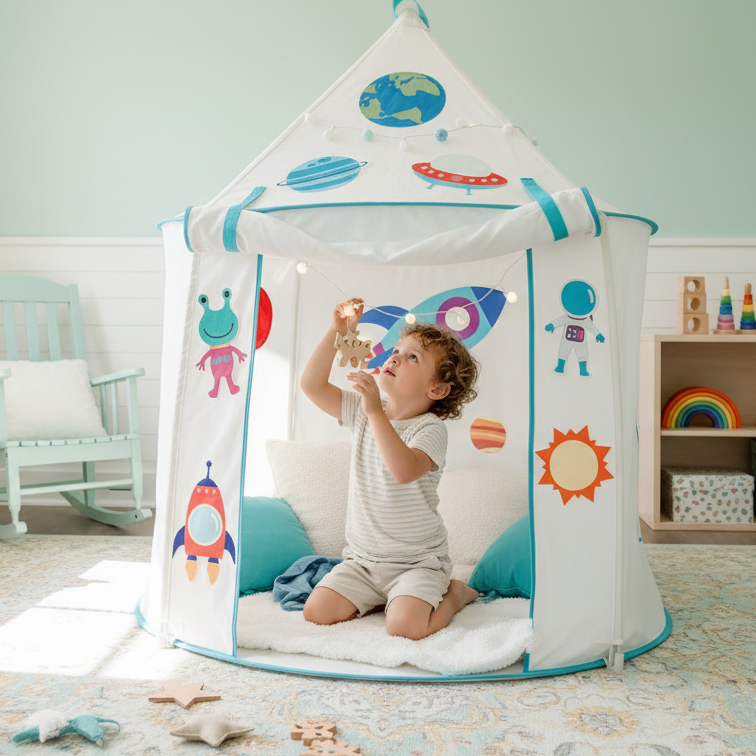
A blanket over a table, a corner with cushions, a reading nook, or a play tent may give a child somewhere distinct from the busier parts of the room.
But be careful about turning that space into a behavioral tool.
A cozy play area should not become somewhere a child is automatically sent whenever an adult decides they need to “calm down.”
Doing so can transform a voluntary play environment into a punishment space.
Instead, let it remain available.
A child might use it for:
reading,
pretend play,
listening,
drawing,
resting,
or simply being somewhere different.
The child does not have to be upset to use it.
And they do not have to use it when they are upset.
Choice matters.
Choose Open-Ended Materials Over Sensory Clutter
A sensory-friendly playroom does not necessarily need more sensory toys.
Often, a few flexible materials create far more possibilities.
Blocks can become buildings, roads, furniture, or mountains.
Fabric becomes clothing, scenery, water, roofs, or blankets.
Cardboard becomes almost anything.
Large felt pieces can be sorted, arranged, removed, replaced, or transformed into characters and scenes.
This kind of open-ended play gives children opportunities to manipulate their environment rather than simply activate something and watch it perform.
The American Academy of Pediatrics continues to emphasize play as an important context for healthy development, while Harvard's Center on the Developing Child highlights playful activity as one way children practice attention, planning, working memory, and flexible behavior.
The goal is not to turn your play space into a classroom.
It is to choose materials that leave enough unfinished for children to contribute their own ideas.
Let the Play Environment Change With the Story
A sensory-friendly environment becomes more useful when it is not locked into one type of play.
A reading nook can become a spaceship tomorrow.
A fort becomes an underwater laboratory.
A few felt pieces turn a familiar wall or play surface into a completely different scene.
This flexible, environment-first philosophy is also part of ZeeZee Adventures. The ZeeZee Adventures Tent uses interchangeable StickeeZ felt scenes so children can change the visual and tactile story of the same familiar play environment as their interests evolve. The current system includes multiple changeable themes rather than fixing the tent into one permanent imaginative world.
That does not mean a particular tent creates sensory regulation or treats sensory differences.
The useful developmental idea is broader:
Children can benefit from environments they are allowed to personalize and reinterpret.
That could mean a ZeeZee tent.
It could mean a cardboard box.
It could mean a space underneath the dining table.
What matters is that the child has some agency over what happens there.
Keep Materials Accessible—but Not Unlimited
Independence becomes easier when children can reach the things they are allowed to use.
If every activity requires an adult to unlock a cabinet, find the supplies, assemble the setup, and explain what to do, spontaneous child-led play becomes harder.
Try keeping a small collection of appropriate materials within reach.
For a preschooler, that might include books, larger blocks, washable drawing materials, pretend-play objects, large tactile pieces, or safe construction materials.
But accessibility does not mean displaying everything.
Rotation can help preserve both simplicity and novelty.
Put some materials away.
Bring them back later.
A familiar object can become interesting again when it returns to a different context.
Let Your Child Help Design the Space
One of the easiest ways to make a play environment more genuinely sensory-friendly is to ask the person who will use it.
For young children, this may mean offering simple choices:
“Would you like the cushion here or there?”
“Do you want the light brighter?”
“Music or quiet?”
“Should the blocks stay out today?”
Older children can take more responsibility.
Ask them what helps when they want to draw, build, read, or invent stories.
You may be surprised.
The child you thought wanted a cozy retreat may actually want a large open floor.
The child you thought needed silence may prefer gentle music.
The child you thought wanted dozens of sensory toys may mostly want somewhere their building project will not be dismantled overnight.
A sensory-friendly environment should evolve through observation and conversation.
What About Sensory Rooms, Swings, Weighted Products, and Specialized Equipment?
This is where home sensory design needs an important boundary.
A comfortable play corner using ordinary household materials is one thing.
Clinical recommendations for sensory interventions or specialized equipment are another.
AOTA states that occupational therapy practitioners assess sensory-processing challenges and develop individualized interventions around a person's participation needs in home, school, and community environments. The AAP similarly notes that occupational therapists may evaluate sensory processing and develop strategies based on the individual child's functional needs.
If you are considering specialized sensory equipment because your child has significant sensory-related challenges, professional guidance may be more appropriate than copying a generic setup online.
The goal of an ordinary home play space is not treatment.
It is participation.
Sensory-Friendly Play Spaces for Small Homes
You do not need a large house.
In fact, a small defined area can work beautifully because the child can understand where certain materials belong without the room becoming visually crowded.
Try one basket instead of an entire shelf.
One comfortable cushion instead of a large seating system.
A storage container that slides underneath furniture.
A temporary blanket fort that comes down after play.
A wall-mounted or portable drawing surface.
A small selection of tactile objects rather than a permanent sensory station.
If the play space shares a living room, portable materials can make the environment flexible enough to return to family use later.
Sensory-friendly design is about responsiveness, not square footage.
Common Mistakes When Creating a Sensory-Friendly Space
One of the most common mistakes is buying before observing. A beautifully equipped sensory corner is not useful if the child does not want to use it.
Another is assuming “calm” means universally dim, silent, soft, and enclosed. Children have different preferences, and active movement may be a meaningful part of play for some children.
A third mistake is creating so many sensory options that the space itself becomes visually or functionally overwhelming.
Parents can also inadvertently over-direct the environment. If every basket has a prescribed activity and every material must be used in one specific way, the space may look child-centered while still being adult-controlled.
Finally, avoid promising yourself that the space will stop meltdowns, improve attention, resolve sensory challenges, or produce better behavior.
A thoughtfully designed environment may make participation easier in particular situations.
It is not a treatment.
A Simple Sensory-Friendly Play Space Checklist
-
Observe how your child currently uses the room before changing it.
-
Remove unnecessary visual clutter.
-
Reduce background noise that nobody is intentionally using.
-
Keep lighting adjustable where possible.
-
Provide some clear floor space for movement.
-
Include a comfortable, quieter option without requiring the child to use it.
-
Offer a manageable variety of textures and materials.
-
Keep age-appropriate favorite materials within reach.
-
Use open-ended materials that can become more than one thing.
-
Rotate rather than continually add.
-
Let the child help choose elements of the environment.
-
Avoid forcing sensory experiences the child clearly dislikes.
-
Treat the space as a play environment, not therapy.
Frequently Asked Questions
What should be in a sensory-friendly playroom?
A sensory-friendly playroom may include adjustable lighting, comfortable flooring or seating, accessible open-ended toys, a manageable amount of visual stimulation, space for movement, and an optional quieter area. What belongs in the room ultimately depends on the individual child.
What colors are best for a sensory-friendly room?
There is no universal “best” color. Neutral or less visually busy palettes may reduce competition in some environments, but children's preferences vary. Focus more on the total visual complexity of the room and whether the child appears comfortable and engaged than on following a prescribed sensory color palette.
Should a sensory-friendly room be quiet?
Not necessarily. The goal is to reduce unwanted or competing noise, not eliminate sound altogether. Some children enjoy music or audio stories during certain activities, while others prefer quiet.
Does my child need a sensory tent or enclosed space?
No. Some children enjoy enclosed play environments while others prefer open space. A tent, fort, reading nook, or table hideaway can be offered as an option rather than treated as necessary for every child.
What toys work well in a sensory-friendly play space?
Open-ended materials such as blocks, large felt pieces, fabrics, cardboard, play dough, books, drawing materials, pretend-play objects, and age-appropriate construction materials can provide sensory and imaginative possibilities without requiring a large collection of specialized toys.
How can I make a playroom less overstimulating?
Begin by reducing unnecessary background noise, putting away some toys rather than displaying everything, creating visual space between materials, and making lighting adjustable. Then observe whether the changes make it easier for your child to engage with the activities they choose.
Is a sensory-friendly play space the same as a sensory room?
Not necessarily. A general sensory-friendly home space is simply an environment designed with sensory comfort and participation in mind. Specialized sensory rooms and clinical sensory interventions may be designed for specific therapeutic or educational purposes and should not be treated as interchangeable with ordinary home play areas.
When should I talk to an occupational therapist?
Consider discussing concerns with your pediatrician or an appropriately qualified occupational therapist if sensory responses consistently cause significant distress or substantially interfere with everyday participation in activities such as dressing, eating, sleeping, school, play, or family routines. An OT can evaluate a child's individual functioning and sensory-processing needs.
You Are Designing for a Child, Not for Pinterest
A sensory-friendly play space does not have to announce itself as one.
It may not contain a single specialized sensory product.
It might simply be a place where unnecessary noise has been reduced, materials have room around them, the child can reach what they need, there is somewhere to move, somewhere to settle, and enough flexibility for today's dinosaur cave to become tomorrow's library.
The most important design tool is not a shopping list.
It is observation.
Watch where your child goes.
Notice what they change.
Notice what they ignore.
Notice the places where play seems to deepen.
Then make those experiences a little easier to access.
For parents who want practical ideas for filling that environment without filling it with clutter, ZeeZee Adventures' indoor sensory play ideas that aren't messy offer simple activities involving movement, sound, building, light, texture, and imagination.
A sensory-friendly play space does not need to control how a child feels.
It simply needs to make more room for the child to participate in play in a way that works for them.
Author Bio
The ZeeZee Play Experts share research-informed ideas about sensory exploration, imaginative play, independent play, screen-free childhood, and child-led environments. ZeeZee Adventures' educational resources translate developmental concepts into realistic ways families can create more room for meaningful play at home.






Comment (0)