
15 Playroom Ideas That Inspire Independent Play
A beautifully designed playroom can still produce the same familiar sentence:
“Mom, what should I do?”
That is because a room full of toys is not automatically a room that supports independent play.
Children are more likely to direct their own play when their environment makes it relatively easy to see possibilities, reach useful materials, begin without extensive adult setup, stay with an idea, and change direction when imagination takes over.
The goal is not to create a playroom that keeps children occupied so adults never need to participate. Independent play is not emotional distance, nor is it something every child should be expected to do for the same amount of time. It is simply the gradually developing ability to initiate and continue age-appropriate play with increasing ownership.
And the playroom can either make that easier or accidentally make adults necessary for every next step.
These 15 playroom ideas that inspire independent play focus less on buying more toys and more on designing an environment where children can choose, create, build, pretend, revisit ideas, and increasingly answer their own question:
“What could I do here?”
Quick Answer: How Can a Playroom Encourage Independent Play?
A playroom can encourage independent play by keeping a manageable selection of materials accessible, reducing unnecessary clutter, providing open-ended toys, leaving physical room for building and movement, creating spaces children can transform, and organizing the environment so children can begin and continue play without requiring constant adult assistance.
The room does not need to be large or perfectly organized. What matters most is whether the environment gives the child appropriate autonomy: they can find materials, make choices, manipulate the space, and develop their own ideas.
Key Takeaways
A playroom designed for independent play usually has fewer barriers between the child and the activity. Materials are reachable, choices are manageable, open-ended objects can be used in multiple ways, and unfinished play has some chance of surviving long enough to continue later.
Research supports the broader developmental importance of play. The American Academy of Pediatrics describes play as an important context in which children practice problem-solving, focused attention, language, creativity, and executive-function skills. Harvard's Center on the Developing Child similarly describes executive-function skills as involving abilities such as planning, focusing attention, switching approaches, and managing information skills children practice gradually through experience.
The purpose of a thoughtfully designed playroom is not to “develop executive function” through interior design. It is to create more everyday opportunities for children to practice choosing, planning, persisting, imagining, and adapting through play.
Independent Play Starts With the Environment, Not the Child's Personality
Some children naturally spend longer playing alone than others. Age, temperament, developmental stage, familiarity with independent play, hunger, fatigue, and even the time of day can affect what a child is ready to do.
That means parents should be cautious about judging a child as “bad at independent play.”
Sometimes the environment asks too much.
Perhaps every interesting material is stored where an adult has to retrieve it. Perhaps there are so many toys that deciding where to begin becomes difficult. Maybe the activities are designed around one correct outcome, so the child repeatedly needs instructions. Or perhaps the parent understandably jumps in the moment the child hesitates, leaving very little opportunity to generate the next idea independently.
The playroom cannot create independence on its own. But it can remove some of the friction that makes self-directed play harder.
If independent play is still developing in your home, ZeeZee Adventures' ideas for designing a home that encourages independent play can provide the broader foundation before you begin changing the room itself.
1. Display Fewer Toys at One Time
A playroom does not need to show everything the child owns.
In a small experimental study involving 36 toddlers, researchers compared free play with four toys versus sixteen toys. When fewer toys were available, the toddlers played with individual toys for longer and used them in a greater variety of ways. The study was small, so it should not be treated as a universal rule, but it offers useful support for something many families notice intuitively: more choices do not always produce deeper play.
Instead of filling every shelf, keep a manageable selection available and store the rest elsewhere. Rotation can bring familiar materials back later without requiring a constant stream of new purchases.
A less crowded shelf also makes individual materials easier to notice.
2. Put Independent Materials Within Reach
A child cannot independently begin an activity that requires an adult to unlock, retrieve, assemble, and explain it every time.
Keep a small collection of developmentally appropriate materials where the child can access them safely.
For a preschooler, that might mean blocks, books, larger pretend-play figures, drawing materials, reusable tactile pieces, or simple puzzles. Materials involving choking hazards, sharp tools, liquids, or other risks should obviously remain appropriately supervised.
Accessibility does not mean children get unrestricted access to everything in the home.
It means the activities intended for independent use are actually independently usable.
That small design choice can make a surprisingly large difference.
3. Give Open-Ended Materials the Best Real Estate
Not every toy needs to have ten possible uses.
But if independent play is the goal, open-ended materials deserve prominent space.
Blocks do not tell children what to build.
Fabric does not announce what it represents.
Cardboard can become a shop, rocket, animal hospital, boat, or something adults cannot identify at all.
The AAP recommends toys and play experiences that encourage interaction rich in language, pretending, creativity, and problem-solving rather than simply prioritizing products with more electronic features.
A useful playroom therefore contains at least a few things that begin the activity without finishing the idea.
4. Leave Some Floor Empty
Empty floor space can look like wasted playroom space.
It is not.
It may be the place where the largest ideas happen.
Children need somewhere to spread blocks, build roads, arrange figures, create a pretend landscape, move their bodies, or construct a fort. CDC guidance for young children continues to emphasize opportunities for active play and movement throughout the day.
If every square foot contains furniture, storage, or another activity station, play has nowhere to expand.
Sometimes the most useful thing you can add to a playroom is nothing.
5. Create a Building Area That Can Stay Built
Imagine spending twenty minutes creating a city and being told to dismantle it immediately because lunch is ready.
Adults would find that frustrating too.
When space allows, designate one surface or corner where longer projects can survive temporarily. It could be a small table, low tray, section of floor, or shelf where a structure can wait until later.
Returning to unfinished play creates a different experience from starting from zero every time.
The child can remember an earlier idea, notice what they want to change, and continue developing the story.
Independent play becomes easier when children know their work does not always disappear the moment they leave it.
6. Make Books Part of the Playroom, Not a Separate “Learning” Activity
Books can quietly feed independent play.
A book about animals may lead to a zoo made from blocks. A story about space may inspire a cardboard rocket. A picture of a castle may suddenly change what yesterday's fort represents.
Keep a small, visible selection of books near the materials children use for play rather than treating reading and imaginative play as unrelated categories.
Children often borrow ideas across experiences.
Independent play does not require children to invent every idea from nothing. Stories, conversations, outdoor experiences, and books can all become raw material for imagination.
7. Build a Simple Art Station Children Can Actually Use
A beautiful art cart is not very useful if everything on it requires an adult.
A small, age-appropriate independent art area might include paper, washable crayons, pencils, or other materials the child already knows how to use safely.
The aim is not to produce crafts.
It is to make drawing available as another form of self-directed expression.
Children may draw a map before pretend play, create a sign for their shop, invent characters, or spend twenty minutes making marks that do not need an adult interpretation.
Art becomes especially supportive of independent play when it can flow into the child's other ideas rather than existing only as a scheduled project.
8. Create a Space That Can Become Something Else
A playroom becomes more imaginative when at least one part of it has no permanent identity.
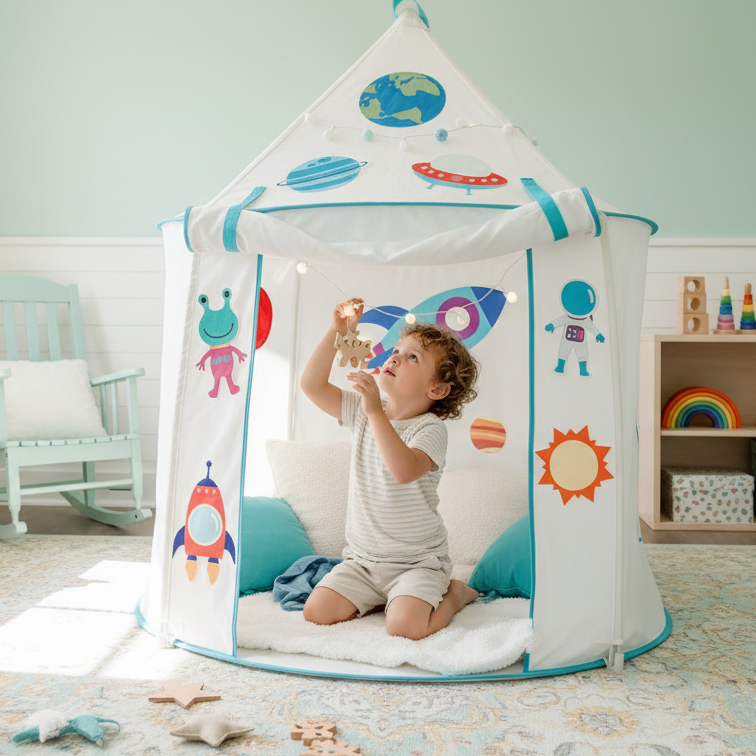
Maybe it is a corner under a fabric canopy.
A play tent.
Two chairs children can drape with a blanket.
A large cardboard structure.
Today, it is a library.
Tomorrow, a restaurant.
After that, a spaceship.
Fantasy and pretend play become increasingly prominent as symbolic abilities develop, and the AAP specifically identifies activities such as dress-up and fort building among the forms imaginative play can take in childhood.
A transformable space gives those ideas somewhere physical to happen.
9. Let Children Change the Scenery
Adults often design playrooms to be visually complete.
Children may benefit from being allowed to make them temporarily incomplete.
A felt board can change.
A magnetic surface can be rearranged with appropriate pieces.
Artwork can rotate.
Large reusable scenery can move.
A play surface can become a town today and an ocean tomorrow.
That ability to alter the environment creates another layer of ownership. The child is not simply occupying a room somebody else designed; they are influencing what the room represents.
This idea of a changeable environment also influences ZeeZee Adventures. The ZeeZee Adventures Tent uses interchangeable StickeeZ felt themes so children can physically change the imaginative setting while keeping the same familiar play structure. The current system includes multiple themes rather than locking the tent into one permanent storyline.
The broader principle matters more than the product:
Let children alter something about the world in which they are playing.
A cardboard wall and a box of crayons can accomplish that too.

10. Include a Quiet Option Without Making It a “Time-Out” Space
Independent play is not always energetic.
Sometimes it looks like drawing.
Looking at a book.
Arranging figures.
Listening.
Building carefully.
A cushion, reading chair, play tent, or comfortable corner can give quieter play somewhere to happen.
But avoid making that area synonymous with discipline.
If a child is sent there whenever adults think they need to “calm down,” it stops being a freely chosen play space.
Let it remain part of everyday play.
Children should be allowed to use a cozy corner because they are happy, imaginative, tired, absorbed in a book, or simply prefer being there.
11. Store Toys by Possibility, Not Only by Category
Organization systems are usually designed for adults.
Cars go with cars.
Animals go with animals.
Blocks go with blocks.
That makes cleanup easier, but independent play can sometimes become richer when children have permission to combine categories.
A basket containing a few figures, blocks, fabric pieces, and vehicles might inspire a more elaborate story than four separate bins used independently.
You do not need to deliberately mix everything.
Simply avoid enforcing rules that prevent children from combining materials in ways that make sense inside their own stories.
A dinosaur is allowed to drive a truck.
Childhood will survive.
12. Add Real-World Pretend-Play Objects Sparingly
Pretend play does not require a complete miniature supermarket.
A notebook, reusable bag, safe container, old keyboard disconnected from electronics, or simple dress-up piece may be enough to suggest an idea.
The child can fill in the missing details.
Too much realism can occasionally do the imaginative work for them. A fully scripted setup says, “This is a café, and this is exactly how you play café.”
A few suggestive objects say:
“Something could happen here.”
That difference leaves more room for the child.
13. Create Natural Play Invitations Instead of Scheduled Activities
A play invitation does not need a handwritten sign or Pinterest-worthy tray.
It might simply mean placing two previously separate materials near each other.
Blocks beside animal figures.
Paper near toy cars.
Fabric beside a cardboard box.
Several StoryWorld pieces arranged differently from yesterday.
Then leave.
You do not have to announce what the child is supposed to notice.
The purpose is not to manipulate the child into playing independently. It is simply to make a possibility visible.
If they ignore it, that is information too.
14. Reduce Background Screens and Unnecessary Noise
Independent play asks children to generate or sustain their own focus.
A television playing in the background is competing for some of that attention even when nobody is intentionally watching it.
The solution is not to make the playroom silent. Children may enjoy music, audio stories, conversation, or ordinary household sounds.
Instead, distinguish between intentional sound and background stimulation.
If nobody is using the television, turn it off.
If the child deliberately chose music for their dance party, that sound is part of the play.
Environment design should support what the child is doing rather than continually asking them to redirect attention elsewhere.
15. Make Cleanup Simple Enough That Children Can Participate
A playroom cannot remain usable if resetting it requires a forty-minute adult organization project.
Use large, obvious storage categories.
Blocks.
Books.
Art.
Pretend play.
Dress-up.
The system does not need to be aesthetically perfect.
It needs to be understandable.
Young children will still need help, and cleanup abilities develop gradually. The goal is not to make children entirely responsible for maintaining the room.
It is to create a system in which they can increasingly participate.
Independence includes what happens after the play too.
Why Toy Rotation Can Help Independent Play
Toy rotation is often described as a strategy for making old toys feel new, but its more practical benefit may simply be reducing the number of simultaneous choices.
The small toddler study mentioned earlier does not prove that every child plays better with exactly four toys. But its finding—that participants played longer with individual toys and explored them in more varied ways under the fewer-toy condition—supports the idea that reducing choice can sometimes change the quality of play.
Try storing part of the collection for several weeks.
Do not rotate according to an elaborate calendar unless you enjoy doing that.
Watch instead.
If something is used deeply, leave it.
If several objects have become invisible to the child, swap one or two.
The rotation should serve the play.
The play does not need to serve the rotation system.
What Independent Play Should Not Look Like
Independent play does not mean expecting a two-year-old to entertain themselves for an hour because a parenting account said they should.
It does not mean ignoring bids for connection.
It does not mean filling the room with activities and expecting children to disappear into it.
Developmentally appropriate play includes relationships as well as independence. The AAP emphasizes that play can support both developmental skills and nurturing caregiver-child relationships.
Children often become more confident exploring independently when they know connection remains available.
A parent can therefore be nearby without directing.
You might read your own book while the child builds.
Fold laundry while they pretend.
Answer when they show you something without taking over the game.
Independent play is not absence.
It is gradually shifting ownership of the play toward the child.
Common Playroom Mistakes That Can Make Independent Play Harder
The first is assuming more toys create more possibilities. Sometimes they simply create more decisions.
The second is designing everything around adult aesthetics. A playroom can be beautiful, but if children cannot reach, move, combine, or temporarily change anything, it may function more like a showroom than a play environment.
Another mistake is over-organizing. If every object must remain in one category and every activity needs to return to its original state immediately, children have less freedom to combine ideas.
Parents may also jump in too quickly when play slows down. A moment of “I don't know what to do” does not always need an immediate solution.
Sometimes that pause is where the next idea begins.
A Simple Independent-Play Playroom Checklist
-
Keep a manageable number of toys visible.
-
Put safe independent materials within reach.
-
Give open-ended toys prominent space.
-
Preserve some empty floor for movement and large projects.
-
Allow selected unfinished creations to remain temporarily.
-
Keep books and art materials integrated with play.
-
Include at least one space the child can reinterpret.
-
Let children move and combine play materials.
-
Provide an optional quieter area.
-
Reduce unnecessary background screens and noise.
-
Use a cleanup system the child can begin to understand.
-
Rotate materials according to interest rather than a rigid schedule.
-
Give children time to generate an idea before solving boredom for them.
Frequently Asked Questions About Playrooms and Independent Play
What should a playroom have for independent play?
A useful independent-play space usually includes accessible open-ended materials, books, simple art supplies, some clear floor space, easy storage, and somewhere children can build or pretend. The exact materials should reflect the child's age and interests.
Do fewer toys encourage independent play?
Possibly for some children. One small experimental study of 36 toddlers found longer periods of play with individual toys and more varied use when four toys were available compared with sixteen. The study is interesting but too small to justify a universal rule about exactly how many toys children should have.
What are the best toys for independent play?
There is no single best toy. Open-ended materials such as blocks, drawing materials, figures, fabrics, cardboard, construction pieces, and age-appropriate pretend-play objects can be especially versatile because children can decide how to use them.
How do I encourage my child to play independently?
Start with short, realistic opportunities while you remain nearby. Make familiar materials accessible, avoid continually directing the activity, and wait briefly before responding to every “What should I do?” with a solution. Independent play develops gradually rather than appearing all at once.
Should a playroom be Montessori?
A playroom does not need to follow a specific educational philosophy to support independence. Montessori-inspired ideas such as child-accessible materials, order, practical autonomy, and manageable choices can be useful, but families can adapt those principles without creating a formally Montessori environment.
Does the playroom need to be screen-free?
It does not have to be governed by an absolute rule, but background screens can compete with self-directed play. Turning off media nobody is intentionally using can make the environment more supportive of sustained play.
How often should I rotate toys?
There is no evidence-based universal schedule. Rotate according to what your child is using. Materials that remain deeply engaging do not need to disappear just because a week has passed.
What if my child still asks me to play?
Play with them.
Independent play and connected play are not competitors.
A child asking for interaction does not mean your playroom has failed. The goal is simply to develop increasing opportunities for children to direct some of their own play alongside the shared play and relationships they also need.
The Best Playroom Gives Children Something Adults Cannot Design
Parents can choose the shelves.
The lighting.
The blocks.
The books.
The baskets.
The floor mat.
But the most important part of the playroom cannot be purchased.
The child's idea.
That is what a room designed for independent play protects.
It gives children enough material to begin without telling them where the experience must end.
The blocks become a city.
The empty corner becomes a hospital.
The tent becomes a spaceship.
The cardboard becomes a machine nobody else understands.
A quiet pause becomes the beginning of a game.
For families looking for more ways to help children turn that physical environment into their own ideas, ZeeZee Adventures' ideas for encouraging more creative play at home are a natural next step.
The goal is not a playroom that entertains children perfectly.
It is a playroom that leaves enough room for children to discover that they can entertain, challenge, surprise, and inspire themselves.
Author Bio
The ZeeZee Play Experts share research-informed ideas about independent play, imagination, sensory exploration, creativity, and screen-free childhood. ZeeZee Adventures' educational resources help families translate child-development principles into realistic ways to give children more ownership of everyday play.



Comment (0)