
Small Playroom Ideas That Maximise Creativity
Rethinking Space in Childhood Environments
In many modern homes, space is often limited. Dedicated playrooms, once considered a standard feature, are now a luxury rather than a given. As a result, children’s play areas are frequently condensed into corners of living rooms, shared bedrooms, or compact multifunctional spaces. This constraint can lead to a common assumption: that creativity requires more space, more toys, and more stimulation.
However, research and practical observation suggest a different reality. Creativity in children is not dependent on the size of the space available, but rather on how that space is designed and experienced. In fact, smaller environments, when thoughtfully arranged, can often support deeper engagement, stronger imagination, and more meaningful play.
The key lies not in expanding the physical dimensions of a playroom, but in maximising its potential through intentional design. A small playroom, when approached strategically, can become a powerful environment for exploration, storytelling, and creative development.
The Relationship Between Space and Imagination
Children do not experience space in the same way adults do. For an adult, a room may be judged by its size or functionality. For a child, it is defined by possibility.
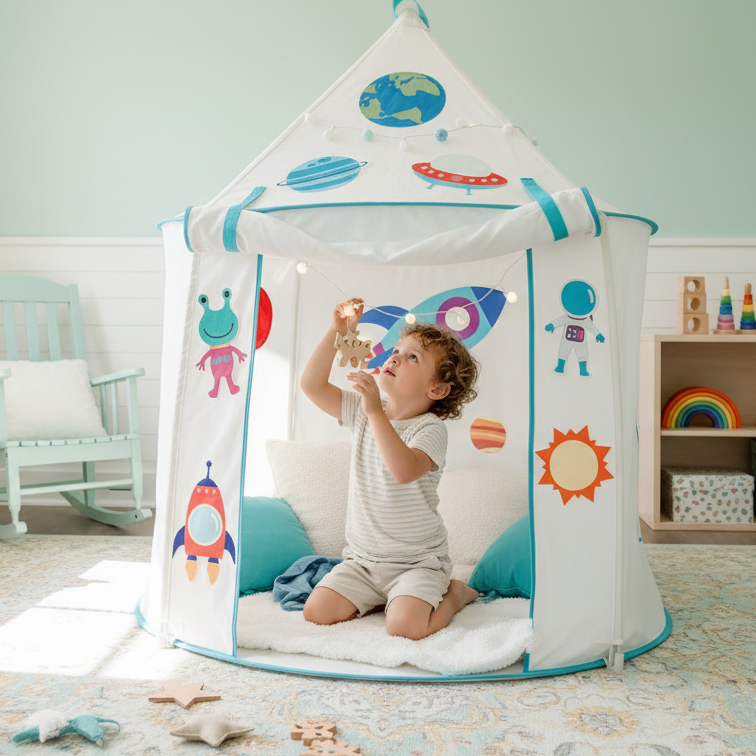
A small corner can become a castle, a spaceship, or a hidden cave. A simple structure can transform repeatedly, shaped by the child’s imagination. In this sense, the effectiveness of a playroom is not determined by how much space it offers, but by how open that space is to interpretation.
Overly structured environments can limit creativity by dictating how objects should be used. In contrast, flexible spaces encourage children to invent their own narratives. The absence of rigid direction allows imagination to take the lead.
This is why smaller playrooms can be particularly effective. With fewer distractions and clearer boundaries, children are more likely to engage deeply with their surroundings.
Simplifying the Environment to Encourage Focus
One of the most common challenges in small playrooms is clutter. In an effort to maximise the use of limited space, it is tempting to include as many toys and materials as possible. However, this approach often has the opposite effect.
An environment filled with too many options can overwhelm attention. Children may move quickly from one activity to another, engaging only superficially with each. The result is fragmented play rather than sustained exploration.
A more effective approach is to simplify the environment. This does not mean removing all variety, but rather curating it carefully. By limiting the number of available items, it becomes easier for children to focus.
In a smaller space, this principle becomes even more important. Every object should serve a purpose, contributing to the overall experience of play. When the environment is clean and intentional, children are better able to engage with it meaningfully.
Creating Defined Zones Within Limited Space
Even in the smallest play areas, it is possible to create a sense of structure by defining different zones. These zones do not require physical walls or large separations. Instead, they can be suggested through subtle changes in layout, texture, or arrangement.
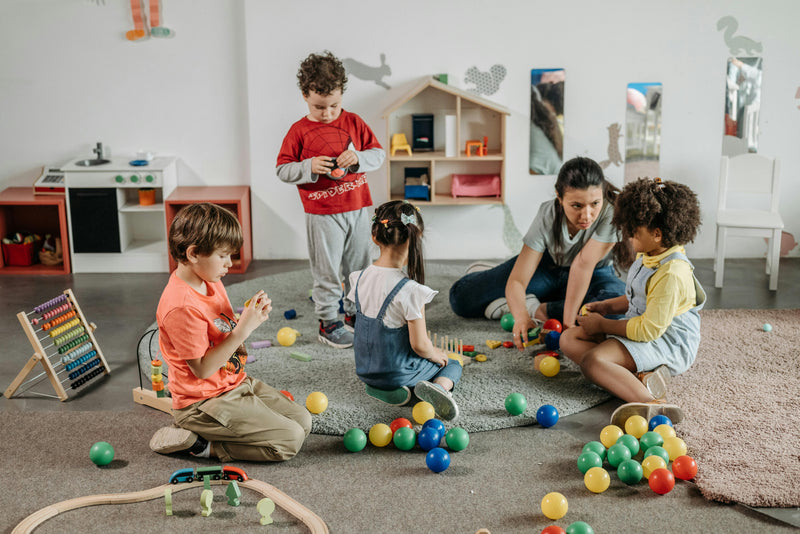
For example, a small corner with soft cushions can become a quiet reading or reflection area. A nearby open space with accessible materials can serve as a zone for building or imaginative play. A low table or mat can define a space for creative activities such as drawing or crafting.
These distinctions help children understand how to use the space without needing explicit instruction. They also support different types of play, allowing for both active and calm experiences within the same area.
In a compact environment, this sense of organisation can significantly enhance usability, making the space feel larger and more functional than it actually is.
The Role of Open-Ended Materials
Open-ended materials play a crucial role in maximising creativity, particularly in smaller spaces. Unlike fixed-function toys, which offer limited possibilities, open-ended objects can be used in a variety of ways.
Items such as blocks, fabrics, simple figurines, and modular structures allow children to create their own narratives. A single object can take on multiple roles, changing from one play session to the next.
This adaptability is especially valuable in limited spaces, where storage and variety are constrained. Instead of requiring a large number of toys, a smaller selection of versatile materials can provide a richer and more enduring play experience.
Over time, children learn to reinterpret these objects, developing creativity and problem-solving skills in the process.
Vertical Space as an Untapped Resource
In small playrooms, the focus is often placed on floor space. However, vertical space can be equally valuable. Walls, shelves, and hanging elements can all contribute to the functionality of the room.
Low shelves can provide accessible storage, allowing children to select and return materials independently. Wall-mounted features can create opportunities for display, interaction, or imaginative play.
By extending the play environment vertically, it becomes possible to maintain an open floor area while still offering a variety of resources. This approach helps prevent overcrowding and maintains a sense of openness within the room.
Creating a Sense of Enclosure and Imagination
Interestingly, children are often drawn to smaller, enclosed spaces within a room. These areas provide a sense of security and focus, allowing the child to immerse themselves more fully in their play.
In a small playroom, this can be achieved through simple design elements. A canopy, a small tent-like structure, or a defined nook can create a “space within a space”.
Such environments often become the centre of imaginative play. They serve as a backdrop for storytelling, role-playing, and quiet reflection.
In many cases, modular play environments—similar to those explored in adaptable concepts like ZeeZee Adventures- demonstrate how a single structure can support multiple forms of play while maintaining a compact footprint.
Balancing Stimulation and Calm
A common misconception is that creative spaces must be visually stimulating at all times. In reality, excessive stimulation can hinder creativity by overwhelming the senses.
Small playrooms benefit from a balanced approach. Calm, neutral backgrounds can provide a stable foundation, while selective use of colour and texture can add interest without distraction.
This balance helps create an environment that is both engaging and soothing. Children are able to focus on their activities without being overwhelmed by visual noise.
Lighting also plays a role. Soft, natural light can enhance the sense of calm, while well-placed lighting elements can make the space feel inviting and comfortable.
Encouraging Independence Through Design
A well-designed small playroom supports independence. When materials are accessible and the layout is intuitive, children are able to navigate the space on their own.
This might involve placing items within reach, organising materials clearly, and ensuring that the environment is safe for independent use.
In such settings, children are more likely to initiate their own play, make choices, and develop a sense of ownership over their activities.
This independence is closely linked to creativity. When children are free to explore without constant direction, they are more likely to experiment, take risks, and develop original ideas.
Adapting the Space Over Time
One of the advantages of a smaller playroom is its adaptability. Changes can be made quickly and easily, allowing the space to evolve alongside the child’s interests and developmental stage.
Materials can be rotated to maintain novelty without increasing clutter. Layouts can be adjusted to accommodate new activities. Zones can be redefined as needed.
This flexibility ensures that the space remains relevant and engaging over time. Rather than becoming static, it continues to support growth and exploration.
A Different Perspective on Small Spaces
Ultimately, the effectiveness of a playroom is not determined by its size, but by its intention. A small space, when thoughtfully designed, can offer everything a child needs to explore, imagine, and create.
By focusing on simplicity, flexibility, and accessibility, it becomes possible to transform even the most compact area into a rich environment for development.
In many ways, smaller spaces encourage a more mindful approach to design. They require careful consideration of each element, resulting in environments that are both functional and inspiring.
Conclusion: Creativity Thrives in Thoughtful Spaces
Creativity does not require excess. It requires opportunity.
A small playroom, when designed with care, can provide that opportunity in abundance. Through thoughtful organisation, open-ended materials, and a balanced environment, it becomes a place where imagination can flourish.
Rather than viewing limited space as a constraint, it can be seen as an invitation to design with intention, to simplify with purpose, and to create environments that truly support the way children play and learn.





Comment (0)