
The Best Pretend Play Activities for Toddlers and Preschoolers
A practical guide to simple, screen-free pretend play ideas that grow with your child.
Pretend play can start with something as simple as feeding a teddy bear.
Then, almost without warning, the teddy has become a patient, the living room has become a hospital, and your child is running the entire clinic.
That transformation is what makes pretend play so special.
Children take familiar experiences, objects, and ideas and turn them into something entirely their own.
For toddlers, pretend play may involve copying everyday routines such as cooking, feeding, or putting a doll to sleep. For preschoolers, those simple actions can grow into elaborate stories involving multiple characters, settings, and imaginary problems.
The good news for parents is that you don't need complicated activities to encourage this kind of play.
A few everyday objects, some time, and plenty of freedom can be enough.
What Is Pretend Play?
Pretend play is essentially "make-believe" play.
A child uses an object, action, character, or situation to represent something beyond what is immediately real.
A block becomes a phone.
A cardboard box becomes a car.
A child becomes a doctor.
A teddy becomes the patient.
The imaginary situation can be simple or elaborate.
What matters is that the child gets to create and explore an idea.
Pretend Play for Toddlers vs Preschoolers
Pretend play develops gradually.
Toddlers
Toddlers often begin with familiar actions:
-
Feeding a doll
-
Putting a teddy to bed
-
Pretending to cook
-
Talking on a toy or imaginary phone
-
Pushing a box like a vehicle
-
Copying household routines
Keep activities short and simple.
Toddlers don't need complicated storylines.
Preschoolers
Preschoolers can often create more detailed scenarios.
They may:
-
Assign different roles
-
Create imaginary rules
-
Develop longer stories
-
Combine several ideas
-
Introduce problems and solutions
-
Play collaboratively with siblings or friends
A simple restaurant can become a restaurant on the Moon.
A hospital can become an animal rescue centre.
A cardboard box can become an entire spaceship.
15 Best Pretend Play Activities for Toddlers and Preschoolers
1. Pretend Restaurant
For toddlers
Give your child cups, plates, and a soft toy.
They can pretend to feed their "customer."
For preschoolers
Let them create a menu, take orders, and become the chef or restaurant owner.
Ask:
"What's today's special?"
2. Doctor's Clinic
For toddlers
A teddy can be the patient.
Your child can pretend to examine and comfort it.
For preschoolers
Create a complete clinic.
Add a waiting room, reception desk, and different patients.
Let your child decide what happens.
3. Pretend Shop
For toddlers
Give your child a basket and a few empty food containers.
They can practise shopping and sorting.
For preschoolers
Let them become the shopkeeper.
Create price tags, shopping lists and pretend money.
4. Animal Rescue Centre
Soft toys make excellent pretend-play characters.
For toddlers, simply caring for the animals can be enough.
Preschoolers can create an entire rescue centre.
Perhaps an animal is lost.
Another needs somewhere to sleep.
Someone needs to find its family.
Your child becomes the person responsible for helping.
5. Indoor Camping
A blanket and some cushions can create an instant campsite.
Pack imaginary supplies.
Search for animals.
Tell stories.
For preschoolers, introduce an imaginary challenge:
"It's getting dark. How will we get back to camp?"
6. Space Adventure
A cardboard box makes a fantastic spaceship.
Toddlers can simply climb inside and pretend to fly.
Preschoolers can create a mission.
Where are they going?
Who is travelling with them?
What happens if the spaceship loses power?
The story belongs to them.
7. Pretend Bakery
Use bowls, wooden spoons, and empty food containers.
Your toddler can pretend to mix and serve.
Your preschooler can create an entire bakery.
They can decide what is on the menu and who works there.
8. Train Journey
Arrange chairs in a line.
One child can be the driver.
Another can be a passenger.
Create paper tickets.
Then choose a destination.
The beach?
The jungle?
A magical kingdom?
Anything works.
9. Veterinary Clinic
Soft toys become patients.
Your child becomes the vet.
Toddlers can practise caring for their animals.
Preschoolers can create appointments, waiting rooms and different cases.
10. Pretend School
Set up a few chairs.
Give your child paper and pencils.
Soft toys become pupils.
Your child becomes the teacher.
They can read stories, take attendance, and create lessons.
And don't be surprised if you're given homework.
11. Treasure Hunt
Hide a safe object somewhere nearby.
For toddlers, keep the clues simple.
For preschoolers, create a map or series of clues.
Then switch roles.
Let your child create a treasure hunt for you.
12. Detective Adventure
Give your child a notebook and pencil.
Now create a mystery.
A toy has disappeared.
Where did it go?
Who saw it last?
Your child can investigate.
Preschoolers may enjoy creating their own mysteries once they understand the idea.
13. Pretend Airport
Create paper tickets and use bags as luggage.
Toddlers can practise simple actions such as checking bags and boarding.
Preschoolers can become pilots, passengers or airport staff.
Then introduce an imaginary problem.
"The flight has been delayed. What should we do?"
14. Puppet Theatre
Use soft toys, dolls, or homemade characters.
A blanket can become the curtain.
Toddlers may enjoy simple puppet conversations.
Preschoolers can create entire stories.
They can choose the characters, dialogue, and ending.
15. Storybook Adventure
Choose a favourite children's book.
Read it together.
Then enter the story.
Your child can become one of the characters.
But don't feel obligated to follow the original plot.
Ask:
"What if the story happened differently?"
Your child can create a new ending.
The Best Pretend Play Materials
You don't need a cupboard full of specialised toys.
Try keeping a small collection of safe, open-ended materials available:
-
Cardboard boxes
-
Blankets
-
Cushions
-
Paper
-
Crayons
-
Scarves
-
Baskets
-
Wooden spoons
-
Empty containers
-
Soft toys
-
Fabric pieces
-
Favourite books
A single object can inspire multiple games.
A basket can be:
A shopping basket.
A boat.
A picnic basket.
A treasure chest.
A baby's bed.
The possibilities come from the child.
How to Adapt the Same Activity for Different Ages
One of the easiest ways to make pretend play grow with your child is to keep the basic scenario the same while changing the complexity.
Take a pretend restaurant.
Toddler
"Feed Teddy."
Younger preschooler
"Take Teddy's order."
Older preschooler
"Create a menu and decide what happens when the restaurant runs out of food."
Same idea.
Different level of complexity.
You don't need to constantly buy new activities.
You can simply let the child's imagination become more detailed.
Let Your Child Take the Lead
This is important.
Pretend play works best when children have ownership over the imaginary world.
If your child says:
"You're the customer."
Be the customer.
If they say:
"The sofa is the spaceship."
The sofa is now a spaceship.
If they suddenly decide the spaceship has landed in a dinosaur hospital, follow them.
Don't worry about whether the story makes sense.
It doesn't have to make sense to you.
Use Small Prompts When They Need Inspiration
Sometimes a child needs a little help getting started.
Try:
"Who are we today?"
"Where are we going?"
"What happened?"
"Who needs help?"
"What should we take with us?"
"What happens next?"
"How can we fix it?"
Then step back.
The goal is to open the door, not walk through it for them.
Encourage Communication Through Pretend Play
Pretend play can naturally create opportunities for children to communicate.
A restaurant gives them a reason to take orders.
A hospital gives them a reason to explain what happened.
A shop gives them a reason to ask and answer questions.
A spaceship gives them a reason to discuss the mission.
When siblings or friends play together, they may also need to negotiate roles, listen to one another and agree on the rules of their imaginary world.
These are opportunities for practising social interaction rather than guaranteed developmental outcomes.
What If Your Child Prefers Independent Play?
That's okay.
Children don't have to play pretend with someone else every time.
Some children enjoy creating their own imaginary worlds.
Give them a comfortable space and a few open-ended materials.
You can stay nearby without directing the activity.
If they invite you in, follow their lead.
If they don't, let their story belong to them.
Create a Space for Pretend Play
A dedicated play space can make imaginative play easier to return to.
It doesn't have to be a large playroom.
A small corner can work.
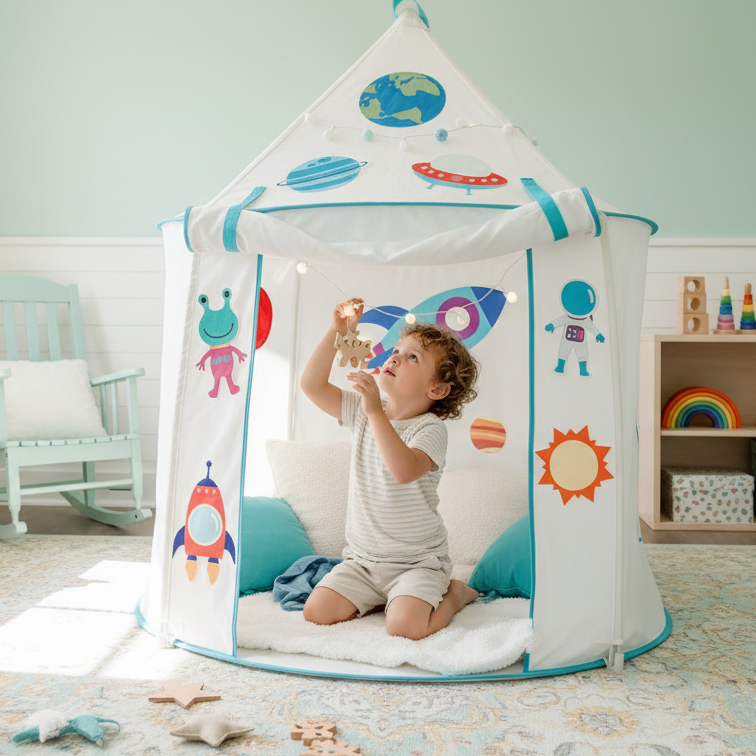
A cosy tent can work.
A space with cushions, books and a few open-ended materials can become a familiar setting for stories.
The ZeeZee Adventure Tent is designed to be an adaptable play environment.
With interchangeable StickeeZ themes, the same space can become a jungle, castle, space station, or another imaginative setting.
The theme inspires.
The child creates the adventure.

Don't Overcomplicate It
You don't need to prepare a Pinterest-perfect activity.
You don't need matching props.
You don't need a complicated craft.
Try this instead:
One object + one role + one problem
A cardboard box.
An astronaut.
A broken spaceship.
Done.
Your child can create the rest.
A Simple Pretend Play Routine
If your family wants more screen-free imaginative play, try creating a predictable rhythm.
Set up
Place a few safe materials in an accessible space.
Invite
Offer one simple idea.
Step back
Let your child take over.
Join
Participate if your child invites you.
Extend
If the game slows down, introduce one small problem.
Repeat
Return to favourite scenarios rather than constantly introducing new ones.
Safety First
Household objects should always be selected with your child's age and abilities in mind.
Avoid small objects that could pose choking hazards.
Keep sharp, fragile, and breakable objects away from play.
Avoid cords, plastic bags, and other potentially hazardous materials.
If furniture is used to create forts or play structures, ensure it is stable and cannot fall.
Supervise whenever the setup or materials require it.
Simple play is often easier to make safe.
The Best Pretend Play Activity Might Be the One Your Child Invents
We can give children restaurants.
Hospitals.
Airports.
Spaceships.
Castles.
Jungles.
But eventually, they may ignore all of our ideas.
The restaurant becomes a spaceship.
The spaceship becomes a dinosaur cave.
The dinosaur cave becomes a school.
And suddenly, the game has become something entirely different.
Let it.
That's the point.
Pretend play isn't about following instructions perfectly.
It's about creating possibilities.
Final Thought
The best pretend play activity isn't necessarily the most elaborate one.
It might be a cardboard box.
A blanket.
A soft toy.
Three ordinary objects that become an entire world.
For toddlers, that world may be very simple.
For preschoolers, it may become wonderfully complex.
But at every age, the most important ingredient is the same:
Room to imagine.
So before you buy another toy or reach for another screen, look around your home.
You may already have everything your child needs for their next adventure.
More Pretend Play Ideas to Encourage Imagination, Language and Social Play
Pretend play doesn't need to be complicated to be meaningful.
For toddlers, a simple basket can become a shopping basket. A spoon can become a microphone. A teddy can become a patient.
For preschoolers, that same basket might become a treasure chest, the spoon might become a magic wand, and the teddy might become the captain of a spaceship.
The materials haven't changed.
The imagination has.
This is why pretend play activities can grow naturally with children. Instead of constantly introducing new toys, parents can make familiar activities more complex as children's language, confidence, and storytelling abilities develop.
Here are some simple ideas to try at home.
16. Pretend Grocery Store
A grocery shop is one of the easiest pretend-play setups because children already understand the basic idea.
You need:
-
Empty food containers
-
A basket
-
Paper
-
Crayons
For toddlers, simply let them collect items and place them in the basket.
For preschoolers, add roles.
One child can be the shopkeeper.
Another can be the customer.
Someone else can organise the shelves.
Create a shopping list together.
Then let your child decide what happens next.
Maybe the shop runs out of bananas.
Maybe a customer can't find their shopping list.
Maybe the shop needs to close because a dinosaur has walked in.
The imaginary problem can become part of the story.
17. Pretend Hair Salon
Set up a simple salon using items that are safe for your child's age.
You need:
-
Hairbrush
-
Towels
-
Empty containers
-
Mirror
Your child can become the stylist.
Soft toys can become customers.
They can create appointments and decide what hairstyles the salon offers.
For younger children, the game can simply involve brushing a doll's hair.
For preschoolers, introduce conversations between stylist and customer.
"What hairstyle would you like today?"
"Something very fancy."
Now the story has begun.
Avoid real scissors or other sharp objects.
18. Pretend Bakery
A pretend bakery can begin with a bowl and wooden spoon.
You need:
-
Bowls
-
Wooden spoons
-
Empty food containers
-
Paper
-
Crayons
Your toddler can pretend to mix ingredients.
Your preschooler can create a bakery menu.
Perhaps today's special is a rainbow cake.
Or a cake that makes you invisible.
Or cookies for dinosaurs.
Let the child decide.
19. Build a Fire Station
Turn a corner of the room into a fire station.
You need:
-
Cardboard box
-
Paper
-
Crayons
-
Toy vehicles, if available
Your child can become a firefighter.
Create an imaginary emergency.
Perhaps a teddy is stuck somewhere.
Maybe a toy building needs rescuing.
Ask:
"What should we do?"
The goal isn't to give your child the answer.
Let them create the rescue plan.
20. Create a Magical Potion Lab
This one can become wonderfully imaginative.
You need:
-
Empty containers
-
Wooden spoons
-
Paper
-
Crayons
Your child can invent imaginary potions.
One makes animals talk.
One makes you fly.
One turns rain into stars.
There are no instructions.
The child decides what each potion does.
21. Pretend Library
Create a small library using books you already own.
You need:
-
Books
-
Paper
-
Crayons
-
A basket or shelf
Your child can become the librarian.
They can organise books and create library cards.
You can become a visitor looking for a very specific book.
For example:
"I'm looking for a book about a dragon who is afraid of the dark."
Your child now has to decide which book might help.
22. Create a Weather Station
This is a great way to combine pretend play with storytelling.
You need:
-
Paper
-
Crayons
-
A safe household object as a pretend microphone
Your child becomes the weather presenter.
Ask:
"What's the weather like today?"
Maybe it's sunny.
Maybe there's a thunderstorm.
Maybe it is raining marshmallows.
Let the forecast become as imaginative as your child wants.
23. Build a Construction Site
Use blocks, cardboard, and toy vehicles if you have them.
Your child can become the builder.
What are they constructing?
A bridge?
A house?
A giant animal shelter?
For preschoolers, introduce a problem.
"The bridge isn't finished, but the animals need to cross."
Now your child has something to solve.
24. Create a Pirate Ship
Chairs, blankets, and cushions can become a ship.
You need:
-
Chairs
-
Blankets
-
Cushions
-
A basket
Choose a captain.
Choose the crew.
Then decide where the ship is going.
The treasure might be hidden somewhere in the house.
Your child can create a map and lead the expedition.
25. Become Animal Explorers
Gather animal toys or soft toys.
Create an imaginary expedition.
You need:
-
Animal toys
-
Blankets
-
Cushions
-
Paper
The blanket can become a river.
The cushions can become mountains.
Your child becomes the explorer.
Perhaps they discover a completely new animal.
Ask:
"What does it eat?"
"Where does it live?"
"What should we call it?"
Now pretend play becomes storytelling.
26. Create a Toy Rescue Mission
Choose a soft toy.
Hide it somewhere safe.
Your child becomes the rescue team.
Give them a simple clue.
For preschoolers, create multiple clues.
They can draw maps, search for evidence and decide how to rescue the toy.
Once the game is familiar, let your child hide something for you.
Now they're not just participating.
They're creating the game.
27. Pretend Hotel
A few blankets and cushions can become a hotel.
Your child can become the manager.
You arrive as a guest.
Ask:
"What kind of room do you have?"
Perhaps there's a jungle room.
Maybe there's a castle room.
Maybe the entire hotel is underwater.
Your child decides.
28. Create an Imaginary Restaurant on the Moon
Take a familiar pretend-play activity and change the setting.
The restaurant is now on the Moon.
What does the menu look like?
How do customers arrive?
What does the chef cook?
Do you need a space helmet to enter?
Changing the setting can make a familiar game feel completely new.
29. Build a Time Machine
A cardboard box becomes a time machine.
Your child chooses the destination.
Maybe they travel back to the dinosaurs.
Maybe they visit a future city.
Maybe they go to a magical version of their own house.
Ask:
"What do you see?"
Let them describe the world.
30. Create a Superhero Headquarters
Use blankets, cushions and cardboard.
Your child can create a secret base.
Who works there?
What powers do they have?
What problem needs solving?
The game can involve storytelling, movement, and role-play all at once.
31. Create a Puppet Story
You don't need actual puppets.
Soft toys can work.
So can paper characters.
Your child can create a conversation between two characters.
You can play one character while your child plays the other.
Don't worry about following a script.
Let the story evolve.
32. Open an Imaginary Travel Agency
Give your child paper, crayons, and a few envelopes.
They can create holiday destinations.
Perhaps customers can travel to:
-
The jungle
-
The Moon
-
A castle
-
The bottom of the ocean
-
A magical island
Your child can create tickets and travel plans.
The activity naturally encourages storytelling and decision-making.
33. Create a Dinosaur Museum
Collect dinosaur toys if you have them.
Add paper signs.
Your child can arrange the exhibits and become the museum guide.
Then give them a challenge:
"Can you show me where the biggest dinosaur is?"
Your child becomes the expert.
34. Pretend to Be Scientists
Create a simple "laboratory".
You need:
-
Paper
-
Cardboard
-
Empty containers
-
Safe household objects
Your child can investigate mysterious objects.
What is inside the box?
What does the machine do?
What happens if two imaginary ingredients are combined?
Keep everything pretend and avoid real experiments involving potentially hazardous materials.
35. Create a Family Café
This is especially fun when several family members participate.
One person can be the chef.
Someone can take orders.
Someone can be the customer.
Then switch roles.
Children get to experience the same scenario from different perspectives.
36. Build a Castle
Blankets and cushions are enough.
Create a castle.
Then decide who lives there.
A princess?
A dragon?
A family of bears?
A group of astronauts?
Let your child's imagination determine the answer.
37. Create a Jungle Hospital
Combine two familiar pretend-play scenarios.
The jungle needs a hospital.
Your child becomes the doctor.
Soft toys become the patients.
Now the game has a setting, characters, and a problem.
The combination itself creates a new story.
38. Make a Rescue Helicopter
Arrange chairs to create the helicopter.
A blanket can become the landing zone.
Your child becomes the rescue pilot.
Who needs help?
Where are they?
How will the rescue team reach them?
Let your child make the decisions.
39. Create a Secret Agent Mission
Give your child a notebook.
Create a simple imaginary mission.
Perhaps they need to deliver a secret message.
Maybe they have to find a missing object.
Or perhaps they need to protect a teddy bear.
Preschoolers may enjoy creating their own missions once they understand the game.
40. Let Your Child Invent the Activity
This might be the most important activity of all.
Give your child a few safe materials.
Then say:
"What should we play today?"
Don't offer options immediately.
Give them time.
They might invent something you've never considered.
And that's exactly what you want.
How to Make One Activity Work for Different Ages
You don't need separate pretend-play activities for every age.
Take a simple pretend shop.
Toddler
Put items into a basket.
Younger preschooler
Pretend to buy and sell items.
Older preschooler
Create a shop, assign roles, make prices, and solve imaginary problems.
The basic activity stays the same.
The complexity changes.
This makes pretend play easier for families with children of different ages.
When Pretend Play Becomes Social Play
A child playing alone can still create a rich imaginary world.
But when another child joins, new possibilities appear.
Now they need to decide:
Who is the doctor?
Who is the patient?
What is the hospital?
What happens next?
Children may need to listen to one another, negotiate roles, and find ways to combine different ideas.
Not every interaction will be smooth.
That's okay.
The disagreements are part of the experience too.
How Parents Can Support Without Taking Over
Try following your child's lead.
If they say:
"You're the customer."
Become the customer.
If they say:
"This is the spaceship."
Accept the spaceship.
If they change the story halfway through, change with them.
You can extend the game with occasional comments or questions:
"I wonder what happens next."
"The astronaut looks worried."
"We seem to have a problem."
Then wait.
Your child can decide what happens.
Create a Flexible Play Environment
Children don't need a different room for every imaginary adventure.
A flexible space can become whatever the story requires.
A cosy tent can become:
A jungle.
A castle.
A spaceship.
A reading nook.
A secret headquarters.
The ZeeZee Adventure Tent is designed to support this kind of adaptable play.
Its interchangeable StickeeZ themes allow children to transform the same familiar play space into different imaginative settings.
The theme provides inspiration.
The child creates the story.
A Simple Rule for Choosing Pretend Play Activities
When you're deciding what to try, look for activities that allow your child to:
Choose.
Create.
Change.
Imagine.
Lead.
The more control children have over the imaginary world, the more room there is for their own ideas.
Don't Chase the Perfect Activity
Your child may love the pretend restaurant.
They may ignore the carefully prepared airport.
They may turn the cardboard spaceship into a bed for Teddy.
There is no wrong answer.
Pretend play isn't about completing an activity correctly.
It's about what children do with the opportunity.
So don't worry if your carefully prepared game becomes something completely different.
That transformation is often the most interesting part.
Part 2 Conclusion
The best pretend play activities are not necessarily the ones with the most props.
They are the ones that leave room for children to decide.
A blanket can become a castle.
A box can become a spaceship.
A basket can become a boat.
A soft toy can become a patient.
And a living room can become an entire world.
For toddlers, these transformations may be simple.
For preschoolers, they can become elaborate stories involving characters, problems, and imaginary adventures.
The materials don't have to change.
The possibilities can.
Give children something ordinary.
Give them time.
Then step back and see what they create.
Choosing the Right Activities, Encouraging Independent Play and Making Pretend Play Part of Everyday Life
Pretend play doesn't need to be complicated.
It doesn't need a special room, an expensive toy collection, or a carefully planned activity every afternoon.
Sometimes, the best pretend-play setup is the simplest one.
A cardboard box.
A blanket.
A teddy bear.
And a child with enough time to decide what those things might become.
As toddlers grow into preschoolers, their pretend play can become more detailed. Familiar actions can turn into stories. Simple roles can become characters. A single object can become part of an entire imaginary world.
The key for parents is knowing when to step in, when to offer an idea and when to simply let the story unfold.
Choosing Pretend Play Activities by Age
Every child develops differently, so age ranges should be treated as general guidance rather than strict rules.
The same activity can work for a toddler and a preschooler.
The difference is often in how the child uses it.
Pretend Play for Toddlers
Toddlers often enjoy familiar, everyday scenarios.
Try:
-
Feeding a teddy
-
Pretending to cook
-
Putting a doll to bed
-
Going shopping
-
Talking on an imaginary phone
-
Pretending to drive
-
Giving a toy animal a bath
-
Caring for a stuffed animal
Keep the setup simple.
You don't need a complicated storyline.
A toddler might spend several minutes pretending to feed a teddy and then move on to something else.
That's perfectly fine.
Pretend Play for Younger Preschoolers
As children become more comfortable with imaginary situations, you can introduce simple roles.
Try:
-
Restaurant
-
Shop
-
Doctor's clinic
-
Animal rescue centre
-
Fire station
-
School
-
Bakery
-
Airport
-
Post office
Your child can decide who they are.
You can participate if they invite you.
Pretend Play for Older Preschoolers
Older preschoolers may enjoy activities involving multiple characters, problems and storylines.
Try:
-
Detective missions
-
Treasure hunts
-
Space missions
-
Dinosaur expeditions
-
Magical kingdoms
-
Puppet theatres
-
Travel agencies
-
Museums
-
Rescue missions
-
Inventor workshops
At this stage, don't feel that you need to create the whole story.
Give them a setting.
Then let them build the world.
One Activity Can Grow With Your Child
You don't need to constantly buy new toys as your child gets older.
Take a pretend shop.
Toddler
Your child places objects into a basket.
Younger preschooler
Your child becomes the shopkeeper.
Older preschooler
Your child creates prices, assigns roles, makes signs, and introduces imaginary problems.
The activity hasn't changed.
Your child's use of it has.
This is one of the reasons open-ended pretend play can be so useful.
Activities for Siblings
Pretend play can become particularly interesting when siblings share an imaginary world.
One child might want to be the doctor.
Another wants to be the patient.
One wants the sofa to be a spaceship.
Another wants it to be a castle.
These moments can become opportunities for communication and negotiation.
You don't have to solve every disagreement immediately.
If the children are safe and reasonably calm, give them some space to work it out.
You might eventually ask:
"How could both ideas work?"
Perhaps the spaceship is inside the castle.
Perhaps there are two doctors.
Perhaps they take turns.
Children may discover solutions you wouldn't have thought of.
Activities for Friends
When children play with friends, the challenge can be even more interesting.
They may have different ideas about the game.
One child may know exactly what they want to play.
The other may have a completely different idea.
Instead of requiring them to agree immediately, let the children experiment.
A restaurant can become a spaceship.
A school can become a superhero headquarters.
A hospital can become an animal rescue centre.
Sometimes the best shared game is one that combines two ideas.
How Pretend Play Can Encourage Storytelling
Storytelling doesn't require sitting down with a blank piece of paper.
Children can tell stories through play.
A teddy gets lost.
Someone goes looking for it.
They discover a secret door.
Behind the door is a castle.
Inside the castle is a dragon.
The story grows one decision at a time.
You can encourage this with simple prompts:
"What happened?"
"Who is there?"
"Where are we going?"
"What happens next?"
"How can we fix it?"
Don't ask questions constantly.
One good prompt at the right moment can be enough.
Use Everyday Experiences as Story Starters
Children often enjoy pretending to do things they have experienced.
Think about their everyday life.
A visit to the doctor.
A trip to the supermarket.
A family holiday.
Going to school.
Taking a train.
Going to a café.
These experiences provide familiar frameworks.
Then imagination can change them.
The supermarket becomes a magical shop.
The train travels to the Moon.
The doctor works in a dinosaur hospital.
The familiar becomes extraordinary.
Encouraging Independent Pretend Play
Independent play doesn't mean leaving a child completely alone.
It means giving them opportunities to play without an adult directing every moment.
Start with a familiar environment.
Place a few safe, open-ended materials nearby.
Stay close if your child needs you.
Then reduce your involvement when they become absorbed.
You might begin by playing together.
Then say:
"I'm going to sit here while you finish building your spaceship."
Over time, children may become more comfortable continuing without constant adult participation.
Don't Expect Independent Play to Happen Immediately
Some children naturally become absorbed in solo play.
Others prefer company.
Some children can play independently for a long time.
Others need frequent connection.
There is no single correct pattern.
If your child constantly asks you to play, you can gradually create small opportunities for independent play rather than expecting them to suddenly entertain themselves for an hour.
Start with five minutes.
Then build from there if your child is comfortable.
Create a "Yes" Shelf or Basket
Children are often more likely to use household materials independently when they know which things are available for play.
Create a small basket or shelf containing safe items such as:
-
Fabric pieces
-
Scarves
-
Cardboard
-
Paper
-
Crayons
-
Empty containers
-
Soft toys
-
Baskets
-
Wooden spoons
-
Books
The important part is accessibility.
If children need an adult to retrieve every item, independent play becomes harder.
The Environment Can Do Some of the Work
A good play environment doesn't need to entertain children.
It can simply invite them to explore.
A cosy corner.
An accessible basket.
A few open-ended materials.
A familiar play space.
This is one reason an adaptable space such as the ZeeZee Adventure Tent can work naturally alongside pretend play.
The tent creates a defined space without defining exactly what children have to do inside it.
With interchangeable StickeeZ themes, the setting can change from a jungle to a castle or another imaginative environment.
The same physical space can support different stories.
Make Pretend Play Part of Everyday Life
You don't need to schedule "pretend play time" every afternoon.
Look for opportunities throughout the day.
During breakfast
Pretend you're running a café.
While tidying
Pretend you're cleaning a spaceship.
Before bedtime
Pretend Teddy needs to get ready for bed.
During a rainy afternoon
Build an indoor campsite.
While preparing dinner
Open a pretend restaurant.
Small moments can become play opportunities.
Don't Make Everything Educational
This is important.
Parents sometimes feel pressure to make every activity teach something.
Counting.
Letters.
Colours.
Vocabulary.
Problem-solving.
There is nothing wrong with learning through play.
But children also need play simply because it is enjoyable.
Your child doesn't need to know that they're practising storytelling.
They don't need to identify the social skills involved.
They can simply be a pirate.
That's enough.
Let Children Repeat Their Favourite Games
If your child wants to play restaurant every day, let them.
Repetition isn't necessarily a sign that the activity has become uninteresting.
Children can change details within familiar scenarios.
The same restaurant may have different customers.
Different menus.
Different problems.
Different endings.
Familiarity can provide a comfortable foundation for experimentation.
What If They Don't Want to Play Your Activity?
Don't take it personally.
You may spend twenty minutes creating an elaborate pretend airport.
Your child may ignore it completely and start putting cushions into a box.
That's not failure.
The cushions and box have simply inspired something different.
Follow their interest.
The goal isn't to get children to complete the activity you designed.
The goal is to give them opportunities to create.
Common Parent Questions
Does pretend play need to be expensive?
No.
Household objects, cardboard, blankets, paper, and soft toys can provide plenty of opportunities for imaginative play.
Should I play with my child?
Yes, when they want you to. Follow their lead rather than directing the entire game.
How do I encourage a child who says they're bored?
Offer a small starting point rather than a complete activity.
Try:
"I wonder what this box could become."
Then give them time.
What if my child doesn't enjoy pretend play?
Children have different interests. Offer opportunities without forcing them. Construction, art, sensory play, reading, and physical play can also provide valuable experiences.
How many pretend-play toys do we need?
There is no magic number. A few versatile, open-ended materials can be more useful than a large collection of highly specific toys.
Can siblings play pretend together?
Absolutely. Shared pretend play can create opportunities for children to negotiate roles, communicate ideas, and build stories together.
A Practical Pretend Play Checklist
Before setting up an activity, ask:
Is it simple?
Can you prepare it in a few minutes?
Is it open-ended?
Can your child decide what happens?
Is it flexible?
Can the activity change direction?
Is it age-appropriate?
Are the materials safe for your child's developmental stage?
Can they lead?
Does the child have meaningful choices?
Can it be repeated?
Will the setup support more than one story?
If the answer is yes to most of these, you probably have a good pretend-play opportunity.
The 3-Object Challenge
Here's a simple activity you can try today.
Choose three safe household objects.
For example:
A cardboard box.
A blanket.
A soft toy.
Put them together.
Then ask:
"What could these become?"
Don't offer an answer.
Give your child time.
Maybe they create a spaceship.
Maybe it's a house.
Maybe it's a shop.
Maybe it's something you've never imagined.
That's the beauty of open-ended play.
Create a Place Where Stories Can Continue
Sometimes children become deeply involved in an imaginary world and don't want to dismantle it.
That's why having a consistent play space can be useful.
A tent, play corner, or small dedicated area can allow a story to continue across multiple days.
The ZeeZee Adventure Tent can serve as that kind of familiar backdrop.
With different StickeeZ themes, children can refresh the setting while keeping the same cosy space.
Today:
Jungle expedition.
Tomorrow:
Castle adventure.
Next week:
Space mission.
Or perhaps none of those.
The tent can simply become a quiet place to read, rest, or play.
The Best Pretend Play Activity Is Often the One Children Invent
Parents can provide ideas.
We can create spaces.
We can offer materials.
But children should have the final word.
If the restaurant becomes a spaceship, let it.
If the hospital becomes a dinosaur cave, let it.
If the carefully planned activity turns into a completely different game, let it.
That's not the plan going wrong.
That's imagination doing what imagination does.
Final Thoughts
The best pretend play activities for toddlers and preschoolers don't need to be complicated.
For a toddler, a teddy bear and a spoon might be enough.
For a preschooler, the same objects could become part of a restaurant, hospital, or spaceship.
The materials are simple.
The possibilities are not.
Pretend play gives children room to make decisions, create stories, and explore familiar experiences through their own ideas.
It can happen with toys.
It can happen with household objects.
It can happen inside a tent.
It can happen on the living-room floor.
It can happen for five minutes or become an afternoon adventure.
What matters most is that children have opportunities to imagine without everything being decided for them.
So the next time you're looking for something to keep your child occupied, don't start by asking:
"What should I buy?"
Start by asking:
"What could we turn this into?"
You might be surprised by the answer.




Comment (0)