
The Link Between Imagination and Emotional Development
Rethinking Play as Emotional Work
Imagination is often viewed as a form of entertainment in childhood—something that fills time, adds joy, and encourages creativity. It is associated with storytelling, pretend play, and the ability to transform ordinary objects into something more meaningful. However, beneath this surface lies a deeper function that is frequently overlooked. Imagination is not merely an activity; it is a mechanism through which children process their emotional world.
When children engage in imaginative play, they are not simply creating stories. They are exploring feelings, testing responses, and making sense of experiences that may otherwise be difficult to articulate. This process is particularly important in early childhood, when emotional awareness is still developing and verbal expression is limited.
Understanding the connection between imagination and emotional development requires a shift in perspective. Rather than seeing play as separate from emotional growth, it must be recognised as one of its primary drivers.
Imagination as a Safe Emotional Space
Children do not experience emotions in isolation. Feelings are often complex, layered, and sometimes overwhelming. Without the ability to fully articulate these experiences, children rely on alternative forms of expression. Imaginative play provides one such outlet.
Within a self-created narrative, the child has control. They can assign roles, create scenarios, and determine outcomes. This sense of control is significant. It allows the child to explore emotions in a way that feels safe and manageable.
For example, a child who feels uncertain or anxious may create a story in which they take on a position of strength or authority. Through this narrative, they are not avoiding the emotion but engaging with it indirectly. The imaginative context acts as a buffer, allowing the feeling to be processed without becoming overwhelming.
This capacity to explore emotions safely is one of the foundational links between imagination and emotional development.
Role Play and Emotional Understanding
Role play is one of the most visible forms of imaginative activity. Children adopt different identities—parents, teachers, explorers, or fictional characters—and act out scenarios that reflect their understanding of the world.
This process serves an important emotional function. By stepping into different roles, children begin to explore perspectives beyond their own. They consider how others might think, feel, and respond. This is an early form of empathy, developed not through instruction but through experience.
When a child pretends to comfort a doll or resolve a conflict between characters, they are rehearsing emotional responses. These rehearsals are not trivial. They provide a framework for understanding real-life interactions.
Over time, this repeated engagement contributes to a more nuanced understanding of emotions. The child learns not only to recognise feelings but also to respond to them appropriately.
Narrative Play and Emotional Processing
Stories play a central role in imaginative development. Whether spoken aloud or enacted through play, narratives allow children to organise their experiences into a coherent structure.
Emotions that may feel confusing or overwhelming in real life can be explored within a story. The child can revisit events, alter outcomes, and experiment with different responses. This process helps to transform raw emotional experience into something more manageable.
For instance, a child who has experienced a challenging situation may recreate a similar scenario in play, adjusting the narrative to achieve a different resolution. This is not simply repetition. It is a form of processing, allowing the child to regain a sense of control.
Narrative play also supports the development of emotional resilience. By exploring different outcomes, children learn that situations can change and that challenges can be addressed in multiple ways.
The Role of Open-Ended Environments
The relationship between imagination and emotional development is influenced not only by the child’s internal processes but also by the structure of their environment.
Highly prescriptive toys and environments can limit imaginative expression. When a toy dictates how it should be used, it reduces the scope for interpretation. The child follows a predefined script rather than creating their own.
In contrast, open-ended environments provide the flexibility needed for imaginative play to flourish. These spaces do not impose a specific function. Instead, they allow children to shape their surroundings according to their ideas.
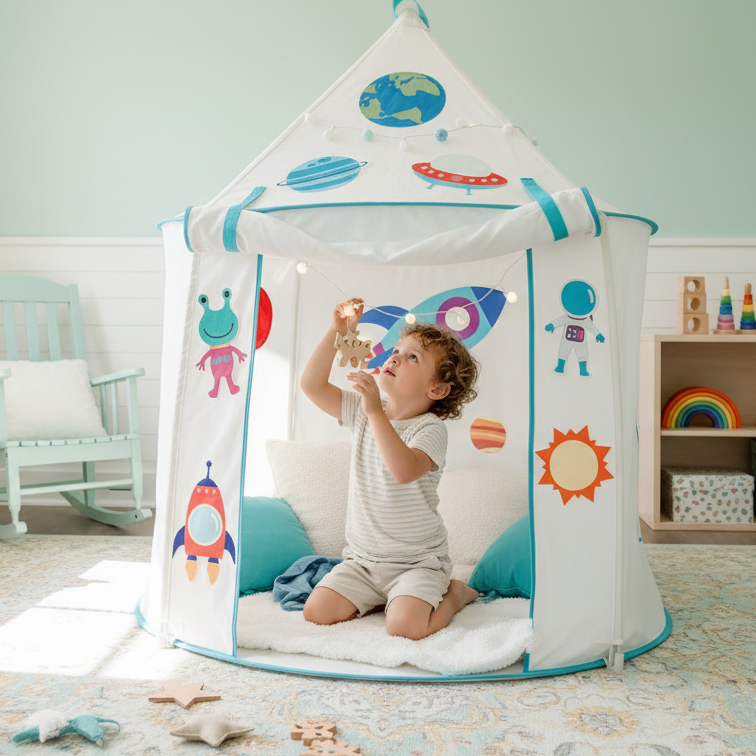
Adaptable play environments, including modular setups similar to ZeeZee Adventures, reflect this principle. By offering a framework rather than a fixed outcome, they create space for children to construct their own narratives. This flexibility supports both imaginative exploration and emotional expression.
Imagination and Emotional Regulation
Emotional regulation is the ability to manage and respond to feelings in a balanced way. In early childhood, this ability is still developing. Imaginative play plays a significant role in this process.
When children engage in pretend scenarios, they encounter a range of emotional experiences. They may create situations involving conflict, resolution, excitement, or uncertainty. Within these scenarios, they have the opportunity to practise managing these emotions.
Because the context is self-created, the child can adjust the intensity of the experience. If a scenario becomes uncomfortable, it can be altered or stopped. This flexibility allows for gradual exposure to different emotions, supporting the development of regulation skills.
Over time, these experiences contribute to a greater sense of emotional stability. The child becomes more familiar with their own responses and more capable of managing them.
The Importance of Time and Continuity
Imaginative play requires time. Emotional exploration does not occur instantly; it develops through sustained engagement. When play is frequently interrupted, the continuity necessary for deeper exploration is disrupted.
In environments where children are given uninterrupted time, imaginative narratives can evolve. The child revisits ideas, extends scenarios, and deepens their understanding. This continuity is essential for emotional processing.
Conversely, environments characterised by constant stimulation or frequent interruptions can limit this process. The child’s attention is redirected before deeper exploration can occur.
Providing time and space for uninterrupted play is therefore critical. It allows imagination to develop fully, supporting both creativity and emotional growth.
A More Integrated View of Development
The link between imagination and emotional development highlights the interconnected nature of childhood learning. Cognitive, emotional, and social processes do not develop in isolation. They are deeply intertwined, each influencing the other.
Imaginative play sits at the centre of this intersection. It engages the mind, expresses emotion, and explores social relationships simultaneously. To view it as merely recreational is to overlook its significance.
When children are given the space to imagine freely, they are not only creating stories. They are building emotional understanding, developing empathy, and learning to navigate their internal world.
Frequently Asked Questions
Why is imagination important for emotional development?
Imagination allows children to explore and process emotions in a safe and controlled way, supporting understanding and regulation.
How does role play help children emotionally?
Role play helps children understand different perspectives, develop empathy, and practise emotional responses.
Can imaginative play reduce anxiety?
Yes. It provides a safe space for children to explore and manage feelings, which can help reduce anxiety over time.
What kind of environments support imaginative play?
Open-ended, flexible environments that allow children to create their own narratives tend to support imagination best.
How can parents encourage this kind of play?
By providing time, space, and simple, adaptable materials rather than highly structured or prescriptive toys.





Comment (0)