
The Power of “Less”: Why Fewer Toys Lead to Better Play
There is a deeply ingrained assumption within modern parenting culture that abundance equates to opportunity. Walk into most children’s playrooms, and the pattern is immediately recognisable: shelves filled with toys, each designed to capture attention through colour, sound, or function. The intention behind this abundance is rarely questioned. More toys are believed to provide more stimulation, more learning, and ultimately more engagement.
Yet, when children interact with these environments, a different reality often emerges. Instead of sustained focus, there is movement—rapid, restless, and often repetitive. A toy is picked up, explored briefly, and then set aside in favour of another. The cycle continues, rarely settling into something deeper. This behaviour is commonly interpreted as a lack of attention or a tendency towards boredom. However, a closer examination suggests that the issue may not lie within the child, but within the structure of the environment itself.
The idea that fewer toys can lead to better play challenges conventional thinking. It suggests that the quality of engagement is not determined by how much is available, but by how the available elements interact with the child’s cognitive and emotional capacities. In this sense, reducing quantity is not about limiting experience. It is about creating the conditions in which experience can be explored more fully.
Access Is Not the Same as Engagement
It is important to distinguish between access and engagement. Providing a child with a large number of toys increases access, but it does not guarantee meaningful interaction. In fact, when access becomes excessive, it can undermine engagement altogether.
Engagement requires focus, and focus depends on the ability to direct attention towards a single activity over time. When multiple toys are present, each one competes for attention. The child’s focus becomes divided, shifting from one object to another without settling.
This pattern is not a reflection of diminished interest, but of competing stimuli. The child is responding to what is available, but the structure of the environment prevents sustained interaction. In contrast, when fewer toys are present, the competition for attention is reduced. Each object becomes more prominent, inviting deeper exploration.
Cognitive Load and the Weight of Abundance
The developing brain is constantly processing information. Every object in the environment represents input that must be interpreted, categorised, and understood. When the number of objects increases, so does the cognitive load.
Cognitive load refers to the total amount of mental effort being used at any given moment. For young children, whose ability to filter information is still developing, this load can quickly become overwhelming. Rather than engaging more deeply, the brain responds by simplifying its effort. Attention becomes scattered, and the child moves quickly between stimuli.
This is often misinterpreted as a short attention span. In reality, the child may be fully capable of sustained focus, but the environment is not structured in a way that supports it. When cognitive load is reduced—by limiting the number of toys—attention becomes more stable. The child is able to invest more energy in a single activity, leading to deeper engagement.
The Hidden Cost of Too Many Choices
Choice is often associated with freedom. Providing children with a variety of options is seen as a way to encourage independence and creativity. However, the relationship between choice and engagement is more complex.
Each additional option requires a decision. The child must evaluate what to play with, how to play with it, and whether to continue or switch. When the number of options becomes too large, this decision-making process becomes cognitively demanding.
Rather than empowering the child, excessive choice can lead to what is effectively decision fatigue. The child moves between options not because they are curious, but because they are unable to settle. Play becomes a sequence of beginnings without continuation.
In environments with fewer toys, this burden is reduced. The child does not need to constantly evaluate alternatives. Instead, they can focus on exploring what is already present. This shift allows play to extend beyond initial interaction into deeper, more meaningful engagement.
From Novelty to Depth
One of the defining characteristics of toy-rich environments is the dominance of novelty. Each toy offers something new, but only for a short period. Once its primary function is understood, the interest diminishes, and the child moves on.
This pattern creates a cycle of shallow engagement. Play becomes dependent on new stimuli, and the duration of interaction decreases. Over time, the child may begin to expect constant novelty in order to remain interested.
Fewer toys disrupt this cycle. Without the immediate availability of something new, the child begins to explore existing objects more thoroughly. The same toy is used in different ways, extended into new scenarios, or combined with imagination to create new possibilities.
This shift from novelty to depth is crucial. It encourages persistence, creativity, and the ability to sustain attention. Play becomes less about consuming experiences and more about generating them.
Imagination Requires Space
Imaginative play thrives in environments that leave room for interpretation. When toys are highly detailed or prescriptive, they often dictate how they should be used. The child follows the intended function rather than creating their own.
In contrast, simpler environments encourage flexibility. A single object can represent multiple things, depending on the context of play. This adaptability allows the child to construct narratives, explore different roles, and extend the experience over time.
The presence of fewer toys enhances this process. With less external guidance, the child is required to contribute more of their own thinking. Imagination becomes the primary driver of play, rather than a secondary addition.
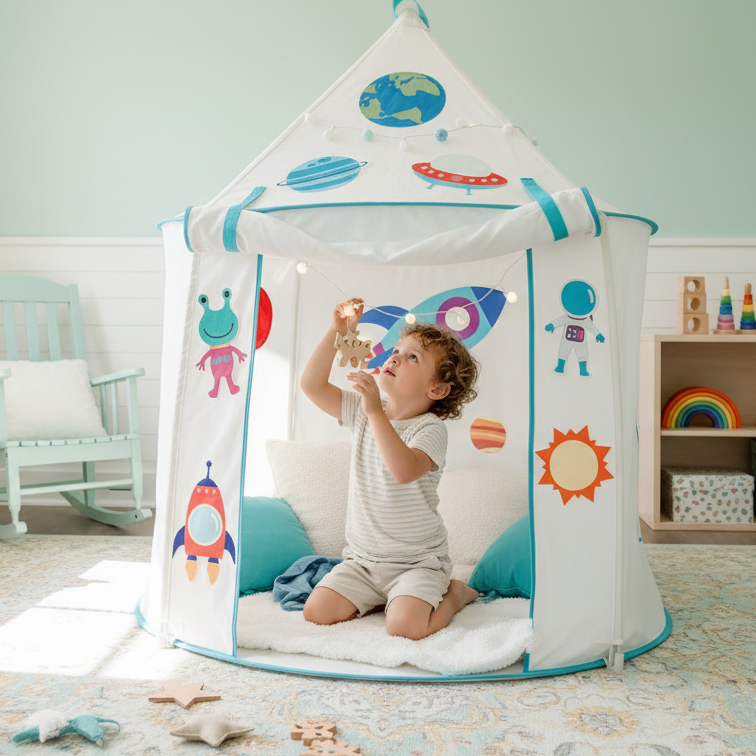
This principle is increasingly reflected in contemporary play design. Flexible, open-ended environments—such as modular play systems similar to ZeeZee Adventures—are structured to support reinterpretation rather than dictate use. Their value lies in their ability to evolve alongside the child’s ideas, rather than limiting them.
A More Intentional Approach to Play
Reducing toys does not mean removing opportunities. It means being more intentional about how those opportunities are presented. One effective approach is to limit the number of toys available at any given time while rotating them periodically.
This maintains variety without creating overload. It allows each toy to be explored fully, rather than being overlooked in a crowded environment.
Similarly, focusing on adaptable play elements—rather than single-function toys—can support longer engagement. Flexible environments, including formats similar to ZeeZee Adventures, reflect this approach by allowing children to reinterpret the same space in multiple ways over time.
Emotional Clarity in Simpler Spaces
The structure of the environment also influences emotional experience. Cluttered spaces can create a sense of overwhelm, even if the child is not consciously aware of it. The constant presence of multiple stimuli can make it difficult to settle, leading to restlessness or irritability.
Simpler environments tend to produce a different effect. With fewer elements competing for attention, the space feels more manageable. The child is able to focus more easily, leading to a sense of calm and control.
This emotional clarity supports longer periods of play. When children feel settled, they are more likely to engage deeply and remain within an activity for extended periods.
Reframing “Less” as an Opportunity
The idea of reducing toys is often misunderstood as a form of limitation. In practice, it represents a shift in perspective. The goal is not to remove opportunities, but to enhance them by creating better conditions for engagement.
Fewer toys do not reduce play. They refine it. They allow children to explore more deeply, think more creatively, and remain engaged for longer periods. The richness of the experience comes not from the number of objects, but from the quality of interaction.
When this shift is embraced, the play environment becomes less about providing constant stimulation and more about supporting meaningful exploration. The result is a form of play that is quieter, more focused, and ultimately more fulfilling.
Frequently Asked Questions
Do children really play better with fewer toys?
Yes. Children tend to engage more deeply and for longer periods when fewer toys are available, as there are fewer distractions competing for attention.
Will my child get bored with fewer toys?
Boredom often leads to creativity. When children are not constantly stimulated, they begin to create their own play experiences.
What types of toys work best?
Open-ended and flexible toys that can be used in multiple ways tend to support longer engagement.
How can I reduce toy overload?
Limiting the number of visible toys, rotating them periodically, and creating a more organised play space can help.
Do play environments matter as much as toys?
Yes. The structure of the environment plays a significant role in how children engage. Flexible spaces, such as those explored in ZeeZee Adventures, can often support deeper play than large quantities of individual toys.




Comment (0)